2003 4.0L V-6 coolant drains on block?

zoomie66

New member
I posted a "similar" thread in the Maintenance Section but have only gotten a couple of partially responsive replies. I tried to drain and replace the coolant in my 2003 V-6 4Runner this weekend for 30k maintenance but I could only get a little over a gallon to drain from the lower radiator petcock, and the system capacity is almost 2.5 gallons. I refilled with distilled water, ran the engine to operating temp with the heater "ON" and drained the radiator again - three times - but with the same results.
There must be a drain valve somewhere on the block, because less than half the rated capacity is draining from the radiator. I looked for a block drain but couldn't find one.
If any of you have a 2003 factory manual for the 4.0L V-6, could you please check the diagram of the engine to see whether this engine has a coolant drain somewhere on the block, and if so, where it is located? If the engine diagram doesn't show a block drain, could you look up Toyota's procedures to drain and refill the coolant? This can't be rocket science, but so far success has eluded me!
 
Register to hide this ad
zoomie66 said:

There must be a drain valve somewhere on the block, because less than half the rated capacity is draining from the radiator. I looked for a block drain but couldn't find one.
If any of you have a 2003 factory manual for the 4.0L V-6, could you please check the diagram of the engine to see whether this engine has a coolant drain somewhere on the block, and if so, where it is located? If the engine diagram doesn't show a block drain, could you look up Toyota's procedures to drain and refill the coolant? This can't be rocket science, but so far success has eluded me!

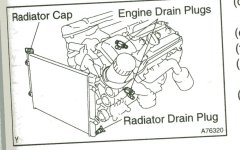
I have 2004 service manual and it shows 3 coolant drain plugs. One in the radiator and two in the block above and below the oil filter. I'll try to attach a diagram. It says from August 2003.
 

Attachments

  • v6 coolant drains2.jpg
    v6 coolant drains2.jpg
    119.5 KB · Views: 13,014
Last edited:
greasefingers said:
I assume the top one is for bleeding air?? And maybe even help facilitate draining.
I think you're right. It could probably be used for filling, although the manual doesn't say this. Keep it open until coolant starts to run out, otherwise you'll trap air in the system when refilling?
 
Many thanks to 'biglata' and 'ToolmanJohn;' both of your posts were exactly what I needed. Thanks again,
zoomie66
 
2003 4.0L V-6 coolant block drains

An update for anyone who's interested in DIY maintenance on their 2003 V-6 4RNR: the factory manual diagram and photos posted earlier on this thread were invaluable, but they only allowed the real "fun" to start! First, as someone else posted, the front end must be placed on jacks and both front wheels removed. Then a "mud flap" toward the rear of each wheelwell must have the top fastener removed so the flap can be folded down for visual and physical access to the coolant drains, both situated under their respective exhaust manifolds. The drain on the driver side is a real bear...hydraulic/brake lines are situated right in the middle of where your hand needs to be. Getting a 10mm socket on the drain was finally accomplished by using a 10" extension mated to a U-joint socket connector mated to a 7" extension...but hard as that was, it was easier than putting tubing on the drain nipple to channel the draining coolant into a pan. The passenger side required the same steps, but once the mud flap was folded down it was a pretty straight shot to the 10mm drain bolt, so only a 10" extension was required (no U-joint needed on the pax side); same difficulty getting the drain hose on the nipple, however.
The total amount of coolant in the system is supposed to be ~2.5 gals, and that's about how much I was finally able to drain out. However, the amount of coolant I drained out of the radiator and each block drain differed substantially: got about 1.2 gals from the radiator, 1 gal from the passenger side block drain, and only about .3 gal from the driver side block drain. I went through this procedure a total of five (5) times and the quantities were consistent each time; initial drain of old coolant, followed by flush with radiator cleaner, followed by three refills with distilled water/run to normal temp/drain.
I've owned many Toyotas since the late 1970's and I've personally done most of the maintenance on them, but this coolant replacement process was the biggest "goat rope" I've ever encountered. Sure seems like the engineers who located those block drains where they did and the other engineers who dreamed up the requirement to replace the coolant at 30K must have been bribed by the stealership association!! Toyota vehicles are normally fairly "owner friendly" to maintain, but the Toyota engineers responsible for this maintenance monstrosity really outdid themselves.
The five hours I spent accomplishing this made me wonder: if the coolant used in the 2004+ V-6 engines is the same as was in my 2003 [Toyota 50/50 premixed, "Extended Long Life Coolant", aka the red stuff with 'unobtanium' mixed in, at $16+/gallon], and the engines themselves haven't changed between 2003 and the present, why does my Owner Manual state a requirement to change coolant at 30K while the coolant replacement interval for 2004+ is 100K?
"Inquiring minds want to know!!"
 
Re: 2003 4.0L V-6 coolant block drains

zoomie66 said:

The five hours I spent accomplishing this made me wonder: if the coolant used in the 2004+ V-6 engines is the same as was in my 2003 [Toyota 50/50 premixed, "Extended Long Life Coolant", aka the red stuff with 'unobtanium' mixed in, at $16+/gallon], and the engines themselves haven't changed between 2003 and the present, why does my Owner Manual state a requirement to change coolant at 30K while the coolant replacement interval for 2004+ is 100K?
"Inquiring minds want to know!!"
Boy, that sounds like it was a real "bear" to do. Usually on jobs like this it makes it easier if you have a buddy along for the ride, if only to commensurate with:)

I wonder if it is this tough on the V8 too, probably is. This all makes me think, why bother? Why not just trade them in at 100k miles and get something new and improved? Wouldn't it be better to forget about timing belts at 100k, spark plugs at 120k, coolant changes at 100k, transmission and differential fluid changes, Mobil 1 oil instead of dino oil changes, tire rotations, special air and oil filters, etc? Just drive the thing; change the oil and filters (OEM), tires, and brakes when needed and then sell it or trade it at 100k??? In my case, that would take 6 years or so, and a lot will/could happen in that time. It seems like my 88 4Runner didn
 
Re: 2003 4.0L V-6 coolant block drains

zoomie66 said:
The five hours I spent accomplishing this made me wonder: if the coolant used in the 2004+ V-6 engines is the same as was in my 2003 [Toyota 50/50 premixed, "Extended Long Life Coolant", aka the red stuff with 'unobtanium' mixed in, at $16+/gallon], and the engines themselves haven't changed between 2003 and the present, why does my Owner Manual state a requirement to change coolant at 30K while the coolant replacement interval for 2004+ is 100K?
"Inquiring minds want to know!!"

You might be able to get away with using the coolant specified for 2004 models. I think in 2004 Toyota changed the coolant type for all their vehicles. I know that was a "change" from the 2003 to 2004 Camry.
 
Re: 2003 4.0L V-6 coolant block drains

zoomie66 said:

The five hours I spent accomplishing this made me wonder: if the coolant used in the 2004+ V-6 engines is the same as was in my 2003 [Toyota 50/50 premixed, "Extended Long Life Coolant", aka the red stuff with 'unobtanium' mixed in, at $16+/gallon], and the engines themselves haven't changed between 2003 and the present, why does my Owner Manual state a requirement to change coolant at 30K while the coolant replacement interval for 2004+ is 100K?
"Inquiring minds want to know!!"

I am coming due for the coolant change interval spec'd for the '04 V6 in Canada which is 64,000 Km (40K mi.) I only plan on doing it once. Drain old, add new (no flush) especially if it is that difficult.
What diameter hose fits the drains? What is the part number of the replacement coolant? Maybe they spec something different for northern climates. The owners manual states "Only use "Toyota Super Long Life Coolant"or similar high quality ethylene glycol based non-silicate, non-amine, non-nitrite, and non-borate coolant with long-life hybrid organic acid technology." So it's not what's in it ("unobtanium") but rather what's not in it that could affect an aluminum engine. It also isn't a propylene glycol mix. So I'm thinking the "similar" coolant would be Dex-Cool from Prestone. This is available unmixed so I can do my own 70/30 mix instead of the 50/50 overpriced premix from the stealer.
What do you think?
 
Last edited:
Re: Re: 2003 4.0L V-6 coolant block drains

Kmvreter said:
I am coming due for the coolant change interval spec'd for the '04 V6 in Canada which is 64,000 Km (40K mi.) I only plan on doing it once. Drain old, add new (no flush) especially if it is that difficult.
What diameter hose fits the drains? What is the part number of the replacement coolant? Maybe they spec something different for northern climates. The owners manual states "Only use "Toyota Super Long Life Coolant"or similar high quality ethylene glycol based non-silicate, non-amine, non-nitrite, and non-borate coolant with long-life hybrid organic acid technology." So it's not what's in it ("unobtanium") but rather what's not in it that could affect an aluminum engine. It also isn't a propylene glycol mix. So I'm thinking the "similar" coolant would be Dex-Cool from Prestone. This is available unmixed so I can do my own 70/30 mix instead of the 50/50 overpriced premix from the stealer.
What do you think?

In the past, I've heard if there's too much coolant it'll be corrosive to the engine and too little the boiling point would be low. I'm not sure the same applies to long life coolant.

Hmmm... if this Toyota Super Long Life Coolant is the same as DexCool, which is the GM stuff then I have left over from our (sold) Chevy.
 
Re: Re: Re: 2003 4.0L V-6 coolant block drains

Uneek said:
In the past, I've heard if there's too much coolant it'll be corrosive to the engine and too little the boiling point would be low. I'm not sure the same applies to long life coolant.

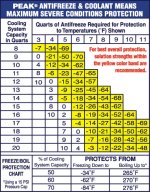
Here's what I got from the peak antifreeze site:

"Why is it important to mix antifreeze with water?
Antifreeze contains chemicals that protect your engine against rust and corrosion, as well as freeze-up and boil over protection. Water is required to activate the chemicals in the inhibitor package. Furthermore, adding water to antifreeze actually increases the freeze-up and boil over protection provided. For example, a mix of 40% antifreeze and 60% water provides freeze-up protection down to -10
 

Attachments

  • art_protection_chart.jpg
    art_protection_chart.jpg
    87.3 KB · Views: 8,257
Re: Re: Re: 2003 4.0L V-6 coolant block drains

Uneek said:
In the past, I've heard if there's too much coolant it'll be corrosive to the engine and too little the boiling point would be low. I'm not sure the same applies to long life coolant.

Hmmm... if this Toyota Super Long Life Coolant is the same as DexCool, which is the GM stuff then I have left over from our (sold) Chevy.

70/30 is the optimum mix. I'm not sure if the Toy Super Long Life is the same as DexCool. That is why I asked.
 
zoomie66:

Thanks for the detail on your coolant exchange. Because the driver's side block is the most troublesome access and one gets only 0.3 gallon out, I would consider forgetting this point, especially with fresh water flushing. Since one knows the total capacity, the proper mix can still be obtained. What do you think?
 
On the past couple of engines that I have worked on, the engine block drain was held in too tight to risk removal (rusted). If you snap that bolt then you are in trouble! I simply drain what ever comes out of the Rad and replace. Then I repeat the procedure again on the following weekend.
 
greasefingers:

Good point...

Since zoomie says that the radiator drain yields 1.2 gallons which is 1/2 of the cooling system volume, one could repeatedly drain and fresh water flush the system using only the radiator drain to get sufficiently clean water throughout the entire system and then fill the radiator with straight anti-freeze as the last step to get a proper 50/50 mix.
 
I usually only flush the radiator with the garden hose, by removing the lower Rad hose. Then I buy concentrated anti-freeze because it is cheaper. I use a large liquid Tide container (2.34 gallon) for mixing. I dump one gallon of distilled water (from the grocery store) into the Tide container and then one gallon of Toyota Pink Stuff pn# 00272-1LLAC-01

Now I have a 2-gallon mixture for $ 16.50.

The pre-mixed stuff like Prestone is $ 9/gal, but you only get one gallon. Prestone concentrate is the same price. So why would anyone buy a 50/50 mixture instead of making it up yourself??
 
An update...

Did the coolant exchange. Slipped a 4' length of 5/16" I.D. vinyl hose on the drains (as noted before by zoomie66.) Didn't bother flushing with water because the old coolant looked very clean. Refilled with original spec'd Toyota "Super Long Life" coolant that comes 55/45 premixed with water (they don't have it full strength) for $16/gal. Not worth trying something else to save a few $$. I wasn't able to drain the entire volumn so I'll replace another gallon in the fall.
 
Can somone instruct me on the proper way to collect coolant as it drains on from the rad/block.

Is coolant or antifreeze an oil based product? I've always thought of it as radio active green stuff. (in general)

Can I collect it in a oil catch can, or should I use a large bucket.

I'll bring used coolant back to a garage for proper disposal, but just wanted any insight you guys can give.
 

Members online

Forum statistics

Threads
278,316
Messages
3,554,107
Members
248,016
Latest member
Advally Service

Trending content

Back
Top