2003 Tow hitch receiver swap

A heads up for you. It can be a HUGE pain to install it. You will need to remove the bolts that hold the recovery tow loop on the rear driver side. It may very well be rust welded by now since 2003. I had to drill mine out. A little at a time, bigger and bigger and then use a bolt extractor.

I was prepared for these bolts to be a pain and then I remembered, my truck spent most of it's life in the Inland Empire of Southern California with a stint of a year in Seattle and now lives in one of the driest places on earth. Rust? Pffft!!! We aint got no stinkin' rust! We DEFINITELY don't see rust like I'd expect the folks from north of the border to be seeing.
 
Maybe I need to re-read Sungod’s post again, but is seems that he was explicitly stating that, “You only would need it on a v6 if you were trying to tow 7000lbs.” My point was that I was towing 3200-3300 lbs with two adults and 3 children (180, 120, 40, 36, 25 lbs apiece) and maybe 200 lbs of gear in the back of my 4Runner and was taking it easy and had no problem hitting 240 degrees wherever the sensor is placed (I’ve read it’s in the pan). My second point is that I was towing absolutely nothing while climbing an extended steep trail and I racked just past 240 in 4HI and held the upper 230’s in 4LO with ambient temps of about 80 degrees when I got to 240, dropping to about 70 degrees outside at the top of the climb which was at 8200’.

I’m sure the V8 would perform better with its aux cooler, probably by 10-20 degrees under similar conditions. I also don’t think 240 degrees in the pan is where transmissions hit the graveyard, but is rather the area at which you begin to sincerely accelerate the aging of the fluid to a point that you would need to be changing the fluid perhaps every 10,000-25,000 miles or less, depending on how long the transmission is experiencing these temps. Of interest, the engine was never straining in either of these situations. We were merrily cruising along at 15000-2000 RPM with the trailer during the climb and 1200-~1700 RPM in 4HI and 1500-2000 RPM in 4LO. If I had not had the transmission temp gauge I would not have suspected that my transmission temps were as high as they were, ESPECIALLY when I was climbing the trail without anything in tow. I would have likely pushed to hold 35 MPH instead of 20 MPH while towing and would have undoubtedly been unknowingly subjecting my transmission to temps higher than what I saw.

My advice now is that anyone with a V6 should either install a transmission temp gauge (might as well do it both places like TechWrench mentions if you’re installing thermocouples) or buy a ScanGaugeII and keep a close eye on your transmission temp. From there it probably makes sense to install an aux transmission cooler if you do any towing in the mountains or even climb steep grades at less than highway speeds where the torque converter will be unlocked.

I have the B&M 70264 on order via Amazon and will be installing it prior to my next towing/off-road adventure coming up in a few weeks so I’ll have some before-and-after data for comparison.

Sure would be nice if the transmission could be reprogrammed to lock up in 2nd or at least 3rd gear in addition to 4th and 5th.

The reason I took his post the way I did, was because he was replying to the post from SunGod, in which Sungod said he had an early '03 V8, and was wondering if it had the aux trans cooler even though it only had the 5k hitch receiver installed. So, I assumed the first part of his reply was meant to say that an aux cooler wouldn't be necessary when upgrading the hitch receiver, because it already had the aux cooler. But, I totally agree that the V6 does need, IMHO, an aux trans cooler if you are going to tow any where near the max limit.

As for your situation, I am not sure where the trans temp sensor is located on your '07. If it is in/on the sump pan, then the temps you are reading (if the system is giving a correct reading) while not immediately dangerous will contribute to shortening the service life of the trans fluid. I believe it does state in the owners/service manuals that the fluid change intervals will need to be shortened if the vehicle is operated under 'severe' conditions.

The reason Toyota, and other manufacturers don't allow the torque converter to maintain lock-up conditions under low speeds or high torque conditions is because the lock-up clutch in the torque converter isn't strong enough to pull under those conditions. I checked my maint manual, and it states that lock-up won't occur until 45-51 mph under throttle opening of 5%, and lock-up will disengage under deceleration between 41-47 mph under the same throttle opening condition. These specs are for the A340F trans, which is the 4 speed in the early V6's. If you have the 5 speed trans in your '07, those numbers may differ slightly. But, in any case, the locking function in the torque converter was designed mostly for fuel economy reasons while under normal cruising speeds. The reduction in heat generated while under lock-up wasn't as big a factor as the desire to increase mpg numbers. This is big reason I would prefer a standard trans over the automatic, but Toyota doesn't offer that option. So we have to work with what we have.
 
Last edited:
As for your situation, I am not sure where the trans temp sensor is located on your '07. If it is in/on the sump pan, then the temps you are reading (if the system is giving a correct reading) while not immediately dangerous will contribute to shortening the service life of the trans fluid. I believe it does state in the owners/service manuals that the fluid change intervals will need to be shortened if the vehicle is operated under 'severe' conditions.

The reason Toyota, and other manufacturers don't allow the torque converter to maintain lock-up conditions under low speeds or high torque conditions is because the lock-up clutch in the torque converter isn't strong enough to pull under those conditions. I checked my maint manual, and it states that lock-up won't occur until 45-51 mph under throttle opening of 5%, and lock-up will disengage under deceleration between 41-47 mph under the same throttle opening condition. These specs are for the A340F trans, which is the 4 speed in the early V6's. If you have the 5 speed trans in your '07, those numbers may differ slightly. But, in any case, the locking function in the torque converter was designed mostly for fuel economy reasons while under normal cruising speeds. The reduction in heat generated while under lock-up isn't that significant, when you consider most of the heat is generated in high torque conditions like start-up acceleration and pulling uphill, when lock-up is off. The big reason I would prefer a standard trans over the automatic, but Toyota doesn't offer that option. So we have to work with what we have.

I can get the torque converter to lock up in 5th as low as 30 MPH; 35 MPH if the AC is running.

Am I missing something regarding lock-up and the generation of heat? When the TC is locked up the temp reading stays steady if it is currently at or slightly below the "normal" range of 170-180 degrees. If the temp was above "normal" then the temp immediately drops as soon as the TC locks up. If the TC unlocks then the temp immediately begins to rise. All of the evidence I saw shows that the heat causing the trans temp to rise above coolant temp was all a result of the TC being unlocked. I observed this rise and fall of transmission temps even though engine load was consistently in the 85%+ range so it wasn't as if the fall was due to the fact that I had crested the hill and torque required had fallen off.

I definitely agree that a MT would be preferred for towing and off-road.
 
Back on to the original post

I think everyone is responding to this thread without actually reading the original question... :offtopic::offtopic::offtopic:

So once again here is the Question.

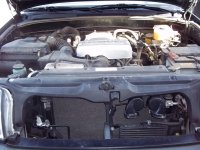
I need to be able to ocasionaly tow a travel trailer of more than 5,000 lbs. however not too close to the 7,000 capacity. I always use a weight distributing hitch when towing something that large along with a good sway system and brakes. So the 2003 pre April 1st v8 models have the 5,000lb. rated cross member receiver that does not mount to the frame which nullifies the weight distributing part and if you use a weight distributing hitch you will most likely damage your frame. So With these 2003 models if I get one I would obviously get the standard receiver swapped out for the on-frame weight distributing type receiver. I know it will be a pain, but nothing a couple of beers and a buddy can´t help! ;) However since I do not have one and am not in the states at the moment to look at one in person I am trying to find out whether the v8 models (4x4) still have this transmission cooler. I was recently able to get a picture of one from a person that I am considering buying from and will try to upload it. It appears to me that there is a small radiator/cooler piece infront of the radiator on the drivers side... It looks to me like a transmission cooler, however I was hoping that someone that has a 2004 or newer v8 or someone who knows for sure can confirm that is what I am seeing.

Thanks again for all the responses everyone!!!

:zoom::roadkill::zoom:

 
I think everyone is responding to this thread without actually reading the original question... :offtopic::offtopic::offtopic:

So once again here is the Question.

I need to be able to ocasionaly tow a travel trailer of more than 5,000 lbs. however not too close to the 7,000 capacity. I always use a weight distributing hitch when towing something that large along with a good sway system and brakes. So the 2003 pre April 1st v8 models have the 5,000lb. rated cross member receiver that does not mount to the frame which nullifies the weight distributing part and if you use a weight distributing hitch you will most likely damage your frame. So With these 2003 models if I get one I would obviously get the standard receiver swapped out for the on-frame weight distributing type receiver. I know it will be a pain, but nothing a couple of beers and a buddy can´t help! ;) However since I do not have one and am not in the states at the moment to look at one in person I am trying to find out whether the v8 models (4x4) still have this transmission cooler. I was recently able to get a picture of one from a person that I am considering buying from and will try to upload it. It appears to me that there is a small radiator/cooler piece infront of the radiator on the drivers side... It looks to me like a transmission cooler, however I was hoping that someone that has a 2004 or newer v8 or someone who knows for sure can confirm that is what I am seeing.

Thanks again for all the responses everyone!!!

:zoom::roadkill::zoom:

I'm guessing you'll pay close to $200 to swap the hitch receiver out to the weight distributing type so why worry about whether it comes with a factory transmission cooler? They are cheap and easy to install. If it comes with it (which it probably does based on your description) then great. If it doesn't, then $70 gets you either of the two most popular coolers and your problem is solved.

Sorry for running your thread in to a ditch with the other discussion! I've got "transmission temperature tunnel vision" right now! :cheers:
 
I can get the torque converter to lock up in 5th as low as 30 MPH; 35 MPH if the AC is running.

Am I missing something regarding lock-up and the generation of heat? When the TC is locked up the temp reading stays steady if it is currently at or slightly below the "normal" range of 170-180 degrees. If the temp was above "normal" then the temp immediately drops as soon as the TC locks up. If the TC unlocks then the temp immediately begins to rise. All of the evidence I saw shows that the heat causing the trans temp to rise above coolant temp was all a result of the TC being unlocked. I observed this rise and fall of transmission temps even though engine load was consistently in the 85%+ range so it wasn't as if the fall was due to the fact that I had crested the hill and torque required had fallen off.

I definitely agree that a MT would be preferred for towing and off-road.

I guess I should have explained myself better. And, if you already know this, forgive my following attempt to simplify how the torque converter works. It is actually a complex fluid dynamics device, but I have found most people can relate to the following. Think of the converter as two fans. One is directly attached to the engine, and the other is directly linked to the imput shaft of the transmission. When you have two air fans facing each other, if one drives the air stream against the other one, the second fan is turned by the air flow from the first. This is the basic theory of how a torque converter works. When the fan(turbine) linked to the engine turns, it drives the fluid that it is surrounded in against the second fan (turbine) and tries to turn it. Because at a low engine rotation, there isn't enough force from the first turbine against the second, the engine can turn without stalling while the vehicle in gear isn't moving. As the engine rotation speed increases, the amount of force exerted on the second turbine increases until it is able to drive the transmission and make the vehicle move. You may have noticed that if you hold the brakes and increase the engine rpm while in gear, you will eventually hit a point where the engine rpm will not increase. This is called the torque converters stall speed. If the converter is working properly, you will not be able to force it beyond that stall speed.

Now to the heat issue. The trans fluid will generate heat as it is driven from one turbine to the other. I forget at the moment, the technical term, but it has to do with fluid shear. The harder the fluid is worked, this shear is increased and fluid temps rise. At low speed and high torque conditions, the fluid heats up very quickly. If one wanted to bring an auto trans up to operational temp quickly in the cold weather, power braking the trans would do that, as long as you didn't take it too far. At higher vehicle speeds, the two turbines almost reach the same rotational speeds, and shear is reduced, thus reducing the amount of heat generated. Without a lock-up device, the two turbines will never reach equal speeds while under a load. When a torque converter acheives lock-up, a clutch disc inside the converter is activated hydraulically, which direcly locks the shell of the converter to the imput shaft of the transmission. This direct connection now makes the second turbine, connected to the imput shaft, to turn at the same speed as the drive turbine, which eliminates the need for the fluid coupling. Since the shear is reduced, the cause of heat build up is greatly reduced. This is why trans fluid temps drop significantly when lock-up is engaged. The rest of the transmission components (clutch packs, gears, and brake bands add very little to the fluid temp, it is all generated in the torque converter. This is why the fluid in the converter is pumped directly to the cooling circuit before returning to the trans.

As I said earlier, this is a simple explaination of how a torque converter works, there are many sites online that can go into more detail if you want.
 
Damn, reading this tread is like reading a Bible, it never ends!!

Tell me about it!

Can anyone simply tell me whether or not the cooler in front of the radiator in this picture is the tranny cooler?
 

Attachments

  • 101_0694.jpg
    101_0694.jpg
    133.6 KB · Views: 327
That's the one you're looking for in the picture. Wish it came on the V6 also. At least it is pretty cheap and easy to install as aftermarket.
 
stacked plate fluid cooler=transmission cooler?

Excuse my ignorance...
:withstupid:

In this instance, Toyota is using it as a transmission fluid cooler. But, in other applications, the same type of device could also be used to cool other automotive fluids, like power steering fluid and engine oil, if nececssary.
 

Members online

Forum statistics

Threads
278,316
Messages
3,554,112
Members
248,016
Latest member
Advally Service

Trending content

Back
Top