2005 Nissan Pathfinder

Thai

Elite Member
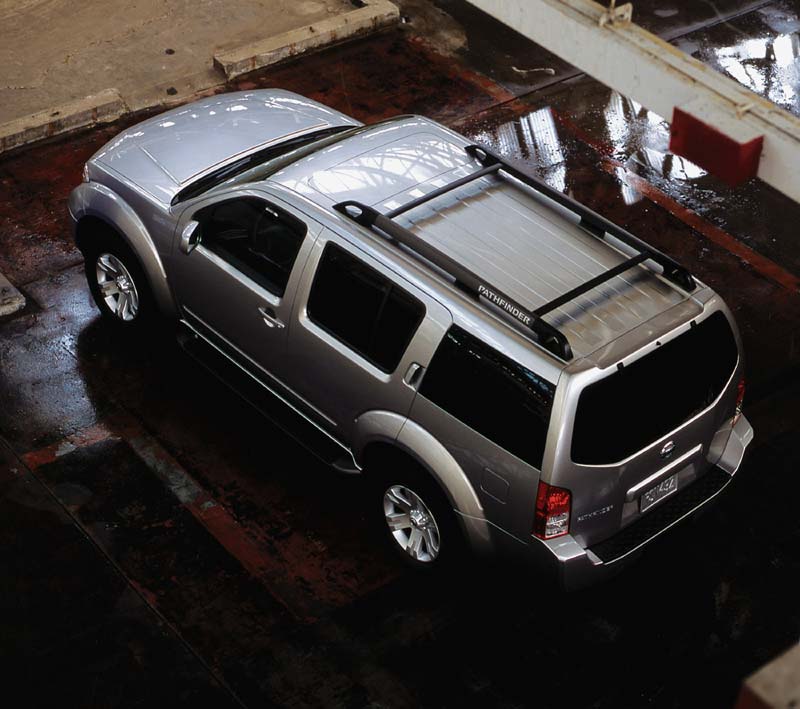
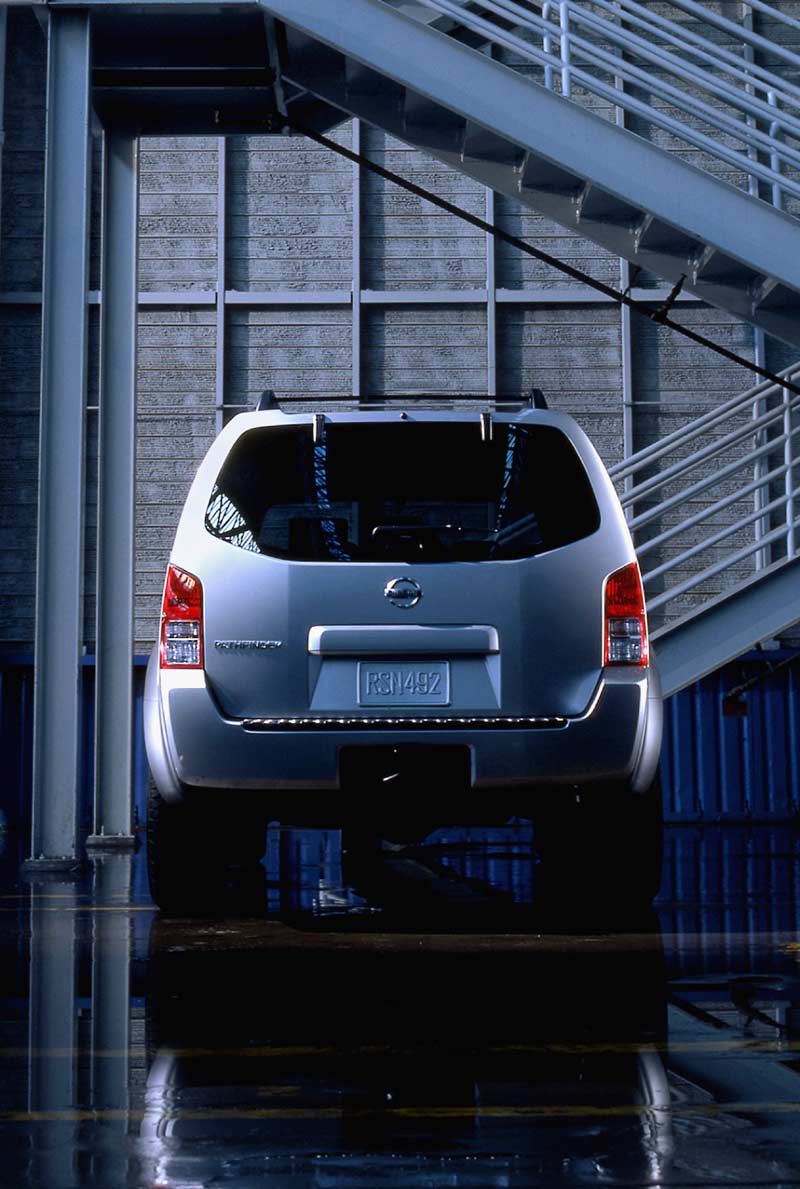
All-new 2005 Pathfinder is bigger, roomier
Detroit, Michigan - Everything's changed but the name on the new 2005 Nissan Pathfinder. Now with a new body-on-frame chassis derived from the full-size Pathfinder Armada chassis, the bigger, roomier 2005 Pathfinder features a new 250 horsepower 4.0 litre V6 engine (derived from the VQ 3.5 litre V6), standard 5-speed automatic transmission, three rows of seats, and an independent front and rear suspension. The Pathfinder is available as a 4x2, or 4x4 with an off-road traction system.

Though the 2005 Pathfinder is bigger than the 2004 model, it's not anywhere as big as the full-size Pathfinder Armada which is 20 inches longer and 6 inches wider than the 2005 Pathfinder.

"The 2005 Pathfinder, with its body-on-frame construction and enhanced utility and performance, is designed to offer a higher level of an authentic, rugged off-road performance than the typical SUVs in its class," said Mark McNabb, vice president and general manager, Nissan Division, Nissan North America, Inc.

Utilizing the Pathfinder Armada's new "F-Alpha" platform as a basis, the Pathfinder features a fully boxed, all-steel ladder frame and adds an all-steel double-wishbone front suspension with stabilizer bar and independent rear double-wishbone suspension with stabilizer bar. Performance shocks are also available with the Pathfinder Off-Road model.

Like other engines in the VQ series, the new 4.0-liter version includes Electronic Throttle Control with secondary mapping in 4LO (4x4 models), Continuous Valve Timing Control (C-VTC), Nissan variable Induction Control System (NICS), silent timing chain, microfinished camshaft and crankshaft surfaces, molybdenum-coated pistons, digital knock control system, high capacity muffler, lightweight aluminum block and platinum-tipped spark plugs.

The Pathfinder's advanced All-Mode four-wheel drive system includes 2WD/AUTO/4H/4LO modes and electronically controlled transfer case. A Vehicle Dynamic Control (VDC) system is also available, along with an advanced off-road traction system.

The addition of a standard 3rd row seat gives the new Pathfinder 7-passenger seating, along with increased passenger/cargo flexibility. The split fold-down 2nd and 3rd row seats can be folded down individually, combining with the fold-down front passenger seat to provide 64 different seating/cargo configurations.

Safety features include stronger body construction, Nissan's Advanced Air Bag System (AABS), and optional roof-mounted supplemental curtain air bags for side impact and rollover protection to outboard passengers in all three rows.

Assembly of the new Pathfinder will be moved from Japan to Nissan's manufacturing facility in Smyrna, Tennessee. The 2005 Pathfinder is scheduled to go on sale at Nissan dealers nationwide in Fall, 2004.
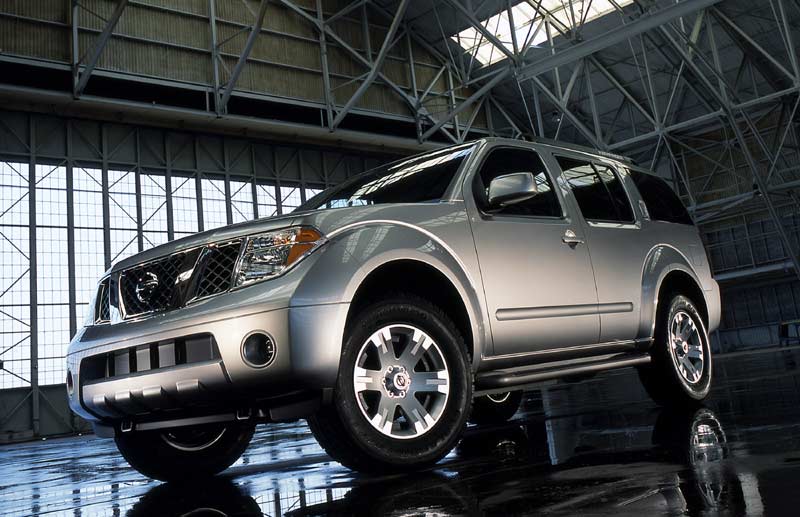
05pathfinder_1.jpg

05pathfinder_2.jpg

05pathfinder_3.jpg

05pathfinder_4.jpg
 
Register to hide this ad
All-New 2005 Nissan Pathfinder Features Three-Row Seating, Powerful 4.0-liter V6 and New Rugged Platform

When it was first introduced in 1986, the Nissan Pathfinder sport utility vehicle (SUV) stood as an innovator in class
 
I find it interesting that the Pathfinder has a 4.0 V6 and a full frame design. The exterior has a lot of Nissan styling cues, but it looks like the design is copying the 4Runner. Also, it is built in the U.S. which should make it a bit cheaper to produce. I would say this is going to be 4Runner's biggest competitor.

That being said, it looks a little like a ugly box, I guess the look has to grow on me.
 
Last edited:
"Assembly of the new Pathfinder will be moved from Japan to Nissan's manufacturing facility in Smyrna, Tennessee. "

Nissan has not achieved the domestic build quality that Toyota has. :(
You can go to any Nissan dealer, sit in the vehicles, and tell which vehicles were made in Japan or if they were made elsewhere.

Looks like a Durango?
Exterior:

02_2005_pathfinder.jpg


04-durango_road.jpg


Interior:

05pathfinder_4.jpg


024949-E.jpg
 
Last edited:
Yeah, my first thought was Durango too.

I like how they say it will be best in class off-road but has IFS all-around. Those marketing guys have a good sense of humor. 's like the Explorer comercial when they say "it's ability will amaze you, on-road and off" then they show it on a gravel road.

It's nice they use a body-on-frame design, but with IFS, what's the point?

Oh yeah. 99% of them will never go off road.
 
I had a 95 Pathfinder (first generation) that ran very well despite its pathetically slow engine. I considered going Pathfinder again before settling on the 4Runner because at the time, I needed a vehicle and Nissan was slow to update their Pathfinder.

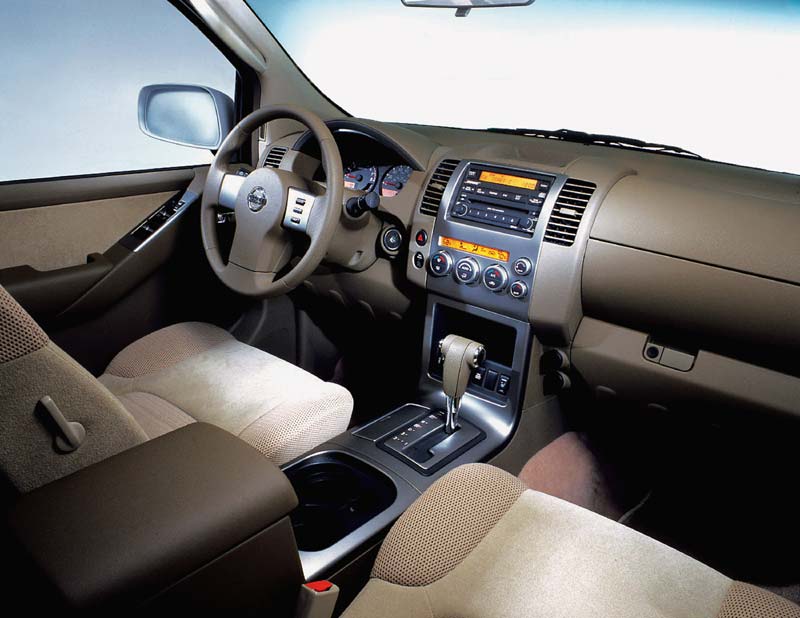
One thing I really would love for Toyota to copy from this Pathfinder is the full set of gauges. Look closely at the instrument cluster and you'll see an oil pressure gauge and a voltmeter.

No one knows yet how it drives or how much it will cost, and no one has been given a chance to look at the interior. Also, the Pathfinder won't have a V-8 option, or an electric rear window. Time will tell to see how it will measure to the 4Runner. If Nissan is successful in later model years to stick the 5.6L V-8 into the Pathfinder, watch out.

I just test drove a Titan (it has that V-8 standard), and the exhaust note sounds like the V-8 from a Mustang...lots of power, too! While the interior is kind of cheap, bet on Nissan improving it in later model years.
 
Last edited:
I've had a Nissan HardBody 1991 and it was a nice King Cab, anyhow. We considered purchasing a Nissan PathFinder, but unfortunately, like typical Nissan built vehicles; it just feels like its built elsewhere other than Japan.
 

Attachments

  • toyota symbol.jpg
    toyota symbol.jpg
    2.2 KB · Views: 12,426
EdDucks916 said:
I just test drove a Titan (it has that V-8 standard), and the exhaust note sounds like the V-8 from a Mustang...lots of power, too! While the interior is kind of cheap, bet on Nissan improving it in later model years.

From what i hear, the new Titan is having unexpectedly slow sale figures! This is most surprising to Nissan (and me). I doubt that the Infiniti QX56 is selling well either. Nissan is doing well with their cars, but their SUV/truck lines are suffering a bit.
 
Link:

Edmunds First Drive of '05 Pathfinder

First Drive: 2005 Nissan Pathfinder
Right Back Where It Started
By Ed Hellwig
Date Posted 09-03-2004

It's not often that a company comes full circle with the design of one of its most successful models, but Nissan has done just that with the midsize Pathfinder. When it was first introduced way back in 1986, the Pathfinder rode on Nissan's small truck chassis giving it the kind of bulletproof hardware and rugged image that consumers craved in an SUV. That configuration, and a distinctive two-door design, made it a hit and put the Pathfinder squarely on the SUV map.

But as tastes changed so did the Pathfinder. Nissan eventually added two more doors and moved to a more road-friendly unibody design to help the Pathfinder appeal to a wider range of drivers. Its popularity continued, but for those who liked the original Pathfinder precisely because of its go-anywhere, do-anything capability, the image was somewhat tarnished.

For 2005, the Pathfinder has returned to its roots and once again rides on a body-on-frame truck chassis. This time around Nissan used a modified version of the F-Alpha platform that underpins the full-size Titan. With its fully boxed frame rails and all-steel, dual-wishbone design, it's a setup that has all the toughness you could ever want or need in an SUV. Along with this robustness, however, there are also fully independent front and rear suspensions designed to deliver a smooth ride and enough additional interior room to add a third-row seat. Nissan may have returned the Pathfinder to its roots but it didn't forget to include the kind of modern features that today's SUVs need to succeed. After two days behind the wheel we found its combination of off-road durability and on-road refinement a curious combination that should satisfy both the fans of the original and those who never wanted to see the last Pathfinder go.

Like most redesigned vehicles these days, the '05 Pathfinder is bigger than its predecessor in most dimensions. Although it's longer, taller and wider, Nissan's engineers did manage to keep the overall length down compared to competitors like the Toyota 4Runner and Ford Explorer. The shorter length keeps its size manageable while a longer wheelbase assures that it has the kind of space inside that today's SUV buyers expect. A third-row seat is now standard equipment, putting the Pathfinder in the same league as most of the competitors in the category.

The larger size and switch to body-on-frame construction brought with it a sizable increase in weight, but the extra heft is compensated by the Pathfinder's marked increase in engine power. The standard V6 was bumped from 3.5 to 4.0 liters, resulting in some pretty impressive numbers. With 270 horsepower and 291 pound-feet of torque, the Pathfinder now boasts the most powerful V6 in its class. Advanced features like variable valve timing, all-aluminum construction and electronic throttle control assure that it retains a refined feel despite the fact that it's been tuned to provide the kind of low-end torque that an SUV of its size needs. A five-speed automatic is the only transmission available but there isn't much need for an alternative.

While plunking around tight city streets, we weren't blown away by the push of the big V6 but there was never any lack of on-demand power either. Between the sharp shifts of the automatic transmission and the quick throttle response, the Pathfinder always feels ready to move out in a hurry. Getting a feel for all the power of its 270 horses requires a jaunt on a wide-open freeway. It was in such conditions that we found the Pathfinder's new engine to be particularly impressive as it was able to build speed like a vehicle half its size. Higher-speed passing is a no-brainer and even when it's winding out to redline the engine never loses its refined nature. We did notice a slightly raucous engine note during our test-drive, but Nissan's engineers assured us that a different muffler would be used on production models — we hope it's enough to quiet things down a little.

Discerning the changes in the Pathfinder's ride quality proved to be more difficult than noticing the easily perceptible increase in power. While some might consider the move to body-on-frame construction a step backward, the Pathfinder combines that move with a switch to a fully independent suspension — a notably more modern setup. This mix of old and new gives the Pathfinder a desirable mix of toughness and tunability, but it delivers varying results.

The previous Pathfinder was often lauded for its comfortable around-town demeanor and the new model isn't much different. Body motions are well controlled, the steering is nicely weighted and road irregularities are soaked up with little cabin intrusion. Interior noise levels are low, too, with minimal howl from even the optional off-road tires.
 
Page 2

As refined as it remains, the '05 model isn't quite as in touch with the road as its predecessor. There's some flabbiness to it that reminded us of the Xterra, Nissan's smaller SUV that has been a truck-based vehicle from Day One. It fumbles a bit over bumps and responds to inputs at a slightly slower pace than before, but only those who are intimately familiar with the previous Pathfinder are apt to notice the difference. Compared to other vehicles in the class, it's a commendable setup that few will find fault with.

As much as the Pathfinder's on-road characteristics reminded us of the limitations of body-on-frame design, its off-road prowess highlighted the advantages of the truck-derived hardware. Although the previous model was a capable performer in the rough stuff, it was never a first choice of hard-core off-roaders. The '05 version is a true backcountry machine that's as capable as any midsize SUV when it comes to tackling adventures far from the beaten path.

Nissan set about fortifying the Pathfinder's off-road ability from two angles. From a fundamental perspective it has a maximum ground clearance of as much as 9.1 inches on 4WD off-road models, steep approach and departure angles and an underbody design that tucks everything underneath up above the frame rails. From a technological standpoint, Nissan introduced several new electronic systems that give the Pathfinder significant help when it comes to tackling tough terrain. A new Hill Descent Control (HDC) system maintains a low speed (roughly 3.5 mph) on steep descents while a Hill Start Assist (HSA) system eliminates the need for fancy footwork on steep climbs by holding the vehicle in place as you go from the brake to the throttle. It also offers four-wheel electronic limited-slip control that moderates the power to all four wheels individually for maximum traction and a low-speed throttle map that offers more precise control while creeping over boulders.

It's a lot of acronyms to keep track of, but after threading the Pathfinder through a tight forest trail we have no doubt that it has what it takes to get you just about anywhere. Regardless of what you know about how all the new gadgetry works, when it comes down to picking your way over logs and through streams all you have to do is keep your foot in it and it just keeps on going. Since most of the systems derive their control through the selected application of the brakes, there's plenty of associated noise from the constant clamping of brake calipers, but once you get used to the racket it becomes an acceptable part of the off-road experience.

As capable as the Pathfinder is in the dirt, buyers who are considering it for nothing more than a family vehicle won't be disappointed either. Along with the sophisticated traction control systems, Nissan also saw to it that the Pathfinder would be just as well equipped to tackle carpool duty. The addition of a third-row seat is the most notable upgrade over the previous generation, one that was made possible by the new independent suspension as it frees up floor space in the rear of the cabin. The larger overall size also allows for more passenger room in the first and second rows while fold-flat seats give it a maximum cargo capacity of 79.2 cubic feet — slightly more than the 4Runner but a little bit less than an Explorer.

The Pathfinder has never been the biggest player in the segment when it comes to passenger room and although the '05 is bigger than any previous model its accommodations are still a little tight. There's plenty of space up front for the driver and front passenger, but the second-row seats are snug when it comes to toe and shoulder room. Like most midsize SUVs, the Pathfinder's third-row seat isn't adult-friendly. Kids will fit fine, however, and it does fold flat into the floor when it's not needed for additional storage space.

Nissan paid close attention to the utility factor of the Pathfinder as evidenced by the unique design of the cargo area. A segment exclusive "easy clean" surface makes it suitable for wet or muddy items as it can be hosed out for quick cleaning. Multiple cargo hooks are available to secure loose items and the overall shape of the space is flat on all sides to make the most out of the area available. Additional storage space is available in side compartments as well as underseat storage boxes below the second row.

Safety wasn't overlooked either as the Pathfinder now incorporates ABS, a tire-pressure monitoring system, Electronic Brakeforce Distribution and an electronic stability control system as standard equipment. Optional safety items include side seat airbags and side curtain airbags that protect passengers in all three rows.

The Pathfinder offers four levels of trim to suit varying desires for simplicity or luxury. The base XE puts together the usual list of expected amenities like power accessories, remote keyless entry, a CD stereo and cloth seating while the SE adds slightly larger tires, foglights and a power-adjustable driver seat in addition to a longer options list. A new SE Off-Road trim comes standard with heavy-duty Rancho shocks, underbody skid plates and even larger tires than the standard SE. The top-of-the-line LE is upgraded with upscale amenities like 17-inch wheels, a sunroof, heated leather seating, a Bose audio system and both side seat and side curtain airbags. Optional items include a DVD-based navigation system and a rear-seat DVD entertainment system.

Needless to say, there's not much missing from the Pathfinder's equipment list. It has just about every feature you could want in a midsize SUV — a powerful drivetrain, a manageable size, serious off-road hardware and enough comfort and feature content to keep the family happy. The fact that it has a slightly choppier ride than the previous version is hardly grounds for dismissal, especially when you consider its ability to tackle just about any terrain you can throw at it.

Given the number of strong competitors in the segment that offer similar combinations of versatility, the success or failure of the all-new Pathfinder could very well rest on the acceptance of its distinctive new look. Nissan proved with the original Pathfinder that the right image is a strong sales tool that can't be overlooked and the new version has enough original lines to get it noticed in a sea of like-sized competitors. You might say that the Pathfinder has returned to its roots in more ways than one, but learned enough new tricks along the way to make it a formidable competitor in the cutthroat world of midsize SUVs.
 
Link:

TheCarConnection.com Preview of Pathfinder

2005 Nissan Pathfinder
Full-size ruggedness, sized down for reality.
by Bengt Halvorson (2004-09-06)

As the SUV market continues to fragment and crossovers take over an ever-increasing portion of the market, the traditional body-on-frame SUV lives on. In the case of the new Pathfinder, it lives on in more serious truck abilities. At the same time, SUVs that still offer trucklike hauling and off-road ability are also getting more road-friendly.

At first glance, it's easy to mistake the Pathfinder for its big brother the Armada, especially if you don't have an Armada next to it. The lines and proportions are very similar on the outside. Pathfinder gets the same upright, "angle-strut" grille as the rest of the recent Nissan truck family, but in back, there's a slightly minivan-like chiseled look with taillights at the side. In keeping with Nissan SUV tradition, door handles for the back doors are at the back of the doors, halfway up. There's no particular advantage of this setup, but it makes for more clean, uninterrupted sheetmetal.

Moving in the opposite direction of most SUVs, the Pathfinder gives up its unit-body construction in favor of a fully boxed light-truck ladder frame setup that's basically a shortened version of the Armada/Titan/QX56 platform, called F-Alpha. But, as handling is never a strong suit for body-on-frame utes, the Pathfinder goes to a modern (for light trucks) double-wishbone setup front and back, with coil-over shocks in front and an offset spring-and-shock configuration in the back, plus stabilizer bars front and back.

Upsized, not supersized

The new Pathfinder is only about four and a half inches longer than last year's model, with a six-inch stretch in wheelbase and a virtually unchanged width and height. That stretch in wheelbase has almost entirely found its way into the cabin, though, putting the Pathfinder in with mid-size SUV competitors like the Toyota 4Runner, Ford Explorer, Chevy Trailblazer, and even Honda Pilot.

Even though the actual increase in cabin size is modest, the interior packaging, which Nissan terms Multi-Flex, is a big step ahead, and better than much of the other mid-size SUV competition. The new interior configuration-standard for all Pathfinders-includes a flat-fold passenger seat in front, 40/20/40-split second row, and 50/50-split third row. Both the second and third rows can fold down to the same level, enabling a long, flat cargo surface, and by folding the front passenger seatback forward against the lower cushion, a cargo length of up to ten feet can be achieved. To round out Multi-Flex, there is a rather large storage area hidden away under the second-row seats, and there's also a handy small storage area inside the back door. A 200-pound-capacity roof rack is now standard, too, including a handle to help in step up and loading.

In a presentation of the vehicle, a Nissan official said that the company pretty much had to offer third-row seating to be competitive in the segment. It's rapidly becoming a required feature for mid-size SUVs as more minivan shoppers migrate over, so all versions of the new Pathfinder get standard third-row seating. But as with most mid-size SUVs - especially those at the smaller end of midsize like the Pathfinder - the third row is rather awkwardly crammed in the back. Entry is challenging, even with the quick-release lever to move the second-row seatback forward, and seating is a bit claustrophobic. The long-limbed need not even try to get in. On the other hand, the second row of seats is very comfortable, with plenty of legroom and headroom.

The Pathfinder's standard (and only) powertrain combination is a new 4.0-liter DOHC V-6, making 270 horsepower and 291 pound-feet of torque, paired with a five-speed automatic transmission. That's 30 hp and 26 more lb-ft than last year's Pathfinder. For 2002, the Pathfinder had received a much-needed engine upgrade, to a new truck-tuned 3.5-liter version of the VQ-series engine used in most of the Nissan car lineup. The new Pathfinder's 4.0-liter (longer stroke) version builds on that, adding continuous (improved variable) valve timing and a variable induction system, plus secondary mapping for the electronic throttle in 4x4 models,

The automatic transmission is actually the same unit used in the Titan and Armada. Downshifts are prompt, there's never hunting between gears, and upshifts are snappy but smooth, thanks to good coordination with the engine control computer.

While competitors like the Toyota 4Runner and Chevy Trailblazer offer an optional V-8, there's plenty of power from the Pathfinder's V-6. It doesn't quite have the off-idle stomp of a V-8, but it builds to a very strong mid-range. Nissan says that 80 percent of peak torque is available at 2000 rpm, while peak torque is at 4000 rpm. At full throttle, the power builds all the way to each shift point, unlike many truck-tuned engines that breath hard at high revs in exchange for more torque.

The steering is a standard rack-and-pinion setup, with the power assist managed by engine speed. The system seems to have a rather slow ratio - normal for a truck-based ute - but it offers precise control on the road and even a slight amount of feedback from the road - great but not at all expected in an SUV. Four-wheel disc anti-lock brakes with electronic brakeforce distribution are standard, and they have a firm, positive pedal feel.
 
Part II of review above

In the corners

If you've been fed up with the on-road queasiness of other mid-size SUVs from a decade or so ago (and we won't name models), there's none of that tippy, unsteady-back-end feeling driving on a curvy road with an irregular surface. The tradeoff for such nice, stable handling is a suspension that's tuned rather firmly. Impact harshness may be noticeable sometimes, but engineers did an admirable job of isolating the occupants despite the firmness. And Nissan believes the more aggressive suspension tuning is what their buyers want. "We may lose a few points on JD Power because of it, but we decided that the firmer ride better fitted the Nissan image that we've worked so hard to establish," said an engineer with the project.

While the Pathfinder feels much more maneuverable than the Armada or even many other mid-size utes, it carries itself with the Armada's authority on the highway, happily blasting along at 80-mph-plus in relative isolation.

The new Pathfinder weighs in a couple hundred pounds heavier than last year's model, yet it offers more sprightly all-around performance and slightly improved efficiency. 4x2 models have been given a 16 city, 23 highway rating from the EPA, while 4x4 models are expected to be a mpg lower in each. Overall, not bad for a vehicle with a 6000-lb towing capacity when properly equipped.

All this good on-road performance doesn't spoil the Pathfinder's off-road performance either. At a preview drive for the Pathfinder, we crept along an off-road trail that wasn't particularly difficult traction-wise, but one that really tested ground clearance, suspension, and maneuverability. In a few places, boulders and huge tree roots scraped the bottom of the truck. But, Nissan officials said, with all critical components tucked above the frame level, this is okay…at least sometimes.

There was a time on the off-road course in which we were actually teetering on two wheels, demonstrating one important point. The Pathfinder doesn't have nearly the suspension articulation (the ability of the suspension to keep the wheels in an awkward position in contact with the surface) of some other off-road-tuned SUVs, but this helps its performance on road and its stability.

Short overhangs and decent ground clearance (which varies depending on the drive system and four tire/wheel packages) allows an impressive, class-leading approach angle of 32.6 degrees, while the departure angle is a still-good 22.4 degrees. The front end is smooth and rather rounded, yet it's easy to see where the corners are, a real plus during off-roading - normal parking maneuvers, too.

The four-wheel-drive system has an electronically controlled transfer case, with low and high ranges and a separate 'Auto' mode in which all power goes to the rear wheels until slip occurs. The system itself is carry over, but it's now aided by some new electronics.

The Continental-Teves-supplied VDC system is a generation ahead of the one used in the Toyota 4Runner and boasts smoother responses and better integration with the electronic throttle. Built into the system are a few new features. The VSC helps both on-road and off-road by bringing power down and selectively applying the brakes where necessary in order to aid vehicle stability. Although the VSC doesn't have a separate mode for off-roading than for pavement, we were told that the system does have some degree of adaptability to the surface, allowing a certain degree of slip on a gravel road, for instance, without constantly chattering the brakes.

Hill Descent Control (HDC), much like the features offered in several other off-road-capable competitors, simply maintains a constant speed (by default, 3.25 mph) down a hill, even one with limited traction. One difference with this new system - versus similar systems - is that the descent speed can be minutely varied with the gas pedal (in some vehicles, touching the gas pedal disables it) and it can either function in 4WD High or Low ranges. Finally, Hill Start Assist (HSA) functions to hold the vehicle in place on a hill start for up to two seconds. An active brake booster automatically coordinates with throttle input. Too bad this system is only meant for off-road situations as a similar system - an electronic equivalent to the venerable Packard/Subaru Hill Holder - would be welcomed for hilly starts such as those we found throughout Seattle .

Thoughtful touches

As we would expect based on Nissan's new products from the past few years and the era of Carlos Ghosn, the interior has little or nothing in common with the interior of the previous Pathfinder (except, possibly, for the font used in the gauge faces). The dash layout is successfully more upscale yet upright and simple-looking at the same time, and the surfaces of the materials used are friendlier to the touch.

When so-equipped, the screen for the optional navigation system is actually at the top of the dash, along with the hot-buttons for the system. The layout is one of the best in the business, as the buttons are very intuitive and self-explanatory and the screen doesn't require you to glance downward away from the road. Nissan is still one of the few automakers to offer what they call a "Bird's Eye View," a 3D representation of the surrounding area. As a map-freak, I love how it gets you acquainted with the geography of an area.

Inside, there are lots of other thoughtful touches. One of them-one that makes you wonder why you haven't seen it before-is the dual-compartment glovebox. A separate compartment above the main glovebox gives a storage area for smaller items (plenty large for gloves). There are six cupholders, all sized for 20-ouncers, and four 12-volt power outlets for gadgets and gizmos.

The Pathfinder will be sold in three different trim levels, XE, SE, and LE, with an Off-Road package available for the SE and all trim levels available in two- or four-wheel-drive variants. The Off-Road package adds proper off-road wheels and tires, HDS/HAS, Rancho shocks, skid plates, and special badging. The XE comes very leanly equipped, while the SE adds some of the most popular convenience features and the LE brings in more standard safety and luxury features and some exclusive options like a navigation system. Much of the equipment is available a la carte for the XE, though. For instance, side-curtain airbags that protect all three rows of seating are optional on XE and SE, standard on LE

The optional Bose six-disc CD changer sound system has MP3 compatibility, enabling it to hold somewhere in the magnitude of a thousand songs. It's the MP3-compatible application for Nissan, and one of the first OEM MP3-compatible changers available.

Probably our biggest gripe with the Pathfinder was the lack of headroom in front and the small, unsupportive front seats. The lower seat cushions in front are extremely short. Even my shorter-than-average co-driver complained that her legs were falling asleep because they weren't supported adequately, and at 6'6" my legs were barely supported at all. Headroom is quite limited in the Pathfinder, and tight for tallish people especially with the sunroof. A senior official with the project said that engineers had tried to make the roofline as low as possible both for aerodynamics and for a good showing on the federal static rollover formula.

The Pathfinder - and the Frontier - will be available in other markets with a turbo-diesel option. Don't count on seeing a diesel anytime soon in the U.S. market, but if Nissan decides to bring a first diesel to test the waters, this might be it, but not until sometime after 2006.

And on another note, don't be surprised if an Infiniti version of the Pathfinder debuts in the first half of next year, probably with an available V-8 to better differentiate it from the Nissan.

We were told to expect well-optioned SE models to be near $32,000. That's a slight increase versus the '04 Pathfinder, but still competitive against the Chevrolet Tralblazer and Ford Explorer and quite a bit below the 4Runner, which may really be its closest competitor - another mid-size SUV with body-on-frame construction. Compared to the 4Runner, the Pathfinder offers cleaner styling, better handling, and V-6 performance that nearly matches the 4Runner's V-8.in the real world. And Pathfinder isn't a leader in interior space, but the flexible configuration makes the most use of it.

The Armada is great, but it's big and ponderous-certainly no swift-boat brigade. Nissan has found a niche by bringing a that full-size truck feel into its mid-size trucks, without sacrificing maneuverability and efficiency. If you need an SUV for frequent towing or occasional off-roading, can't accept a 10-mpg reality, and don't want to feel like you're docking a ship every time you parallel park, the Pathfinder is a very strong choice.
 
First Drive:
2005 Nissan Pathfinder
by Paul Williams

Seattle, Washington - Driving a 2005 Nissan Pathfinder over fallen trees, sharp, craggy boulders and deep, rutted trails in Washington's Olympic National Forest, you have to wonder, "How many owners who've just spent $36,000-$52,000 on one of these upscale, generously-equipped, mid-size SUVs would ever subject it to this treatment?

Nissan Canada says the owner of the new Pathfinder, "Is active and engaged in life. He wants a "purpose-built tool that sharpens and shapes his life, enabling him to "reclaim his own space, his own pursuits, his inner self."

Okay, it's a guy thing, but again I ask, how many fellas are actually going to bash their shiny, new pride-and-joy over jagged tree stumps, even if they are looking for their inner self?

Maybe a few, but as Ian Forsyth, Nissan Canada's Director of Marketing concedes, "It's about an active, rugged, outdoor image. With off-road capability, 'just in case.'"

So, do we talk about Pathfinder's off-road bone-fides, even though they're rarely, if ever, going to be used, or do we focus on the Pathfinder in the more mundane context of daily transport?

Fact is, the Pathfinder image - what owners think it says about them - is key in the decision to buy this vehicle.

According to Nissan research, the Pathfinder buyer is family-focused, but is still looking for solo adventures. Consequently, the vehicle of choice needs to be practical, capable and safe, but able to "step up" when conditions warrant.

For 2005, the "stepping up" for this third-generation truck, has reached new levels of competence, both on and off road.

The biggest change is the new body-on-frame construction, which replaces the monocoque structure of previous Pathfinders. A stiff, box-frame, based on the Nissan Titan/Armada platform, now serves as the basis for the Pathfinder, which has grown in all dimensions (by 12.5-centimetres in length, 15-cm in wheelbase and 1.8-cm in height).

The frame makes extensive use of high-tensile steel, and its body mounting points are optimized to eliminate vibration and maximize balance. Towing capacity has increased to 6,000-pounds (from 5,000), and the added length permits including a third row seat, behind which there's room for a 40-U.S. quart (38-litre) cooler (an important piece of cargo, say respondents to Nissan surveys).

The grunt required to pull 6,000-lbs plus passengers and their beverages is supplied by a 4.0-litre version of Nissan's ubiquitous (and near-legendary) VQ 3.5 litre V-6 engine, specially tuned for truck applications, and providing 270-horsepower and 291 pound-feet of torque (the latter achieved with a longer stroke and special camshaft profile). Nissan states that fuel economy will be improved over the current model, but figures are not yet available.

The engine also receives additional block reinforcement, increased main journal diameter, continuous valve timing control and a two-stage timing chain.

A five-speed automatic transmission is now standard for Pathfinder (no manual option is available), as are 16" alloy wheels (17" available), anti-lock brakes with four-wheel discs and a range of electronic stability and traction assists that comprise the Vehicle Stability Control system.

Front suspension is all-steel, double-wishbone with stabilizer bar, as is the rear, whose low-profile design maximizes interior space.

Although a two-wheel drive model is available in the U.S., Canadians will only receive four-wheel drive (4WD) versions in XE (base), SE (popularly equipped), SE OR (performance, off road) and LE (fully equipped) trim levels.

All Pathfinders come with a four-wheel limited slip system (part of the ABS/VDC technology) to optimize the driving force of each wheel and assist starting on slopes and slippery surfaces. In the XE and SE versions, the 4WD system locks power distribution to 50:50, front and rear, and is selectable between 2WD/4Hi/4Lo. The LE gets an additional "AUTO" mode that never locks to any given ratio, as the system is continuously distributing power between front and rear axles.

Hill Descent Control (a technology based on the ABS system) controls hill descent speed automatically and is only available as part of the SE Off Road package. This package also includes Hill Start Assist (to prevent the vehicle rolling back on a grade), special wheels and tires, Rancho branded shock absorbers, and underbody skid plates.

I've already alluded to the 2005 Pathfinder's off-road ability, but to make it clear, this vehicle will get you up, down, through and over just about any terrain you are likely to tackle. This doesn't mean it's unstoppable, invincible, or that skill is not required to drive it safely and effectively. But show it a tough backwoods trail, keep your hands on the wheel, feet on the pedals and take your time, and there won't be much beyond its ability.

Rugged as it can be off-road, the Pathfinder is thoroughly at home on the highways and bi-ways of the typical urban neighbourhood, which really is where it will spend most, if not all, of its time.

A navigation system is available, as are such amenities as DVD video, leather interior, wood trim, heated seats and automatic climate control.

Cargo volume behind the second-row seats is up 317 litres over the 2004 model, for a total of 1,392 litres over the 2004 model, and the third row seat disappears into the floor when not needed. By comparison, the Toyota Highlander has 1,124 litres behind the second-row seat and the Honda Pilot 1,379 litres.

The second-row seat is a 40/20/40 split, but folds flat when required and is comfortable for passengers to lie on. But when seated, second-row passengers may complain on longer trips as there's no room under the front seats for their feet.

Grab handles are everywhere (in the A-pillars, B-pillars, above the rear doors) as are cup and bottle holders.

Even though this is a body-on-frame vehicle, there's no bouncing or harshness you may associate with trucks or early SUVs. On the contrary, this is a smooth, comfortable ride with nimble, responsive handling and a super-quiet interior in which to listen to your CD's on the standard six-speaker audio system (premium Bose is available on higher trim levels).

The 2005 Pathfinder has the appearance of the Nissan Armada, only smaller. With the available appointments of a luxury sedan, and genuine off-road capability, it will exceed the mundane requirements of the urban commute, and satisfy the off-road fantasies of the frustrated adventurer.

It's schedule to go on sale in November.
 
xterra on steriods

looks like an xterra on steriods to me...and i've never really liked that look on nissan/infiniti steering wheels...and its not made in japan...other than those 2 things it looks and sounds like the 4runner will have some real competition...

ray
 

Members online

No members online now.

Forum statistics

Threads
278,309
Messages
3,554,068
Members
248,016
Latest member
Advally Service

Trending content

Back
Top