+1 there is a wiki about these engine and difference in octane rating used can cause a few changes.
2013 4runner limited 2wd stock 3rd row seat.
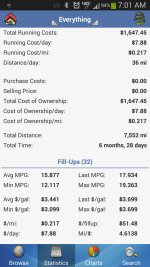
HWY driving on consistent road and speeds bewteen 60-70MPH, average speed 65MPH ,when MPGs were checked. This was after several runs each time. 4 times on 87 octane 3 times on 91 octane.
When I switched over from 87 to 91 I waited till 3 tank fulls and drove it like I stole it before checking the 91 octane MPG.
MPG: 19.9 on 87 octane.
Same road same driving 21.7MPG on 91 octane.
Best I ever got was 22.5MPG, but that must have been on a road where there was a descent because I have not been able to get that again.
Please...
You have many post on here, give me something a bit more educated then a single word of sarcasm to my statement.
Explain to me not why I'm incorrect in my post, but as to why I would have to lie on my first post in the forums. Anything else about octane rating and power or efficiency is already a debate on the internet and I rather not have to read it again if that is all you have.
NOTE TO MODS: Please don't remove this thread just because it is beating the proverbial "MPG dead horse." I spent some time on the below information that could actually maybe help someone more than just telling them "I got 22 mpg last night coming from work!" Thanks [MENTION=48772]Jesse1983[/MENTION]!
I don't know you but I do know telling someone octane gives you better mpg's is a crock. There is good and bad information on the internet. You have to be smart enough to understand it to begin with so you know what is right and wrong. With that said I spent some time last night putting a post together that is factual and should arm you with enough information to shut your buddies up when this topic comes up around the water cooler. Ready? Go!
Background:
Octane is a flammable hydrocarbon liquid but more importantly, octane is a measure of a fuel’s tendency to knock or ping when it is mixed with
air and burned in the cylinder of an engine. This octane rating of the fuel is NOT based on the amount of chemical
octane in the gasoline.
Now that we have that out of the way, here are a few more facts to bust your perpetuated myth:
High octane gasoline burns slower than low octane gasoline. The slow burn prevents engine knock when
cylinder pressures are high.
If your engine runs well and does not knock or ping on low octane gasoline, there is NO (none, zip, nada, nein, zero) advantage in switching to higher octane gasoline.
Look, the reason that 91 octane gas costs more than 87 octane gas is additional steps are required in the refining process, not that it is a “better” grade of fuel. They just yield a different blend of hydrocarbons that
burns more slowly to reduce engine knock. The additional steps also increase the price.
And if the above is not enough to convince you how about this:
Your 4Runner’s ECU will automatically adjust the fuel/air mixture for the most efficient combustion. It has several analytical feedback loops from sensors to achieve this function. In other words, if you put good hot burning gas in you will use less than putting a cool burn gas in there. So if you want to achieve the max mileage from a tank of gas then use ethanol free gasoline. The octane ratings at the pump are just for pinging and knocking, nothing else. Now, if you want to advance timing and change ECU settings to achieve a bit higher HP, then you need to run higher octane to eliminate the knock that invariably comes with that.
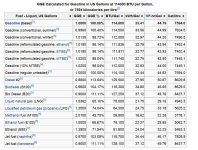
Now, if you still think I am full of it, here is the nail in the coffin of that myth you are spreading. Below is a chart that shows the potential energy from different fuels if you could burn them with 100% efficiency. Just pay attention to the BTU/Gal column and please note there is no different octane fuels on the chart because it does not make one bit of difference! The "GGE" is an equivalent comparing it to other fuels but the last four columns are true potential energy data.
Last note: For all you that don't understand winter and summer blends of gasoline you can see on the chart that winter gasoline is less efficient than summer gasoline, hence the decreased mpg you see in the winter.