3rd Gen 4runner Preventative Maintenance

Thanks [MENTION=10169]TheDurk[/MENTION]. It sounds like our intervals and diligence for maintenance are quite similar, and it has served us well thus far. I also have used Napa filters for many years on several vehicles, and they have worked very well for me.

I appreciate your notes, as I learned several things. A few follow up questions and just one experience I'll share. What are your intervals for brake fluid and clutch fluid (I also avoid shush boxes, which another personal preference)? Do you have a good procedure for clutch fluid changes? Unfortunately, I do not and want to improve how I do this. My share experience: I also change the rubber pcv valve grommet because I do not want it to get brittle and disenegrate with bits ending up in the valve train.

Brake fluid I try to do every two years, but it ends up being every two to almost three. Clutch fluid I have only done once, when I did my clutch and swapped in a new slave. I don't think it has nearly the stress that brake fluid does. No, I don't have a good procedure. I sort of made one up after a few false starts, and I don't really remember how I did it, I'm afraid.

I swap the PCV grommet but I have only done it twice, so I guess every five+ years. I always got the old one out whole but not without drama.
 
Last edited:
Makes sense. I did my clutch fluid once - when I did timing belt. Probably because this was the longest job in terms of hood being up I have done, so I had time to consider other things I should do. I used a new turkey baster to remove the old fluid then put in the new fluid and drove it for a week or two and did it again. I used such a small amount of fluid, so I decided to do it twice and call it good because I do not keep left over brake fluid after cracking the seal. There was no appreciable difference in how the clutch felt after doing it. I probably could have gone another 100k and been just fine.
 
I found a thread under the Maintenance/Detailing section of the forum regarding 3rd Gen scheduled/preventative maintenance but the thread only had 6 posts so I thought it would get more views and more commentary if it was in the main 3rd Gen section.

Here's the preventative maintenance schedule I've done with my 4runner and other vehicles and I'm wondering what the rest of you do.

Engine Oil and Filter every 3000 miles unless you're using synthetic which will allow you to do it less frequently. I believe synthetic oils will allow you to change it up to as high as every 15,000 miles. Supposedly, with regular non-synthetic oil, changing your oil every 3000 miles is excessive since engine oil technology has improved a lot over the years and you can change it every 5000 - 7500 miles. For me, I'm going to stick with the old school suggested oil change frequency of 3000 miles because an oil and filter change isn't expensive and it's easy to do. And, I also believe the single best thing you can do for your engine is regular oil and filter changes.

Engine Coolant (Antifreeze) should be changed at a minimum every 30,000 miles. I just do a drain and refill of the radiator and I usually renew around 8 quarts of the 9.5 quart cooling system capacity.

Transmission Fluid should be changed at a minimum every 30,000 miles. If you do a lot of off-roading or towing, a 15,000 mile interval is recommended. Since I just do a drain and refill of the pan and not a full flush, I change my trans fluid every 10,000 miles to keep the fluid in good shape. I renew around 5 quarts of the 12 quart capacity every drain and refill.

Power Steering Fluid should be changed at a minimum every 30,000 miles. I did several rounds of the turkey baster method of drawing out fluid out of the reservoir, replacing it with new fluid, and turning the wheel back and forth to cycle the fluid. Now that my fluid is looking clean, I plan on maintaining it by drawing out the fluid in the reservoir every engine oil change and replacing it with fresh fluid. With past vehicles, I never paid much attention to the power steering fluid but I'm going to do a much better job with my 4runner.

Transfer Case Gear Oil should be changed every 30,000 miles.

Differential Gear Oil should be changed every 30,000 miles. If you do a fair amount of off-roading or hard driving like towing, changing the rear differential every 15,000 miles is recommended. If you have a 4wd 4runner and you don't use 4wd very often, you can change the front differential much less frequently. But, since it's simple and affordable to do, I just change the front differential fluid anyway when it's time to do the rear differential.

Greasing U-Joints and Slip Yokes should be greased every other oil change but giving them a little grease every oil change isn't going to hurt anything.

Air Filter should be changed at a minimum every 30,000 miles but more frequently if you're driving dusty fire roads or trails.

MAF Sensor should be cleaned every 30,000 miles but again more frequently if you've been driving a lot in dusty conditions.

Spark Plugs should be replaced around every 30,000 miles if you're using standard copper plugs. If you have the iridium or platinum plugs, you can probably replace them every 60,000 miles.

Timing Belt and Water Pump should be replaced every 100,000 miles. I've heard it's advisable to replace the tensioner and idler pulleys too while you're in there. and the mechanics never replaced the tensioner or pulleys so I'm wondering if this is overkill.

Brakes should be inspected every 30,000 milesHowever, I've paid (never done one myself yet) for several timing belt/water pump replacements , whenever you hear abnormal braking noise, or your brakes are pulling one way or the other.

Tires should be rotated and balanced every 5000 miles.

[MENTION=102606]infamousRNR[/MENTION] and I have a video coming out soon that shows changing all the fluids, greasing the u-joints and slip yokes, inspecting the brakes and changing the air filter.

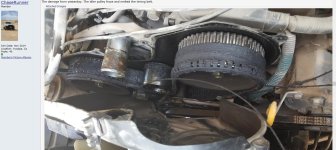
I guess this would be a reason to replace the pulleys when doing the timing belt.

pic from this thread: http://www.toyota-4runner.org/so-cal/220475-june-2016-meet-run-9.html
 

Attachments

  • Idler pulley seized.jpg
    Idler pulley seized.jpg
    139.4 KB · Views: 4,419
I also change the rubber pcv valve grommet because I do not want it to get brittle and disenegrate with bits ending up in the valve train.

I'm guessing you haven't replaced valve cover gaskets yet on your rig. I had the same thought you have regarding the pvc grommet being able to drop into the valve train but that won't happen. There's a space under the grommet hole that is separated by metal from the valve train so even if it did fall in there, it wouldn't do any harm. But, you should probably fish out the old one which might prove a challenge.

I'm glad I started this thread because it's interesting to learn what others are doing. I'm actually going to change the interval of how often I renew the rear differential gear oil from 30,000 to 15,000 because of what I've learned on this thread. I know many love their synthetic fluids but I've had great luck with conventional fluids and will probably stick with them for some time to come.
 
I think Fluid filming brake lines should be added here, especially in the salt belt.

checking your rear breather, maybe every 4-5years 50k miles? if you are in the rust belt that is. Mine was rusted shut. Im surprised my axle seals didn't give

Lastly, how often do you guys get an alignment? My 04 never was aligned since the factory and it has pretty perfect wear for a 12 year old car. I guess maybe pot holes don't affect the relatively larger size tires. I think its silly to every year paying nearly 200 dollars for rotate balance and alignment... every 2-3 years for the alignment makes more sense to me.
 
Last edited:
Lastly, how often do you guys get an alignment? My 04 never was aligned since the factory and it has pretty perfect wear for a 12 year old car. I guess maybe pot holes don't affect the relatively larger size tires. I think its silly to every year paying nearly 200 dollars for rotate balance and alignment... every 2-3 years for the alignment makes more sense to me.

I usually only get an alignment when something like uneven tire wear or the vehicle pulling one way or the other, let's me know something is off. But, if you do any front end work like replacing tie rods or installing a lift, an alignment is advisable.
 
Great information. And yes, all looks good and proper intervals.

You will be amazed how good these trucks going to serve you if you do this maintenance. A steering rack will last 400K miles or even more with proper fluid changes.
 
Anything on Chassis rust prevention? I Think thats a big factor in how long these 3rd gen's last..

I use Eastwood internal frame coating : Internal Frame Coating w/Spray Nozzle | Eastwood

And Oil based brush on tremclad on the outside.

http://www.toyota-4runner.org/3rd-gen-t4rs/171083-frame-rust-prevention.html

Us Left-Coasters don't have to worry too much about rust but I'm glad you brought this up. From what I've seen on this forum, rust damage is a definite limiting factor of how much life you'll get out of your 4runner. The engine and drivetrain will have low miles and be in great shape and the frame will be rusted to shit. I feel for the people who live in the Rust Belts. Working on a rig that requires penetrating oil on every fastener has got to get old. Vehicles in general last so much longer on the West Coast because of this issue.
 
Us Left-Coasters don't have to worry too much about rust but I'm glad you brought this up. From what I've seen on this forum, rust damage is a definite limiting factor of how much life you'll get out of your 4runner. The engine and drivetrain will have low miles and be in great shape and the frame will be rusted to shit. I feel for the people who live in the Rust Belts. Working on a rig that requires penetrating oil on every fastener has got to get old. Vehicles in general last so much longer on the West Coast because of this issue.

You would think someone would make a car/truck with a kind of rust-proof frame by now for our East Coast Brethren, right?
 
You would think someone would make a car/truck with a kind of rust-proof frame by now for our East Coast Brethren, right?

Problem is you need to at least yearly clean that crap off the frame. If you are my parents with a billion things on their mind, and was never told to wash it they probably they won't. I think fluid film or something like fluid film should be mandatory.... But that is just me.
 
Maintaining the frame would be a good DIY guide idea. Such as a guide on where to rinse out the frame and where to best inject rust spray. I've been using a can of Rust Check every season but I dont think that has the same potency as a proper spray due to the nozzle. I'd be curious on where the professionals spray and if it's necessary to drill any holes.
 
Maintaining the frame would be a good DIY guide idea. Such as a guide on where to rinse out the frame and where to best inject rust spray. I've been using a can of Rust Check every season but I dont think that has the same potency as a proper spray due to the nozzle. I'd be curious on where the professionals spray and if it's necessary to drill any holes.

[MENTION=14772]shootmymime[/MENTION] and others have some rust prevention/frame spraying posts in their BT's.
 
I'm not knocking those that do complete flushes whether it's transmission fluid, power steering fluid or coolant. I just find the dilution method effective and a lot easier to do. For example, is it better to wait until 30,000 miles to do a complete tranny fluid flush, or do a drain and refill every 10,000 miles like I do? I guess the key here is renewing the fluid in some fashion on a regular basis is much better than ignoring the fluid change like many vehicle owners do and then wonder why their vehicle didn't last them very long.

Any thoughts on doing the dilution method to change brake fluid?

I've flushed my brake fluid once because i was installing stainless brake lines but once the brake system is properly bled, was wondering if syringing out the old fluid from the master cylinder & replacing with new a little more regularly might be an easier option in changing brake fluid and to avoid getting air in the brake lines?
 
I agree that dilution is fine for hard to access fluids, like power steering and automatic transmission. Those components constantly pump the fluid around, so you're always getting good mixing.

However, for brake fluid it's only marginally harder to do a proper bleed. Dilution won't be effective because the stagnant fluid downstream of the master cylinder and towards the caliper end will almost never fully circulate.
 
I agree that dilution is fine for hard to access fluids, like power steering and automatic transmission. Those components constantly pump the fluid around, so you're always getting good mixing.

However, for brake fluid it's only marginally harder to do a proper bleed. Dilution won't be effective because the stagnant fluid downstream of the master cylinder and towards the caliper end will almost never fully circulate.

I agree with this. All you need is someone to help you by pumping and holding the brakes while you're under the rig doing the bleeding at each wheel. Find out which wheel is the right one to start with for your year rig. I've heard there is a difference depending on the year. If you can't figure out which one to start with, I'd start with the wheel furthest away from the master cylinder which would be the passenger side rear wheel. I'd then bleed the driver side rear wheel, followed the the passenger side front wheel and finally the driver side front wheel. Bleed each one until clean brake fluid comes out.

In case people reading this haven't bled brakes, here's the steps I would do:
1) Have the proper brake fluid on hand to refill the master cylinder while you're bleeding and to top off after you're finished.
2) Get yourself a small diameter hose that will slip over the bleeder fitting and fit snugly enough to not slip off. A small vacuum hose would probably work good. I actually used a 1/4" drip line for landscape irrigation that worked ok.
3) Get yourself a container to catch the brake fluid you're bleeding out of the wheel cylinders.
4) Get under the rig and put the hose over the bleeder fitting and the other end into the catch container. Have the right size wrench for the fitting, ideally a flare nut wrench.
4) Have your helper get in the driver's seat and pump the brakes a few times and then hold pressure against the pedal. Tell them to hold pressure even when the pedal goes to the floor until you tell them to release the pedal.
5) Open the bleeder and let dirty fluid flow out.
6) Close the bleeder
7) Tell your helper they can release the pedal, pump it up again, and hold.
8) Repeat steps 4-7 until you're satisfied with the color of the brake fluid coming out at that wheel.
9) Now go to the next wheel.
** Don't forget that you will have to regularly refill the master cylinder during this process so it doesn't run dry.
 
Last edited:
On at least the 01-02 you have to have the key at on to bleed the brakes. And to bleed the rear brakes you just push the pedal down and open the bleeder. The abs pump will keep pumping the fluid out. No need to pump with your feet. The front brakes bleed like normal brakes, can't remember if you need the key at on for the front or not.
 
On at least the 01-02 you have to have the key at on to bleed the brakes. And to bleed the rear brakes you just push the pedal down and open the bleeder. The abs pump will keep pumping the fluid out. No need to pump with your feet. The front brakes bleed like normal brakes, can't remember if you need the key at on for the front or not.

I didn't know this^.

I used the mityvac hand pump. It worked, just took a while.
 
I didn't know this^.

I used the mityvac hand pump. It worked, just took a while.

Yeah took me forever to figure out how to bleed those stupid drums after doing a rear axle bearing. Found it posted somewhere in the depths of these forums...
 

Members online

Forum statistics

Threads
278,309
Messages
3,554,067
Members
248,016
Latest member
Advally Service

Trending content

Back
Top