4Runner Decision Help - Fuel Requirements

mikeynavy1

New member
I just posted this in another thread, but seeing as it hadn't been visited in quite some time I figured I'd post again. I'm looking at new cars, and the 4Runner is top choice at the moment. The pressing question right now is if the V6 or V8 require premium fuel (the owners manual recommend it) or if regular fuel is fine. With my current car, premium isn't that big of a deal because the tank is small. With a mid-size SUV with larger tank and lower gas mileage, it becomes a big issue.

I currently have a 2002 Nissan SE-R Spec V, that I'll be trading in shortly. I'm very interested in a 2006 4Runner Sport Edition 4WD V8. The gas mileage is the only thing holding me up. The actual mileage is one thing, but adding to it that Toyota is recommending premium is another. I've called more than one dealer in my area and have heard both responses:

1) It will run fine on Regular (87) unleaded and will not void warranty.
2) You have to run premium or you'll get knock and ping, damage your motor, and void warranty.

Will the 2006 i-Force V8 (or the 4.0L V6) run fine on regular to save money or is premium a must? The 4Runner says premium but the Tundra says regular. I'm confused. Please help as this sways my decision towards a 4 Runner or a Camry SE V6. I'm assuming the 4Runner has a knock sensor that should prevent knock and ping at the expense of a few horsepower.
 
Register to hide this ad
Plenty of people here use 87 octane in their V6 and V8 engines without any problems at all.

The recommendation to use the higher octane stuff is just that--a recommendation. Your 4Runner will be fine with the lower octane stuff.
 
I run 89 in my V8 just because I feel I get a little more milage out of a tankfull of it. Maybe if you figure the extra cost vs. the extra miles it becomes a wash but in my mind it makes me feel better. Just my .02! But I see no reason why you cant run 87...as long as you run 87 all the time and dont switch back and forth you should be just fine.
 
Toyota suggests that you use premium for "maximum" performance, but the truck can run on regular. That is the case with most cars today.
 
87 is fine. The manual even says so.
That dealer who told you it will void the warranty must be an ex-Jiffy Lube employee (the district manager?! :D )
 
Both the V8 and V6 will run fine on regular 87 octane. You should not get any knocking (pinging) since both engines incorporate an anti-knock sensor which detects knocking (pinging) tells the main ECU to retard the timing accordingly to adjust for the lower octane fuel.

You will get better performance (more advanced timing) by using higher octane fuel. Heck, it is not that much more expensive. In my mind that works out to slightly more than one beer at a bar per tank).

I use 91 Octane and am very happy with the performance, but many run on regular with no problems and are happy. So it's really your call. The dealership will still recognize the warranty whatever you decide.

4Runner is a great SUV. There a few that can match it.

-Toy-man-
 
Thanks for the advice.

Thanks to all that replied. It was the first I'd heard of being able to void warranty by using a particular grade of gasoline. As my girlfriend says, it's time to trade in the rice rocket for a "big boy's" vehicle. She and her sister, a ridiculous insurance quote, and a near-miss test drive speeding ticket turned me away from a WRX STi. The Nissan has been fun, and had minimal problems, despite extensive modifications. Bumpy roads and California smog standards (I can't legally install a nice turbo or supercharger kit) have pretty much ended it's career with me, and I feel I need more room and something that rides better. Toyota is one of the few Japanese companies that retain their quality reputation (Nissan SUCKS now) and I've also held the 4Runner as one of the premier mid-size SUVs. Anyways, thanks for the warm welcome to this forum. Hopefully, next weekend I'll be driving home in the new V8 4Runner.

P.S. I ran premium in the Spec V for nothing more than preventing retarding timing. The knock sensor in this car is overly sensitive and many people take it off (and increase timing) for better performance..as long as they don't use lower-grade fuel. No need for that in the 4Runner...I'm not interested in it for racing...haha.
 
Last edited:
The mannual for the V6 actually says 87 octane is fine but it "recommends" 91 octane. Not sure why... probably to ensure no-one experiences engine knocking when they're half way up Kilamanjaro or perhaps drag racing.

I've actually found I get slightly better mileage out of 89. I could be dreaming, but it seems to be 0.5-1mpg more. However, until gas price go down I'm sticking with 87. IMO, 91 octane fuel is a rip off and waste of time for 99.9% of cars on the road.
 
Toy-Man said:


You will get better performance (more advanced timing) by using higher octane fuel.


Actually, you don't get advanced timing by using higher octane fuel. The timing will not change from high octane to low octane, unless the engine experiences knock (pinging), in which case the knock sensors will retard timing. If the lower octane fuel does not cause knock (which seems to be the case, from my experience), then the timing will remaining at the original spec and performance will not suffer at all.

I hooked up my OTC scan tool and watch the spark advance while driving in a variety of conditions (plenty of uphill full throttle running) to try and cause the knock sensors to retard the timing. Never once was I successful. That's the reason why I'll continue to use the lower octane fuel in my 4Runner.
 
Re: Thanks for the advice.

mikeynavy1 said:
...I'm not interested in it for racing...haha.

Wait until you feel that V8 off the line...you might change your mind about this! :biggrin2: :biggrin2:
 
Both engines run FINE on regular fuel! I even ran regular pulling a trailer with no ping what-so-ever!

Koz
 
Koz said:
Both engines run FINE on regular fuel! I even ran regular pulling a trailer with no ping what-so-ever!

Koz

You're probably right, but one thing to keep in mind is that you should never hear any knock/ping even if it is occuring. That's because the knock sensors in today's vehicles are so good that they'll retard timing at the first sign of detonation. They are so good and so fast that the driver should be unaware that it is even occuring. The only true test is to use a scan tool that has live data stream and watch the timing spec.
 
I don't know if anyone has noticed this, but the same V8 used in the Lexus GX470 has a hp and torque rating of 263 HP and 323lbft of torque versus the 4runners 260 HP and 306 lb/ft. The only difference I can tell between the two is that Lexus makes a disclaimer that the performance rating was achieved using the "required" premium fuel to achive those numbers. So it stands to reason that if you wan't maximum power, use premium for when your towing or hauling heavy loads.
 
ilocan said:
I don't know if anyone has noticed this, but the same V8 used in the Lexus GX470 has a hp and torque rating of 263 HP and 323lbft of torque versus the 4runners 260 HP and 306 lb/ft. The only difference I can tell between the two is that Lexus makes a disclaimer that the performance rating was achieved using the "required" premium fuel to achive those numbers. So it stands to reason that if you wan't maximum power, use premium for when your towing or hauling heavy loads.

The fuel is not the difference, there are tuning differences. It could be a different intake system, exhaust, cam timing, etc. Premium fuel does not have any more energy then regular, it just has additives that allow the fuel to burn slower. The best octane fuel for your vehicle is the lowest octane that does not cause ping/knock.

Koz
 
Koz said:
The fuel is not the difference, there are tuning differences. It could be a different intake system, exhaust, cam timing, etc. Premium fuel does not have any more energy then regular, it just has additives that allow the fuel to burn slower. The best octane fuel for your vehicle is the lowest octane that does not cause ping/knock.

Koz

I understand that Octane is designed to lower the flash point of fuel thus reducing the chance for detonation. However, before Toyota adopted the new SAE standards of measuring engine power, both the GX and 4Runner had identical hp and torque figures. They both and the same 2005 VVT V8 engines. So I don't think their are any significant tuning or cam timing differences that I am aware of that would account for the power differences. If anything, I read from another forum that the ECU in these Toyota truck engines actually ignore the Knock sensor until the engine reaches 4k rpm, at which it will start pulling the time back if knock is detected. I dont know if that is true or not but it does make sense given that the VVT V8 has somewhere in the range of 10:1 compression ratio.
 
ilocan said:
I don't know if anyone has noticed this, but the same V8 used in the Lexus GX470 has a hp and torque rating of 263 HP and 323lbft of torque versus the 4runners 260 HP and 306 lb/ft. The only difference I can tell between the two is that Lexus makes a disclaimer that the performance rating was achieved using the "required" premium fuel to achive those numbers. So it stands to reason that if you wan't maximum power, use premium for when your towing or hauling heavy loads.


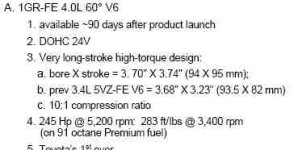
Toyota made a similar statement with the V6 in 2003.
 

Attachments

  • v6_hp.jpg
    v6_hp.jpg
    9.5 KB · Views: 483
ilocan said:
I don't know if anyone has noticed this, but the same V8 used in the Lexus GX470 has a hp and torque rating of 263 HP and 323lbft of torque versus the 4runners 260 HP and 306 lb/ft. The only difference I can tell between the two is that Lexus makes a disclaimer that the performance rating was achieved using the "required" premium fuel to achive those numbers. So it stands to reason that if you wan't maximum power, use premium for when your towing or hauling heavy loads.
The GX could easily have a more aggressive timing map that takes better advantage of premium fuel. Perhaps the thought is that Lexus buyers will care less about spending more money on fuel. Even still, you will be able to drive a GX just fine on 87 octane, and I have done it many times personally.

Drive a GX back to back with a 4R and it's noticeable that something's different with the tuning/electronics. The first portion of the gas pedal's travel in the GX gets you more power than the same throttle position in the V8 4Runner. I assumed it was simply different calibration of the drive-by-wire gas pedal, but it could be more agressive tuning of the engine itself. Or a combination of the 2.
 

Members online

Forum statistics

Threads
278,307
Messages
3,554,056
Members
248,016
Latest member
Advally Service

Trending content

Back
Top