
You are using an out of date browser. It may not display this or other websites correctly.
You should upgrade or use an alternative browser.
You should upgrade or use an alternative browser.
4runner TRD Pro
- Thread starter Trob20
- Start date


444
New member
Jeez, he hit you so hard he turned your 5th gen into a 4th gen.
If you can believe it his wife and 2 little girls were in the back seat and they didn't have a scratch on them! I hit right behind the driver's side wheel and spun them like a top!
Until then I didn't think you could hit something with that much force and walk away.

1engineer
Moderator
How's this for a panic brake on a 4Runner? Sadly this was my 2010.
http://www.toyota-4runner.org/members/444-albums-2010+4runner+lifesaver.html
Tough hit! What did you think of the braking performance? Hopefully everyone was ok.

Cypher
New member
Have you panic braked in your 4Runner yet? If not make sure you go to a deserted piece of highway before you do it. Get it up to about 65 and hit the brakes like a deer ran out in front of you. You will stop! QUICKLY! Everyone should do this because the 4Runner is a bit different than other vehicles because it feels like the hand of God is pushing against you the first time you do it.
IMHO this is something that everyone should do when they get a different vehicle and occasionally after that. It is much the same as hand-to-hand combat or self defense firearms training. Knowing some of the things that will happen and how they will happen when you are in an emergency situation can go a long ways towards helping you preform better when the proverbial brown stuff hits the fan. Knowing how your vehicle handles in these situations is imperative. I am looking forward to trying this soon after I get my TRDP.
It is also important when doing this to not stand on the brake for very long when you come to a complete stop. This could lead to warped rotors or uneven wear.
Happy stopping!
Last edited:
Do me a favor: Show me your Tacoma mpg numbers where you documented by fill up for a complete year. When you do that we will talk because several here includong me document their numbers.
I never said four mpg, I said around 10%. That would equate to about 1-2 mpg and bring your 15 mpg city up to around 17 mpg.
Look, believe what you want. i gave you a reasonable explanation on why you get bad mileage this time of year. You disagree which is fine but show me why I should believe you by presenting the numbers. Now if you tell me you just know and would have sensed a drop in mpg then I will call BS and tell you to this from my world:
"If it's not measured by data then it does not exist."
Although I do generally agree with you 1engineer in most cases, my data does not in this specific one. I drive to work, as an engineer, about 50 miles a day at about 5,000 ft elevation. I have done the exact same commute for the last year I have owned the truck. I'm not using last years winter months as the truck was still in it's break in period and I figured that would skew the data. Everything on my truck has been kept stock, and I haven't had a chance to do any outdoor adventures in the truck yet (all miles on pavement or graded dirt roads). I did take the truck to Grand Junction twice in the data set, once in the summer and once in the winter. This data starts at about 9,000 miles on the odometer. I am only showing about a 2% difference in MPG from summer gas to winter gas. I got my dates from this website Summer-grade versus Winter-grade Fuel - HowStuffWorks , not sure how reliable the web site is as it's a little dated but I did not have time to do an extensive search. Below are my data points and line chart over the last year of ownership.
Thoughts?

Data Points ^

Line Chart ^

Mooney
New member
Although I do generally agree with you 1engineer in most cases, my data does not in this specific one. I drive to work, as an engineer, about 50 miles a day at about 5,000 ft elevation. I have done the exact same commute for the last year I have owned the truck. I'm not using last years winter months as the truck was still in it's break in period and I figured that would skew the data. Everything on my truck has been kept stock, and I haven't had a chance to do any outdoor adventures in the truck yet (all miles on pavement or graded dirt roads). I did take the truck to Grand Junction twice in the data set, once in the summer and once in the winter. This data starts at about 9,000 miles on the odometer. I am only showing about a 2% difference in MPG from summer gas to winter gas. I got my dates from this website Summer-grade versus Winter-grade Fuel - HowStuffWorks , not sure how reliable the web site is as it's a little dated but I did not have time to do an extensive search. Below are my data points and line chart over the last year of ownership.
Thoughts?
Data Points ^
Line Chart ^
Andy,
Can't help but wonder if there are additional unaccounted factors that support 1E's data and may better explain your results.
If winter blend simply provides less BTU's per gallon than a summer blend, then a straight across comparison would show a less efficient vehicle in the winter . . . correct?
Here's the additional; during the winter, temperatures and humidity are lower and air is more dense. Combine that with your A/C not being used (as much), clutched fan not engaging and I can't help but wonder if some/all attribute to the flatter line in your chart.
In piston engine aircraft a turbo charged engine requiring 38" of manifold pressure to produce 270 bhp is reduced to 34" when temps are colder at the same altitude. While not totally relevant when comparing a vehicle, aircraft are more efficient during the cold winter months (ice on wings aside).
My question is whether the benefits of denser winter air make up for some of the efficiency lost in the fuel change?
Thoughts?

C
Carolina Roscoe
Guest
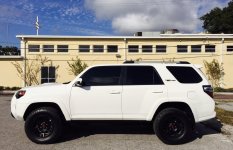
Had the windows tinted on my TRDP today.
Also, I have Spidertrax 1.25" spacers in the mail. Has anyone installed them on a Pro yet? Any rubbing?
I was wondering the same thing. I have almost purchased a few times but was hoping someone else would volunteer to be the Guinea pig.:bravo::biggrin1:
444
New member
Tough hit! What did you think of the braking performance? Hopefully everyone was ok.
All I remember about the braking is I slammed the brakes to the floor and threw the steering wheel as far left as possible. As I did that I punched the horn which thankfully saved the airbag from smashing me in the face. It blew up and around my extended arm. I heard the ABS chirp for about 1 second and then the explosion. I feel it slowed me down to about 50-55 mph from 65/70 in 100 feet. It definitely slowed me and I did not flip or roll my truck.
My truck was deflected into oncoming traffic which thankfully the next vehicle in that lane saw the whole thing from enough distance and he stopped. He was driving a loaded semi with a large skid steer on the trailer. Correct me if I'm wrong but air bags don't reset themselves and deploy again with a second impact. If it was about 10 seconds later I would've been road kill.
The driver of the other car was unconscious and not breathing when I got to him with my medic kit. He didn't start breathing until we opened his airway. He had some broken ribs, collapsed lung, and I'm sure one helluva headache.
Thankfully he lived. The rest of his family was fine.

3wbdriver
New member
Had the windows tinted on my TRDP today.
Also, I have Spidertrax 1.25" spacers in the mail. Has anyone installed them on a Pro yet? Any rubbing?
I was wondering the same thing. I have almost purchased a few times but was hoping someone else would volunteer to be the Guinea pig.:bravo::biggrin1:
I can't vouch for the Pro, but on my regular Trail (woe is me) they gave me rub on the front fender and on the mudflap. I had to trim both. 17 x 8 wheels, 265/70-17 tires, 2" lift in front.
C
Carolina Roscoe
Guest
I can't vouch for the Pro, but on my regular Trail (woe is me) they gave me rub on the front fender and on the mudflap. I had to trim both. 17 x 8 wheels, 265/70-17 tires, 2" lift in front.
I wouldn't exactly call your ride "regular":nicethread::biggrin2:

TRDProGirl
New member
Happy TRD Pro
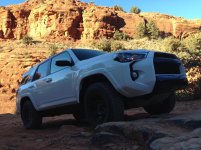
I finally got to take my TRD Pro out today near our house in Sedona. As soon as it hit dirt it felt alive. This thing has been surviving on traffic safety cones and poorly parked mountain bikes. It was hungry for something to climb, some nice red sand to settle onto every brand new surface.
I finally got to take my TRD Pro out today near our house in Sedona. As soon as it hit dirt it felt alive. This thing has been surviving on traffic safety cones and poorly parked mountain bikes. It was hungry for something to climb, some nice red sand to settle onto every brand new surface.
Attachments
Last edited:
3wbdriver
New member
I wouldn't exactly call your ride "regular":nice thread::biggrin2:
Well. It does have that dealer installed double pinstripe down the sides......

Last edited:
Cypher
New member
I finally got to take my TRD Pro out today near our house in Sedona. As soon as it hit dirt it felt alive. This thing has been surviving on traffic safety cones and poorly parked mountain bikes. It was hungry for something to climb, some nice red sand to settle onto every brand new surface.
Nice!!! What trials did you run in Sedona? My personal favorite spot to off-road in all of AZ.

Ridin4Runner
New member
I also came out of an Acura that required 93. I use 93 in my T4R because I read somewhere it's cleaner, purer, helps with knock and maybe adds a bit more power. If you do the math it's only $6 more per tank.
I actually got much better gas mileage with 93 and my Limited. Mathematically it was basically a wash price wise. Been using 87, but think I will switch back to 93 see if it improves as well.
TRDProGirl
New member
Nice!!! What trials did you run in Sedona? My personal favorite spot to off-road in all of AZ.
Thanks! Today we took it up Schnebly Hill for an easy first dirt trip. Other spots we like are mostly in west Sedona like Greasy Spoon, Van Deren Cabin and Outlaw trail. Sedona is supposed to get very cold and some precipitation in the next few days so I might get to see how it drives in a little snow.
LOL XD this was hilarious.more mileage questions:
I put 1/8th of a 16 ounce can of SeaFoam every 700 miles in the summer. I drive about 3000 miles per month from May through September.
In the winter (October through April) I put 1/6th of a 16 oz can of Sea Foam every 700 miles. I drive about 2300 miles per month in the winter.
I drive less down hill in the winter so I have less chance of sliding through icy intersections at the bottom of hills.
In the summer I "vent" my sunroof on days where the temp is above 60 when I'm going less than 40 mpg.
My summer and winter tires are the same however I've lost .8 mm of tread depth since March. I've rotated my tires every 10,000 miles and changed my oil with Mobil 1 full synthetic. I've used a Fram extra guard filter for my summer oil changes and a Wix filter for my winter oil changes.
I wash my car more frequently in the winter than the summer- about every 3 weeks in the winter and every 5 in the summer.
I carry extra supplies in my vehicle in the winter that total to be around 15 pounds in addition to wearing thicker socks- typically a merino wool blend. I prefer smart wool over other brands.
My mileage is better in the summer by 9.844 percent.
I have a few questions that you guys might be able to help me with:
1. Who gives a shit?
2. If I buy my SeaFoam from Wal Mart is it just as good as from an auto parts store?
3. What color is my vehicle?
4. Who makes a better 9 mm FMJ round for my Glock?; Federal or Blazer?
5. What make/model/style of beer am I drinking right now?
6. When the F is my TRD Pro being delivered?
Thank you for your participation.

TRDPRO
New member
Had the windows tinted on my TRDP today.
Also, I have Spidertrax 1.25" spacers in the mail. Has anyone installed them on a Pro yet? Any rubbing?
That is dark tint. It looks darker than 20%
Andy,
Can't help but wonder if there are additional unaccounted factors that support 1E's data and may better explain your results.
If winter blend simply provides less BTU's per gallon than a summer blend, then a straight across comparison would show a less efficient vehicle in the winter . . . correct?
Here's the additional; during the winter, temperatures and humidity are lower and air is more dense. Combine that with your A/C not being used (as much), clutched fan not engaging and I can't help but wonder if some/all attribute to the flatter line in your chart.
In piston engine aircraft a turbo charged engine requiring 38" of manifold pressure to produce 270 bhp is reduced to 34" when temps are colder at the same altitude. While not totally relevant when comparing a vehicle, aircraft are more efficient during the cold winter months (ice on wings aside).
My question is whether the benefits of denser winter air make up for some of the efficiency lost in the fuel change?
Thoughts?
I know there must be thousands of variables that could potentially affect my gas mileage, and I'm sure the ones you presented could be included into that list. I have heard about the denser winter air affect on aircraft engines and is one of the reason why the Air Force tests fighter air craft in Alaska. I do not know if that rule applies to auto engines tho. Humidity is pretty much non existent year round here in this great state of Colorado. Other factors I see; traffic is typically slower during the cold winter days especially if snow is on the ground, Engine idles much higher and longer when initially starting up before coming to resting idle, much more use of a locked center diff, more weekend driving during the warm summer months. Most of these seem to me like they would lower the gas mileage during the winter. I really have no idea why it is relatively the same but the data doesn't lie. What do you think is the cause [MENTION=66316]1engineer[/MENTION]?
Andy
1engineer
Moderator
I honestly don't know [MENTION=108420]EasyAndy[/MENTION]. Here is a link to a post I did awhile back on horsepower, barometric pressure and altitude here http://www.toyota-4runner.org/5th-gen-t4rs/133786-cold-air-horsepower.html that explains a bit and might be applicable to your situation.I know there must be thousands of variables that could potentially affect my gas mileage, and I'm sure the ones you presented could be included into that list. I have heard about the denser winter air affect on aircraft engines and is one of the reason why the Air Force tests fighter air craft in Alaska. I do not know if that rule applies to auto engines tho. Humidity is pretty much non existent year round here in this great state of Colorado. Other factors I see; traffic is typically slower during the cold winter days especially if snow is on the ground, Engine idles much higher and longer when initially starting up before coming to resting idle, much more use of a locked center diff, more weekend driving during the warm summer months. Most of these seem to me like they would lower the gas mileage during the winter. I really have no idea why it is relatively the same but the data doesn't lie. What do you think is the cause [MENTION=66316]1engineer[/MENTION]?
Andy
If you could repost your numbers and pertinent information I would be glad to try to help.
Similar threads
- Replies
- 2
- Views
- 3K

- Replies
- 0
- Views
- 11K


