MNT4R
New member
Lots of Research for putting 285's on the rig, decided to put it in one spot:
* For terminology defining upper control arms, fender liner, body mount, and mud flaps see my post further down the thread.
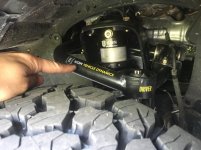
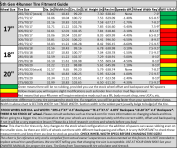
1)Fitment: This is the way that tire size and wheel size will interact with the non-moving parts of the car (fenders, upper control arm) to cause things like rubbing. A great reference is [MENTION=66316]1engineer[/MENTION]s posted tire fitment guide: http://www.toyota-4runner.org/5th-gen-t4rs/156378-going-bigger-5th-gen-tire-fitment-guide.html Another is [MENTION=106176]wfo9[/MENTION] 's http://www.toyota-4runner.org/5th-g...-tire-size-wheels-read-first.html#post2161256 Some of the most critical information from the first thread is posted in the first figure below. Basically, using a 2013 trail as an example, if you wanted to go the standard wheel size of 17” you can use up to a 275/70r17 with minimal/no issues rubbing. Most folks are doing heavy research to decide whether 285’s will rub. So if you aren’t diving into the yellow on that chart, stop here and go buy your 275 tires. If you are changing your wheels or going bigger read further….
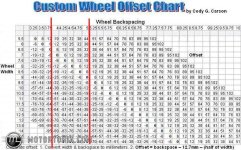
2)Wheels: So you decided to change your wheels or go bigger than 275’s, good. [MENTION=8206]harper7[/MENTION] is apparently the master of cramming wheels under 4runners so he has published the custom wheel offset chart to keep you safe http://www.toyota-4runner.org/5th-gen-t4rs/154290-wheel-offsets-285s-stock-5th-gen-trail.html If you don't know what offset and backspacing are, Google "offset and backspacing" and look at a thousand pics until it makes sense, then look at this chart (figure 2 below). Make sure that your wheels provide enough backspacing to keep your tires from rubbing on the upper control arm if you are staying stock (i.e. stay between the red lines). If you are getting a lift then look at the recommended backspacing for that lift based on control arm size (example 2003-2009 Toyota 4Runner 0-3.5" Suspension System - Stage 2 (Tubular) | K53052T ). Typically you are safe if your wheel offset puts you at a backspace less than 5 inches. I have posted the chart from Harper7’s thread below to consolidate
**Wheel spacers can be used to push the mounting interface out (thus decreasing your backspacing and decreasing the propensity for tires to rub the UCA), but remember this pushes the whole wheel out from the vehicle, taking load off of the suspension and putting on the wheel itself. There are pros and cons to their use http://www.tacomahq.com/202/wheel-spacers-pros-cons/ Thoroughly research this before going down that road.
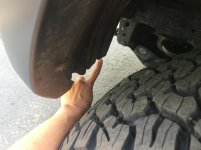
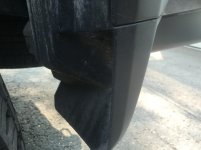
3)Wheel well mods: so if the dynamics of your wheel well are such that your 275’s are rubbing (bad luck) or you want to gun for the 285’s, you may need to modify your wheel well to accommodate the tires. Again, [MENTION=8206]harper7[/MENTION] has a thread on this. http://www.toyota-4runner.org/5th-gen-t4rs/150779-falls-lift-questions.html Another solid write up is by [MENTION=137794]JasonKoko[/MENTION] at the following link http://www.toyota-4runner.org/5th-gen-t4rs/223710-285%92s-2016-4runner-trail-fender-liner-mod.html I can tell you from personal experience that it takes about 15 minutes to move both front fenders forward, and another 10 minutes to remove the mud flaps. This exposes your body mount in the back of the front wheel well, but believe me, even with a 3.5” lift you will be cutting it close, so go ahead and make these mods, then if you add weight to the front end in the future you won’t be left with a nasty rub.
4)Lift: So at the bare minimum you will need to lift the front end of your car between 1.5 and 3.5 inches to accommodate 285’s (based on thread research). You can do this with a leveling kit, adjustable shocks, or a lift kit. I am not sure if a body lift would work, but honestly if you are going to lift your vehicle that much, I would save the money and get the suspension lift, you won’t be sorry. Wheel spacers, while moving the tire away from upper control arm (in essence decreasing your backspacing), won’t necessarily work because you will be moving the tire further out of the well, but not changing the relationship to the back of the well when it is fully locked (turned). You really need to lift the well over and away from the tire (at least for 285’s). There are some threads that talk about 285s fitting no problem, or 285’s fitting with fender mods, but later comments admit that with heavy breaking at lock (wheel turned all the way) or off road adventures that rubbing is an issue. When you have your lift installed, often the manufacturer will have a preset caster angle (google, read, pics, it will click). However, if you have the option, have the tech (or you) put the lift at full caster and this will avoid body mount rubbing in many cases. With all of these items considered you should be good, unless… you rub anyway, then:
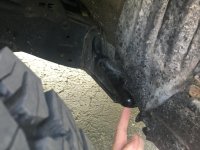
5)What am I using the vehicle for? Even with through research and helpful posts, some vehicles rub anyway with 285’s, or the 285’s work well on the street but rub off road. This is bad luck for the former and maybe even expected for the latter (particularly if you are giving the shocks some heavy travel(like rock crawling). Don’t fret. If you have done most everything above and you still rub it will probably be at full lock or at serious travel with your shocks. Take ‘er easy for a few days and isolate a shop that does “body mount chop,” because likely that is where you are rubbing. The body mount is visible as the big round piece of metal that is at the back of your wheel well with the long bolt sticking out of the bottom. This was uncovered when you removed your front well mud flaps (in the back of the well). Though you will see many a thread talking about chopping this off with a dremmel in the garage in DIY fashion, if you are like me, it might make you a little nervous (that is actually the hard stop for most forum go’ers). If you ask around (even in rural Minnesota) you can find a shop that does a chop and also offers to cover the chop with sheet metal and weld it flat. This stabilizes the area where the chop was done. You can cover with Herculiner (truck bed liner) at home to prevent rust if you like.
6) Weight, the killer of “my tires don’t rub” posts: Sweet, your 285’s fit. Congrats. For most of us, lifting the vehicle and sporting more aggressive tires is the first stage of many because it provides the most bang for the buck. The thing to keep in mind is that you will likely add more weight to the car. Given infinite time and money, most of the individuals on this forum would turn their 4runner into a fully armored, Gobi-racked, rock railed, winch toting monster in preparation for the zombie apocalypse… and would be more than happy to load it down with 40 gallons of gas, an ARB frig full of beer, and a bladder full of water on the way to Moab (or in my case Canada) to wait things out. But even without a payload, all of these items add weight, compress the suspension and bring the dreaded body-mount closer to the tire. Big ticket items all ring in at 90-120 lbs (winch with cable, front armor, rear armor, Gobi rack). Even the slimmest of hidden winch mounts is 40lbs. If things are working great now with your 285’s keep ‘er light on the front end (use synthetic rope in your winch, maybe aluminum armor). Measure the fender at the center of the well (through the centerpoint of the wheel in a neutral position) before and after the mod. If you just added 350lbs of steel armor, cable winch, etc to the front end and you dip 0.5” then you might develop a rub. Here the body mount chop (above) or even a small body lift might play a role in getting you back to a rub-less ride.
*** If you like the info, "like" the thread. Please reply or PM with other suggestions for this thread, I would love to make it great, this is just where my research took me.
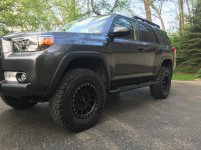
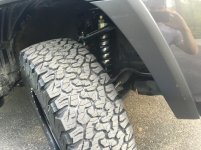
So with all that research done, on my 2013 Trail (Figure 3):
1)Icon Stage 2 Lift (3.5” front, 2” back)
2)BFG KO2’s 285/70r17
3)Method NV 17x8.5 (omm offset; backspace of 4.72”)
4)No body mount chop, Harper 7 well mods, mud flaps removed
******DO THEY RUB? HECK NO********:thumb3:
* For terminology defining upper control arms, fender liner, body mount, and mud flaps see my post further down the thread.
1)Fitment: This is the way that tire size and wheel size will interact with the non-moving parts of the car (fenders, upper control arm) to cause things like rubbing. A great reference is [MENTION=66316]1engineer[/MENTION]s posted tire fitment guide: http://www.toyota-4runner.org/5th-gen-t4rs/156378-going-bigger-5th-gen-tire-fitment-guide.html Another is [MENTION=106176]wfo9[/MENTION] 's http://www.toyota-4runner.org/5th-g...-tire-size-wheels-read-first.html#post2161256 Some of the most critical information from the first thread is posted in the first figure below. Basically, using a 2013 trail as an example, if you wanted to go the standard wheel size of 17” you can use up to a 275/70r17 with minimal/no issues rubbing. Most folks are doing heavy research to decide whether 285’s will rub. So if you aren’t diving into the yellow on that chart, stop here and go buy your 275 tires. If you are changing your wheels or going bigger read further….
2)Wheels: So you decided to change your wheels or go bigger than 275’s, good. [MENTION=8206]harper7[/MENTION] is apparently the master of cramming wheels under 4runners so he has published the custom wheel offset chart to keep you safe http://www.toyota-4runner.org/5th-gen-t4rs/154290-wheel-offsets-285s-stock-5th-gen-trail.html If you don't know what offset and backspacing are, Google "offset and backspacing" and look at a thousand pics until it makes sense, then look at this chart (figure 2 below). Make sure that your wheels provide enough backspacing to keep your tires from rubbing on the upper control arm if you are staying stock (i.e. stay between the red lines). If you are getting a lift then look at the recommended backspacing for that lift based on control arm size (example 2003-2009 Toyota 4Runner 0-3.5" Suspension System - Stage 2 (Tubular) | K53052T ). Typically you are safe if your wheel offset puts you at a backspace less than 5 inches. I have posted the chart from Harper7’s thread below to consolidate
**Wheel spacers can be used to push the mounting interface out (thus decreasing your backspacing and decreasing the propensity for tires to rub the UCA), but remember this pushes the whole wheel out from the vehicle, taking load off of the suspension and putting on the wheel itself. There are pros and cons to their use http://www.tacomahq.com/202/wheel-spacers-pros-cons/ Thoroughly research this before going down that road.
3)Wheel well mods: so if the dynamics of your wheel well are such that your 275’s are rubbing (bad luck) or you want to gun for the 285’s, you may need to modify your wheel well to accommodate the tires. Again, [MENTION=8206]harper7[/MENTION] has a thread on this. http://www.toyota-4runner.org/5th-gen-t4rs/150779-falls-lift-questions.html Another solid write up is by [MENTION=137794]JasonKoko[/MENTION] at the following link http://www.toyota-4runner.org/5th-gen-t4rs/223710-285%92s-2016-4runner-trail-fender-liner-mod.html I can tell you from personal experience that it takes about 15 minutes to move both front fenders forward, and another 10 minutes to remove the mud flaps. This exposes your body mount in the back of the front wheel well, but believe me, even with a 3.5” lift you will be cutting it close, so go ahead and make these mods, then if you add weight to the front end in the future you won’t be left with a nasty rub.
4)Lift: So at the bare minimum you will need to lift the front end of your car between 1.5 and 3.5 inches to accommodate 285’s (based on thread research). You can do this with a leveling kit, adjustable shocks, or a lift kit. I am not sure if a body lift would work, but honestly if you are going to lift your vehicle that much, I would save the money and get the suspension lift, you won’t be sorry. Wheel spacers, while moving the tire away from upper control arm (in essence decreasing your backspacing), won’t necessarily work because you will be moving the tire further out of the well, but not changing the relationship to the back of the well when it is fully locked (turned). You really need to lift the well over and away from the tire (at least for 285’s). There are some threads that talk about 285s fitting no problem, or 285’s fitting with fender mods, but later comments admit that with heavy breaking at lock (wheel turned all the way) or off road adventures that rubbing is an issue. When you have your lift installed, often the manufacturer will have a preset caster angle (google, read, pics, it will click). However, if you have the option, have the tech (or you) put the lift at full caster and this will avoid body mount rubbing in many cases. With all of these items considered you should be good, unless… you rub anyway, then:
5)What am I using the vehicle for? Even with through research and helpful posts, some vehicles rub anyway with 285’s, or the 285’s work well on the street but rub off road. This is bad luck for the former and maybe even expected for the latter (particularly if you are giving the shocks some heavy travel(like rock crawling). Don’t fret. If you have done most everything above and you still rub it will probably be at full lock or at serious travel with your shocks. Take ‘er easy for a few days and isolate a shop that does “body mount chop,” because likely that is where you are rubbing. The body mount is visible as the big round piece of metal that is at the back of your wheel well with the long bolt sticking out of the bottom. This was uncovered when you removed your front well mud flaps (in the back of the well). Though you will see many a thread talking about chopping this off with a dremmel in the garage in DIY fashion, if you are like me, it might make you a little nervous (that is actually the hard stop for most forum go’ers). If you ask around (even in rural Minnesota) you can find a shop that does a chop and also offers to cover the chop with sheet metal and weld it flat. This stabilizes the area where the chop was done. You can cover with Herculiner (truck bed liner) at home to prevent rust if you like.
6) Weight, the killer of “my tires don’t rub” posts: Sweet, your 285’s fit. Congrats. For most of us, lifting the vehicle and sporting more aggressive tires is the first stage of many because it provides the most bang for the buck. The thing to keep in mind is that you will likely add more weight to the car. Given infinite time and money, most of the individuals on this forum would turn their 4runner into a fully armored, Gobi-racked, rock railed, winch toting monster in preparation for the zombie apocalypse… and would be more than happy to load it down with 40 gallons of gas, an ARB frig full of beer, and a bladder full of water on the way to Moab (or in my case Canada) to wait things out. But even without a payload, all of these items add weight, compress the suspension and bring the dreaded body-mount closer to the tire. Big ticket items all ring in at 90-120 lbs (winch with cable, front armor, rear armor, Gobi rack). Even the slimmest of hidden winch mounts is 40lbs. If things are working great now with your 285’s keep ‘er light on the front end (use synthetic rope in your winch, maybe aluminum armor). Measure the fender at the center of the well (through the centerpoint of the wheel in a neutral position) before and after the mod. If you just added 350lbs of steel armor, cable winch, etc to the front end and you dip 0.5” then you might develop a rub. Here the body mount chop (above) or even a small body lift might play a role in getting you back to a rub-less ride.
*** If you like the info, "like" the thread. Please reply or PM with other suggestions for this thread, I would love to make it great, this is just where my research took me.
So with all that research done, on my 2013 Trail (Figure 3):
1)Icon Stage 2 Lift (3.5” front, 2” back)
2)BFG KO2’s 285/70r17
3)Method NV 17x8.5 (omm offset; backspace of 4.72”)
4)No body mount chop, Harper 7 well mods, mud flaps removed
******DO THEY RUB? HECK NO********:thumb3:
Attachments
Last edited: