6" lift is taking off in Hawaii

6" Bracket Lifts? Well hopefully they're running the right suspension set-up with those; otherwise they're only good for fitting bigger tires but no flex.

As an elite member and all your experience as an ASE certified Toyota Technician I am assuming you are aware the only way an IFS suspension will get any "flex" is from 6" of lift. To even use "flex" when speaking about an IFS suspension is not recommended. Most long travel suspensions come from straight-axle type front suspension; i.e. Jeeps and full size dodge/ford trucks or toyota's that have been converted. The true ideology followed in rock crawling is fitting the largest tires with the smallest lift accomplishing the most ground clearance with the lowest center of gravity. It would be enlightening to say the least what your thoughts of the "right suspension" would be on an IFS to achieve good flex.
 
Surprised you can make it across a'a with those tires, I figured you'd want something a little more forgiving over that stuff!

Had BFG's once, went down Kaena point, and the lava rock I went over (used to fish out there every weekend) put a really nice knot in the middle of the front passenger's tire!

Damned tire blew out on me on the freeway (in the left lane ewa bound by Tripler!), it literally split in half at the middle of the tread! Took my mirror off and put a dent in the door! Lava rock is not nice to tires!!!

Although I haven't had a blowout, I certainly would be bummin. On the Big Island, most spot we go to are lava like Kipahoehoe and Smoking Rock. Lava and rubber naturally don't jive... Hahaha... But its possible and there is definitely an expense. I just know between my BFG OG mud terrains, BFG all terrains and the Toyo Open Country Mud terrains wrapped around BMF 20's I had the longest life out of the Toyo's. Lucky we don't have freeways or else might have happened to us before...
 
Sorry I don't have anything better to do... But one last question before bed. What would be the disadvantages of having a 6" lift oppose to having a 3" lift? Even the 3" lifts some of you are paying around $5k for and think they are getting you places basic lifts aren't. I definitely have my thoughts on the matter but would like to hear some of yours if you feel warranted in doing so... Aloha
 
I think I need to come back to Kona and examine your lifts in person before making any judgments. I think the process may take several months. Where's your shop located? The blue buildings look like the industrial area up near Costco and Home Depot.
 
And I would love to see what you would consider is "serious off road use" in such a new vehicle that for the most part has more form than function.

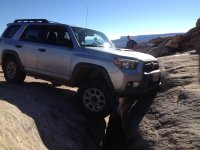
Not from [MENTION=78273]Jeremy556[/MENTION] (but he has PLENTY of similar Moab pics). Me crossing Golden Crack in Moab in my lightly modded 4Runner.
 

Attachments

  • IMG_4360.jpg
    IMG_4360.jpg
    127.2 KB · Views: 1,384
Last edited:
personally I would rather have the LCG of a 2.5" lift over a 6"+ lift. In an off camber situation it will make a big difference! There is a reason you don't see large lifts on Jeeps anymore. I ran 2.5" on 37s and it would run circles around those Jeepers with bro lifts.
 
[MENTION=79300]KonaHI808[/MENTION],

My main concern would be the wheels/tires. I would be interested to know who has more contact patch, that set up or a 285/70 air downed to 12psi on a 7-8" rim. I would guess the air down tire by a wide margin, dropping the air pressure also gives a much more compliant ride on rough terrain. Is it common to air down tire/wheel combos like that?

Honest question, not trying to poke the bear
 
IMO drop down brackets are sketch. I don't like the though of putting added stress on the chassis that a drop down lift does. I've seen a lot of chassis crack, bend, and twist from drop down brackets. To each their own I guess :popcorn:
 
Sorry I don't have anything better to do... But one last question before bed. What would be the disadvantages of having a 6" lift oppose to having a 3" lift? Even the 3" lifts some of you are paying around $5k for and think they are getting you places basic lifts aren't. I definitely have my thoughts on the matter but would like to hear some of yours if you feel warranted in doing so... Aloha

My opinion is that most 6" lifts give limited benefit in performance because you're not adding any suspension performance, possibly making it worse, and you're losing a lot of stability for off camber situations. Lower COG is better for almost everything. The rear lift, unless it's moving the mount points, is now causing major anti-squat under load due to improper geometry which isn't always a bad thing, but it probably doesn't handle very well most of the time. I'm guessing most bracket lifts never consider the rear geometry.

You're also now into a situation where the u-joints are difficult to setup correctly. You can rotate the pinion angle up toward the transfer case and then use double cardains at the t-case (that's my preferred option for my own junk), but then you have the issue of pinion bearing lubrication. Again it's solvable - but I highly doubt most installers are considering this or doing anything to solve it. In the alternative you can keep them in normal offset plane alignment, but at full articulation I suspect you may be at such an angle that they are significantly compromised for strength. This is where you tend to either brake the u-joint or snap the pinion shaft. I've done both. It sucks either way.

This is all of course from the prospective of where I tend to go. Every location is different. My setup for Montana is a lot different than what would be ideal for rocks in Utah. In Montana it's logging and mining roads with big obstacles and you often need higher body clearance and taller underbelly to get over logs and through deep water crossings. Off camber rock crawling wasn't such a big concern. For Utah I'd want ultra low COG above all else. Tipping over is the single greatest obstacle, not getting over something. My next iteration will be to probably drop at least 6" out of the suspension height. I can see where you'd want to be pretty high up in Hawaii to cross the high water areas. Most of the offroading I've done in Hawaii was in a rental Wrangler and it was beach, mud, and water. None of which are really going to stress the drivetrain like rock crawling does. For that terrain maybe the axles can handle 35's? Where 35's would be pretty much out of the question for hard trails in the rocks on an 8" clamshell, they might be right at home in slippery mud and sand.

So I guess my general thought is that a 6" bracket lift where I live is a show truck. You'd never seriously consider taking it offroad because you'd break it right away. Where you live it might be totally different. If I were spending a lot of time in deep water crossings, I'd probably be doing the same thing.
 
Most on this forum (me included) are about functional mods for serious off road use, not things that are for "looks," like stretched tires and 12" lifts that are 2wd.

Yeah we get it you're not a fan of them ! so when you see the threads pass on them , just say these aren't my type thing but some people enjoy it I'll save my negative comment. But nope every time we have a lifted truck thread you guys got to come in here and tell us how it's all no good. Until everybody just gets beaten up beaten down and the thread dies. Look back it happens every time . It's a one-way street with you guys .
 
Last edited:
Regarding tall Lifts 6" inch lift it up. I wheel with jeeps and full-size trucks I would consider 35" inch tire a minimum in most of the areas we go. Stream crossings , mud holes where a 37" or 38" inch tire is close to ideal. Even if you took the fenders off of your 4Runner and ran 35" you would never have the clearance.
We run a lot of trips out here on the West Coast . I encourage all Big Mouth bracket lift haters to grab your 32" inch tires and KDSS and try to follow us ! You better have a snorkel and a tow strap. So there it is , a challenge, let's get a trip going and see what really works in the real world .We can video it and take pictures to show everybody how it worked out .
 
I respect your lifestyle. And I would agree that the 12" lift is a bit excessive. But how do you actually obtain ground clearance? Usually through larger tires. And I would love to see what you would consider is "serious off road use" in such a new vehicle that for the most part has more form than function. I love my 4Runner but it really seems contradicting for you say you are a Serious off roader and then say you chose such an expensive, beautiful, comfortable platform to begin building upon. And then try and defend your viewpoint of function over form. Im not criticizing but trying to see the logic. In Hawaii we have every terrain possible. But for the most part we build for sand on our beautiful beaches and mud.......everywhere. Wide footprints are the fundamentals to these terrains. So a 12.5 wide tire on a 12 wide rim, although stretched to the manual's definition of fitment, are right up our alley in function. Some would say that because you have nice shiny wheels, you MUST not take them off road. We have, we do and we will continue to do so because we are about function and form. Don't get me wrong. There are many that don't. But I know the majority do. I know your just someone who shares the belief of many but I respect you for having beliefs.

The quotes are all messed up in this thread. Hope your post was not directed at me as I never expressed my lifestyle. I am neutral on all this. Just curious, if anything.

The quotes are are missing an end quote function (open bracket, /, quote, close bracket).
 
Regarding tall Lifts 6" inch lift it up. I wheel with jeeps and full-size trucks I would consider 35" inch tire a minimum in most of the areas we go. Stream crossings , mud holes where a 37" or 38" inch tire is close to ideal. Even if you took the fenders off of your 4Runner and ran 35" you would never have the clearance.
We run a lot of trips out here on the West Coast . I encourage all Big Mouth bracket lift haters to grab your 32" inch tires and KDSS and try to follow us ! You better have a snorkel and a tow strap. So there it is , a challenge, let's get a trip going and see what really works in the real world .We can video it and take pictures to show everybody how it worked out .

There is at least two other options: Custom a-arms to relocate the wheel forward by 1-2" at stock height. You'd get 35's and reasonably ride height.

Option 2 is SAS. Not a lot more $, but then you can actually use 35's on tougher trails around here and still drive home at the end of the day. Doesn't take many grenaded 8" diffs before a SAS looks pretty cost effective. And again you can keep the COG more manageable. Probably 37's on 3" lift would be doable.
 
Flex is inherent in an IFS system, it's not as large as a SAS; but I'm talking strictly from a Stock/Coilover Lift sense vs. Bracket Lift.

Most of the bracket lifts I see are on Tacomas, Tundras, Sequoias, and FJ Cruisers; in those vehicle the installation & quality vary greatly. Even more are obviously meant as cheap slap-ons to fit skinny MTs and chrome rims to get that "Bro-Dozer" look more than actual off-road function.

For example, I see about half come in with just the bracket itself and no support bars; either the kit does not come with them or they were not installed; this means that the extended sub-frame bracket will have a tendency to bend back and forth under load and could cause issues later down the line. There's a reason you have the frame ties with those units.

Additionally MANY of the bracket lifts I see are not set-up correctly for the tire/vehicle combination they are meant for. A lot of the ProComp units I see on the Tacomas and Tundras show signs of heavy cupping on their fancy new tires (usually less than 5k and the tires are so cupped there's no saving them), this is a sign of incorrect spring & shock combinations as well as improper shock valving on the vehicle; most of the kits I see run either wimpy looking ProComps or just use a spacer on the factory set-up to make it work.

Which brings me to the other point, depending on the size of the tire/wheel and the suspension set-up you're running; you'll take out your compression and extension on your suspension (which equates to flex for us). For example, last time I went wheeling with a certain forum member who wanted 40's on his 4th gen, he'd went all out on a bracket lift and still kept the same Bili 5100's he had on his way overloaded rig for the longest time; when on the trails you could hardly see the truck flex at all, it barely compressed or drooped when on obstacles because the combination of bump stops and incorrect suspension set-up limited travel that much to fit his 40's. The obvious fix being to first start with beefier, longer travel shocks and springs and measure/adjust the bump stops to provide good flex/articulation while fitting bigger tires (last I heard he started doing this and the vehicle articulates much better now.) Looking at the first picture I would venture to say that the 5th gen with Yellow Wheels is probably set-up in the same "general" way I see many of the bracket lifts done and has little actual travel when off-road. I would really only look at a bracket lift if you want to run a larger than 35" tire, while it takes a lot of work (fender trimming, BMC, flatting pinch welds, adjusting bump stops correctly, good suspension set-up with a 3~4" lift, and at least a 1.5" Body Lift) you can fit a 35" tire onto a 4th or 5th gen and have it flex well with minimal rubbing. Any larger in tire size and you physically need to drop the sub-frame or hike the body up a lot.

Which comes back to other points made by the above members, not all kits are made or installed equally as I pointed above; this means there's potential issues that are not addressed. Pinion Angle, trailing link angles, and alignment set-up tend to be other factors that tend to be overlooked, untouched when doing these types of bracket lifts from my experience.

Bottomline:

If the bracket lift is set-up for the vehicle, tire, and suspension needs then it can function very well off-road (after all most of those Artic trucks are basically running exaggerated bracket lifts for those sexy balloon tires). But most of them are just slapped on for the "Bro-Dozer" look and thus will have limitations to suspension travel and flex and will affect the vehicle in negative ways, excessive tire wear, incorrect alignment, improper suspension tuning, bracket flex, ect.

It's not really my style as I don't really see a strong need for the J120/J150 platform to exceed 35" tires for most off-roading; but I do understand the need to use such set-ups for larger tire diameters. I've seen some very well set-up bracket lifts and I've seen far more incorrectly or improperly tuned set-ups (both Domestic and Toyota), much like any other mod for our vehicles it comes down to if it is done properly for the vehicle's current mod state and goals.

 
Last edited:
There is at least two other options: Custom a-arms to relocate the wheel forward by 1-2" at stock height. You'd get 35's and reasonably ride height.

Option 2 is SAS. Not a lot more $, but then you can actually use 35's on tougher trails around here and still drive home at the end of the day. Doesn't take many grenaded 8" diffs before a SAS looks pretty cost effective. And again you can keep the COG more manageable. Probably 37's on 3" lift would be doable.

SAS is not an option in California because we need to keep our vehicle smog legal. There is no option to make the electronics work with a straight axle conversion on our Toyotas. When you disconnect electronics all the check lights come on therefore it will not pass smog .So again that is no other option. the only option is a lift kit and bigger tires Period.
 
Flex is inherent in an IFS system, it's not as large as a SAS; but I'm talking strictly from a Stock/Coilover Lift sense vs. Bracket Lift.

Most of the bracket lifts I see are on Tacomas, Tundras, Sequoias, and FJ Cruisers; in those vehicle the installation & quality vary greatly. Even more are obviously meant as cheap slap-ons to fit skinny MTs and chrome rims to get that "Bro-Dozer" look more than actual off-road function.

For example, I see about half come in with just the bracket itself and no support bars; either the kit does not come with them or they were not installed; this means that the extended sub-frame bracket will have a tendency to bend back and forth under load and could cause issues later down the line. There's a reason you have the frame ties with those units.

Additionally MANY of the bracket lifts I see are not set-up correctly for the tire/vehicle combination they are meant for. A lot of the ProComp units I see on the Tacomas and Tundras show signs of heavy cupping on their fancy new tires (usually less than 5k and the tires are so cupped there's no saving them), this is a sign of incorrect spring & shock combinations as well as improper shock valving on the vehicle; most of the kits I see run either wimpy looking ProComps or just use a spacer on the factory set-up to make it work.

Which brings me to the other point, depending on the size of the tire/wheel and the suspension set-up you're running; you'll take out your compression and extension on your suspension (which equates to flex for us). For example, last time I went wheeling with a certain forum member who wanted 40's on his 4th gen, he'd went all out on a bracket lift and still kept the same Bili 5100's he had on his way overloaded rig for the longest time; when on the trails you could hardly see the truck flex at all, it barely compressed or drooped when on obstacles because the combination of bump stops and incorrect suspension set-up limited travel that much to fit his 40's. The obvious fix being to first start with beefier, longer travel shocks and springs and measure/adjust the bump stops to provide good flex/articulation while fitting bigger tires (last I heard he started doing this and the vehicle articulates much better now.) Looking at the first picture I would venture to say that the 5th gen with Yellow Wheels is probably set-up in the same "general" way I see many of the bracket lifts done and has little actual travel when off-road. I would really only look at a bracket lift if you want to run a larger than 35" tire, while it takes a lot of work (fender trimming, BMC, flatting pinch welds, adjusting bump stops correctly, good suspension set-up with a 3~4" lift, and at least a 1.5" Body Lift) you can fit a 35" tire onto a 4th or 5th gen and have it flex well with minimal rubbing. Any larger in tire size and you physically need to drop the sub-frame or hike the body up a lot.

Which comes back to other points made by the above members, not all kits are made or installed equally as I pointed above; this means there's potential issues that are not addressed. Pinion Angle, trailing link angles, and alignment set-up tend to be other factors that tend to be overlooked, untouched when doing these types of bracket lifts from my experience.

Bottomline:

If the bracket lift is set-up for the vehicle, tire, and suspension needs then it can function very well off-road (after all most of those Artic trucks are basically running exaggerated bracket lifts for those sexy balloon tires). But most of them are just slapped on for the "Bro-Dozer" look and thus will have limitations to suspension travel and flex and will affect the vehicle in negative ways, excessive tire wear, incorrect alignment, improper suspension tuning, bracket flex, ect.

It's not really my style as I don't really see a strong need for the J120/J150 platform to exceed 35" tires for most off-roading; but I do understand the need to use such set-ups for larger tire diameters. I've seen some very well set-up bracket lifts and I've seen far more incorrectly or improperly tuned set-ups (both Domestic and Toyota), much like any other mod for our vehicles it comes down to if it is done properly for the vehicle's current mod state and goals.

I totally get it on paper, But in the real world grab your truck with a 32" tire and any suspension kit you want and try and follow me off road. Let's go
 
SAS is not an option in California because we need to keep our vehicle smog legal. There is no option to make the electronics work with a straight axle conversion on our Toyotas. When you disconnect electronics all the check lights come on therefore it will not pass smog .So again that is no other option. the only option is a lift kit and bigger tires Period.

There is a 4th gen SAS that had a workaround made by a shop up here where I live that keeps it all nice and tidy and able to run 37s. I looked at doing my runner but it doesn't make sense since I also run in an 80 and just couldn't justify the cost of doing it right. If I did/do, it will be with sourced portals and I'll gear down appropriately. There are lots of places I won't wheel my runner here in CA.
 

Members online

No members online now.

Forum statistics

Threads
278,316
Messages
3,554,120
Members
248,016
Latest member
Advally Service

Trending content

Back
Top