i copied/pasted the first post into ChatGPT and here's what it said:
--------------------------------------------------------------------------------------------------------------------------------
— the poster is very close on the lock-sensor theory, but there are a couple of important details I'd point out.
The behavior they describe is almost textbook Toyota compressor-lock protection:
Static pressure around 100 psi on both sides → that's plausible for a charged system at ambient temperature.
A/C commanded on → compressor clutch engages.
Low side immediately falls toward 40 psi → compressor is actually pumping refrigerant.
Within ~2 seconds, compressor shuts off and the low side rapidly equalizes back toward 100–120 psi.
A/C indicator starts blinking.
Toyota's system specifically watches the relationship between engine RPM and compressor RPM. If the compressor speed signal indicates that the compressor isn't turning at the expected speed, the A/C amplifier interprets that as a locked/slipping compressor and shuts the clutch off. Toyota documentation describes the fault detection as occurring after roughly 3 seconds of an abnormal speed relationship.
So the fact that the compressor does pump when initially engaged is actually a pretty important clue. It makes "the compressor is completely seized" much less likely.
But I would NOT condemn the lock sensor yet
The Toyota diagnostic tree generally has several possibilities:
Compressor lock sensor
Wiring/connectors between the sensor and A/C amplifier
Compressor clutch/compressor itself
Belt/slippage
A/C amplifier
Toyota's own diagnostic procedure has you test the lock-sensor resistance and wiring before condemning components.
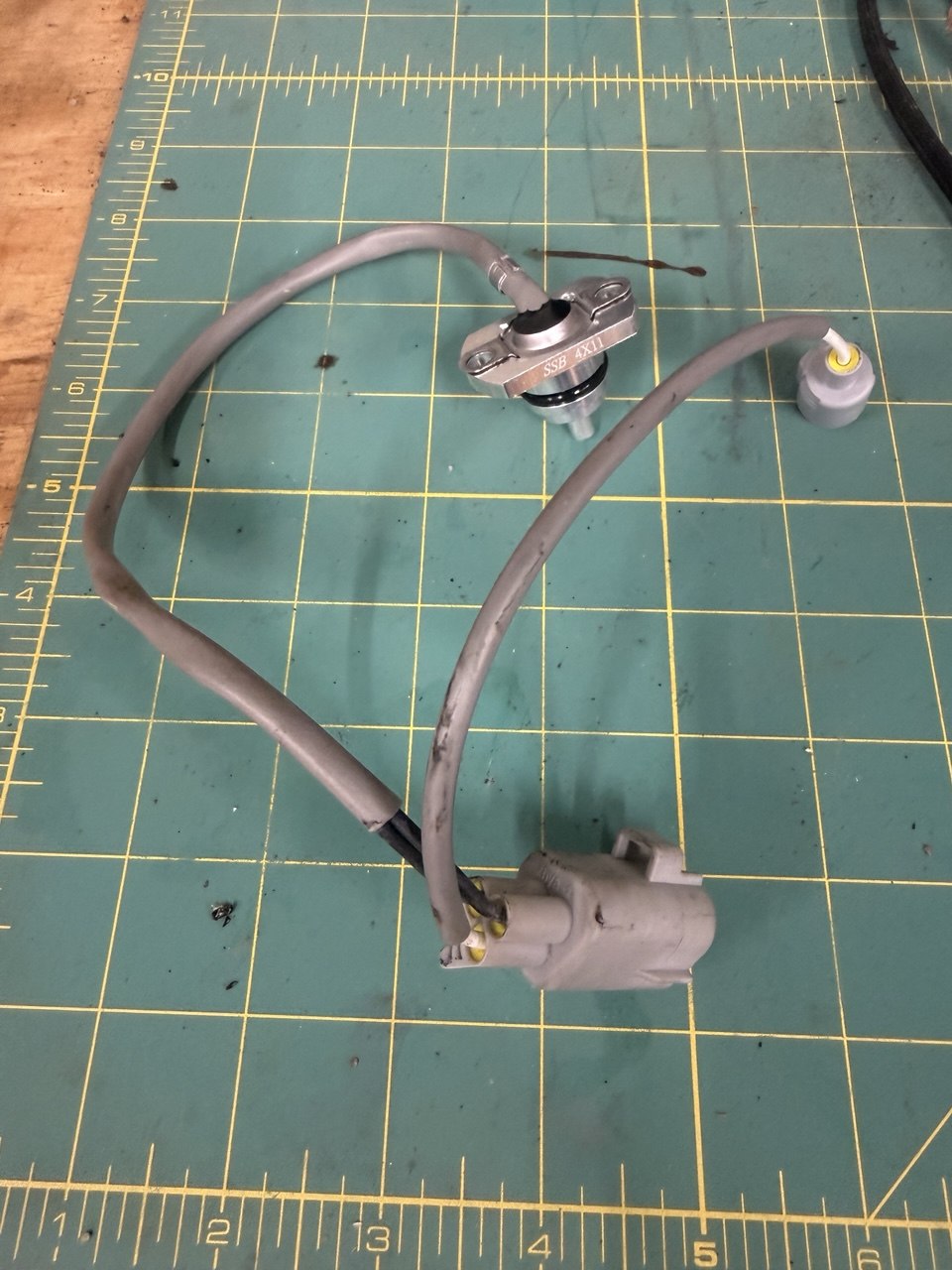
And there's another interesting possibility here: the clutch coil wire he pulled out.
That sounds like he may have damaged the magnetic clutch coil lead, not the lock-sensor wiring. If so, I'd be very concerned about that before doing anything else. The compressor assembly has separate circuits for the magnetic clutch and lock sensor; on Toyota systems, the lock sensor is the speed-feedback circuit while the clutch circuit actually supplies the coil.
There is also a much easier test
If this is the Toyota application I'm thinking of, you don't necessarily need to "jump the compressor" in some exotic way.
You can determine what's happening electrically by watching the clutch command:
A/C on → clutch gets 12 V → clutch engages → ~2–3 sec later 12 V disappears → A/C light flashes
If that's exactly what happens, the A/C control system is commanding the shutdown, rather than the clutch simply dropping out on its own.
Then I'd test the lock sensor directly.
Toyota gives resistance specifications for the sensor depending on the compressor/application. For example, one Toyota procedure specifies 65–125 Ω at 20°C, while another Toyota compressor uses 160–210 Ω. So the exact vehicle/compressor matters here.
And ideally, you want to look at the lock-sensor pulse waveform while the compressor is running. That's the definitive test because the amplifier isn't merely looking for "continuity"; it's looking for the expected compressor-speed pulses. Toyota service information actually specifies checking that waveform.
One thing I'd tell the poster
Don't keep jumping the high-pressure sensor.
If the system is genuinely around 100 psi static and the compressor immediately produces a 40-psi suction pressure, the refrigerant circuit is telling us something useful. Bypassing the pressure protection can turn a diagnostic exercise into a compressor/condenser problem if there really is a pressure issue.
And the fact that jumping the pressure sensor makes the compressor engage doesn't prove the pressure sensor is bad. It may simply be bypassing the control circuit that is preventing compressor operation.
Interestingly, Toyota/Denso have documented cases where a bad magnetic-clutch relay causes the exact symptom of an A/C light flashing, including on 2002–2004 4Runners. So if this happens to be one of those vehicles, I'd verify the relay part number/function before buying a compressor.
Bottom line: their "lock sensor" hypothesis is quite reasonable, but I'd diagnose it as lock-sensor circuit / clutch / relay / wiring rather than assuming the sensor itself is bad. And if they really pulled a braided clutch-coil lead out of the compressor, I'd repair/verify that first.
If you tell me what Toyota/model/year this forum post is about, I can dig up the exact compressor connector pinout, lock-sensor resistance spec, and a safe way to test the clutch without replacing the compressor.