A/C hot/cold - thermistor - read before replacing

rpm5099

Junior Member
This is my first post here, I hope it saves some of you some money. I happen to have a background in chemical engineering and familiarity with refrigeration systems, but none of that is necessary here to fix this issue.

This specifically addresses an issue with the evaporator cooler thermistor, which controls the A/C compressor cycle (referred to by SM as COOLER THERMISTOR NO. 1). There are a LOT of other sensors (solar, ambient, cabin, etc.) but they are not used when the temperature is set to "LO" and the system is not in automatic mode. The only inputs that should affect it (per FM) are these:

- A/C button on dash
- evaporator temperature sensor
- liquid line high pressure sensor
- to prevent refrigerant release through vent valve, mounted
- Mounted by the bumper and easily accessible with the hood open
- Can be tested by jumping
- Full throttle from ECM

Here is how you know if this is sensor is the problem:

- The compressor engages and air is cooler but cycles back and forth between "cool" and not very cold at all
- Compressor cycles at idle frequently even though air is not cold
- Refrigerant charge is correct (or you are confident it is close enough - contrary to what you will find there is an acceptable range)
- I'm going to double down on this - if you are knowledgeable and reasonably certain of the charge by looking at the sight glass and gauges that the charge is correct, then that's NOT your problem
- *MOST IMPORTANTLY* - listen for a sighing sound coming from under the glove box if you listen closely as the expansion valve repeatedly becomes starved of liquid input due to the compressor cycling off before cooling temperatures are reached (while you are sighing and sweating a well). This is a good sign that the A/C controller (I am NOT calling it an amplifier) is receiving incorrect temperature input from the evap coil temperature sensor. There are other reasons this one can be checked with a multimeter, continue reading

Here are the specifics for my vehicle:
2007 4th Gen 4Runner
255k
V8 4WD Limited 2UZ-FE

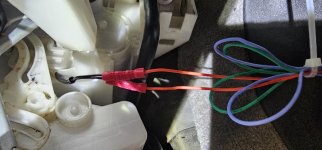
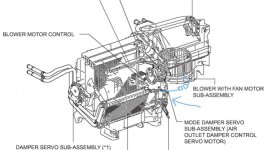
The evaporator temperature sensor is located inside the evaporator housing in the middle of the dash - you cannot access it without removing the entire dash. It has a long wire and then sticks directly into the fins of the evaporator - there's no doing surgery by removing the glove box, it's all or nothing. Here are the steps to diagnose

DIAGNOSIS
----------------
- Remove glove box and gain access to the wire harness
- Disconnect the wiring harness and
- jumper the side to the controller with a 2k ohm resistor
- connect multimeter to measure resistance in the suspected faulty evap temp sensor thermocouple
- thermometer in vent directly to right of steering wheel on drivers side
- Start the car and run the a/c with the blower on low
- Note the resistance as the temperature drops past ~37 F (if it doesn't - stop, this probably isn't your problem, otherwise this is the number you need below in the "resistance is too..." calculations)

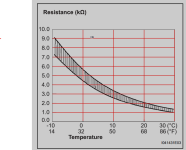
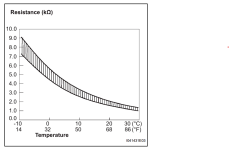
>>>>>>>>>> diagram of T/R for thermistor

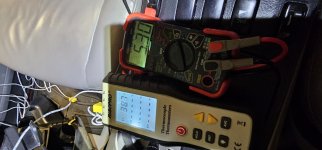
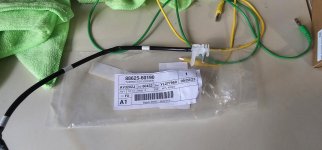
One thing to note here - this an NTC (negative temperature coefficient) thermistor, so the resistance goes DOWN as temperature goes UP (this is in contrast to most conductors like copper). At 37F the resistance I got was 5.25kΩ - but it should be closer to 4.25kΩ. I know this because I purchased a replacement thermistor (wrong part for a Lexus, the one I needed wasn't available) and checked it's resistance at that temperature. In addition, I used a potentiometer to check what resistance the controller cycles the A/C off - 3.9kΩ.

If you get infinite or zero resistance from the thermistor, unfortunately you have to take apart the dash and evaporator to replace it. However, if the reading is high or low, and the "sort of cool" temperature has been pretty consistent for a while indicating that the thermistor is functional - it
is precise but inaccurate) you can adjust it with some resistors, up or down.

If the resistance is too HIGH (>4.25 at 37F):
- Use resistors wired in PARALLEL to reduce the total resistance according to this:

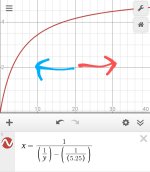
x = 1 / ((1/a) - (1/b))

If you do python:
def DecreaseResistance(desired, now):
new_resistors_add = (1 / ((1/desired) - (1/now)))
if new_resistors_add < 0:
raise ValueError("Numbers switched?")
return (1 / ((1/desired) - (1/now)))

If the resistance is too low (<4.25 at 37F):
- Use resistors wired in SERIES
x = b - a

where x is the necessary resistance to be added, a is the desired resistance (4.25 kΩ) and b is the resistance measured above (mine was 5.25 kΩ). In my case I wanted to reduce the resistance by 1 kΩ, so I added a 20 kΩ resistor in parallel which made the evap thermistor be 4.25 kΩ at 37F.


The wiring can be done however you want, I personally preferred to cut the side of the thermistor rather than the non-replaceable wiring going the other way. But the latter is easier to access.

I'll figure out how to post the pictures.
 
Last edited:
Register to hide this ad
Pics
 

Attachments

  • Screenshot 2023-10-02 014919.png
    Screenshot 2023-10-02 014919.png
    50.4 KB · Views: 3,731
  • bad thermistor at setpoint.jpg
    bad thermistor at setpoint.jpg
    136.2 KB · Views: 3,548
  • evap sensor wiring2.jpg
    evap sensor wiring2.jpg
    140.7 KB · Views: 3,681
  • evaporator housing diagram marked.jpg
    evaporator housing diagram marked.jpg
    43.5 KB · Views: 3,971
  • replacement thermistor.jpg
    replacement thermistor.jpg
    134.4 KB · Views: 3,571
Man! For a first post, this is pretty incredible. Thanks for posting the diagram as well for the resistance and temperatures. I'll have to give this a shot with the multimeter and see what comes up!
 
Great, let me know how it goes. Based on all the searching I have done it seems like a LOT of people have been having this problem, so I'm a little surprised that there hasn't been more responses. From what I can tell a lot of these vehicles were either (a) spec'ed and assembled with the wrong evap thermistor or (b) the A/C controller evap thermistor setpoint is wrong. Ironically the exterior temperature thermistor has always been dead on.


Man! For a first post, this is pretty incredible. Thanks for posting the diagram as well for the resistance and temperatures. I'll have to give this a shot with the multimeter and see what comes up!
 
Great, let me know how it goes. Based on all the searching I have done it seems like a LOT of people have been having this problem, so I'm a little surprised that there hasn't been more responses. From what I can tell a lot of these vehicles were either (a) spec'ed and assembled with the wrong evap thermistor or (b) the A/C controller evap thermistor setpoint is wrong. Ironically the exterior temperature thermistor has always been dead on.

It's possible, although I feel like it might be more on the possibility (B) side. I ended up actually replacing my thermistor with a new OEM one, since mine is the earlier thermistor that doesn't clip into the evap core fins, it just rides on the "carrier" that clips onto the side of the evap core housing. I even played around a bit on the positioning of the sensor on the carrier but it made little difference. Only time it ever gets freezing cold is when I jump those two wires.

Mine also makes the same noise with the expansion valve, the "sighing" when the sensor is plugged in.
 
You are dead on the problem. Whether the problem is A or B, the fix is the same. Put a 20kohm resistor on that thermistor clip. The measurements aren't that important, it's the same incorrect Toyota part inaccurate by the same resistance differential all of them are. If you are worried about cutting wires you can stick the resistor prongs in the wiring harness and tape it temporarily (make sure it has contact). The only reason to not leave the circuit jumpered is to avoid icing up, especially in cold weather with defrost on.

It doesn't really matter how much contact the thermocouple has with the evap coil surface, they are very sensitive. If it's in the evap housing and in front of the air discharge it's fine.

I am pretty much 100% certain this will fix your problem based on what you've said.

https://www.amazon.com/EDGELEC-Resistor-Tolerance-Resistance-Optional/dp/B07HDGCGB3

It's possible, although I feel like it might be more on the possibility (B) side. I ended up actually replacing my thermistor with a new OEM one, since mine is the earlier thermistor that doesn't clip into the evap core fins, it just rides on the "carrier" that clips onto the side of the evap core housing. I even played around a bit on the positioning of the sensor on the carrier but it made little difference. Only time it ever gets freezing cold is when I jump those two wires.

Mine also makes the same noise with the expansion valve, the "sighing" when the sensor is plugged in.
 
Last edited:
You are dead on the problem. Whether the problem is A or B, the fix is the same. Put a 20kohm resistor on that thermistor clip. The measurements aren't that important, it's the same incorrect Toyota part inaccurate by the same resistance differential all of them are. If you are worried about cutting wires you can stick the resistor prongs in the wiring harness and tape it temporarily (make sure it has contact). The only reason to not leave the circuit jumpered is to avoid icing up, especially in cold weather with defrost on.

It doesn't really matter how much contact the thermocouple has with the evap coil surface, they are very sensitive. If it's in the evap housing and in front of the air discharge it's fine.

I am pretty much 100% certain this will fix your problem based on what you've said.

Amazon.com


Hey man! Incredibly late reply, but I ended up testing your theory pretty significantly with my AC system in my '03. I started using a 20k ohm resistor on mine, and it was good for an extra 5 degrees pretty much all the time.

Turns out, my compressor starting going bad due to a bad clutch (it was the original compressor, 21 years old). So I just had that swapped out, and I took the resistor out beforehand. When I got it back, I was cycling between 49-56 degrees at idle (70 degrees outside temp). With the resistor back in place, I'm down to 44-50 degrees at idle. This is pretty much dead on with my fiancee's Ford Escape which has great AC (by our standards at least).

So in my case, it definitely made a difference. And so far, I haven't seen any temps low enough to cause a freezing situation inside the evaporator. That 20k ohm seemed spot on. We get a lot of humidity near the coast so I'll do some further testing as summer rolls in.
 
Based on your description that had to be the problem. I'm glad it worked out. Funny that you took out the resistor for the repair, you lacked faith!

I just used mine in the first hot weather and no question 20kohm is not enough. I'm going to install a variable resistor and adjust pedantically like a nut until I get the exact value for maximum cooling with no freezing. I've gone this far, might as well.

Onwon 20K Ohm Resistor 10 Turn Potentiometer 2W Wirewound Multi-Turn Adjustable Precision Potentiometer with 10 Turn Counting Dial Rotary Knob 6mm Shaft (20K Ohm) https://a.co/d/gh9Q00Q
 
Based on your description that had to be the problem. I'm glad it worked out. Funny that you took out the resistor for the repair, you lacked faith!

I just used mine in the first hot weather and no question 20kohm is not enough. I'm going to install a variable resistor and adjust pedantically like a nut until I get the exact value for maximum cooling with no freezing. I've gone this far, might as well.

Onwon 20K Ohm Resistor 10 Turn Potentiometer 2W Wirewound Multi-Turn Adjustable Precision Potentiometer with 10 Turn Counting Dial Rotary Knob 6mm Shaft (20K Ohm) https://a.co/d/gh9Q00Q

Yeah I totally agree with you now. Once it started getting into the 90's here, the AC is definitely still lacking.

At this point I've had my evaporator core, expansion valve, thermistor, and compressor replaced. Condenser has been cleaned twice now (washed by me) and is free of any leaks or external obstructions.

Still using the 20k ohm resistor. My vent temps yesterday after 15 minutes of driving to the gym were 60-65 degrees. Set to recirculate. Outside temp of 91, with 50ish humidity. What was odd though was after leaving to go back home, same 15 minutes of driving, vent temps got down to 52-55. Same outside temp, same humidity. Only an hour difference between measurements, and internal cabin temp before leaving was the same in both cases.

I can never get the icy cold 40 degree temps when it's 90 out, but some trips it works better than others. At this point I'm close to trying a used AC amplifier from another 4Runner to see if it would get it working better. I'm not sure what else to look at.
 
Avery you are found - I've done the testing I mentioned last time and though I am a little surprised I've settled on 14kΩ which I initially thought would be way too far. I went all the way down to 8kΩ and with high heat load it just worked the way A/C should by just running all the time, but set on low (i.e at night or in the winter for defrost) it iced up and didn't let any air through. I connected the variable resistor with wiring long enough to fit in my cupholder and had a thermocouple in the vent while driving for the past week. Either my estimates on the temperatures/resistances were way off or the "amplifier" has even more faulty logic than I thought.

My suggestion - don't spend any more money on vehicle A/C parts. Switch out your 20kΩ and put in the variable resistor I linked above. If I had to guess I'd venture that all Toyota's of those years that have this A/C problem probably need the same resistance correction, but I do not have the data to say for sure. Start dialling it down until you get to the point where (A) the compressor is running when it should be and (B) it does not freeze with low heat load (fan on low, night, etc.). 60-65F is a no go - if you turn that resistor down and it still doesn't get cold on the highway then there is something else going on.

If you have verified that your compressor clutch is engaging and you still have 65F cooling consistently then you may have moisture in your system icing up the TXV (I'm pretty sure it's not).

:beer:


Yeah I totally agree with you now. Once it
started getting into the 90's here, the AC is definitely still lacking.

At this point I've had my evaporator core, expansion valve, thermistor, and compressor replaced. Condenser has been cleaned twice now (washed by me) and is free of any leaks or external obstructions.

Still using the 20k ohm resistor. My vent temps yesterday after 15 minutes of driving to the gym were 60-65 degrees. Set to recirculate. Outside temp of 91, with 50ish humidity. What was odd though was after leaving to go back home, same 15 minutes of driving, vent temps got down to 52-55. Same outside temp, same humidity. Only an hour difference between measurements, and internal cabin temp before leaving was the same in both cases.

I can never get the icy cold 40 degree temps when it's 90 out, but some trips it works better than others. At this point I'm close to trying a used AC amplifier from another 4Runner to see if it would get it working better. I'm not sure what else to look at.
 

Attachments

  • thermistor_parallel_r_add_graph.jpg
    thermistor_parallel_r_add_graph.jpg
    100.3 KB · Views: 2,673
  • factory evap temp sensor chart.png
    factory evap temp sensor chart.png
    93 KB · Views: 2,712
Edit, had these switched.

y = total resistance (evap sensor + resistance added in parallel)
x = parallel resistance added

Actually, my estimate of the A/C "amplifier" being set to cycle the compressor at 3.9kΩ and estimate for the evap sensor resistance at 32F was 5.25kΩ was really pretty close:

1 / ((1/14kΩ) + (1/5.25kΩ)) = 3.8kΩ

I think 15kΩ should make a big difference. Below that the curve really starts to drop off fast so it's more touchy.


httpsXXX://www.amazon.com/gp/product/B07MC68WPW
 
Last edited:
Avery you are found - I've done the testing I mentioned last time and though I am a little surprised I've settled on 14kΩ which I initially thought would be way too far. I went all the way down to 8kΩ and with high heat load it just worked the way A/C should by just running all the time, but set on low (i.e at night or in the winter for defrost) it iced up and didn't let any air through. I connected the variable resistor with wiring long enough to fit in my cupholder and had a thermocouple in the vent while driving for the past week. Either my estimates on the temperatures/resistances were way off or the "amplifier" has even more faulty logic than I thought.

My suggestion - don't spend any more money on vehicle A/C parts. Switch out your 20kΩ and put in the variable resistor I linked above. If I had to guess I'd venture that all Toyota's of those years that have this A/C problem probably need the same resistance correction, but I do not have the data to say for sure. Start dialling it down until you get to the point where (A) the compressor is running when it should be and (B) it does not freeze with low heat load (fan on low, night, etc.). 60-65F is a no go - if you turn that resistor down and it still doesn't get cold on the highway then there is something else going on.

If you have verified that your compressor clutch is engaging and you still have 65F cooling consistently then you may have moisture in your system icing up the TXV (I'm pretty sure it's not).

:beer:


Thanks a ton for the follow-up post! Wow 14k ohms, that is surprising.

Yeah it's definitely not icing up the expansion valve or evap. It takes forever to cool down the cabin because the compressor continues to cycle for too short of a timeframe, and never lets the temp come down unless you're driving for long trips. It works okay when the outside temp is low 80's or less. But once it's in the mid 80's and up, it really never cools down the cabin for any trip under 45 minutes or so.

I've got a pack of resistors and I think I have a 15k ohm. Sounds like the 15k will be close to what you've got the potentiometer dialed in to. I'll give that a shot first, make sure it's working well without icing. And if I need to go lower I'll grab the potentiometer and dial it in more accurately.

Thanks a ton for all your research! It's crazy to have these continued AC issues after throwing so much money at it. I'm surprised more people don't have complaints. When it's 90 out, a vent temp of 65 is just a cool breeze compared to the ice box my 3rd gen 4Runner could produce.
 
That sounds like a good plan. If the compressor is cycling before it gets cold keep lowering that resistor until it stops cycling when it shouldn't. Don't waste any more money on it - I did the same thing, replaced the entire system because incorrect evap temp sensor calibration is virtually unheard of. Evaporator, condensor, expansion valve, compressor, even some of the lines. There is no way ANY shop would fix this problem, including a dealer, unless you happened to have a mechanic who owned one and figured this out, but if they have there isn't anything online that I can find.
 
Did you make the changes yet? Mine has been working much better. In the summer when the heat load is higher I think you can get away with 14kΩ, but with low heat load I am pretty sure there will be freezing in the winter. Lower than 14kΩ doesn't seem to do anything but make it ice up on low heat loads.
The problem, I believe, is the integrated TXV without a sensing bulb. The temperature sensor is placed just after the TXV where the condenser is coldest, so even if the outlet is at 90F it's still going to meter the refrigerant. I guess it's a cheaper and simpler solution, but it makes me want to keep that variable resistor accessible and turn it down during the hotter months - I don't care if there's a little freezing on the first 25% of the evaporator coil.

Driving home on the highway on Sunday It was 90F with dew point of 83F (awful), and it managed to get the temperature down to about 58F on fan 3 setting (which was more comfortable than the fan on high because of the reduced humidity). Most of the cooling capacity in those conditions is lost to latent heat of condensation, the humidity kills A/C performance. The compressor ran continuously, like I wanted. With less humidity it's well below 40F unless the fan is on high and ices up on lower fan settings until I adjust it back up to 15kΩ or a bit more. I'm not complaining.
 
How about a switch for two different resistors. Label the switch 80+ and 80- for outside temps. Or 85+ or similar, which ever seems to be the point of the biggest error (cycle time).
 
The variable resistor is only like $12. It has less failure points and is adjustable for any resistance. Although I guess a switch would be easier to change when needed once you have the resistances dialed in.
 
Did you make the changes yet? Mine has been working much better. In the summer when the heat load is higher I think you can get away with 14kΩ, but with low heat load I am pretty sure there will be freezing in the winter. Lower than 14kΩ doesn't seem to do anything but make it ice up on low heat loads.
The problem, I believe, is the integrated TXV without a sensing bulb. The temperature sensor is placed just after the TXV where the condenser is coldest, so even if the outlet is at 90F it's still going to meter the refrigerant. I guess it's a cheaper and simpler solution, but it makes me want to keep that variable resistor accessible and turn it down during the hotter months - I don't care if there's a little freezing on the first 25% of the evaporator coil.

Driving home on the highway on Sunday It was 90F with dew point of 83F (awful), and it managed to get the temperature down to about 58F on fan 3 setting (which was more comfortable than the fan on high because of the reduced humidity). Most of the cooling capacity in those conditions is lost to latent heat of condensation, the humidity kills A/C performance. The compressor ran continuously, like I wanted. With less humidity it's well below 40F unless the fan is on high and ices up on lower fan settings until I adjust it back up to 15kΩ or a bit more. I'm not complaining.


I had my AC condenser replaced because I went to get the refrigerant checked one last time, and they couldn't get it to stop hitting the high pressure cutoff and shutting down the compressor early. Said there was a restriction in the condenser. Surprisingly this made an absolute world of a difference. Afterwards, with the 15k ohm resistor the ac completely froze up on me 3 times on our 2 hour drive to the mountains. Outside air temp was 91 with 50% humidity. I had to keep manually turning off the AC to keep it from freezing, the vent temp was getting down in the high 30's. I couldn't believe it. This was with the AC fan speed on 1-2.

I've since moved to using an 18k ohm resistor and haven't had any freeze ups so far, and I'm getting mid 40's vent temps on low 90 degree days after about 10-15 minutes of the truck running. Still using the GX470 condenser fan for air movement at idle.

So at this point, my entire AC system has been replaced. Honestly the only thing that made a difference on mine was the condenser itself. And I had every little bent fin straightened out with the old one, and had washed it multiple times. Guess it really was just junk in the system causing an internal restriction. I'm guessing it was due to previous moisture in the system from the leaky evap core when I bought the truck.
 
I had my AC condenser replaced because I went to get the refrigerant checked one last time, and they couldn't get it to stop hitting the high pressure cutoff and shutting down the compressor early. Said there was a restriction in the condenser. Surprisingly this made an absolute world of a difference. Afterwards, with the 15k ohm resistor the ac completely froze up on me 3 times on our 2 hour drive to the mountains. Outside air temp was 91 with 50% humidity. I had to keep manually turning off the AC to keep it from freezing, the vent temp was getting down in the high 30's. I couldn't believe it. This was with the AC fan speed on 1-2.

I've since moved to using an 18k ohm resistor and haven't had any freeze ups so far, and I'm getting mid 40's vent temps on low 90 degree days after about 10-15 minutes of the truck running. Still using the GX470 condenser fan for air movement at idle.

So at this point, my entire AC system has been replaced. Honestly the only thing that made a difference on mine was the condenser itself. And I had every little bent fin straightened out with the old one, and had washed it multiple times. Guess it really was just junk in the system causing an internal restriction. I'm guessing it was due to previous moisture in the system from the leaky evap core when I bought the truck.


Wow, ok. I had already had my evaporator and condenser replaced, so it sounds like you did have a different problem. I'm surprised modifying the evaporator temperature reading made a difference at all with a blocked condenser, that's why I thought you were on the right track. I probably should have mentioned that you want to rule out restrictions in the system before going this route, but I guess at the end of the day you now have a way of making your A/C ice cold in the summer when you aren't worried about it icing up. Could be that I just have a drifting evap temperature sensor, but it never got very cold even with the previous evaporator and I would hope the new unit came with a new sensor (the one thing I did not do myself, was just too busy at the time).

I mentioned it in my original post but I probably should have called it out more directly - if you jumper that evap temp sensor with a 2kΩ resistor and the A/C goes from being coolish 55F to blasting ice cold air then your A/C is mechanically sound and the evap sensor is a potential culprit.

Glad you got it worked out!
 
Last edited:
Wow, ok. I had already had my evaporator and condenser replaced, so it sounds like you did have a different problem. I'm surprised modifying the evaporator temperature reading made a difference at all with a blocked condenser, that's why I thought you were on the right track. I probably should have mentioned that you want to rule out restrictions in the system before going this route, but I guess at the end of the day you now have a way of making your A/C ice cold in the summer when you aren't worried about it icing up. Could be that I just have a drifting evap temperature sensor, but it never got very cold even with the previous evaporator and I would hope the new unit came with a new sensor (the one thing I did not do myself, was just too busy at the time).

I mentioned it in my original post but I probably should have called it out more directly - if you jumper that evap temp sensor with a 2kΩ resistor and the A/C goes from being coolish 55F to blasting ice cold air then your A/C is mechanically sound and the evap sensor is a potential culprit.

Glad you got it worked out!


Thanks for all your help! To be honest, I really didn't think there was anything wrong with it based on what the shops kept telling me. The only way I found out about the condenser issues was taking it to a THIRD shop who immediately said you've got a restriction. So I had them replace the condenser (being the last part in the system yet to be replaced) and I couldn't believe how much cooler it was.

I am not sure about your evap temp sensor. I know on mine, when the shop replaced my evap core, they did not swap out the old sensor. I did that on my own since mine is an earlier model where it rides on a carrier instead of
attaching to the evap core fins.

I will say, even with a fully replaced system, the resistor still makes a difference. So far I haven't seen any issues with the 18k resistor as far as icing up, and it allows the compressor to run a little longer and drop down into the mid-low 40's. Without it, the compressor will shut off for long enough that the air temp will creep up to around 55-57 before coming back down with the compressor cycling.

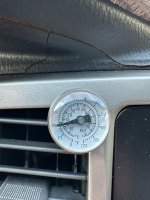
Here's yesterday's vent temps with outside air of 88, humidity around 78% (very rainy here at the moment).
 

Attachments

  • ACpic.jpg
    ACpic.jpg
    79.3 KB · Views: 337
Based on your description that had to be the problem. I'm glad it worked out. Funny that you took out the resistor for the repair, you lacked faith!

I just used mine in the first hot weather and no question 20kohm is not enough. I'm going to install a variable resistor and adjust pedantically like a nut until I get the exact value for maximum cooling with no freezing. I've gone this far, might as well.

Onwon 20K Ohm Resistor 10 Turn Potentiometer 2W Wirewound Multi-Turn Adjustable Precision Potentiometer with 10 Turn Counting Dial Rotary Knob 6mm Shaft (20K Ohm) https://a.co/d/gh9Q00Q

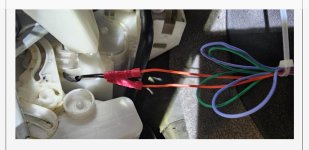
I’m hoping you could provide some info on where exactly to install this resistor. Is it as simple as cutting one of the two wires and putting this in line?
 

Attachments

  • IMG_7366.jpg
    IMG_7366.jpg
    131.6 KB · Views: 132

Members online

Forum statistics

Threads
278,307
Messages
3,554,050
Members
248,016
Latest member
Advally Service

Trending content

Back
Top