
You are using an out of date browser. It may not display this or other websites correctly.
You should upgrade or use an alternative browser.
You should upgrade or use an alternative browser.
A/C issues
- Thread starter apb2148
- Start date
Register to hide this ad

4Reak Show
New member
Overcharging is highly unlikely, especially if you had the symptom of poor A/C PRIOR to charging it. If I had to take an absolute guess I'd say expansion valve, but that's a TOTAL GUESS.
The only way to be sure on that particular avenue is to hook up gauges while it's running and see what they say...expansion valve issues normally show a vacuum on the low side.
Other options are cooling fan, both mechanical and electric, compressor internals (RARE) or even a blend door that's not moving. Should be able to hear the door move around when changing temps. Seen it often where linkage pops out and the whole problem is that you're not fully shutting off from the heater core.
Good luck
The only way to be sure on that particular avenue is to hook up gauges while it's running and see what they say...expansion valve issues normally show a vacuum on the low side.
Other options are cooling fan, both mechanical and electric, compressor internals (RARE) or even a blend door that's not moving. Should be able to hear the door move around when changing temps. Seen it often where linkage pops out and the whole problem is that you're not fully shutting off from the heater core.
Good luck

mtbtim
Elite Member
I have heard you can overcharge your system and potentially screw up you compressor. I've used the home charging kits with success several times but I sometimes think it's not worth the risk of killing your very expensive compressor if you screw up. A shop with the proper gauges and equipment will probably do it for around $90. I'm of the opinion that the cheap gauge they give you with the refrigerant could be anywhere from accurate to way the f#*k off.
I looked into what it would cost for a quality gauge and vacuum kit to service AC systems and decided it was way more than I'd want to spend.
If a person is confident with what they're doing with recharging the AC, go for it. If you're unsure, I'd just pay a shop to do it because it's not like you need to do this every season, unless you have a leak. I'm usually not one to advise someone to use a shop for a service/repair, but this is one of those situations that if you don't have the right tools, it might be better to let someone else do it for you.
I looked into what it would cost for a quality gauge and vacuum kit to service AC systems and decided it was way more than I'd want to spend.
If a person is confident with what they're doing with recharging the AC, go for it. If you're unsure, I'd just pay a shop to do it because it's not like you need to do this every season, unless you have a leak. I'm usually not one to advise someone to use a shop for a service/repair, but this is one of those situations that if you don't have the right tools, it might be better to let someone else do it for you.

thegipper
New member
I believe that if you over charge your system, there is a valve in there that protects the compressor so it doesn't get messed up. Over charging is definitely a bad thing though! I over charged mine and the compressor would not engage (so no cold air). Once I realized what I did, I kept letting pressure out through the low side port until it dropped to where it was supposed to be. Once I did that, the AC worked perfectly again and I haven't had any issues since.
Don't quote me but I think the low side is supposed to be like 35psi approximately. When I over charged mine, it was up to like 45psi on the low side.
Next time I do it, I'm just going to take it to the shop where I have access to an actual AC charging machine......for free none the less.
:redbrick::redbrick::redbrick::redbrick:
Don't quote me but I think the low side is supposed to be like 35psi approximately. When I over charged mine, it was up to like 45psi on the low side.
Next time I do it, I'm just going to take it to the shop where I have access to an actual AC charging machine......for free none the less.
:redbrick::redbrick::redbrick::redbrick:
Last edited:

runnyrunnerton
New member
overcharging is real. I did it to mine. Singtoe has a bunch of no nonsense responses to AC. Look him up and look at his answers, that's how i fixed mine. If you charged with the autozone guage for a charge, if the compressor keeps clicking on and bumping the needle into the red, then clicking off. You my son are overcharged, per my experience. cut some pressure in the system and try again.
thegipper
New member
overcharging is real. I did it to mine. Singtoe has a bunch of no nonsense responses to AC. Look him up and look at his answers, that's how i fixed mine. If you charged with the autozone guage for a charge, if the compressor keeps clicking on and bumping the needle into the red, then clicking off. You my son are overcharged, per my experience. cut some pressure in the system and try again.
That's exactly what mine did when I over charged it.....
soupkitchen
New member
+1 it will not cool properly if overcharged. Just evacuate the system and recharge with gauges so you don't overdo it.
mtbtim
Elite Member
I looked in my 2000 FSM and it says the following in the Air Conditioning section:
"BE CAREFUL NOT TO OVERCHARGE SYSTEM WITH REFRIGERANT
If the refrigerant is overcharged, it causes problems such as insufficient cooling, poor fuel economy, engine overheating, etc."
No mention of killing the compressors, so that's good, I reckon.
There's lots of info in the pages in the FSM for servicing the AC but here's a couple that would be helpful for someone with a DIY kit from an auto parts store.
[MENTION=138943]thegipper[/MENTION] was correct that the low pressure side shouldn't be filled to more than 35psi. In the FSM, they say a normal gauge reading on the low pressure side is 0.15 - 0.25 MPa. MPa stands for "Megapascal". I looked up a conversion for Megapascal to PSI and the MPa values equate to 22 - 36 psi.
You can view the site glass on the liquid tube on the passenger side near the condenser. It sits on top of the receiver. No need to take anything off to see it. Just look down between the grill and AC condenser on the passenger side and you'll see it. One of the pics I provided gives you info on how to use the site glass to diagnose your system.
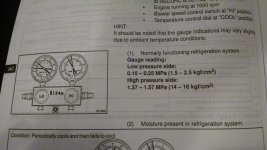
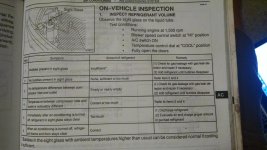
"BE CAREFUL NOT TO OVERCHARGE SYSTEM WITH REFRIGERANT
If the refrigerant is overcharged, it causes problems such as insufficient cooling, poor fuel economy, engine overheating, etc."
No mention of killing the compressors, so that's good, I reckon.
There's lots of info in the pages in the FSM for servicing the AC but here's a couple that would be helpful for someone with a DIY kit from an auto parts store.
[MENTION=138943]thegipper[/MENTION] was correct that the low pressure side shouldn't be filled to more than 35psi. In the FSM, they say a normal gauge reading on the low pressure side is 0.15 - 0.25 MPa. MPa stands for "Megapascal". I looked up a conversion for Megapascal to PSI and the MPa values equate to 22 - 36 psi.
You can view the site glass on the liquid tube on the passenger side near the condenser. It sits on top of the receiver. No need to take anything off to see it. Just look down between the grill and AC condenser on the passenger side and you'll see it. One of the pics I provided gives you info on how to use the site glass to diagnose your system.
Attachments



geohil
New member
+1 it will not cool properly if overcharged. Just evacuate the system and recharge with gauges so you don't overdo it.
What is the correct/easiest way to depressurize the system? Pretty sure I'm in this boat right now....dang it.
mtbtim
Elite Member
What is the correct/easiest way to depressurize the system? Pretty sure I'm in this boat right now....dang it.
I looked up a few YouTube videos and it sounds like the best way without special AC service tools like a vacuum pump is to reattach the the gauge to the Low Pressure port and without the refrigerant canister attached. With the engine on, AC on full blast, point the refrigerant bottle connection in a safe direction, and squeeze the trigger. The refrigerant could cause freeze burns so I would use some type of work glove to protect your hand. You could get some lubricant coming out so maybe pointing it into a 5 gallon bucket would work. Using the gauge, reduce the pressure to 35 psi and then check to see if you AC is blowing cold. If not, maybe evacuate a little more.
You could then look at the site glass and use the info I provided above to see if the system is charged correctly.
I'm not a AC Tech, but this does make a lot of sense to reduce the pressure if you overcharged. Maybe somebody else with more experience could chime in.

stir_fry_boy
New member
What is the correct/easiest way to depressurize the system? Pretty sure I'm in this boat right now....dang it.
Get some manifold gauges from Harbor Freight for like $50, and hook them up. Then you can slowly release the pressure by turning the knobs on the gauges. That's what I do (yes, i'm aware that there are environmental concerns).
THE BEST WAY IS TO OBTAIN MANIFOLD GAUGES. Knowing the pressure on the low side alone will NOT tell you the status of the system.
For years I would drive to a shop like Jiffy Lube and they would depressurize for free. They started charging $20 for it, so I stopped going.
A vacuum pump is $100 which buying the tools pays for itself just doing your own A/C once. Watch some videos online about how to do it, overcharging will cause A/C to not work, as much as undercharging. If overcharged/undercharged, the compressor will NOT receive cooling damaging it. Then you have to change everything including the condenser, drier, expansion valve, and flush the lines.
I usually am no greater than 215 psi, usually 200 psi exactly on the high side. Low side can be whatever the compressor does, which is usually about 15-35 psi. It takes about 45 minutes to get the Freon into the system and stabilized to a consistent pressure. There is a sticker on the underside of the hood that tells you the amount of Freon in oz to put in. Cans are usually 12 oz.
I've done a lot of A/C work, please feel free to ask any questions.
Last edited:
mtbtim
Elite Member
Get some manifold gauges from Harbor Freight for like $50, and hook them up. Then you can slowly release the pressure by turning the knobs on the gauges. That's what I do (yes, i'm aware that there are environmental concerns).
THE BEST WAY IS TO OBTAIN MANIFOLD GAUGES. Knowing the pressure on the low side alone will NOT tell you the status of the system.
For years I would drive to a shop like Jiffy Lube and they would depressurize for free. They started charging $20 for it, so I stopped going.
A vacuum pump is $100 which buying the tools pays for itself just doing your own A/C once. Watch some videos online about how to do it, overcharging will cause A/C to not work, as much as undercharging. If overcharged/undercharged, the compressor will NOT receive cooling damaging it. Then you have to change everything including the condenser, drier, expansion valve, and flush the lines.
I usually am no greater than 215 psi, usually 200 psi exactly on the high side. Low side can be whatever the compressor does, which is usually about 15-35 psi. It takes about 45 minutes to get the Freon into the system and stabilized to a consistent pressure. There is a sticker on the underside of the hood that tells you the amount of Freon in oz to put in. Cans are usually 12 oz.
I've done a lot of A/C work, please feel free to ask any questions.
Any idea how accurate Harbor Freight manifold gauges are? I'm more than a little leery to trust gauges from Harbor Freight, but then again, I've sort of trusted the cheap gauge that comes with the refrigerant.
Did you also get the vacuum pump at Harbor Freight as well?
Could you supply links to the ones you'd recommend buying?
I looked for manifold gauges of a higher quality before and they are quite expensive. If you can highly recommend Harbor Freight gauges, I'll probably buy a set for myself along with a vacuum pump.
Thanks!
stir_fry_boy
New member
Any idea how accurate Harbor Freight manifold gauges are? I'm more than a little leery to trust gauges from Harbor Freight, but then again, I've sort of trusted the cheap gauge that comes with the refrigerant.
Did you also get the vacuum pump at Harbor Freight as well?
Could you supply links to the ones you'd recommend buying?
I looked for manifold gauges of a higher quality before and they are quite expensive. If you can highly recommend Harbor Freight gauges, I'll probably buy a set for myself along with a vacuum pump.
Thanks!
They seem really accurate, when I started doing A/C recharging, my work was checked by a Toyota tech who used expensive gauges. The gauges were really close (some refrigerant is lost with transferring and connecting gauges). I got a set of the Pittsburgh gauges and vacuum pump. Wish I would have ordered from Amazon, read the reviews, and gone from there. The gauges don't need to be accurate to .1 of psi. Just a round about number. The hotter the day you recharge your system, the better the charge.
The first set I had they were horrible but still worked. The open/close valve knobs fell off the first use. 1st set. I then upgraded to this one: 2nd set (I believe). Picture appears to be the same, but the gauges were much higher quality including metal knobs on the valves.
Any one of those would be good. If I had to get some off amazon I would get these: Performance Tool Manifold Gauge Set
I got this Vacuum pump . If I was to get one off Amazon, I would get this one. Which is a 5 CFM pump, I use a 3 CFM and it works fine. The 5 CFM does a better job of vacuuming the lines than a 3. The $20 extra could be worth it, I've never used a 5.
mtbtim
Elite Member
Guys
Thanks for all the info, I was over charged for sure. Was able to fix that and seems to be cooling better now.
How did you evacuate the excess? Did that method I suggested work?
How did you evacuate the excess? Did that method I suggested work?
That is how I did it. Just have to be careful. Thanks again!
Sent from my iPhone using Tapatalk

TheDurk
Elite Member
They seem really accurate, when I started doing A/C recharging, my work was checked by a Toyota tech who used expensive gauges. The gauges were really close (some refrigerant is lost with transferring and connecting gauges). I got a set of the Pittsburgh gauges and vacuum pump. Wish I would have ordered from Amazon, read the reviews, and gone from there. The gauges don't need to be accurate to .1 of psi. Just a round about number. The hotter the day you recharge your system, the better the charge.
The first set I had they were horrible but still worked. The open/close valve knobs fell off the first use. 1st set. I then upgraded to this one: 2nd set (I believe). Picture appears to be the same, but the gauges were much higher quality including metal knobs on the valves.
Any one of those would be good. If I had to get some off amazon I would get these: Performance Tool Manifold Gauge Set
I got this Vacuum pump . If I was to get one off Amazon, I would get this one. Which is a 5 CFM pump, I use a 3 CFM and it works fine. The 5 CFM does a better job of vacuuming the lines than a 3. The $20 extra could be worth it, I've never used a 5.
I also got that second set of gauges and have no complaints. The day I was there they had a really good sale on the 2 stage 3 CFM pump so I got that:
3 CFM Two Stage Vacuum Pump
At the the time it was less than $20 more than the single stage so I went with it. I've used them on three different cars so far (one of them twice--I screwed up an O-ring install) and all three cars are blowing cold this summer.
I was hesitant to get into DIY A/C work but paying for it on all the old cars I maintain was adding up. I had to do a fair amount of study to learn enough to not be dangerous, but I'm glad I invested the time and effort. The tools (I also got an electronic leak detector) have paid for themselves a few times already. Other than the O-ring misstep, no disasters so far.
Last edited:
mtbtim
Elite Member
I also got that second set of gauges and have no complaints. The day I was there they had a really good sale on the 2 stage 3 CFM pump so I got that:
3 CFM Two Stage Vacuum Pump
At the the time it was less than $20 more than the single stage so I went with it. I've used them on three different cars so far (one of them twice--I screwed up an O-ring install) and all three cars are blowing cold this summer.
I was hesitant to get into DIY A/C work but paying for it on all the old cars I maintain was adding up. I had to do a fair amount of study to learn enough to not be dangerous, but I'm glad I invested the time and effort. The tools (I also got an electronic leak detector) have paid for themselves a few times already. Other than the O-ring misstep, no disasters so far.
Any chance you and [MENTION=48234]stir_fry_boy[/MENTION] could recommend YouTube videos or point me to good write-ups on how to use the manifold gauges and vacuum to service the AC system? I think I'm going to buy that Harbor Freight gauge set both of you have and then grab that vacuum pump that [MENTION=48234]stir_fry_boy[/MENTION] recommended on Amazon. I'm thinking maybe it would be good to get both from Harbor Freight since it will be much easier to return if something isn't working right or they break.
I'm also taking care of 3 vehicles and it would be nice to service the AC systems on them with more confidence than trusting those hokey gauges that come with the refrigerant.
stir_fry_boy
New member
Any chance you and [MENTION=48234]stir_fry_boy[/MENTION] could recommend YouTube videos or point me to good write-ups on how to use the manifold gauges and vacuum to service the AC system? I think I'm going to buy that Harbor Freight gauge set both of you have and then grab that vacuum pump that [MENTION=48234]stir_fry_boy[/MENTION] recommended on Amazon. I'm thinking maybe it would be good to get both from Harbor Freight since it will be much easier to return if something isn't working right or they break.
I'm also taking care of 3 vehicles and it would be nice to service the AC systems on them with more confidence than trusting those hokey gauges that come with the refrigerant.
I follow Eric The Car Guy on YT. He is a Honda mechanic and explains things well. Here is a good one: ETCG AC
Before I started doing it in my own, I read and researched a ton like [MENTION=10169]TheDurk[/MENTION]. Keep in mind that the AC system is hydrolyic NOT mechanical. I just replaced the entire AC system under the hood on my brothers TSX, he had even more stuff in the way than stock because he is turbocharged, namely the intercooler. It saved him ~$800 and took about 2 hours total. It was easy. Our trucks are a little more difficult due to the location of the compressor right above the frame, but it's not bad.
Last edited:
mtbtim
Elite Member
I follow Eric The Car Guy on YT. He is a Honda mechanic and explains things well. Here is a good one: http://youtu.be/lglPJuBXVeE
Thanks. I just watched that video from Eric the Car Guy on recharging AC before I saw you responded to my post.
The big question I have is I wonder if DIY mechanics are actually taking their vehicle to a place that can reclaim the refrigerant and follow the EPA rules, or are they just vacuuming it out into the atmosphere. [MENTION=48234]stir_fry_boy[/MENTION], I'm not expecting you to answer this question in a public setting.
Unless you actually had a leak or a failure of some part of the system and the refrigerant is already evacuated, you're technically suppose to reclaim the refrigerant, and then draw a vacuum to remove moisture from the system before you recharge it.
Since one of the main points of DIY Mechanics is to save yourself some money, I'm having a hard time believing people are actually going to pay a shop to properly reclaim the refrigerant.
Anyways, I guess I'm thinking out loud with this post but I'd be interested to hear from people who have brought their rig to a shop to evacuate the refrigerant to find out what they were charged for this service.
Last edited:
Similar threads
- Replies
- 4
- Views
- 1K

- Replies
- 10
- Views
- 3K


