A possible solution to leaking axle seals

I am currently in the middle of my own rear axle seal saga. I had a Toyota Dealership do the work for me when I discovered my right rear drum brakes were coated in gear oil. I researched this problem on the Toyota forums first and realized it was an involved process with pressing all the parts on and off the axle. I was planning on taking the axles to Toyota anyway to let them do the axles so I decided to let them do the entire job which included replacing the rear brakes. $1450 later, both sides were replaced with all new parts. I brought up Dr. Coffee's research to them but they said they had to follow Toyota spec when doing the repair. I was told not to worry because they do lots of these with success. Luckily for me, I was more informed from Dr. Coffee's post and knew I could confirm the axle seals weren't leaking by pulling the ABS sensors. I had this work done last September and it's been around 3500 miles. The driver's side is now leaking but the passenger side still looks like it's holding for now.

I talked with a couple different service managers regarding this problem and have it scheduled for repair this Saturday with their most experienced mechanic. I'm going to try to talk them into installing the retainer in reverse but I already know it's going to be an uphill battle because they're worried about liability. At the very least, I'm going to be there with the mechanic and have them show me the best case scenario how far the the retainer will go into the seal doing the job the factory spec way. I will take pictures. By doing this, maybe they will see for themselves that following factory spec isn't working and they need to think outside the box and come up with a solution. Short of them redesigning the seal again, I think Dr. Coffee's fix makes the most sense.

If they are adamant that they can't install the retainer backwards, I'll just pull the axles myself and make sure the repair is done right. It's frustrating since I've spent so much money on this repair but I'd rather spend some more time and money to make sure the job is done right. I regularly take long trips to go mountain biking in the Western States and I'd hate to have this problem a couple states away from home. I'll report back what happens at the Toyota dealership on Saturday. I've got my fingers crossed they will see it my way and just give me what I want.

Thanks again Dr. Coffee for sharing your information with the rest of us.
 
I am currently in the middle of my own rear axle seal saga. I had a Toyota Dealership do the work for me when I discovered my right rear drum brakes were coated in gear oil. I researched this problem on the Toyota forums first and realized it was an involved process with pressing all the parts on and off the axle. I was planning on taking the axles to Toyota anyway to let them do the axles so I decided to let them do the entire job which included replacing the rear brakes. $1450 later, both sides were replaced with all new parts. I brought up Dr. Coffee's research to them but they said they had to follow Toyota spec when doing the repair. I was told not to worry because they do lots of these with success. Luckily for me, I was more informed from Dr. Coffee's post and knew I could confirm the axle seals weren't leaking by pulling the ABS sensors. I had this work done last September and it's been around 3500 miles. The driver's side is now leaking but the passenger side still looks like it's holding for now.

I talked with a couple different service managers regarding this problem and have it scheduled for repair this Saturday with their most experienced mechanic. I'm going to try to talk them into installing the retainer in reverse but I already know it's going to be an uphill battle because they're worried about liability. At the very least, I'm going to be there with the mechanic and have them show me the best case scenario how far the the retainer will go into the seal doing the job the factory spec way. I will take pictures. By doing this, maybe they will see for themselves that following factory spec isn't working and they need to think outside the box and come up with a solution. Short of them redesigning the seal again, I think Dr. Coffee's fix makes the most sense.

If they are adamant that they can't install the retainer backwards, I'll just pull the axles myself and make sure the repair is done right. It's frustrating since I've spent so much money on this repair but I'd rather spend some more time and money to make sure the job is done right. I regularly take long trips to go mountain biking in the Western States and I'd hate to have this problem a couple states away from home. I'll report back what happens at the Toyota dealership on Saturday. I've got my fingers crossed they will see it my way and just give me what I want.

Thanks again Dr. Coffee for sharing your information with the rest of us.

Honestly, no matter how it's done, if the grease test were performed before reassembly, that would be the definitive way to tell where the seal is going to ride on the retainer. Takes 5 minutes. Should be SOP for this repair. Have them do the test and take you out in the shop to see the results.
 
mtbtim,

Your first mistake was going to the stealership. Once again they lived up to their reputation.

I would find an idependant shop or do it yourself. Its really not a tough job. Messy yes, tough no.

The issue of "liability" is a frikin joke. They dont seem to worry about sending you out with a leaking axle. Just what do they think could go wrong by doing it this way? Will the wheels fall off. What a bunch of jamokes. The mechanics at dealerships are just a bunch of programmed monkeys.
 
Last edited:
This seems like a solution. Only problem is I'm confused about seating everything properly. I've never done a job like this and im positive the dealer wouldn't do it this way so I would probably end up doing the repair myself and renting or buying the tools needed. If only you lived in North Carolina Dr. Coffee...
I'll do more research and try to figure all this out. This will be the route I go.
 
Last edited:
Some updated information regarding the axle seal repair I had done at a Toyota Dealership: Well, there was a happy ending to the failed axle seal repair I had done last September. After returning to the dealership and talking with a service advisor with mechanic experience, he understood what I was telling him about the situation with the 3rd Generation 4runner redesigned seals and the need to reposition the retainer to get the seal to ride in the proper placement. He set up an appointment for yesterday when I could be there to talk directly with the mechanics in the shop. After some debate they still didn't understand what I was trying to tell them so they pulled the axle and we did the grease test. The seal was barely riding on the shoulder of the retainer. The leak wasn't bad yet but there was no doubt it was leaking.

The mechanic was busy so the repair was scheduled for today. Again, I requested to be there when they would do the grease test so I could see for myself where the seal was riding on the retainer. What amazed me is they were willing to reverse the retainer without putting up a fight and saying it was going against spec. We started at 3mm of polished axle showing and it wasn't centered. We went to 4mm, checked and then went to 5mm. At 5mm of polished axle showing, the seal was pretty much centered. Based off my experience, I really don't know how other people were able to have the seal centered at 3 or 4mm of polished axle showing. 5mm (factory spec) seems to make sense because when you reverse the retainer, you're gaining the 3mm of the bevel.

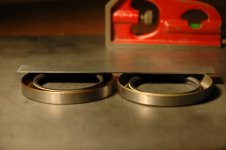
Looking at the picture showing the old seal vs the new seal, it doesn't look like there is more than a 3mm difference inboard between the two seals. The new seal design is on the left. It looks like there's only around a 2mm difference but it's hard to tell just from the picture and not taking measurements. I wonder if anyone actually has documented the exact distance the seal lip placement has moved inboard changing from the old seal to the new one. The guy who provided this picture on Dr. Coffee's Axle Seal thread on the TTORA forum mentioned there was a chance people were damaging the seals using the improper tool to drive the seal in and thus bending the seal pushing the seal lip further inboard. Using a large socket or a piece of pipe rather than an actual seal driver is probably not the best way to go. You can pick up a seal driver kit for a decent price from harbor freight and other manufacturers. I bought a nice set by OTC via Amazon. This could explain why my retainers were centered on the seal with 5mm of polished axle showing and others were able to achieve center at 3 or 4mm of polished axle showing. I also had them bolt up the axle too before doing the grease test to make the sure the axle was fully seated all the way to get a more accurate measurement. This could also be a reason why I got different results than the others if they didn't actually get the axle fully seated when performing the grease test. The other possibility for the difference I thought of is maybe the bearings on my axles were pressed in a little further than the others. If the bearing isn't pressed on fully, maybe due to a little corrosion on the end of the axle, that would leave less axle length after the bearing thus changing the position the retainer would be at. I'm not saying the others that had different results than me must have done something wrong. I'm just trying to figure out why my results came out different.
Toyota Inner Axle Seal.jpg

Anyways, I'm finally confident the repair was done right. If I have to do this again, I'll pull the axles myself and bring them to a machine shop and save myself some money.

I really appreciate these forums. Thanks again Dr. Coffee for sharing the information.
 

Attachments

  • Toyota Inner Axle Seal.jpg
    Toyota Inner Axle Seal.jpg
    26.8 KB · Views: 1,315
Last edited:
Hats off to you OP. You obviously stuck to your guns and kept it simple for them with the grease test. I guarantee you you just schooled several techs and saved many future customers thousands of dollars and heartaches. It's nice to read a success story especially in a dealership. Congrats again to you.
 
Quick update on my ride. I am totally grease free after 500 miles. I am extremely happy I went the Dr. Coffee route. Im glad the ordeal is over for the time. Solution makes sense and I don't see why there would be problems. [MENTION=120071]mtbtim[/MENTION] I'm psyched the dealership listened and you're hopefully good to go!
 
So I rotated the tires and peeked inside the axle housing through the ABS sensor hole. Still dry going on 40,000 miles and 3 years.

Left side: the wetness around the opening was from WD40 and the lube in the hole was from the silicone lube I used the last time I opened it up. The ABS ring is dry.
ry%3D400


Right side: I wiped it clean but the ABS ring is dry.
ry%3D400
 
yes accuracy is vitally important here but i agree with the retainer reversal as it will allow you another 2 mm of inaccuracy which is always helpful in my books !
 
Yotatech contribution

engifineer said:
Wanted to add to this thread (and thanks for creating it).
As a note (I almost found this out the hard way). With a little bit of heat from a small propane torch, the retainer will go on with almost no effort. I put mine on the shaft and it literally fell all the way down. I luckilly yanked it back off before it cooled and shrunk into place :P But if you had something in place as a stop, you could heat the ring and drop it right on.

That is a good tip to know. So anyone who is not replacing the bearings could simply cut off the old retainer and replace it just by heating it and placing it in position. Thank you
 
Dr. Coffee, why don't you make "spacer" rings that go between the retainers and ABS ring so they stack up to exact measurements. This would take all the measurements and guesswork away, especially if you have to take your axles to a shop to have them pressed.
 
here's a questions no one has asked and I'm curious.

What's the bevel for? With your mod the bevel now faces the teeth. The old way it faces inside around the axle rod.

I don't see a need for the bevel to be honest. is there any thing to be missed from the inside when you flip it over?
 
here's a questions no one has asked and I'm curious.

What's the bevel for? With your mod the bevel now faces the teeth. The old way it faces inside around the axle rod.

I don't see a need for the bevel to be honest. is there any thing to be missed from the inside when you flip it over?

The original seals were square cut. The bevel was to ease installation and prevent damaging seals. The new seal is more resilient and tapered. The big end of the retainer does have a radius edge so it goes into the seal very easily watch the video on the first page.
 
When my first axle seal went south, I had the parts counter guy sell me a new Timken. He suggested getting some RTV and smearing it on the outside of the freshly installed seal. Over 100K later, I am golden. I did that for a friend too. One of his went bad and we replaced both using the same method.
 
Drcoffee, I saw your post about the retainer on TacomaWorld, read BFD's write up twice and yours three times but you both have abs. I have a NON-ABS first gen tacoma (2001 4wd 5sp v6 trd sr5 with stock axle and 165k miles if it matters) with gear oil on both tires and drums after riding miles of washboard road. Naturally assuming new seals, o-ring, bearings and retainers and brakes of course, does your reverse 1mm retainer placement with the updated seal design only pertain to the 3rd gen ABS 4runner or also to the 1st gen NON-ABS tacoma? (I am personally unaware if there is a 3rd gen NON-ABS 4runner crowd that may have the same question)
 
Your lucky in this instance that you don't have ABS. The retainer on non ABS pushes right up against the bearing with no gap to measure. Just do the grease test before you put it back together and you should be fine.
 
Drcoffee, I saw your post about the retainer on TacomaWorld, read BFD's write up twice and yours three times but you both have abs. I have a NON-ABS first gen tacoma (2001 4wd 5sp v6 trd sr5 with stock axle and 165k miles if it matters) with gear oil on both tires and drums after riding miles of washboard road. Naturally assuming new seals, o-ring, bearings and retainers and brakes of course, does your reverse 1mm retainer placement with the updated seal design only pertain to the 3rd gen ABS 4runner or also to the 1st gen NON-ABS tacoma? (I am personally unaware if there is a 3rd gen NON-ABS 4runner crowd that may have the same question)

I would consider reversing the retainer on both ABS & non-ABS. If you watched my video on page 1 you will see that for the seal to ride on the polished surface the seal outer face would need to be flush with the retainer. Reversing it give you more real estate to seal against. In this picture, the seal looks to flush against the bearing but it may not be positioned in the center of the retainer even tho. The new seal design shifts the contact point for the seal more inboard than originally designed.

ry%3D400


But here is what I would do if I were you. Use only an OEM seal. Pull the axle (dont disassemble it yet) and install the new seal. Then do the grease test with the old axle retainer and see where it rides. Then cut off old retianer, flip it around and retest with grease. Since this has not been discussed here, please post pictures of your results here so other members with non-ABS can learn from your experience. I'm curious as well.
 
So what if someone wants to do PM on a non-ABS Tacoma or 4Runner? has anyone replaced the seals before they leaked, then done grease test?
 

Members online

No members online now.

Forum statistics

Threads
278,310
Messages
3,554,080
Members
248,016
Latest member
Advally Service

Trending content

Back
Top