RichinRidgewood
New member
Stalled Out on Tesla's Electric Highway
Anybody remember this stellar review of using an EV in the real world?
Stalled on the E.V. Highway - The New York Times
Stalled Out on Tesla's Electric Highway
By John M. Broder
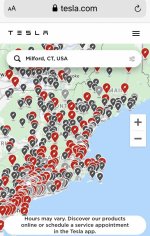
WASHINGTON — Having established a fast-charging foothold in California for its electric cars, Tesla Motors has brought its formula east, opening two ultrafast charging stations in December that would, in theory, allow a speedy electric-car road trip between here and Boston.
But as I discovered on a recent test drive of the company’s high-performance Model S sedan, theory can be trumped by reality, especially when Northeast temperatures plunge.
Tesla, the electric-car manufacturer run by Elon Musk, the billionaire behind PayPal and SpaceX, offered a high-performance Model S sedan for a trip along the newly electrified stretch of Interstate 95. It seemed an ideal bookend to The Times’s encouraging test drive last September on the West Coast.
The new charging points, at service plazas in Newark, Del., and Milford, Conn., are some 200 miles apart. That is well within the Model S’s 265-mile estimated range, as rated by the Environmental Protection Agency, for the version with an 85 kilowatt-hour battery that I drove — and even more comfortably within Tesla’s claim of 300 miles of range under ideal conditions. Of course, mileage may vary.
The 480-volt Supercharger stations deliver enough power for 150 miles of travel in 30 minutes, and a full charge in about an hour, for the 85 kilowatt-hour Model S. (Adding the fast-charge option to cars with the midlevel 60 kilowatt-hour battery costs $2,000.) That’s quite a bit longer than it takes to pump 15 gallons of gasoline, but at Supercharger stations Tesla pays for the electricity, which seems a reasonable trade for fast, silent and emissions-free driving. Besides, what’s Sbarro for?
The car is a technological wonder, with luminous paint on aluminum bodywork, a spacious and ultrahip cabin, a 17-inch touch screen to control functions from suspension height to the Google-driven navigation system. Feeding the 416 horsepower motor of the top-of-the-line Model S Performance edition is a half-ton lithium-ion battery pack slung beneath the cockpit; that combination is capable of flinging this $101,000 luxury car through the quarter mile as quickly as vaunted sport sedans like the Cadillac CTS-V.
The Model S has won multiple car-of-the-year awards and is, many reviews would have you believe, the coolest car on the planet.
What fun, no? Well, no.
Setting out on a sunny 30-degree day two weeks ago, my trip started well enough. A Tesla agent brought the car to me in suburban Washington with a full charge, and driving at normal highway speeds I reached the Delaware charging dock with the battery still having roughly half its energy remaining. I went off for lunch at the service plaza, checking occasionally on the car’s progress. After 49 minutes, the display read “charge complete,” and the estimated available driving distance was 242 miles.
Fat city; no attendant and no cost.
As I crossed into New Jersey some 15 miles later, I noticed that the estimated range was falling faster than miles were accumulating. At 68 miles since recharging, the range had dropped by 85 miles, and a little mental math told me that reaching Milford would be a stretch.
I began following Tesla’s range-maximization guidelines, which meant dispensing with such battery-draining amenities as warming the cabin and keeping up with traffic. I turned the climate control to low — the temperature was still in the 30s — and planted myself in the far right lane with the cruise control set at 54 miles per hour (the speed limit is 65). Buicks and 18-wheelers flew past, their drivers staring at the nail-polish-red wondercar with California dealer plates.
Nearing New York, I made the first of several calls to Tesla officials about my creeping range anxiety. The woman who had delivered the car told me to turn off the cruise control; company executives later told me that advice was wrong. All the while, my feet were freezing and my knuckles were turning white.
After a short break in Manhattan, the range readout said 79 miles; the Milford charging station was 73 miles away. About 20 miles from Milford, less than 10 miles of range remained. I called Tesla again, and Ted Merendino, a product planner, told me that even when the display reached zero there would still be a few miles of cushion.
At that point, the car informed me it was shutting off the heater, and it ordered me, in vivid red letters, to “Recharge Now.”
I drove into the service plaza, hooked up the Supercharger and warmed my hands on a cup of Dunkin’ Donuts coffee.
If this is Tesla’s vision of long-distance travel in America’s future, I thought, and the solution to what the company calls the “road trip problem,” it needs some work.
The federal government has invested in the effort to find a solution. Three years ago, Steven Chu, the Nobel Prize-winning physicist and secretary of energy, proudly announced a $465 million loan to Tesla as part of an advanced vehicles program intended to cut fossil fuel use and address global warming.
The loan to Tesla would “begin laying the foundation for American leadership in the growing electric vehicles industry,” Dr. Chu said.
At the time, Tesla set a target of producing 20,000 Model S cars by the end of 2013. Some 13,000 eager buyers have reserved 2013 models at prices from about $61,000 to more than $100,000. To give those cars family-vacation capability, the company plans to have 90 Supercharger stations built across the country by the end of 2013.
At the Washington Auto Show last month, Dr. Chu, who has since announced his plan to leave office in the next few weeks, discussed the Energy Department’s goal of making electric vehicles and plug-in hybrids as cheap and convenient as comparable gasoline-powered cars.
He continued: “We can’t say this everywhere in America yet, but driving by a gasoline station and smiling is something everyone should experience.”
I drove a state-of-the-art electric vehicle past a lot of gas stations. I wasn’t smiling.
Instead, I spent nearly an hour at the Milford service plaza as the Tesla sucked electrons from the hitching post. When I continued my drive, the display read 185 miles, well beyond the distance I intended to cover before returning to the station the next morning for a recharge and returning to Manhattan.
I drove, slowly, to Stonington, Conn., for dinner and spent the night in Groton, a total distance of 79 miles. When I parked the car, its computer said I had 90 miles of range, twice the 46 miles back to Milford. It was a different story at 8:30 the next morning. The thermometer read 10 degrees and the display showed 25 miles of remaining range — the electrical equivalent of someone having siphoned off more than two-thirds of the fuel that was in the tank when I parked.
I called Tesla in California, and the official I woke up said I needed to “condition” the battery pack to restore the lost energy. That meant sitting in the car for half an hour with the heat on a low setting. (There is now a mobile application for warming the battery remotely; it was not available at the time of my test drive.)
After completing the battery conditioning process, the estimated range reading was 19 miles; no way would I make it back to Milford.
The Tesla people found an E.V. charging facility that Norwich Public Utilities had recently installed. Norwich, an old mill town on the Thames River, was only 11 miles away, though in the opposite direction from Milford.
After making arrangements to recharge at the Norwich station, I located the proper adapter in the trunk, plugged in and walked to the only warm place nearby, Butch’s Luncheonette and Breakfast Club, an establishment (smoking allowed) where only members can buy a cup of coffee or a plate of eggs. But the owners let me wait there while the Model S drank its juice. Tesla’s experts said that pumping in a little energy would help restore the power lost overnight as a result of the cold weather, and after an hour they cleared me to resume the trip to Milford.
Looking back, I should have bought a membership to Butch’s and spent a few hours there while the car charged. The displayed range never reached the number of miles remaining to Milford, and as I limped along at about 45 miles per hour I saw increasingly dire dashboard warnings to recharge immediately. Mr. Merendino, the product planner, found an E.V. charging station about five miles away.
But the Model S had other ideas. “Car is shutting down,” the computer informed me. I was able to coast down an exit ramp in Branford, Conn., before the car made good on its threat.
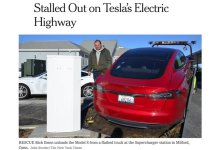
Tesla’s New York service manager, Adam Williams, found a towing service in Milford that sent a skilled and very patient driver, Rick Ibsen, to rescue me with a flatbed truck. Not so quick: the car’s electrically actuated parking brake would not release without battery power, and hooking the car’s 12-volt charging post behind the front grille to the tow truck’s portable charger would not release the brake. So he had to drag it onto the flatbed, a painstaking process that took 45 minutes. Fortunately, the cab of the tow truck was toasty.
At 2:40 p.m., we pulled into the Milford rest stop, five hours after I had left Groton on a trip that should have taken less than an hour. Mr. Ibsen carefully maneuvered the flatbed close to the charging kiosk, and 25 minutes later, with the battery sufficiently charged to release the parking brake and drive off the truck, the car was back on the ground. A Model S owner who had taken delivery the previous day watched with interest.
Tesla’s chief technology officer, J B Straubel, acknowledged that the two East Coast charging stations were at the mileage limit of the Model S’s real-world range. Making matters worse, cold weather inflicts about a 10 percent range penalty, he said, and running the heater draws yet more energy. He added that some range-related software problems still needed to be sorted out.
“It’s disappointing to me when things don’t work smoothly,” Mr. Straubel said in a post-mortem of my test drive. “It takes more planning than a typical gasoline car, no way around it.
“Hopefully you’ll give us a little slack in that we put in the East Coast stations just a month ago,” he said. “It’s a good lesson.”
After 80 minutes of charging in Milford, the battery registered an estimated 216 miles of range. The trip to the Tesla dealership in Manhattan was an uneventful 71 miles. When I pulled in, the battery had an estimated 124 miles remaining.
I trust that the next driver savored those miles — and dressed warmly, just in case.
A version of this article appears in print on Feb. 10, 2013, Section AU, Page 1 of the New York edition with the headline: Stalled on the E.V. Highway. Order Reprints | Today’s Paper | Subscribe
Anybody remember this stellar review of using an EV in the real world?
Stalled on the E.V. Highway - The New York Times
Stalled Out on Tesla's Electric Highway
By John M. Broder
WASHINGTON — Having established a fast-charging foothold in California for its electric cars, Tesla Motors has brought its formula east, opening two ultrafast charging stations in December that would, in theory, allow a speedy electric-car road trip between here and Boston.
But as I discovered on a recent test drive of the company’s high-performance Model S sedan, theory can be trumped by reality, especially when Northeast temperatures plunge.
Tesla, the electric-car manufacturer run by Elon Musk, the billionaire behind PayPal and SpaceX, offered a high-performance Model S sedan for a trip along the newly electrified stretch of Interstate 95. It seemed an ideal bookend to The Times’s encouraging test drive last September on the West Coast.
The new charging points, at service plazas in Newark, Del., and Milford, Conn., are some 200 miles apart. That is well within the Model S’s 265-mile estimated range, as rated by the Environmental Protection Agency, for the version with an 85 kilowatt-hour battery that I drove — and even more comfortably within Tesla’s claim of 300 miles of range under ideal conditions. Of course, mileage may vary.
The 480-volt Supercharger stations deliver enough power for 150 miles of travel in 30 minutes, and a full charge in about an hour, for the 85 kilowatt-hour Model S. (Adding the fast-charge option to cars with the midlevel 60 kilowatt-hour battery costs $2,000.) That’s quite a bit longer than it takes to pump 15 gallons of gasoline, but at Supercharger stations Tesla pays for the electricity, which seems a reasonable trade for fast, silent and emissions-free driving. Besides, what’s Sbarro for?
The car is a technological wonder, with luminous paint on aluminum bodywork, a spacious and ultrahip cabin, a 17-inch touch screen to control functions from suspension height to the Google-driven navigation system. Feeding the 416 horsepower motor of the top-of-the-line Model S Performance edition is a half-ton lithium-ion battery pack slung beneath the cockpit; that combination is capable of flinging this $101,000 luxury car through the quarter mile as quickly as vaunted sport sedans like the Cadillac CTS-V.
The Model S has won multiple car-of-the-year awards and is, many reviews would have you believe, the coolest car on the planet.
What fun, no? Well, no.
Setting out on a sunny 30-degree day two weeks ago, my trip started well enough. A Tesla agent brought the car to me in suburban Washington with a full charge, and driving at normal highway speeds I reached the Delaware charging dock with the battery still having roughly half its energy remaining. I went off for lunch at the service plaza, checking occasionally on the car’s progress. After 49 minutes, the display read “charge complete,” and the estimated available driving distance was 242 miles.
Fat city; no attendant and no cost.
As I crossed into New Jersey some 15 miles later, I noticed that the estimated range was falling faster than miles were accumulating. At 68 miles since recharging, the range had dropped by 85 miles, and a little mental math told me that reaching Milford would be a stretch.
I began following Tesla’s range-maximization guidelines, which meant dispensing with such battery-draining amenities as warming the cabin and keeping up with traffic. I turned the climate control to low — the temperature was still in the 30s — and planted myself in the far right lane with the cruise control set at 54 miles per hour (the speed limit is 65). Buicks and 18-wheelers flew past, their drivers staring at the nail-polish-red wondercar with California dealer plates.
Nearing New York, I made the first of several calls to Tesla officials about my creeping range anxiety. The woman who had delivered the car told me to turn off the cruise control; company executives later told me that advice was wrong. All the while, my feet were freezing and my knuckles were turning white.
After a short break in Manhattan, the range readout said 79 miles; the Milford charging station was 73 miles away. About 20 miles from Milford, less than 10 miles of range remained. I called Tesla again, and Ted Merendino, a product planner, told me that even when the display reached zero there would still be a few miles of cushion.
At that point, the car informed me it was shutting off the heater, and it ordered me, in vivid red letters, to “Recharge Now.”
I drove into the service plaza, hooked up the Supercharger and warmed my hands on a cup of Dunkin’ Donuts coffee.
If this is Tesla’s vision of long-distance travel in America’s future, I thought, and the solution to what the company calls the “road trip problem,” it needs some work.
The federal government has invested in the effort to find a solution. Three years ago, Steven Chu, the Nobel Prize-winning physicist and secretary of energy, proudly announced a $465 million loan to Tesla as part of an advanced vehicles program intended to cut fossil fuel use and address global warming.
The loan to Tesla would “begin laying the foundation for American leadership in the growing electric vehicles industry,” Dr. Chu said.
At the time, Tesla set a target of producing 20,000 Model S cars by the end of 2013. Some 13,000 eager buyers have reserved 2013 models at prices from about $61,000 to more than $100,000. To give those cars family-vacation capability, the company plans to have 90 Supercharger stations built across the country by the end of 2013.
At the Washington Auto Show last month, Dr. Chu, who has since announced his plan to leave office in the next few weeks, discussed the Energy Department’s goal of making electric vehicles and plug-in hybrids as cheap and convenient as comparable gasoline-powered cars.
He continued: “We can’t say this everywhere in America yet, but driving by a gasoline station and smiling is something everyone should experience.”
I drove a state-of-the-art electric vehicle past a lot of gas stations. I wasn’t smiling.
Instead, I spent nearly an hour at the Milford service plaza as the Tesla sucked electrons from the hitching post. When I continued my drive, the display read 185 miles, well beyond the distance I intended to cover before returning to the station the next morning for a recharge and returning to Manhattan.
I drove, slowly, to Stonington, Conn., for dinner and spent the night in Groton, a total distance of 79 miles. When I parked the car, its computer said I had 90 miles of range, twice the 46 miles back to Milford. It was a different story at 8:30 the next morning. The thermometer read 10 degrees and the display showed 25 miles of remaining range — the electrical equivalent of someone having siphoned off more than two-thirds of the fuel that was in the tank when I parked.
I called Tesla in California, and the official I woke up said I needed to “condition” the battery pack to restore the lost energy. That meant sitting in the car for half an hour with the heat on a low setting. (There is now a mobile application for warming the battery remotely; it was not available at the time of my test drive.)
After completing the battery conditioning process, the estimated range reading was 19 miles; no way would I make it back to Milford.
The Tesla people found an E.V. charging facility that Norwich Public Utilities had recently installed. Norwich, an old mill town on the Thames River, was only 11 miles away, though in the opposite direction from Milford.
After making arrangements to recharge at the Norwich station, I located the proper adapter in the trunk, plugged in and walked to the only warm place nearby, Butch’s Luncheonette and Breakfast Club, an establishment (smoking allowed) where only members can buy a cup of coffee or a plate of eggs. But the owners let me wait there while the Model S drank its juice. Tesla’s experts said that pumping in a little energy would help restore the power lost overnight as a result of the cold weather, and after an hour they cleared me to resume the trip to Milford.
Looking back, I should have bought a membership to Butch’s and spent a few hours there while the car charged. The displayed range never reached the number of miles remaining to Milford, and as I limped along at about 45 miles per hour I saw increasingly dire dashboard warnings to recharge immediately. Mr. Merendino, the product planner, found an E.V. charging station about five miles away.
But the Model S had other ideas. “Car is shutting down,” the computer informed me. I was able to coast down an exit ramp in Branford, Conn., before the car made good on its threat.
Tesla’s New York service manager, Adam Williams, found a towing service in Milford that sent a skilled and very patient driver, Rick Ibsen, to rescue me with a flatbed truck. Not so quick: the car’s electrically actuated parking brake would not release without battery power, and hooking the car’s 12-volt charging post behind the front grille to the tow truck’s portable charger would not release the brake. So he had to drag it onto the flatbed, a painstaking process that took 45 minutes. Fortunately, the cab of the tow truck was toasty.
At 2:40 p.m., we pulled into the Milford rest stop, five hours after I had left Groton on a trip that should have taken less than an hour. Mr. Ibsen carefully maneuvered the flatbed close to the charging kiosk, and 25 minutes later, with the battery sufficiently charged to release the parking brake and drive off the truck, the car was back on the ground. A Model S owner who had taken delivery the previous day watched with interest.
Tesla’s chief technology officer, J B Straubel, acknowledged that the two East Coast charging stations were at the mileage limit of the Model S’s real-world range. Making matters worse, cold weather inflicts about a 10 percent range penalty, he said, and running the heater draws yet more energy. He added that some range-related software problems still needed to be sorted out.
“It’s disappointing to me when things don’t work smoothly,” Mr. Straubel said in a post-mortem of my test drive. “It takes more planning than a typical gasoline car, no way around it.
“Hopefully you’ll give us a little slack in that we put in the East Coast stations just a month ago,” he said. “It’s a good lesson.”
After 80 minutes of charging in Milford, the battery registered an estimated 216 miles of range. The trip to the Tesla dealership in Manhattan was an uneventful 71 miles. When I pulled in, the battery had an estimated 124 miles remaining.
I trust that the next driver savored those miles — and dressed warmly, just in case.
A version of this article appears in print on Feb. 10, 2013, Section AU, Page 1 of the New York edition with the headline: Stalled on the E.V. Highway. Order Reprints | Today’s Paper | Subscribe