Apple iPhone 8/X and A11

Found this reading another site: https://www.wired.com/2016/09/top-shelf-iphone-hack-now-goes-1-5-million/

IOS 10 hack bounty (grey market) = $1.5 million.

Android 7 hack bounty = up to $200,000.

(In San Bernardino case, FBI paid Israeli company just over $1.3 million to hack iPhone 5c from 2012.)

Grey market is Zerodiums bounty. Apple has there own bounty program that's no where near 1.5M. Zerodiums payout is for a complete jailbreak of iOS 10. Google's bounty payed out 3 million last year. That's from Google not Zerodium.

To understand why is easy. Google is open sourced and currently using a Linux kernel. Android 8(Oreo) is using 4.10. Older versions of the OS go all the way down to 2.6. Every version that's released has exploits that have been patched from a previous version. Then hackers find new exploits. It's a cycle that's been going on since Unix was released by ATT back in the 60's.

Apple uses it's own XNU kernel. Developed from the same Unix base as Linux in the 90's. There's one thing that makes Apple harder to crack and one thing only. The source code is proprietary. It's a huge difference.

Anyone wanting to find a hack in the Lixux model has all the source code to review. Anyone wanting to hack a proprietary model has to deconstruct the code first. Think of it has having a map to get to where your going compared to not having a map.

Like I said upthread I'm not saying one system is better or superior to the other. Both have there pros and cons. But to extrapolate hacking rewards into the superiority of kernel code is presenting a picture that's not truly accurate.

https://9to5mac.com/2017/07/06/apple-bug-bounty-program-payouts/

https://techcrunch.com/2017/01/31/googles-bug-bounty-2016/
 
Grey market is Zerodiums bounty. Apple has there own bounty program that's no where near 1.5M. Zerodiums payout is for a complete jailbreak of iOS 10. Google's bounty payed out 3 million last year. That's from Google not Zerodium.

To understand why is easy. Google is open sourced and currently using a Linux kernel. Android 8(Oreo) is using 4.10. Older versions of the OS go all the way down to 2.6. Every version that's released has exploits that have been patched from a previous version. Then hackers find new exploits. It's a cycle that's been going on since Unix was released by ATT back in the 60's.

Apple uses it's own XNU kernel. Developed from the same Unix base as Linux in the 90's. There's one thing that makes Apple harder to crack and one thing only. The source code is proprietary. It's a huge difference.

Anyone wanting to find a hack in the Lixux model has all the source code to review. Anyone wanting to hack a proprietary model has to deconstruct the code first. Think of it has having a map to get to where your going compared to not having a map.

Like I said upthread I'm not saying one system is better or superior to the other. Both have there pros and cons. But to extrapolate hacking rewards into the superiority of kernel code is presenting a picture that's not truly accurate.

https://9to5mac.com/2017/07/06/apple-bug-bounty-program-payouts/

https://techcrunch.com/2017/01/31/googles-bug-bounty-2016/

Your post is misleading.

Google bounty payout is over a period of time...here and there payments for bug reporting and patches, etc that totaled the amount you stated.

Apple payout for bugs is low...probably because Apple does not rely too much on outside debuggers. That is true.

Again, the amount you posted is for Apple (and Google) payout for bug reporting. It is not a one-time payout for a OS hack.

However, the above post by me ($1.5 million vs. $200k) is about a total hack of the OS. A one-time payment for the hack...not for bug reporting. This shows how hard it is to hack iOS vs. Android.

Open vs. closed source kernels...wonderful...but what I (and 99.999% of consumers) care about is the END result. I could care less about open or closed source. What i care about is security and privacy...the end result that affects my family and financial health.
 
Last edited:
Google's bounty payed out 3 million last year.

The more that i think about this amount, the more that it worries me. Granted, debugging is the norm for programming. But i am not so sure that an Android user should be proud of this bounty amount. It meant that there were A LOT of bugs in Android last year...and the bugs were MAJOR because the more severe the bugs, the bigger the payout for EACH issue.

I think that i would be happier if the Google bounty payout this year was much less.
 
“Face ID will “just work.” Thanks to the way Apple implemented Face ID in iOS 11, any app that currently makes use of Touch ID for authentication will automatically work with Face ID. There will be no work needed on the developer’s part, so users won’t have to wait for Face ID to work with their favorite apps.”
 
I can't wait for the iPhone 8 to finally be here. My iPhone 6 is looking more like Frankenstein's monster instead of an actual phone. I'm going for the 8 plus since I fly my mavic and don't want the controller to cover parts of the screen like it would with the X
 
I can't wait for the iPhone 8 to finally be here. My iPhone 6 is looking more like Frankenstein's monster instead of an actual phone. I'm going for the 8 plus since I fly my mavic and don't want the controller to cover parts of the screen like it would with the X

Don’t blame you. The 8+ has pretty much everything X has...and the stuff on it are proven (e.g. TouchID). Early reviews show that 8+ camera is now best among all smartphones. The AI apparently helps the photos tremendously.
 
So what will it mean for normal users like me? All that processing power is sweet but what can I do with it? I feel like all the features should be on the 8.... which seems to have received very little in way of upgrades. I have a 6 but I don't see what I am missing out on by not trading in... at least for now anyway.

Any insight would be appreciated!

For normal users, it won't mean anything. For high-end photographers, people interested in augmented reality, and bleeding-edgers, the iPhone 8 is top-shelf and the iPhone X appears to be the new market leader. We'll see if that holds true when the new Pixel in introduced on October 4th.
 
What do you think about the OLED display on the X being significantly less bright than on the note 8 and some other Samsung devices?
 
What do you think about the OLED display on the X being significantly less bright than on the note 8 and some other Samsung devices?

Apple usually under-rates their specs. So, i would wait till 3rd party reviews it, such as Anandtech or Displaymate. From what we have heard, Apple bought Samsung’s top display and then calibrate it to Apple specs at Apple factory. (Samsung sells display of different quality to other OEMs...rumor has it that Apple paid top dollar for Samsung’s best.)

What do i expect? I expect X display to be excellent with very accurate colors and good brightness. X also has TrueTone technology too.
 
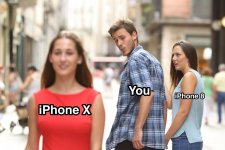
Saw this picture...made me laugh....
 

Attachments

  • 6B574860-015B-419C-B255-0566A2106242.jpg
    6B574860-015B-419C-B255-0566A2106242.jpg
    127.4 KB · Views: 68
Something interesting I've seen crop up a few times is that the modems in both the iPhone8 and the iPhoneX are actually slower than what's available from other current releases. That seems really weird, have you seen that as well @Thai?

Something about the 8 & X being limited to only a 600mbps modem while pretty much anything running a newer SnapDragon (I guess it's built into the last two chips from them?) or newer Qualcomm modem chip is set for Gigabit LTE, it seemed weird that while all the new phones are set for the future the iPhone 8 & X basically are outdated in something as critical as modem. Any validity there as that seems like a huge oversight...
 
Last edited:
Something interesting I've seen crop up a few times is that the modems in both the iPhone8 and the iPhoneX are actually slower than what's available from other current releases. That seems really weird, have you seen that as well @Thai?

100% true I think. Apple is trying to avoid using Qualcomm due to legal battles and avoid paying royalties. Unfortunately for Apple, Qualcomm has the best modems! Apple likely using Intel modems which is significantly slower.
 
100% true I think. Apple is trying to avoid using Qualcomm due to legal battles and avoid paying royalties. Unfortunately for Apple, Qualcomm has the best modems! Apple likely using Intel modems which is significantly slower.

That's what I was reading as well, they're using a combination of lower-end Qualcomm and Intel modems to supplement them.

I suppose it'll just come down to how quickly Gigabit LTE get's rolled out? If it's within the next year than these phones will essentially be out-dated on release until Apple makes a new version with a better modem while the competition is "future-proofed" in that regard. If it's longer than a year or two, by that time they'll have caught up on sourcing competitive modems and the issue is moot; bit of a risky gamble I suppose.

I mean current speed is nice, but let's be honest from a consumer standpoint speed/connectivity is a huge factor in not only handset sales but provider sales as well. I would have thought at least the X would have been future-proofed in that regard since they did such a good job on the phone otherwise. Oh well, still a powerful platform.
 
Right now I am happy with just 50 mbps! If I ever get to 600, I might just pee in my pants!
 
no 600Mhz (band 71) as well

Both new iPhones don't support 600Mhz LTE, which T-Mobile will be rolling out over the next couple of years. Yet another reason I'll hang onto by 6s+ and stay on the sidelines for a year.
 
That's what I was reading as well, they're using a combination of lower-end Qualcomm and Intel modems to supplement them.

I suppose it'll just come down to how quickly Gigabit LTE get's rolled out? If it's within the next year than these phones will essentially be out-dated on release until Apple makes a new version with a better modem while the competition is "future-proofed" in that regard. If it's longer than a year or two, by that time they'll have caught up on sourcing competitive modems and the issue is moot; bit of a risky gamble I suppose.

I mean current speed is nice, but let's be honest from a consumer standpoint speed/connectivity is a huge factor in not only handset sales but provider sales as well. I would have thought at least the X would have been future-proofed in that regard since they did such a good job on the phone otherwise. Oh well, still a powerful platform.

Apple has always been slow to adapt new standards...they usually only do so after it being tested thoroughly.

Actually, with iPhone 7 from Verizon and Sprint, Apple used the latest Qualcomm modem (at time of introduction), BUT Apple throttled it to keep the speeds in line with the GSM iPhone 7 (ATT & TMo), which had the Intel modem. (This is why Verizon/Sprint iP7 could be used on ATT/TMo network, but GSM iP7 could not be used on CDMA Verizon/Sprint network.). For example, my iP7+ from Verizon has the same Qualcomm chip as S7 (and S8 i think)...but will never reach its potential because of software limitation.

Right now, no one knows what modem is in iP8/X. BUT, it seems like apple is following iPhone 7. There are two models for iP8/X...one CDMA model that works on GSM and one GSM model that only works on GSM.

So, MY 100% GUESS is that Apple is using 50% Qualcomm and 50% Intel like they did with iP7...but the software throttles the Qualcomm chip.
 

Members online

Forum statistics

Threads
278,312
Messages
3,554,087
Members
248,016
Latest member
Advally Service

Trending content

Back
Top