Deep Snow Commuter
New member
Winter AND Long Distance Driving
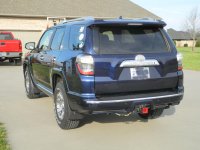
I live in southern Indiana and I work in Houghton, Michigan (home to Michigan Tech. Univ.). I commute back and forth 4 times a month, 750 miles each way. Adding in-town driving, I put 3,200 miles a month on my 4Runner like clockwork. The commute is 13 hours across what can be 60 degree temps in Indiana (60 miles north of Kentucky) on the same day I cross a blizzard anywhere from Champaign, IL to Houghton. The UP of Michigan is permanently snowed in from Thanksgiving on, and it snows seemingly ceaselessly. When I arrive back in MI, it's Sunday night past 10pm, cell phone tower coverage is filled with gaps, the road crews are gone, the sparsely-traveled highways are completely whited out, the elevation ranges from 760 feet to almost 1800 feet, the lake effect snow can be coming down heavily enough to cause whiteout conditions, and deer can pop out in front of you on these curvy two lane highways with no visible warning. I'll try to enclose some photos of UP roads in the winter, daytime and at night.
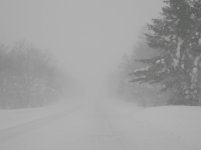
This second photo was taken with low beams, not high beams, on.

The LE's torsen and its ground clearance could get anyone out of a 30" snow drift ON A PAVED SURFACE even with all season tires. But it's about so much more than that, than STARTING to move and driving 10 mph for 3 blocks.
There is powdery snow, frozen caked snow, melted then refrozen snow, sandy snow, slushy snow, there is snow on gravel, snow on asphalt, snow on soil, snow on ice, snow on grooved concrete, etc. These debates about "are skinny or fat tires better on snow?" are worthless b/c they fail to cross reference all these other variables.
All season tires are clearly inferior on most varieties of snow when it comes to STOPPING and TURNING. So I really wanted better than the 5 or so tire options for the 7" wide rim on the LE.
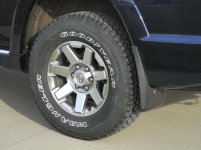
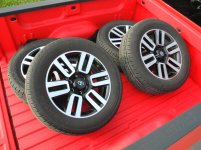
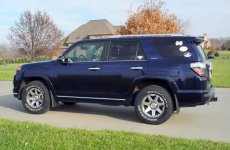
I chose a set of the 7 spoke 17x7.5 wheels, actually off an FJ Cruiser, and donned a set of Goodyear Wrangler AT Adventure with Kevlar tires in 265/70 R17. I have only the trip up here to Houghton to speak of so far, but (1) they're quiet on dry highway, (2) they did not hydroplane at 68 mph in the light rain across Wisconsin, (3) the mpg for the 750 mile trip up here was 21.2 (winter 10% ethanol), (4) they HANDLE very nicely on dry surfaces; cornering is distinctly more stable with less roll, (5) they STOP and TURN in the snow up here [our base is over 20" now] MUCH better than the Continental Cross Contacts they replaced (my 275/55 R20s), (6) unlike a Blizzak, etc, they have a 60,000 mile treadlife warranty.
We can all talk endlessly about whether siping helps and in what conditions, whether deep grooves are "bad" because they retain snow (actually, if you know the "packed snowball" argument, retained snow in the treads is in some circumstances good for grip), and we can discuss how many angels can dance on the head of a pin. Keep in mind how "research" works. The tests may vary road conditions very precisely but they only use existing, on-the-market tires.
What I mean is this - consider: SIPING -- is it the siping of a Blizzak that accounts for its relative grip under XYZ road conditions, or is it the rubber compound? Yes, other tires with different compounds but SOME siping will be compared, but until Bridgestone molds an essentially IDENTICALLY TREADED, IDENTICALLY SIPED tire with a DIFFERENT RUBBER COMPOUND, all conclusions about its grip can only be drawn with respect to the whole package, and not to any particular trait of that tire. So, we can wax eloquently on the Forum about all manner of hypothetical tire features, and we can even quote some "studies" (such as those done here in Houghton at Michigan Tech's Keweenaw Research Center) which reach conclusions about various on-the-market tires, but YOU must take it all IN CONTEXT.
Look at the above photos. As Liam Neeson said in Taken, "I do this fer a livin'..." I walk the walk. And this set of tires on this vehicle get me to my destination, 13+ hours into the drive, the end of which involve 2-5 hours of the above photographed CRAP, time and time again. And when I'm settled into town, and the pager goes off for a stat C-section at 4am during a blizzard with 3 foot snow drifts everywhere, I am not allowed to make excuses for why I can't get to work and get there NOW.
I HIGHLY recommend these tires.
Yes, if I didn't commute the long distances, I'd go for Firestone Winterforce rubber or some other dedicated, zero-treadlife warranty shoes, but my circumstances make such tires an impractical choice.
I live in southern Indiana and I work in Houghton, Michigan (home to Michigan Tech. Univ.). I commute back and forth 4 times a month, 750 miles each way. Adding in-town driving, I put 3,200 miles a month on my 4Runner like clockwork. The commute is 13 hours across what can be 60 degree temps in Indiana (60 miles north of Kentucky) on the same day I cross a blizzard anywhere from Champaign, IL to Houghton. The UP of Michigan is permanently snowed in from Thanksgiving on, and it snows seemingly ceaselessly. When I arrive back in MI, it's Sunday night past 10pm, cell phone tower coverage is filled with gaps, the road crews are gone, the sparsely-traveled highways are completely whited out, the elevation ranges from 760 feet to almost 1800 feet, the lake effect snow can be coming down heavily enough to cause whiteout conditions, and deer can pop out in front of you on these curvy two lane highways with no visible warning. I'll try to enclose some photos of UP roads in the winter, daytime and at night.
This second photo was taken with low beams, not high beams, on.
The LE's torsen and its ground clearance could get anyone out of a 30" snow drift ON A PAVED SURFACE even with all season tires. But it's about so much more than that, than STARTING to move and driving 10 mph for 3 blocks.
There is powdery snow, frozen caked snow, melted then refrozen snow, sandy snow, slushy snow, there is snow on gravel, snow on asphalt, snow on soil, snow on ice, snow on grooved concrete, etc. These debates about "are skinny or fat tires better on snow?" are worthless b/c they fail to cross reference all these other variables.
All season tires are clearly inferior on most varieties of snow when it comes to STOPPING and TURNING. So I really wanted better than the 5 or so tire options for the 7" wide rim on the LE.
I chose a set of the 7 spoke 17x7.5 wheels, actually off an FJ Cruiser, and donned a set of Goodyear Wrangler AT Adventure with Kevlar tires in 265/70 R17. I have only the trip up here to Houghton to speak of so far, but (1) they're quiet on dry highway, (2) they did not hydroplane at 68 mph in the light rain across Wisconsin, (3) the mpg for the 750 mile trip up here was 21.2 (winter 10% ethanol), (4) they HANDLE very nicely on dry surfaces; cornering is distinctly more stable with less roll, (5) they STOP and TURN in the snow up here [our base is over 20" now] MUCH better than the Continental Cross Contacts they replaced (my 275/55 R20s), (6) unlike a Blizzak, etc, they have a 60,000 mile treadlife warranty.
We can all talk endlessly about whether siping helps and in what conditions, whether deep grooves are "bad" because they retain snow (actually, if you know the "packed snowball" argument, retained snow in the treads is in some circumstances good for grip), and we can discuss how many angels can dance on the head of a pin. Keep in mind how "research" works. The tests may vary road conditions very precisely but they only use existing, on-the-market tires.
What I mean is this - consider: SIPING -- is it the siping of a Blizzak that accounts for its relative grip under XYZ road conditions, or is it the rubber compound? Yes, other tires with different compounds but SOME siping will be compared, but until Bridgestone molds an essentially IDENTICALLY TREADED, IDENTICALLY SIPED tire with a DIFFERENT RUBBER COMPOUND, all conclusions about its grip can only be drawn with respect to the whole package, and not to any particular trait of that tire. So, we can wax eloquently on the Forum about all manner of hypothetical tire features, and we can even quote some "studies" (such as those done here in Houghton at Michigan Tech's Keweenaw Research Center) which reach conclusions about various on-the-market tires, but YOU must take it all IN CONTEXT.
Look at the above photos. As Liam Neeson said in Taken, "I do this fer a livin'..." I walk the walk. And this set of tires on this vehicle get me to my destination, 13+ hours into the drive, the end of which involve 2-5 hours of the above photographed CRAP, time and time again. And when I'm settled into town, and the pager goes off for a stat C-section at 4am during a blizzard with 3 foot snow drifts everywhere, I am not allowed to make excuses for why I can't get to work and get there NOW.
I HIGHLY recommend these tires.
Yes, if I didn't commute the long distances, I'd go for Firestone Winterforce rubber or some other dedicated, zero-treadlife warranty shoes, but my circumstances make such tires an impractical choice.
Attachments



Last edited: