Bilstein 5100 0.85-1.75" up front, any reason to put Bilsteins rears?

str8flexed

Member
I've googled and searched for some time now but can't really can't find the answer to this exact question, so sorry :)

I have a 2017 TRD Off-Road and wanting to level it, and was thinking of going the Bilstein 5100 @ 1.75" and 1" Cornfed in the rear route.

Question is, should I put on Bilstein rear shocks at the same time? Probably makes no difference in labor if they're putting the rear spacer on anyway right? Money isn't really an issue, but is there any improvement? I only have 5,000 miles on the truck so the rear shocks are relatively new as well, but I wanted to know if there was any benefit to having matching front and rear suspensions.

Also, I read putting the Bilsteins in the rear gives me 2" more suspension travel? That would be enough reason to me I think. I'm planning on keeping the setup I choose for ~50,000 miles until I replace the tires, at which point I'll probably do a 2.5" lift and get bigger tires.

My other option is to just do the Bilstein 0.85" up front and nothing to the rear. This is for a DD that spends 95% of its time on-road...

Thanks in advance!
 
Last edited:
Register to hide this ad
I've googled and searched for some time now but can't really can't find the answer to this exact question, so sorry :)

I have a 2017 TRD Off-Road and wanting to level it, and was thinking of going the Bilstein 5100 @ 1.75" and 1" Cornfed in the rear route.

Question is, should I put on Bilstein rear shocks at the same time? Probably makes no difference in labor if they're putting the rear spacer on anyway right? Money isn't really an issue, but is there any improvement? I only have 5,000 miles on the truck so the rear shocks are relatively new as well, but I wanted to know if there was any benefit to having matching front and rear suspensions.

Also, I read putting the Bilsteins in the rear gives me 2" more suspension travel? That would be enough reason to me I think. I'm planning on keeping the setup I choose for ~50,000 miles until I replace the tires, at which point I'll probably do a 2.5" lift and get bigger tires.

My other option is to just do the Bilstein 0.85" up front and nothing to the rear. This is for a DD that spends 95% of its time on-road...

Thanks in advance!


I was in the same boat as you. In fact, I am scheduled to get the 1.75” lift in front, 1” cornfed spacers in rear with the 5100 rear shocks as well this Tuesday. I have a 2018 ORP with about 5k miles. I read that the 5100 was a better shock than stock and that the suspension travel would be better. I assume that the additional height puts additional stress on the stock shock. I am hopeful that better quality shock leads to a better ride throughout.

I’ll post once I get it all done. I don’t mind sharing if it was a waste of money if that’s the case.


Sent from my iPhone using Tapatalk
 
Do the Bilsteins in the rear also if you're putting a spacer. You'll bottom out the stock shocks and ruin them.
 
I did Bilsteins on all 4. It completes the look with the silver towers on all 4 corners.

Bilsteins on all 4 gives a better, more controlled ride feeling over stock rear shocks even on-road and a noticeable improvement off-road.

IMO -- 1.75 in front and no spacer in the rear with the Bilsteins will give a good level look. I went with 0.85 and wish I had done 1.75. If you carry much of a load, adding air bags to the rear will help keep it level when needed.
 
Bottom line, you're going to end up busting the stock shocks if you put spacers on them. Might not happen right away, but it will happen. Might as well put the bilsteins on the rear to get the extra travel, and for peace of mind.
 
Thank you guys. I knew there was a good reason to put the rear shocks on.

That leads me to my next question, with the rear shocks then what’s the difference between choosing new coils vs using the corners spacer?

Coils are better because they allow more travel but cost slightly more? Again, I want to do the right thing and money isn’t really an issue.
 
Thank you guys. I knew there was a good reason to put the rear shocks on.

That leads me to my next question, with the rear shocks then what’s the difference between choosing new coils vs using the corners spacer?

Coils are better because they allow more travel but cost slightly more? Again, I want to do the right thing and money isn’t really an issue.

I had cornfed spacers on my SR5 with bilsteins in the rear, and bilsteins in the front set at 1.75. Had no issues whatsoever. Not sure if maybe there is a ride difference with coils or not, but I didn't have any issues.
 
I think I answered my own question: coils in the back give a minimum 2” lift, so if I’m only going 1.75” up front with the Bilstein 5100 then I should just do a 1” spacer. Right?
 
I think I answered my own question: coils in the back give a minimum 2” lift, so if I’m only going 1.75” up front with the Bilstein 5100 then I should just do a 1” spacer. Right?


That seems to be the consensus if you want the 4Runner to sit level (or as level as it can be with the 1.75” lift). I’ll be using the stock coils with the 1” spacers in the back but with 5100 bilsteins swapped in. Here’s the last pic before the installation takes place
ad3623cbc324181aaa15a9d5a74578be.jpg


Sent from my iPhone using Tapatalk
 
Here is my plan and my $.02:

My goal:
1) Small lift (on the budget): to have about 1.75 to 2 in the front and 1.5 in the rear (I like the front (stock) rake look and truck levels out with the load in the back anyway).
2) Have a ride feel as close as possible to stock.
So, In the next couple of month, I am planning to install Bilstein 5100 on all 4 corners: 0.85 in the front with 1/2 “poly spacers (plus 1/4” spacer on the right front – to compensate possible lean on KDSS truck that is lifted), 1.5” daystar spacers on the rear.

Reason for Bilstein 5100 in the rear: Bilstein have longer travel vs. stock shocks, so with 1.5" lift-stock shocks would be overextended if rear wheel (s) drops to the max level of travel.

Reasons for Bilstein 5100 0.85 setting and using 1/2 “spacers in the front:

1) Not to preload the spring too much -keep the ride as plush as possible.
2) More preload you do more up travel is reduced- so 0.85 is as much I want go with.
3) Adding poly spacers insulates some of the road noise (vibration)- this one is more theory than an actual statement, however, my personal experience on 4th gen 4Runner confirms that theory.

So overall, above setup should achieve desired goals and I believe the small price increase ($32.50) for 1/2 “poly spacers is well worth it in this situation.
Hope this helps to OP, any comments are welcome.
 
Last edited:
Here is my plan and my $.02:

My goal:
1) Small lift (on the budget): to have about 1.75 to 2 in the front and 1.5 in the rear (I like the front (stock) rake look and truck levels out with the load in the back anyway).
2) Have a ride feel as close as possible to stock.
So, In the next couple of month, I am planning to install Bilstein 5100 on all 4 corners: 0.85 in the front with 1/2 “poly spacers (plus 1/4” spacer on the right front – to compensate possible lean on KDSS truck that is lifted), 1.5” daystar spacers on the rear.

Reason for Bilstein 5100 in the rear: Bilstein have longer travel vs. stock shocks, so with 1.5" lift-stock shocks would be overextended if rear wheel (s) drops to the max level of travel.

Reasons for Bilstein 5100 0.85 setting and using 1/2 “spacers in the front:

1) Not to preload the spring too much -keep the ride as plush as possible.
2) More preload you do more up travel is reduced- so 0.85 is as much I want go with.
3) Adding poly spacers insulates some of the road noise (vibration)- this one is more theory than an actual statement, however, my personal experience on 4th gen 4Runner confirms that theory.

So overall, above setup should achieve desired goals and I believe the small price increase ($32.50) for 1/2 “poly spacers is well worth it in this situation.
Hope this helps to OP, any comments are welcome.

"Preload," in the context of a T4R at least, is a myth. Compressing the spring to install it into the coil-over does not change the spring rate, which remains constant. With the weight of the vehicle resting on the springs, they will be compressed the same amount no matter which spring perch position is used or how much they needed to be compressed for assembly into the coil-over. The vehicle sits higher because you're essentially making the non-compressed portion of the spring assembly longer.

Whether you're adding spacers or raising the the spring perch position, you're accomplishing the same thing. Using a 1/2" spacer instead of raising the spring perch simply moves the position of the spring downward 1/2" in relation to the suspension and has no effect on ride, or on spring rate, or on the amount of spring compression with the vehicle's weight on it.

The only valid use for thin spacers is to correct for a lean on a non-adjustable suspension setup.
 
"Preload," in the context of a T4R at least, is a myth. Compressing the spring to install it into the coil-over does not change the spring rate, which remains constant. With the weight of the vehicle resting on the springs, they will be compressed the same amount no matter which spring perch position is used or how much they needed to be compressed for assembly into the coil-over. The vehicle sits higher because you're essentially making the non-compressed portion of the spring assembly longer.

Whether you're adding spacers or raising the the spring perch position, you're accomplishing the same thing. Using a 1/2" spacer instead of raising the spring perch simply moves the position of the spring downward 1/2" in relation to the suspension and has no effect on ride, or on spring rate, or on the amount of spring compression with the vehicle's weight on it.

The only valid use for thin spacers is to correct for a lean on a non-adjustable suspension setup.

IMHO: I believe once you go to 1.75 or 2.5 setting you are actually do preload (you have to comperes the spring in order fit it if perch is on 3rd or top notch) -one of the reasons I do not want to go past 0.85.
I also understand that preload is not changing the spring rate, but it does affect droop and bump which consequently affect the ride quality… it was confirmed (reported) by many people on this and other forums (taco, tundra etc.) who went with 1.75 and 2.5 settings.
 
Any new pics with the lift Rector15?


Didn’t have much time for a full photo shoot, but here it is. Bilstein 5100 set at 1.75” in the front, 1” cornfed spacer in the back with 5100 shocks as well. I’ll take more pics later in the week from the same angles as other pictures so that the difference can be seen. I’ve only driven it 5000 miles on mostly city streets but I can definitely feel the difference of the suspension (not sure how to explain except that going over bumps/potholes feels like nothing and the car dips a lot less in the front while braking). I love the height, especially in the front. One casualty though was the driver side front ARB sensor harness which got stretched and appears to have split. We ordered the replacement online. Until then, it’s Christmas on my dash
c3cdf2751a22b0da9fc997d1dd85c174.jpg


Sent from my iPhone using Tapatalk
 
What advantage does going with a 1.5” spring like the SAW spring in addition to the 5100s provide over doing a 1” spacer?
 
I recently installed 5100 all around. Fronts set at 1.75 with factory springs. For the rear, I used Wheeler’s T13 springs. Actual lift gained was 1.8 front and 1.28 in the rear. I had the Toyota dealer do the alignment… got 3.6 caster on stock UCA.

Thoughts: Like the damping provided by 5100. Stiffer for low speed inputs, softer for high-speed inputs. In other words, it doesn’t feel as floaty for normal driving but when you go over railroad tracks at 40mph it feels smmoooth. I wish the T13 gave the advertised 1.5” lift because I would like a bit more rake. T13’s are working well and do not sag as much as stock when the rear is loaded. I hauled a KLX 140 and a DRZ 400 (on separate occasions) using a hitch mounted motorcycle carrier and was happy with the suspension. New setup handled the load much better than when I hauled a YZ80 with factory suspension. Wish I had done it sooner.
 
I recently installed 5100 all around. Fronts set at 1.75 with factory springs. For the rear, I used Wheeler’s T13 springs. Actual lift gained was 1.8 front and 1.28 in the rear. I had the Toyota dealer do the alignment… got 3.6 caster on stock UCA.

Thoughts: Like the damping provided by 5100. Stiffer for low speed inputs, softer for high-speed inputs. In other words, it doesn’t feel as floaty for normal driving but when you go over railroad tracks at 40mph it feels smmoooth. I wish the T13 gave the advertised 1.5” lift because I would like a bit more rake. T13’s are working well and do not sag as much as stock when the rear is loaded. I hauled a KLX 140 and a DRZ 400 (on separate occasions) using a hitch mounted motorcycle carrier and was happy with the suspension. New setup handled the load much better than when I hauled a YZ80 with factory suspension. Wish I had done it sooner.

Any pics of your set up?
 
I looked at a lot of pictures trying to figure out what my 4Runner would look like with x.xx" of lift. Ultimately, I put a few bottle jacks under the frame and went to lifting. Stopping a different "lift" heights as I went up. I was able to look at different front and rear lift combinations... Front .85 Rear 0; Front 1.75 Rear 1; Front 2 Rear 2 etc. without spending a dime. I highly recommend doing this if you want to see what your 4Runner would look like lifted.

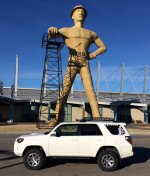
Here is the one picture I have readily available. Hope this helps.
 

Attachments

  • drillRunner sm.jpg
    drillRunner sm.jpg
    130.6 KB · Views: 8,663

Members online

Forum statistics

Threads
278,317
Messages
3,554,125
Members
248,016
Latest member
Advally Service

Trending content

Back
Top