Bilstein 6112/5160 vs Fox 2.0 - ???

the next question to ask you is what springs did you use and where did you get the shocks from? because its a pretty well known position that FOX factory valving on shocks is very stiff (read truck like, but not empty dump truck) there are many companies that order their own versions of preexisting FOX shocks with specific valving. and beyond that - if you ordered a kit from someone that includes the springs, your spring measurements may be entirely different than that of the TuRD Pro.

if you're getting nose dive with the FOX's you may want to consider bringing your control arms back into spec with a set of upper control arms if you haven't already. nose dive is more geometry based than compression resistance.

The reading of progressive vs. digressive wasn't directed personally at you. I am aware you are very familiar with the different aspects of the front coil-overs. It was more of a general statement to the thread for additional info.

Shocks were purchased from AutoAnything
They use 3.0 Eibach racing springs but it doesn't say the spring rate. I am guessing 600lb but I would have to find the part number on mine.

I did get the Total Chaos UCAs since those require the use of them.

But for a side by side comparison, the Fox 2.5s that I got are a softer ride than the tuned 6112s that the OP is asking about.
 
Last edited:
spring rate has nothing to do with the shocks themselves. you're assuming the OP wants shock/spring combo packs which totally negates the purpose of the thread anyway.

please re-read his posts.... the Fox 2.0 is a complete coil-over system.

its making a blind statement that Fox is stiffer than other systems is what "negates the purpose of the thread".

feedback on the ride of any particular suspension system is probably best left to those who actually are running it on the subject vehicle. heck, id say this would be a nice change of pace for many of the responses given on this site.

"nose dive is more geometry based"... OMG.. i'm not even gonna touch that one!

Good Luck OP, PM me if you want to talk about the Fox 2.0 or 2.5's.
 
Last edited:
please re-read his posts.

its making a blind statement that Fox is stiffer than other systems is what "negates the purpose of the thread".

feedback on the ride of any particular suspension system is probably best left to those who actually are running it on the subject vehicle. heck, id say this would be a nice change of pace for many of the responses given on this site.

"nose dive is more geometry based"... OMG.. i'm not even gonna touch that one!

Good Luck OP, PM me if you want to talk about the Fox 2.0 or 2.5's.

It's not a blind statement, it's the facts. And I'd love to hear how nose dive isn't heavily driven by geometry. You're clearly much smarter than everyone here.
 
well, at least im smart enough to know the 2.0 is a complete coil-over system.. and why is that? oh yeah, i actually have experience with it.
 
Shock Comparison

Most of this thread is a very useful comparison of shocks.

Personally, I find the personal attacks to be a waste of time. Everyone does not have to agree and there's no need to bash someone who doesn't hold the same opinion you have. I'm not naming names, I'm just saying... :lasercannon:

I'd like to hear more about progressive versus regressive, although what was said was pretty clear and may be enough said.

I'd really like to know how the UCA and geometry affects the notorious T4R nose dive I keep hearing about. I'd also like to hear how shocks and spring rate affect nose dive.

To my thinking, nose dive would be a function of spring resistance, but I'm a newbie to Toyota. I will be making this same choice with my new T4R and really appreciate any insight everyone has here. TIA :couch2:
 
well, at least im smart enough to know the 2.0 is a complete coil-over system.. and why is that? oh yeah, i actually have experience with it.

too bad you're dumb enough to assume that i don't.

thats great that the 2.0 is a complete coil over system, but that again doesnt mean jack shit when you're comparing it across the board. plain and simple the shocks are stiffer than the other brands, the spring weights are what is making you think that your Fox's ride better than the others, and thats great. of course a stiffer shock is going to ride better with a 600lb spring compared to a lighter valved one with a 650, 675 or even 700lb spring

still waiting for your genius reply on how suspension geometry has nothing to do with anti-dive.
 
I'd really like to know how the UCA and geometry affects the notorious T4R nose dive I keep hearing about. I'd also like to hear how shocks and spring rate affect nose dive.

To my thinking, nose dive would be a function of spring resistance, but I'm a newbie to Toyota. I will be making this same choice with my new T4R and really appreciate any insight everyone has here. TIA :couch2:

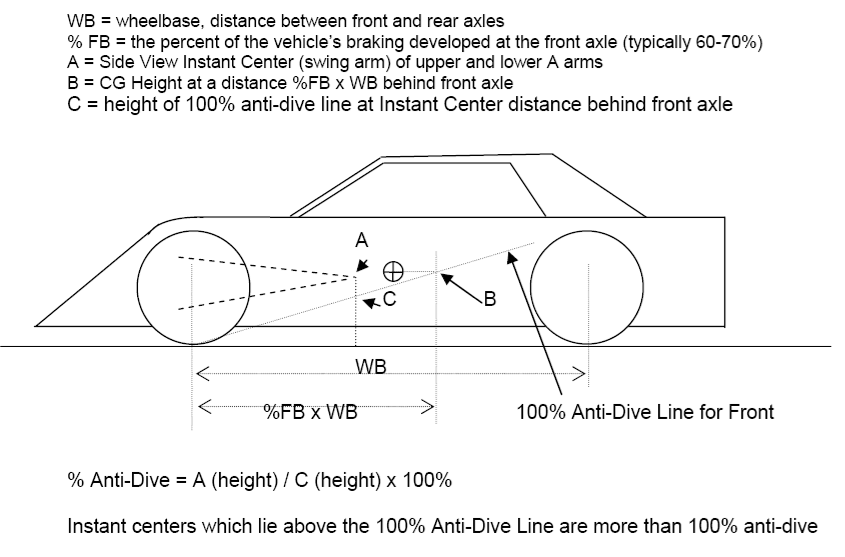
Anti Dive describes the amount the front of the vehicle Dives under braking. As the brakes are applied, weight is transferred to the front and that forces the front to dive. Anti Dive is dependant on the vehicles center of gravity, the percentage of braking force developed at the front tires vs the rear, and the design of the front suspension. (For the rare case where brakes are not mounted on on the suspended wheel, like "inboard brakes", this definition does not apply.)

For the very common double A Arm suspension, anti-dive is designed into the suspension based on the angle of the A Arm mounting points when viewed from the side. These are shown as the dotted lines in the picture below. If the intersection point of the extension lines for the mounting points is located above the neutral line, there is more than 100% anti-dive. The picture shows about 130% anti-dive which is EXTREMELY high. Because high anti-dive values can "feel" strange, require more complex suspension designs, and cause "rattling" type noises, typical values are in the range on 0-50%.

Anti-Dive.gif


basically, when you lift your truck your castor changes, which is part of the angle relative to the centerline when viewed from the side. the control arm drops down, and sucks the wheel in which affects the anti-dive coefficient. by replacing the stock upper arms with aftermarket ones that return the castor to a stock number you regain your anti-dive. ultimately the best way to further reduce your anti-dive would be to cut off the upper control arm mounts and reposition them for a more optimal figure - but thats pretty labor intensive and outside of the bounds of what people are wiling to do to these trucks.

if you look at Long travel front suspension components, the upper control arms are raked back significantly further than they would be in a stock position, their anti-dive numbers have increased. this geometry change, coupled with proper compression dampening would have a significant impact on what amount of brake dive is experienced.
 
Last edited:
genius no, but wise enough to know that no matter how i reply, you will find error. besides, now your just being rude and your fabulous graph & essay has explained everything! please keep on telling people UCA's will reduce nose dive.

for the record: i never said my fox rides better than anyone elses.
 
Last edited:
[MENTION=104049]marshal[/MENTION]
Thanks for the detailed response to my question. I think you omitted the explanation of the neutral line. If this sketch shows 130% anti dive can I assume it's the line between the center of the wheels? If not, what?
I'm a civil engineer, not a mechanical engineer. I almost get this. I think I understand the general theory.
Oh BTW, it's Clint Eastwood's 85th birthday today. I see a bit of his character from Gran Torino in your responses. My favorite line from Gran Torino: "Would it kill you to buy an American car?".
Clint Eastwood's life in pics
[MENTION=117793]RESQLAB[/MENTION]
Is that dog your rescue Labrador? He/she's a cute puppy. Did you rescue this one or do you rescue other labs too. Thanks for your input here. I got a lot out of your posts.
 
genius no, but wise enough to know that no matter how i reply, you will find error. besides, now your just being rude and your fabulous graph & essay has explained everything! please keep on telling people UCA's will reduce nose dive.

for the record: i never said my fox rides better than anyone elses.

me being rude? you're the one that picked the fight - do you need me to draw you a road map back to where you started being an *******? And, I'm terribly sorry that you don't agree with math and physics.

[MENTION=104049]marshal[/MENTION]
Thanks for the detailed response to my question. I think you omitted the explanation of the neutral line. If this sketch shows 130% anti dive can I assume it's the line between the center of the wheels? If not, what?
I'm a civil engineer, not a mechanical engineer. I almost get this. I think I understand the general theory.
Oh BTW, it's Clint Eastwood's 85th birthday today. I see a bit of his character from Gran Torino in your responses. My favorite line from Gran Torino: "Would it kill you to buy an American car?".
Clint Eastwood's life in pics

if i remember correctly how the suspension physics come together, your neutral point would be wherever 50% anti-dive would fall. I'm not 100% certain on this, but i am pretty confident thats your neutral centerline.

When a naked man is chasing a woman through an alley with a butcher knife and a hard-on, I figure he isn't out collecting for the Red Cross.
 
me being rude? you're the one that picked the fight - do you need me to draw you a road map back to where you started being an *******? And, I'm terribly sorry that you don't agree with math and physics

i simply did not agree with your original statement about fox. you took offense and it went south from their (you are the one who threw profanity around and attacked my intelligence).

in conclusion, the best part about you Marshall is that your are not even running any of the suspensions being discussed here, you have Old Man Emu! you can throw numbers and graphs at it all day, your still an opinion w/o any real world personal experience on these particular suspension applications.

no, i'm not smarter or trying to act like a genius regardless of your thoughts.. just a guy who has actually run a couple of the topic suspension set ups on his 5th gen. and offering positive feedback.
 
Last edited:
Is that dog your rescue Labrador? He/she's a cute puppy. Did you rescue this one or do you rescue other labs too. Thanks for your input here. I got a lot out of your posts.

nope, stole that image off the net.. i have 2 rescue Labs at the moment and its not a business for me. thought about it, but its a ton of work trying to place dogs.

good luck in your suspension work/build, it can be a lot of fun!
 
i simply did not agree with your original statement about fox. you took offense and it went south from their (you are the one who threw profanity around and attacked my intelligence).

in conclusion, the best part about you Marshall is that your are not even running any of the suspensions being discussed here, you have Old Man Emu! you can throw numbers and graphs at it all day, your still an opinion w/o any real world personal experience on these particular suspension applications.

no, i'm not smarter or trying to act like a genius regardless of your thoughts.. just a guy who has actually run a couple of the topic suspension set ups on his 5th gen. and offering positive feedback.

just because i called you out doesnt relieve you of being obtuse

the only old man emu component i run is their front coil springs, and i have real world experience with many of the available suspensions that fit the entire 120/150 series land cruiser chassis, just because i don't run them doesnt mean i don't have experience with them. the only one that i don't have first hand experience with is the 6112, of which i never claimed i did.

i think the fox stuff is great, i never said anything bad about it - fox is my go to brand for race shocks and i think their IFP system they've come up with for general use is a fantastic medium. I'm just a guy who has actually run a couple of the topic suspension set ups on 120/150 series land cruiser platform vehicles and offering positive feedback.
 
just because i called you out doesnt relieve you of being obtuse

seriously... obtuse? i think someone has watched Shawshank Redemption! LOL

and it was you that was called out, but whatever makes you happy in the end... bye
 
Last edited:
running with scissors

...if i remember correctly ...

When a naked man is chasing a woman through an alley with a butcher knife and a hard-on, I figure he isn't out collecting for the Red Cross.

No, He's asking for a shorter stick. :banana:

Edit: Is that a line from Dirty Harry?
 
Last edited:
WRT dive - as I understand ifs geometry caster a useful predictor of dive/anti-dive as it reflects closely the rest of the geometry relative to anti-dive characteristics. And the anti-dive is a function also of the center of gravity of the vehicle. SO... is the 4runner COG too high to have both caster angle that's functional for daily driving and anti-dive at the same time?If so is the only way to do this to design the ifs so that caster angle dramatically increases as the suspension compresses - so anti-dive increases with load on the front suspension? And if that is the case - can you actually design that into the system and still retain small bump dampening without excessive harshness? - this, in practice, would mean relocation of either the UCA or LCA pivot brackets on the frame.

It seems - without being an expert in this - that the front IFS geometry is tricky to strike a balance of driveability and anti-dive with a higher COG. But bumping the caster up to +3 or 4 might go a long way toward the anti-dive characteristics and a lot of folks are likely attributing geometry adjustment to the new shock/spring combo, when in reality it's just a function of alignment and UCA replacement.
 
Last edited:
Reality has to set in sometime for some of these guys [MENTION=104049]marshal[/MENTION]. Just because some of you are running a certain setup does not make you an "expert" or qualified to speak with authority on that component or system. Suspensions are complex. Read up and then come back to argue.

If you are properly prepared to debate a subject then you will never have your feelings hurt nor despise your opponent at the outcome.
 
WRT dive - as I understand ifs geometry caster a useful predictor of dive/anti-dive as it reflects closely the rest of the geometry relative to anti-dive characteristics. And the anti-dive is a function also of the center of gravity of the vehicle. SO... is the 4runner COG too high to have both caster angle that's functional for daily driving and anti-dive at the same time?If so is the only way to do this to design the ifs so that caster angle dramatically increases as the suspension compresses - so anti-dive increases with load on the front suspension? And if that is the case - can you actually design that into the system and still retain small bump dampening without excessive harshness? - this, in practice, would mean relocation of either the UCA or LCA pivot brackets on the frame.

It seems - without being an expert in this - that the front IFS geometry is tricky to strike a balance of driveability and anti-dive with a higher COG. But bumping the caster up to +3 or 4 might go a long way toward the anti-dive characteristics and a lot of folks are likely attributing geometry adjustment to the new shock/spring combo, when in reality it's just a function of alignment and UCA replacement.

race-spec upper control arms like the ICON billet's that have heims on the frame side that let you dial in custom caster settings would be the easiest way to increase your caster count substantially to increase anti-dive. now that said, jus like you said is highly tied around the center of gravity. those people who have heavy steel roof racks and roof top tents will need variable settings to accommodate their ever shifting COG.
 

Members online

Forum statistics

Threads
278,316
Messages
3,554,106
Members
248,016
Latest member
Advally Service

Trending content

Back
Top