brake flush

orcking

New member
I am thinking of getting a pressure bleeder to flush my brake fluid.
what is the recommended PSI ?
Rear right
Rear Left
Front right
Front left

anything else needed? keep ignition off or on for the abs to be flushed properly?

Thanks
 
Register to hide this ad
Good brake bleeders are very expensive, the cheapest way is with a miti-vac for about $50. It takes time but eventually works well. If your wife is into a workout, you can just manually bleed/flush them. Suck out and replace the fluid in the MC, start pumping/bleeding the furthest wheel first keeping an eye not to run the MC below about 1/4. If your TRUSTED local shop runs a special a flush can be had for $100-$150 and if done every 50-60k may not be bad money spent if you don't want to spend the time.
 
You don’t need one. Simply start the car, open a brake bleeder and have someone step on the brake. It will power flush out. Do so until the fluid is clean. Make sure the fluid reservoir is topped off before doing this.

I just changed rear brake pads before work this and did exactly this. The whole job, brake pad change and fluid flush, took me an hour.

 
You don’t need one. Simply start the car, open a brake bleeder and have someone step on the brake. It will power flush out. Do so until the fluid is clean. Make sure the fluid reservoir is topped off before doing this.

I just changed rear brake pads before work this and did exactly this. The whole job, brake pad change and fluid flush, took me an hour.

Only the rear brakes will do this. You will have to have someone pump the brake pedal for the front and bleed a little at a time. Still an easy thing to do with someone helping you.
 
Only the rear brakes will do this. You will have to have someone pump the brake pedal for the front and bleed a little at a time. Still an easy thing to do with someone helping you.

I swear I have done this on the front brakes too. But I’m maintaining 5 vehicles and could be wrong on this.
 
I'm sure there will be a million replies and suggestions on this but I had good results with the Care Care Nuts method. (and its easy)
Although my next bleed I'll loose the nipple and stick the tubing directly on the bleeder for a tighter fit.

https://www.youtube.com/watch?v=jpiXOBRkZs4

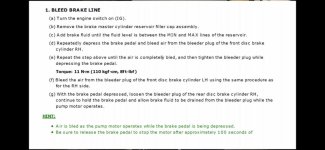
Also adding some addtl info from service manual I found somewhere on forum.
 

Attachments

  • IMG_1924.jpg
    IMG_1924.jpg
    63.7 KB · Views: 1,614
Last edited:
I'm sure there will be a million replies and suggestions on this but I had good results with the Care Care Nuts method. (and its easy)
Although my next bleed I'll loose the nipple and stick the tubing directly on the bleeder for a tighter fit.

https://www.youtube.com/watch?v=jpiXOBRkZs4

Also adding some addtl info from service manual I found somewhere on forum.

Thanks for the info.
It seems that this is different from Car Care nut and he mentions no turning on of ignition.
Also both do not mention to start in rear first which is odd.
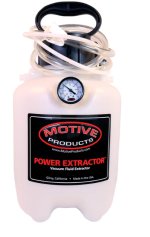
I am going to use the motive power pressure with air only to push the fluid down. and hopefully it should work...
 
Yes, Car Care Nut method you do by yourself, no need to pump brakes or turn on ignition. I think some call it gravity bleed.

Re starting in the front vs back, I think this has something to do with ABS and pump with more modern cars, where in the "old" days you would have to start with furthest piston.

I have done motorcycle brake bleeds for ages but the 4R was my first vehicle. Wasn't as bad going thru it once (as with most things!)

Good luck!
 
Thanks for the info.
It seems that this is different from Car Care nut and he mentions no turning on of ignition.
Also both do not mention to start in rear first which is odd.
I am going to use the motive power pressure with air only to push the fluid down. and hopefully it should work...

I always started the bleed process on the furthest wheel (right rear) from the master cylinder….and so on. I guess I am old AF, but that was how I was taught.
 
I always started the bleed process on the furthest wheel (right rear) from the master cylinder….and so on. I guess I am old AF, but that was how I was taught.

Ive researched the power bleeders for Toyotas and seems the general consensus is they aren't worth the time. Apparently no one makes a pressure cap, only a "universal" type and it is finicky.

I do remember reading somewhere the bleed procedure being deferent than what we have all been taught; start at the furthest caliper. I feel like Toyota recommends starting on one of the front calipers.
 
Ive researched the power bleeders for Toyotas and seems the general consensus is they aren't worth the time. Apparently no one makes a pressure cap, only a "universal" type and it is finicky.

I do remember reading somewhere the bleed procedure being deferent than what we have all been taught; start at the furthest caliper. I feel like Toyota recommends starting on one of the front calipers.

So is a vacuum pump necessary or gravity would work???
 
So is a vacuum pump necessary or gravity would work???

Just power flush the rear by stepping on the brake with the engine on. Try that on the front. If it does not work, do the old two person pump the pedal while the other opens and closing the bleeder valves.
 
I agree with [MENTION=177976]CutthroatSlam[/MENTION] I did get a vacuum bleeder because we have other vehicles. A vacuum bleeder is way easier and less messy than a pressure bleeder but not really needed for a 4Runner.
 

Attachments

  • Vacuum.jpg
    Vacuum.jpg
    120.9 KB · Views: 1,500
CutthroatSlam & SlvrRnnR are right. I replaced all the brake lines at the wheels with extended lines and flushed all my old brake fluid at that time. Key on, engine off, had my son simply step on the brake pedal and the booster pump did all the power flushing. All I had to do was crack the bleeder on the calipers and drain the fluid into an old pickle jar.
 
CutthroatSlam & SlvrRnnR are right. I replaced all the brake lines at the wheels with extended lines and flushed all my old brake fluid at that time. Key on, engine off, had my son simply step on the brake pedal and the booster pump did all the power flushing. All I had to do was crack the bleeder on the calipers and drain the fluid into an old pickle jar.

I need to do this. So simply pushing the pedal(not pumping)while KOIO will force fluid out?
 
I need to do this. So simply pushing the pedal(not pumping)while KOIO will force fluid out?

I know for a fact it does it on the rears (depress pedal with engine on) as I just did this last week. It does not take more than 2 to 3 seconds to flush each side.

I thought it does it for the fronts, but my memory could be wrong. If not, then simply do the old standby of one person pumping brake pedal, while another opens and closes the bleeder valve.
 
Because the filter in the brake res is non-removable, you’ve got to pass a lot of old fluid through the lines. Doing the rears, with the assistance of the pump, makes this much easier. I feel like I still do 5-10 sessions at 20-30 seconds each to do this. Then the fronts are easy to gravity bleed since you’re only flushing the lines.
Again, gravity bleeding is using gravity to allow the old fluid to escape the system. You can do this simply by cracking the bleeders but it’s cleaner if you use tubing and a bottle but keep it above the bleeder valve so air can’t go back up into the system. I think it takes about 20-30 minutes each wheel for this part but you don’t need to monitor it very closely.


366843d1596333974-brakepad-check-32-000-miles-80-000-miles-101-000-miles-cd595339-f42d-46ee-9d55-5db2e1c2f211-jpg
 
Last edited:
Ive researched the power bleeders for Toyotas and seems the general consensus is they aren't worth the time. Apparently no one makes a pressure cap, only a "universal" type and it is finicky.

I do remember reading somewhere the bleed procedure being deferent than what we have all been taught; start at the furthest caliper. I feel like Toyota recommends starting on one of the front calipers.

I’ve used this Toyota cap very successfully, along with a Motiv pressure tank:
Car Certified Tools Ba10 Small Toyota Master Cylinder Adapter
 
I have a Motive pressure bleeder that works great with the correct cap for the vehicle (I have the GM cap ).

For my 3rd gen T4R I bought the Motive "Universal cap" that has chains to secure it and didn't have any success with it. It was too large to work with the clutch master cylinder and getting a good seal on the brake MC was difficult.

So I bought this one man brake bleeder and it worked like a charm -

Amazon.com

This 3rd Gen T4R owner shows how it works -

Brake Fluid Bleeding / Flush (One Man) - 3rd Gen Toyota 4Runner - YouTube
 

Members online

Forum statistics

Threads
278,304
Messages
3,554,041
Members
248,016
Latest member
Advally Service

Trending content

Back
Top