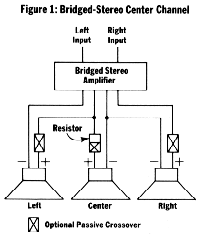
Essentially, you are taking positive from one speaker and negative from the other speaker (stereo), which would give you a mono signal for your center channel.
The crossover would go in series on the positive line into the center channel and is meant to filter out certain frequencies for your smaller center speaker.
Personally, I would not do this unless you had a signal processor to control the center channel independently from the other front speakers. Basically, all your front speakers would be getting the signal from the same amp at the same time, and because they are all positioned at different locations in the vehicle in relation to your ears, you would want to delay the ones that are closer to your ear. This is called time alignment, and can be used so that all the speakers reach your ears at the same time. Similar to a surround sound in a home theater setup, as a plane flies overhead, the sound comes out of different speakers at different times to achieve this effect.
Also, having a different center speaker than the side speakers, would mean the speaker sensitivity and power handling would be different than the other side speakers.
Generally adding a center channel to a basic setup, you have more things working against you than any benefits that may be had. If you really wanted a center channel, I'd recommend either going with a signal processor with time alignment and a center channel out, our an amplifier that has a center out. The l-pad is meant to attenuate, not control delay, essentially a volume knob to turn the center channel down or independent of the other front speakers negating some of the effect of the center channel. This will allow you to turn the stereo volume up louder than the point of distortion of the center channel. Without this, as you turn up the stereo, the center channel will begin to distort far sooner than the larger, higher power handling door speakers will. By turning down/ cutting power to the center channel, it allows you to run the volume higher than you would otherwise. More speakers does not equal louder necessarily, it is the power of your amplifier that is driving the speakers that dictates the db's you hear. The amplifier does not care how many speakers are connected to the outputs or where they are located in the vehicle in proximity to the listener. But based on whatever the effective impedance the amplifier sees, will dictate what the speakers see in watts which you hear in db's.
I hope this helps.