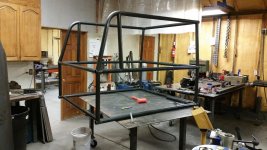
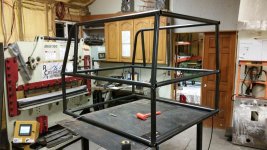
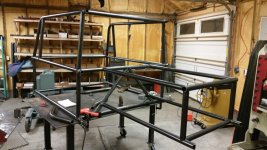
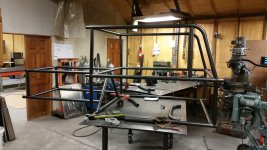
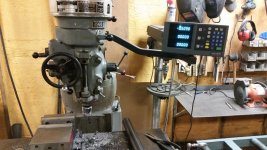
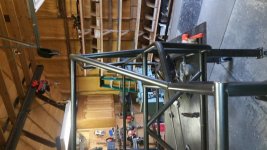
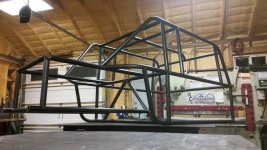
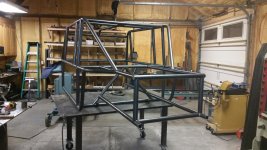
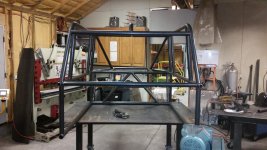
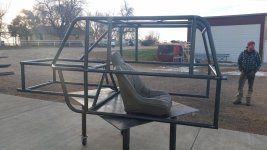
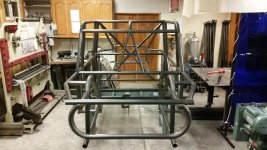
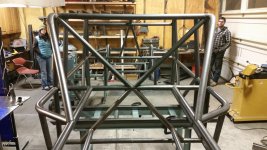
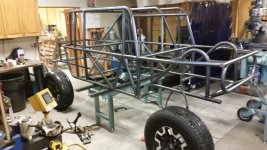
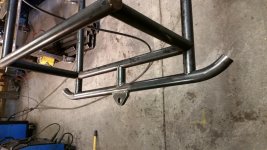
Man, there are a lot of connections/joints on that. Wont be as strong as it could using continuous lengths where you can
Apparently bends are technically weaker than straight tubing (I'm not entirely sure if I agree with that consensus as combining arches and nodes I would imagine would provide better load distribution with less material than tons of straight tubing and nodes), so Node construction is used to maximize the use of straight tubing and reinforcement.
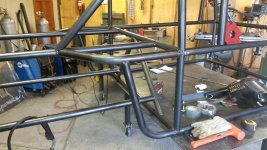
This actually makes a lot of sense when you think about the varying forces the frame will sustain in varying situations. With proper material, welding, and design the force of impacts and stress should be directed along the tubes and into the nodes where they will be strongest, vs. in the tubes themselves where they could buckle. Ideally you use Triangles anywhere and everywhere you can; Triangles are your friend. They are one of the best ways to distribute loads and can take a lot more punishment from various directions than a square. In places where a triangle cannot be used or is not desired (i.e. for an aesthetic or practical choice like for passenger seating and/or doors, ect.) plate or tube gussets should be used.
Also an example of Gusseting using tubing:
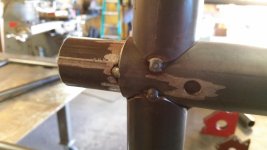
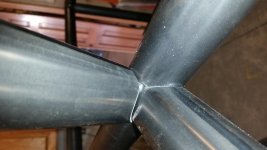
A close up of a node joint using TIG, what you don't see is that each tube is welded as it's layered like a puzzle, creating a strong load bearing joint.
Personally I would want go with a Halo-Bar Type build and use one or two long "perimeter" tubes that are bent slightly to establish the sides of the vehicle. Then tie them to the Halo-bar on top to establish a rough shape/skeleton, before going crazy with reinforcement triangles and gussets. But that's not always viable depending on what kind of mandrel bender you're using and tubing length/size/diameter you're using. Most small scale builders are probably not going to have the bender and space to bend a 30ft tube like the OP pointed pointed out.
You know more than me. I just know that chit wouldn't fly in a drag car. Were talking about lives here. I'm not bashing...as stated, you know more about this than I do.
Maybe thats why rock crawlers have, like, a rediculous amount of tubes, bent all different directions and such? To strengthen the 'nodes' and joint areas?
That's mostly right, if look at most race cars you'll see that they also utilize nodes a lot as well. Keep in mind this is the beginning stages of his frame construction. I imagine after he's squared away the perimeter and rough shape he'll go back and add additional supports and gussets to the nodes to make it solid.
...Dual transfer case gearing is twice as low, and I can still use single low if I don't need to crawl too slow.
Hmm... I was going to say "isn't that what a dual stick transfer case does?" But apparently my assumption that the second stick was an additional gear reduction was erroneous (though honestly I'm surprised it's not utilized like that.) So when you say 2 transfer cases do you mean 2 actual full chain driven units that have both input and 3 outputs? or like one is a traditional case and the other is just a gear reduction box? I'm trying to visualize how you would install two transfer cases to use as a gear reduction set.
Post Note-
I almost forgot to say, that thing looks great! Can't wait to see it with the running gear in it!