Charging Trailer batteries from the 4R.

rickst29

Member
I write this post as a new Thread, providing definitive answers for two questions which appear frequently - with usually incorrect answers. The way that it all works is complicated. :flamewar:

  1. Will my 4Runner (and unmodified Trailer) re-charge the TM batteries while towing?" and
  2. Will the Fridge, while running from 12 VDC power, discharge the Trailer batteries during towing?
Short answer #1: NO , an unmodified Tow Vehicle will never re-charge Trailer batteries while towing; and #2, the Fridge WILL (usually) draw on the Trailer batteries "first", discharging them to roughly 50%, before drawing much power from the 4Runner.
- - - -
"Will my 4Runner (unmodified) re-charge the TM batteries while towing?"
The answer is NO,
and upgrading to a somewhat bigger "Trailer Battery Charge" wire will not help this by much. (The "Trailer Battery Charge" wire in my 2007 "Sport" was only 14-awg; I upgraded to 10-AWG, and found virtually no improvement in "ability-to-charge" from that step alone.)

In the 4R, voltage of "+12VDC" is determined by a regulator which is integrated into the Alternator. It sets the Output Voltage (and resulting current) by using a "sense" wire connected into the under-hood fuse box bus. When voltage on the Sense wire is tested, the Alternator's output-adjusting moveable magnets are moved slightly, creating a change in the induced Voltage and Current.

For a short period after running the Starter, the Alternator will run at very high levels of Voltage and Output current - creating a system Voltage well above 14 Volts, which will help the 4R battery recover quickly. But, after the 4R Battery has recovered to a fairly high State-Of-Charge, the system Voltage will be allowed to drop - to a value which around 13.5 Volts.

Even with an upgraded "Trailer Battery Charge" wire, and with further upgrades to the Trailer Battery wiring connections, 13.5 Volts (or even less) will not provide significant charging power into the Trailer batteries. The problem is Low Voltage right at the beginning. Reducing Voltage drop along the wiring path helps a little bit, but not enough to push substantial power into the batteries.
- - - - -
"Will the Fridge, while running DC-12V, discharge the Trailer batteries while Towing Towing"?
Generally YES, although this IS a function of Voltage Drop along the wires.
The DC-Powered Refrigerator will draw about 12A from the "best" source of Voltage into the DC Load Center. Within my own Trailer, Voltage can be provided from Trailer batteries at 12.8 -> 12.5V (as the batteries discharge). At the 4Runner fuse box, Voltage can be provided at about 13.5V. But the Trailer Batteries are the preferred source, until wiring from the TV is substantially modified, or more substantial modifications are made in the Trailer.

Before upgrading my 4R "Trailer Battery Charge" to 10-AWG, running the Refrigerator in my trailer would cause the Trailer batteries would fall to about 50% State-Of-Charge, before a majority of the necessary power started to be taken from the 4Runner. With the wiring Upgrade, the Trailer batteries would "level off" at 65-70% SOC. But actual charging still doesn't happen.
 
Register to hide this ad
Solutions which Work (for charging batteries).

  1. Buy a purpose-built Redarc or Ctek, which Boosts "Tow Vehicle Voltage" after it is received in the Trailer. They include the Charge Controller (to avoid over-charging your batteries). They cost a lot. They don't REQUIRE mods to the 4R, but upgraded trailer wiring is desirable - because these devices can pull a lot of amps.
  2. Create a new "Charge from TV" method (using a 120VAC cable connected to Trailer 'Power Converter' AC input), fed by a 120VAC "Inverter" inside the 4R. This is fairly cheap, but requires another cable between TV and TM at the hitch, and running all the way back to the Converter. (It's ugly, and it's a high-voltage cable.)
  3. Increase TV Voltage by modifying the Alternator Sense Wire. Simply insert a Diode into the wire. (A standard silicon diode, NOT a Shottky.) This will introduce a Voltage drop of about .7 Volts, and raise the TV operating Voltage by the same amount. Very quick, very easy - but I do not recommend this, because it will overcharge both the Trailer and TV batteries if left in place for "too long".
  4. If you already have Solar panels, but need charging at night (or under clouds) - create a Redarc-Like "split configuration". (Next Post, with pictures).
 
Last edited:
My solution, Charge Trailer Batteries from the 4Runner

The Redarc device includes a voltage booster AND a Solar controller. I already own a very good Solar Controller for my 300W of Trailer panels: For me, about half of the Redarc device is an expensive redundancy. Furthermore, Redarc pulls power through the 4R Trailer wiring (and Bargman connector) at low Voltage, causing relatively high Voltage Drop and Power Loss.

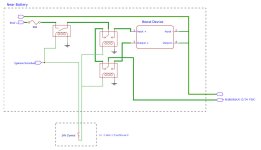
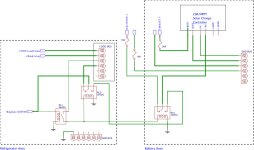
I instead built a "split system". Under the 4Runner hood, right near the battery and Alternator, I boost the Voltage to 24+ VDC. This "boost function" is controlled by a switch at the dashboard. Then, in the Trailer, a Relay with 24V coil detects whether the 4R is connected at ~24V or ~12V, and responds as follows:
  • If 24V is present, the Solar Controller receives input from the 24V "Boost" 4Runner power source; or
  • If 24V is not present (i.e., the Relay "sees" ~12V or nothing at all) then the 4Runner connection goes directly to the "DC Power Distribution Panel", and the Solar Controller Receives input from the genuine Solar Panels.
When Solar conditions are not optimal, I switch my system to run 24V through the Bargman wiring (at only half the current of the Redarc solution). Diagram and 4R pictures are attached. In my Trailer, the Bargman cable terminates behind the refrigerator, while the Solar Controller and Battery are "remote". Maximum power is about 300W, and actual Battery Charging is controlled by my MPPT Solar controller. Two other connectors (a 4-wire Push terminal, and two yellow wire nuts) simply connect all "Ground" leads back to the bolt which connects frame to "battery -", forward and above the outside edge of the OE fuse box.

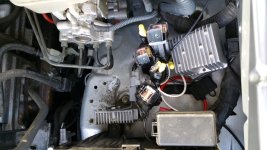
In picture #2 (under the hood): You see a large black wire from the bottom right, going from the battery into the red wire nut under the small OE plastic Relay Box. The red wire nut connects into the weather-resistant fuse holder (30 fuse inside). A smaller black wire comes from the right, up the middle: This is an engine switched wire from inside the OE fuse box. (the OE connection was for a 120VAC Inverter, which I don't have.) It's used to switch the Bottom Relay, which is simply an ON/OFF for power from the 30A red fuse.

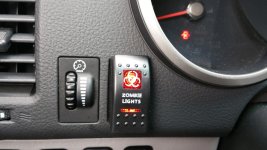
The two other Relays are 5-pin, and switched together (12V control from the "zombie switch", smaller black wire going to the top-most yellow wire nut. When unswitched, "12V" goes straight through to the 12/24V output wire (heavier black wire, going to the right from the "middle" Relay. But when switched, 12V is diverted to Booster input ("top" Relay) - and 24V Booster Output is connected to the output wire.
 

Attachments

  • zombie-switch.jpg
    zombie-switch.jpg
    79.5 KB · Views: 1,958
  • 4runner_under_hood.jpg
    4runner_under_hood.jpg
    142.7 KB · Views: 2,058
  • Rick-TV-wiring-scheme-A.jpg
    Rick-TV-wiring-scheme-A.jpg
    57.1 KB · Views: 2,396
  • Trailer-Wiring.jpg
    Trailer-Wiring.jpg
    70.2 KB · Views: 3,469
Last edited:
Thanks for this thread, I am in the process of adding a camping trailer to our garage that has a solar charging feature for it's internal batteries but I'd love to take advantage of using the tow vehicle to top off the batteries while on the road. Subscribing to the thread so that I can follow the discussion and refer to it when needed.
 
My Parts list (matching 170 aH of batteries).

(1) Prerequisite: A solar configuration of about 300W total rated power, using a 20A MPPT controller. Among current models I recommend the newer model "Tracer 2215BN" from EP Solar. (Not a cheaper old model, because they lacked ability to tune charging parameters, and they were also more likely to "blow up".)

(2) Qty 4: High-Amperage 5-pin Automotive Relays (with standard 12VDC Coil Voltage). Two in the 4R, two more in the Trailer. Like these: DC 12V 80A Coil 5 Pin SPDT Vehicle Car Universal Power Relay w LED Light | eBay.

(3) A Booster Module, maximum power slightly greater than the maximum which the Solar Controller will use. (In my own case, which is almost identical to the "20A" Tracer I listed above, maximum power handling is about 14.4V * 20A = 288W). This one is sufficient, barely: DC 12V 80A Coil 5 Pin SPDT Vehicle Car Universal Power Relay w LED Light | eBay. Ebay also offers plenty of bigger ones, which assure that the limiting factor will be Solar Controller protection circuitry.

(4) In the Trailer, Qty 1: Another High Amperage Relay, but one equipped with 24V coil voltage. (Hint: Car alarms use these.) Car Alarm SPST 15mm Rail Relay Socket 4 Pin 4 Wire Cable 40A 24V DC JD2914 | eBay

(5) Optional: Fuse and Relay for connecting the Booster directly to the Battery, as I did. Your easiest choices are #1, build everything in the cabin starting with the already-switched "30A" 12V Trailer Battery charge wire (from just above the wiring harness.) Or, #2, build everything under the hood. With #1, you have a segment of AWG-14 (at best) supporting a load which could reach up to 25A, and you have a heat-producing "Booster" in the cabin. I don't like those things. With #2, you pull a small "control wire" from your controller switch, back through the firewall to run the Relay coils - and you pull new AWG-10 wire segments through the fuse, ignition-switched Relay, and "power path" wiring back through the cabin to reach the Bargman. I did #2, using this 4-pin Relay: 1pcs DIY Heavy Duty Car Vehicle Truck 12V 12 Volt DC 80A SPST Relay 4pin 4P | eBay
 
why not do this and use an solenoid on the positive side so it disconnect the hot while not running in case you forget to unplug? basically a removable dual battery set up. and you can also integrate your solar system to it too i think.
<iframe width="1280" height="720" src="https://www.youtube.com/embed/I8CECwKQaPk?rel=0" frameborder="0" allowfullscreen></iframe>
 
Good Comments!

why not do this and use an solenoid on the positive side so it disconnect the hot while not running in case you forget to unplug?
I agree, and that's optional part #5. My 4-pin Relay is switched ON/OFF by an "engine-running" fuse socket connector which Toyota provided in the under-hood fuse box. (It's there for an accessory I don't have, the on-board 120V inverter.) That Relay is the first thing after the fuse, and affects both 12V and 24V operation. There's never a need to unplug or flip the switch when you're stopping for lunch.
.... and you can also integrate your solar system to it too i think.
My Solar panels run at about 60 Volts. The Redarc devices runs a small Solar setup in parallel with the 4R, and that's better - but they require panels to be wired in parallel, causing more power loss in the wires. (They can't do voltage matching past about 25V). A variable boost, with circuitry to create a voltage match, would add a lot of cost and complication - that's why the Redarc machines cost so much.

For running simultaneously, the Redarc units are optimal. But my scheme allows Solar (alone) when sky conditions are good, and a switch to the 4R alterator (alone) when lighting conditions are bad - both at a maximum of about 300W, which is plenty for small trailers (without people watching TV in the Trailer, or similar loads). With a more powerful booster, bigger wiring, and a bigger MPPT controller, my scheme could manage more power - but you're slightly limited by the bargman cable, which probably shouldn't be asked to handle more than 20A continuous.
 
"Brute Force" 12v versus Voltage Mods. (Long Reply).

Your video's method uses "brute force" at 12V, while my ideas utilize some kind of conversion before sending power from the TV.

In the video, massive wires are used to help the alternator "see" that the Trailer batteries are low (in need of charging). The use of huge wires between the Trailer Bank and the House Battery (basically) pulls the whole F150 down to the Voltage of the lowest battery - which is a good thing, when batteries need charging. The 3 batteries constitute a single battery bank.

My scheme is a bit more complicated, with separate battery charge controllers focused on their own batteries. (The 4R alternator "sees" the 4R battery, in the usual way, and the Solar Controller "sees" the Trailer battery string). But it has a couple of relative advantages: First, it avoids hanging more wires between TV and Trailer. And second, the maximum draw allowed on the "Trailer Charge Connection" is limited to 300W, in multiple places. That's a significant safety advantage, compared to loose wires hanging between TV and Trailer, carrying unlimited (and possibly fatal) amounts of power and current.

Another, safer version of your scheme (i.e., higher power, new wires) would use a high powered inverter in the Ford, and run the 120V through an arc-fault Breaker immediately after that conversion. (Combining techniques of your implentation AND mine.) The wires can be quite a bit smaller. But you still need at least one add-on wire because the Bargman DC "ground" should not be mixed with AC "grounding" return loads on a single wire. (I'd probably use one 3-wire "extension cords" between the Inverter and a locking Trailer connector, and another between the Trailer end of the Cennctor and the Trailer's 120VAC Power Converter/AC distribution panel.) This adds a lot of safety.

Bit, an issue with this scheme is compatibility of the Arc Fault Breaker with the Trailer's "Power Converter". A lot of lower-quality Power Converters are quite "messy", and cause GFCI and Arc-Fault Breakers to trip when they start running conversion to "12VDC".

OTOH, if it works, with your massive Alternator, you could possibly even run AC in the Trailer- while driving down the road.

Just another 'alternate' idea. Your uses "brute force" at 12V, mine do different kinds of conversion before sending power from the TV. Thanks for your post, it was great!
 

Members online

No members online now.

Forum statistics

Threads
278,315
Messages
3,554,104
Members
248,016
Latest member
Advally Service

Trending content

Back
Top