Clutch Engaging Too Low (Looking for suggestions)

Jwpete

New member
Hoping for some tips and suggestions from the more experienced T4R owners out there. Any tips or suggestions welcome.

Recently completed a full clutch swap and transmission service in my 98' 3.4L 5 speed. The following items were replaced: Clutch, Throwout Bearing, Pilot Bearing, Flywheel, Master Cylinder, and Slave Cylinder. Also Flushed transmission and refilled with Masterpro 75W-90 GL-5 Gear oil and replaced the shifter seats and bushings with the marlin crawler ones.

The problems is, the clutch engages about 1/2" off the floor and doesn't seem to 100% disengage even with the pedal fully pushed to the floor. Shifting into first and reverse is very notchy and often requires some muscling to even get it into gear. Other gears seem to be fine.

This issue was happening before I even swapped the clutch and related items, which is the main reason I swapped the clutch to begin with, and the issue seems to be about the same now as it was before I started. Not fun after spending so many hours and dollars getting the new parts in.

After several hours of scouring the forums and seeing a variety of similar issues here are a few things i have already tried: Replacing master and slave cylinder (issue appeared after just swapping the clutch so I hoped a new slave and master would solve it); bleeding the hydraulic fluid, both by vacuum and the old fashioned way (no bubbles and good flow); checking for leaks in the lines from master to slave (seem to be none); checking the mounting bolts on the slave to the bellhousing (no movement or cracks noted); checking the movement of the clutch fork (getting somewhere between 5/8 and 1" of travel at the slave); and fully turned out the adjustment rod from the master cylinder to clutch pedal (with rod in, trans won't even go into gear, and rod is currently turned so far out it has hardly any thread engagement).

Not sure what else to try to remedy this issue so any ideas or suggestions would be appreciated, or if I'm missing something obvious call it out.

Thanks in advance - JP
 
Register to hide this ad
My first thought was pushrod but you said you tried it at both extremes and it didn’t help?
 
This issue was happening before I even swapped the clutch and related items, which is the main reason I swapped the clutch to begin with, and the issue seems to be about the same now as it was before I started. Not fun after spending so many hours and dollars getting the new parts in.

Thanks in advance - JP
Was it ever right since you owned the truck?

Any chance the rubber line is bulging? Did you use OEM master/slave cylinders or aftermarket?

-Charlie
 
My first thought was pushrod but you said you tried it at both extremes and it didn’t help?
Yeah, pushrod fully extended I couldn't even shift into first and pushrod all the way out it shifts into gears but barely.
 
Last edited:
Did you put the Clutch in properly? I believe the 4runner clutch can physically go in either way and it supposed to be put in backwards from what the clutches say on them. We are supposed to follow the factory manual on how they go in.

Clutch Kit Install Instructions | Marlin Crawler, Inc.
the friction disk only fit one way into the clutch cover and it was labled flywheel side which went against the flywheel, so to the best of my knowledge and following the FSM, It is installed correctly.
 
Was it ever right since you owned the truck?

Any chance the rubber line is bulging? Did you use OEM master/slave cylinders or aftermarket?

-Charlie

Its hard to tell if the line is bulging, probably should just go ahead and replace it to remove a variable. My gut says it would not be getting as much travel at the slave as it is if the line were giving a lot. The amount of movement from the pedal to the slave cylinder seems pretty linear also. Its not like there is a delay for the line to expand before the slave moves or the slave stops while the pedal keeps traveling. They seem pretty direct, it's as if i need an inch more adjustment on the master cylinder push-rod and everything would be perfect. Slave and master cylinder were "Power Torque" O'Reilly parts. Looked identical to what was in it before. For better or for worse...
 
Last edited:
Did you bench bleed the master cylinder to get any tiny air bubbles out? It might be worth a shot. You could probably do it while its still in the vehicle with the help of another person stepping the clutch pedal and use something to catch the fluid. The main thing you want to do when bench bleeding is to plug the hose with your thumb when the push rod is released so that the air bubbles don't suck back in. I never understood the youtube videos that show the hose in a container of brake fluid and sucking the air bubbles in and out over and over again.
 
clutch suggestions

Another possibility is that the throw out bearing fork has a stress crack and is deflecting when you press in the clutch. U might be able to tell by removing the dust cover on it and looking at it while someone else is pressing the clutch pedal. This happened to my friends FJ40. Good luck


Mike M
 
Did you bench bleed the master cylinder to get any tiny air bubbles out? It might be worth a shot. You could probably do it while its still in the vehicle with the help of another person stepping the clutch pedal and use something to catch the fluid. The main thing you want to do when bench bleeding is to plug the hose with your thumb when the push rod is released so that the air bubbles don't suck back in. I never understood the youtube videos that show the hose in a container of brake fluid and sucking the air bubbles in and out over and over again.
We bled the clutch by pumping it in and out and then holding it to the floor, cracking the bleeder and letting the fluid come out, and then closing the bleeder before releasing the pedal. This avoids sucking up air bubbles no? Or would there potentially still be bubbles in there?
 
You made sure to properly torque the pressure plate right?
I have seen people over torque the plate and they get the same results or worse that you have.
 
Did you bench bleed the master cylinder to get any tiny air bubbles out? It might be worth a shot.
Clutch master cylinders are much less finicky with bleeding that brake master cylinders... I was recently able to bleed a brand new master and slave on my Camry with 0 help (just pumped the pedal with the slave bleeder slightly cracked and diligently keeping fluid in the master).

A cracked clutch fork is an interesting idea...

Here's the FSM list of stuff to check for "Clutch does not disengage"

1. Clutch pedal (Freeplay out of adjustment)
2. Clutch line (Air in line)
3. Master cylinder cup (Damaged)
4. Release cylinder cup (Damaged)
5. Input shaft bearing (Worn, dirty or damaged)
6. Clutch disc (Out of true)
7. Clutch disc (Runout is excessive)
8. Clutch disc (Lining broken)
9. Clutch disc (Dirty or burred)
10.Clutch disc (Oily)
11.Clutch disc (Lack of spline grease)
12.Diaphragm spring (Damaged)
13.Diaphragm spring (Out of tip alignment)
14.Pressure plate (Distortion)

-Charlie
 
For what it's worth, during the clutch swap I pulled the TOB fork out and cleaned it up with a wire wheel because it was covered in old grease and clutch gunk. I think I would have noticed any major cracks, bends, or damage on the fork while i was cleaning it up, though to be fair, I wasn't looking for them at the time. In hindsight I wish i had gotten a replacement fork just to rule out another issue. Really hoping to not drop the trans again but it may have to happen.

To address the pressure plate comment, I did not use a torque wrench on the flex plate bolts like I know I should have, as mine does not go as low as the 14 ft. lbs required by the FSM. Shouldn't make a huge difference though right as it is simply snugging up to the flywheel? All the research I have done makes me believe that bolt torque should have no effect on clutch plate engagement or disengagement. But if any of you know better, please correct me.

One thing i'm beginning to suspect is just shoddy parts? All major clutch and hydraulic parts were O'Reilly "Power Torque" brand. I don't know if any of you have had any positive or negative experience with the quality of these parts. Perhaps the master cylinder rod or the slave cylinder are just not quite the right length? or the fingers on the pressure plate weren't quite right? Still more questions than answers.

Thanks to all of you for input!
 
Last edited:
Oh man, Aisin parts are not that much. Swap out both cylinders for Aisin and put a new hose on there too. I used Centric brand with good success so far.
 
For what it's worth, during the clutch swap I pulled the TOB fork out and cleaned it up with a wire wheel because it was covered in old grease and clutch gunk. I think I would have noticed any major cracks, bends, or damage on the fork while i was cleaning it up, though to be fair, I wasn't looking for them at the time. In hindsight I wish i had gotten a replacement fork just to rule out another issue. Really hoping to not drop the trans again but it may have to happen.

To address the pressure plate comment, I did not use a torque wrench on the flex plate bolts like I know I should have, as mine does not go as low as the 14 ft. lbs required by the FSM. Shouldn't make a huge difference though right as it is simply snugging up to the flywheel? All the research I have done makes me believe that bolt torque should have no effect on clutch plate engagement or disengagement. But if any of you know better, please correct me.

One thing i'm beginning to suspect is just shoddy parts? All major clutch and hydraulic parts were O'Reilly "Power Torque" brand. I don't know if any of you have had any positive or negative experience with the quality of these parts. Perhaps the master cylinder rod or the slave cylinder are just not quite the right length? or the fingers on the pressure plate weren't quite right? Still more questions than answers.

Thanks to all of you for input!

Only use OEM Clutches, Marlin Clutches and a handful of excellent A/M high end clutches. Never use low end Clutch parts from Auto parts. We used to see those scatter in the Toyota 80s Trucks but they were cheap and all really junk quality.

If your use Chain stores parts, that could be your entire problem. I learned this a long time ago. Actually in the 1990s never use auto parts store after market parts for your clutch pieces.

For Example:

The plunger went bad in my 1983 Toyota 4x4 5 speed in about 1998. I changed it with a chain parts store. it didn't last a week and started leaking again. I changed it again. I few weeks later It started leaking again. I went and bought an OEM plunger and it never leaked again.

Same truck slave cylinder. Started leaking fluid. So I changed it with an auto parts replacement cylinder. A few months later it started leaking again. I went and bought a OEM slave cylinder and it never leaked again. Granted. I believe the slave cylinder OEM was twice as much as the autoparts one. However, it was worth every penny to have the clutch working properly that was when I learned not to mess around with a lot of parts on Toyota vehicles.

From what you are explaining, This is really sounding like the clutch isn't getting disengaged properly. Could be a pile of different reasons and that makes it very hard to find. From the slave cylinder, Pressure plate, wrong size throughout bearing, incorrect clutch size{ mfg made it the wrong size }.


If its not a hydraulic issue, with the Plunger, slave cylinder or air in the fluid. I would suspect the pressure plate as the cause.

You do have the pedal adjustment set to factory spec right?

Clutch engaging too soon

Has info on how to adjust your pedal.
 
For what it's worth, during the clutch swap I pulled the TOB fork out and cleaned it up with a wire wheel because it was covered in old grease and clutch gunk. I think I would have noticed any major cracks, bends, or damage on the fork while i was cleaning it up, though to be fair, I wasn't looking for them at the time. In hindsight I wish i had gotten a replacement fork just to rule out another issue. Really hoping to not drop the trans again but it may have to happen.

To address the pressure plate comment, I did not use a torque wrench on the flex plate bolts like I know I should have, as mine does not go as low as the 14 ft. lbs required by the FSM. Shouldn't make a huge difference though right as it is simply snugging up to the flywheel? All the research I have done makes me believe that bolt torque should have no effect on clutch plate engagement or disengagement. But if any of you know better, please correct me.

One thing i'm beginning to suspect is just shoddy parts? All major clutch and hydraulic parts were O'Reilly "Power Torque" brand. I don't know if any of you have had any positive or negative experience with the quality of these parts. Perhaps the master cylinder rod or the slave cylinder are just not quite the right length? or the fingers on the pressure plate weren't quite right? Still more questions than answers.

Thanks to all of you for input!
Did you take any photos of the installation. I have seen a truck where the pressure plate was over torqued because they didn't use a wrench. (Harbour freight torque wrenches are actually really accurate so go grab some) and they couldn't disengage the clutch.

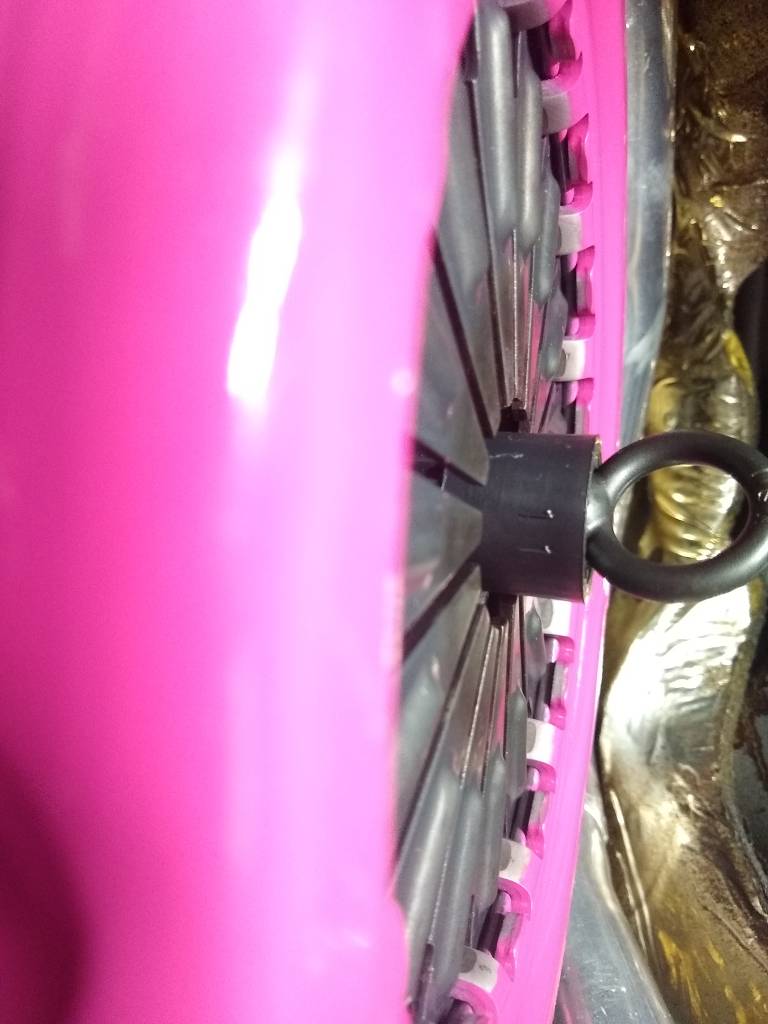
The forks should be nice and level when properly torqued.
039c3fdaeb4667e2cc46aed20d714645.jpg


Sent from my moto g(6) using Tapatalk
 
I'll also add this. A couple of years ago my brother replaced his clutch/parts with autozone stuff and it behaved the same ways as yours. Barely let off on the clutch pedal before the jeep would start going. We tired different things to fix the issue and finally ended up pulling the tranny and replacing the clutch/pressure plate and it's hydraulic system with better quality parts. That solved our problem. Granted this jeep clutch/pressure plate and hydraulic system is different from Toyota's but my point is that your problem could due to low quality parts. Good luck and hopefully you won't have to pull tranny out again.

Mike M
 
I also think you should check your clutch pedal adjustment first per FSM. Also make sure those little plastic buttons that your clutch switches hit are still intact
 
I concur with St. Runner, there is a lot of adjustment under the dash to increase throw. Just don't wrench your back twisting in there, take seat out if you plan on working under there for an extended period of time.

I have had a couple 5 speeds and never had a low engagement.
 
I have installed clutches in three Gen3s. One V6, two I4s. All were Aisin clutch kits obtained from A Large Online Seller, CKT-040 and CKT-051 respectively.

In the first two jobs I had to use too much, in my opinion, of the travel adjustment under the dash to get proper pedal height.

For the 3rd job, I tried to do something while the transmission was removed to alleviate this situation, if only just a little bit. I perhaps bought myself 2 threads worth of adjustment under the dash.

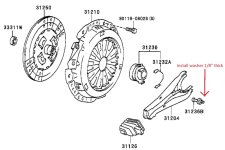
The reasoning goes like this: if the flywheel is resurfaced, likely only .010 inches or so - make sure your machinist maintains the step - then the entire clutch assembly moves forward that amount.

What can be done to move the fork forward by that amount so the difference doesn't have to be taken up my the pushrod from the slave cylinder?

I installed a washer under the fork's fulcrum, that round-headed "bolt" at the back of the bell housing. Doing so moves the fulcrum forward by the washer's thickness. You wouldn't want to do more than 1/8", 3mm, or so as it doesn't have a real deep purchase in the aluminum. But it doesn't need a lot: it's under compression, not tension.

I think (I've not measured) the Aisin items sold outside the OEM channel are perhaps not the same height as the OEM ones. I know they're different in appearance. I've been happy with their performance.
 

Attachments

  • 5vz-fe clutch.jpg
    5vz-fe clutch.jpg
    100.2 KB · Views: 806

Members online

No members online now.

Forum statistics

Threads
278,312
Messages
3,554,089
Members
248,016
Latest member
Advally Service

Trending content

Back
Top