Comparison/Ratings List for MOST Toyota OME Coils

JWaldz

Moderator
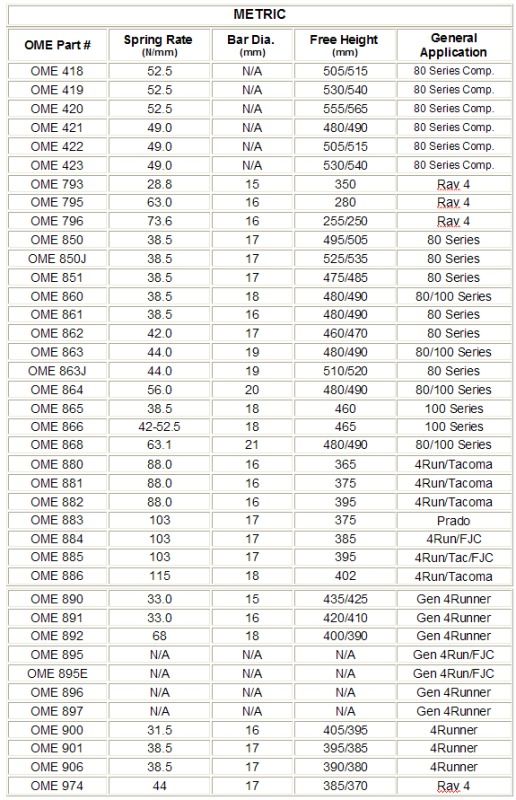
Found this list online and decided to dr. it up a little bit. Should be helpful down the line for others.

omecoilsmetric.jpg~original


omecoilsstandard.jpg~original


Thanks to CruiserOutfitters
 
Register to hide this ad
Can someone explain the relation between Free Height, Spring Rate and Bar Diameter is? I see that the 906's have a 10lb greater spring rate than 891's, but most people are complaining about a super stiff ride for the 891's and not the 906's. Also the 883's have a greater spring rate and bar diameter than the 882's, but a shorter height. Yet people say the 882's ride stiffer and handle weight better than the 883's.
 
You can have a higher spring rate but with more coils per inch and it will be a softer coil.

Basically if you have two coils of the same length, the one with more wraps will flex better but still hold the weight.

Progressive coils have a few wraps that are close together and more wraps that are further apart.

It's real hard to just look at some numbers and definitively say what a coil is going to ride with. Those lists are helpful but don't have all the info to make a definitive decision. You also need to know wraps per inch and if it's progressive.

A perfect example is the 861 (OME 861, 220, .630, 18.90/19.29) Progressive
will ride lower than the 851 (OME 851, 220, .669, 18.70/19.09) Non-progressive
by about an inch. This is partly due to the fact the 861 is a progressive coil.

FYI: stock 4runner rear coils are ~170#
stock LC coils are ~180#
Tundra TRD coils are ~595#
 
Last edited:
Got ya, so basically it would be helpful to include a column stating progressive or non-progressive. Yeah the numbers look deceiving and could lead people down the wrong path. Thanks again Gerdo.
 
You can have a higher spring rate but with more coils per inch and it will be a softer coil.

Basically if you have two coils of the same length, the one with more wraps will flex better but still hold the weight.

Progressive coils have a few wraps that are close together and more wraps that are further apart.

It's real hard to just look at some numbers and definitively say what a coil is going to ride with. Those lists are helpful but don't have all the info to make a definitive decision. You also need to know wraps per inch and if it's progressive.

A perfect example is the 861 (OME 861, 220, .630, 18.90/19.29)
will ride lower than the 851 (OME 851, 220, .669, 18.70/19.09)
by about an inch. This is partly due to the fact the 861 is a progressive coil.

FYI: stock 4runner rear coils are ~170#
stock LC coils are ~180#
Tundra TRD coils are ~595#
Thank you Gerdo. I meant to state that but forgot. As long as the thread grows with more information, it's still helpful for others.
 
I toiled over the 861/851s for quite a while I knew that the 851s were too tall for me but I needed the capacity. The 851s are taller but ride shorter once in the rig. I took a chance and it worked out great for me.
 
I have a question as well. The 890s are taller than the 891s according to the free height numbers. And the two are identical for spring rate (33). So how is it that the 891s give more lift and ride stiffer? I see the bar diameter is 1mm thicker on the 891s, but what difference does that make if the spring rate is identical? If you have two coils with the same spring rate, the taller one should sit higher (mind blowing logic I know). And the ride quality should be about the same regardless of height if the spring rates are identical.
 
I have a question as well. The 890s are taller than the 891s according to the free height numbers. And the two are identical for spring rate (33). So how is it that the 891s give more lift and ride stiffer? I see the bar diameter is 1mm thicker on the 891s, but what difference does that make if the spring rate is identical? If you have two coils with the same spring rate, the taller one should sit higher (mind blowing logic I know). And the ride quality should be about the same regardless of height if the spring rates are identical.

It must be a typo from the site I got it off of. If you look at the standard measurements you can see that the spring rates are different. The 891's have a higher spring rate.

The spring rate is how much weight it takes to compress the coils by inch increments. Thus, less wight, the higher it will sit. (or something like that)

The biggest downside like stated above is the fact there are no stats on which are progressive or not. That's a big difference.
 
Last edited:
I have a question as well. The 890s are taller than the 891s according to the free height numbers. And the two are identical for spring rate (33). So how is it that the 891s give more lift and ride stiffer? I see the bar diameter is 1mm thicker on the 891s, but what difference does that make if the spring rate is identical? If you have two coils with the same spring rate, the taller one should sit higher (mind blowing logic I know). And the ride quality should be about the same regardless of height if the spring rates are identical.

It's easier to look at the second chart (USCS).
The 890 is 190# and the 891 is 210#
The 890, being a lighter spring rate, compresses a little more than the 891 with the same weight. The heavier the rig, the bigger the difference.

Again, number of wraps and progressive/non-progressive. I had both and I can't remember.
 
Spring rate, preload, lift, wraps, diameter etc

I know this is an old thread, but hopefully this will clear things up for those referencing it in the future.

OK - spring rate is only a measure of deflection vs force applied. The simple formula is F=KX where:

F is the applied force (Newtons or lbf)
K is the rate (n/mm or lbs/in etc)
X is the displacement of the spring (inches, mm, etc)

A taller spring with the same rate will give greater static lift to an otherwise identical vehicle, because for a given rate K, F must increase with displacement. So if I pre-load my 15 inch tall 100 in/lbf spring by 1 inch, I will get little to no additional movement when I apply less that 100 lbf load. A 14 inch tall spring of the same rate would displace 1 full inch under the same 100 lbf load.
When you buy a cheap lift that just stuffs a hockey puck between the spring and the frame, all you have done is increase the pre-load. The vehicle will sit higher (if you haven't added any weight) because under static load the spring is exerting more force (as X is increased, F must increase). However your suspension will suffer from initial stiffness (pre-load must be overcome before spring response) and you will not have gained any true load carrying capacity.

Wraps per inch and diameter (along with material properties) are tied to rate. To say a spring with more wraps but the same spring rate is softer is technically incorrect. K is K. It will be, however, more compliant. A coil spring is basically a torsion bar wound in a spiral. What we see as compression is actually the twisting of the wire used to make the spring. A smaller diameter wire will twist more under a given load, adding additional wraps allows for this greater twisting to distribute over more wire for the same vertical displacement as a thick wire with less wraps. As the thinner wire deforms more under lesser loads it will be more responsive to smaller inputs and feel more supple than heavy gauge wire, but the load handling ability will be the same for a give rate.

Hope I answered some questions.
 
Last edited:
Good read.

I have 891 that are sacked out after 10 years of abuse.

I run fox2.0 shocks the ride was great until the springs sagged out.

I was looking at lc springs but I think I'll get another set of 981's.
 

Members online

Forum statistics

Threads
278,316
Messages
3,554,120
Members
248,016
Latest member
Advally Service

Trending content

Back
Top
