
Coolant Leak

datsuyama

New member
Hey gang,

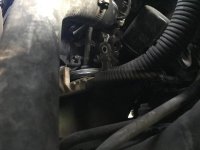
I did some searching and I thought I figured out the coolant was leaking from the small hose by the lower radiator hose but that doesn't seem to be the case. The coolant seems to be coming from an area on the engine near the lower radiator hose... is this the water pump? I tried to take a pic but it's hard to get a good angle on what I'm seeing when I'm under the truck...

What do y'all think? Time for a timing belt and water pump? Thank you for your help!

Datsuyama.
 

Attachments

  • Coolant Leak.jpg
    Coolant Leak.jpg
    73.3 KB · Views: 1,022
Register to hide this ad
I don't see the leak.

Sent from my SM-J337V using Tapatalk

Yeah, it's so hard to get a good pic but below the radiator hose to the left of the oil filter in the pic, that grey metal area seems to be weeping. That was the best I could figure for an origin after following the drip up as far as I could see.
 
Are you sure it’s not coming from the lower radiator hose connection near the oil filter? That doesn’t look like the OEM “constant tension” hose clamp on there. I’m not sure if that worm-drive style clamp seals as evenly (just a guess)
 
Are you sure it’s not coming from the lower radiator hose connection near the oil filter? That doesn’t look like the OEM “constant tension” hose clamp on there. I’m not sure if that worm-drive style clamp seals as evenly (just a guess)

I felt all around the hoses and don't feel any liquid. I was really hoping it was a bad hose or clamp. And yeah, it looks like someone replaced the hoses at one time in the past with those clamps.
I got the truck after my dad passed away last July and he bought it used so the history is a mystery...
 
I had a small coolant leak on the thermostat housing, thought it was the lower rad hose for awhile, once I got the t-stat housing off I could see the housing was corroded where it met the water pump, cleaned it up, JB weld to smooth the mating surface, all good. Maybe something to look into.
 
Are you sure it’s not coming from the lower radiator hose connection near the oil filter? That doesn’t look like the OEM “constant tension” hose clamp on there. I’m not sure if that worm-drive style clamp seals as evenly (just a guess)

They absolutely do. The only reason car manufacturers use spring clamps is because they cost literal pennies and they can be attached in seconds.
 
So, went out there again and (why does it have to be so damn cold when this stuff happens?) ran the engine a bit and can't seem to see any leaking anywhere. I felt around the hoses and no leaks. But there is a drip coming off the skid plate. Not a big active drip but I can see two drips hanging on the back of the skid plate waiting to fall. Running the engine for a bit did not seem to create more drips.

Yesterday when I came home there was enough dripping to cause a small puddle - maybe 8" diameter puddle, thats how I noticed the leak. The radiator took about half a gallon to fill it back up.

I'm puzzled. Starting to think maybe it's that little hose near the lower radiator hose but damn, I can't see more than the first couple inches of it!
 
If it has anything to do with the ATF hoses that go to the lower rad, stop driving it and check ATF and rad fluid for contamination, if it's the original rad they used aluminum fittings that corrode and allow radiator and ATF to exchange fluids aka strawberry milkshake as I'm sure you're familiar with, but it sounds like an external leak or your ATF would be overfilled and radiator would have ATF in it usually, (mine was leaking at that fitting, opened the rad and ATF poured out the top, my OCD caught it at the exact time it happened towed it home flushed both new rad saved the tranny) in this senerio when running the ATF has more pressure than the radiator and pumps ATF into rad, when you shut it off rad fluid is still pressurized and pumps rad fluid into the Auto trans fun fun next drive out and about. Also a likely spot to leak that's hard to determine is the end tanks of the rad where they join the rad core, these can be difficult to see as the rad fluid evaporates as it leaks typically depending on how bad the leak is and usually leaks on cold startup as the t-stat is closed increasing pressure in rad, lower rad hose and t-stat housing ect,. There is also coolant lines running to the oil filter cooling housing and there is an o-ring on the rad fluid to oil filter housing that can leak, usually this happens after an oil filter change if the oil filter sticks to the housing badly.
*Could also be the weeping holes on the waterpump telling you it's due or corrosion on any of the mating surfaces like t-stat housing I mentioned, they are aluminum and corrode often.
 
Last edited:
They absolutely do. The only reason car manufacturers use spring clamps is because they cost literal pennies and they can be attached in seconds.
I disagree. Those constant clamp radiator clamps work extremely well. Unless they are extremely rusted they mostly last the life of the vehicle.

I never had one fail on me in over 30 years.
I seen them get thin and need replaced. Heck I even seen the lowers rusted off and the hose still not blow off.

If people feel better using the stainless steel clamps with the rusty screw that's their choice. :)


Sent from my SM-J337V using Tapatalk
 
Agreed^ the continuos tension clamps that came from the Tahara factory in Japan are amazing and still like new in the salt belt after 21 years, as are the 30 year old ones on my Mitsubishi motor that came from Japan. The ones on my dads 2010 Tacoma are falling off the truck as is any little steel strap, and all the hardware has rusted to the point they are no longer the size they use to be, so there has been a change in gaurd and not all tension clamps are created equal.
 
I would pull and reseat the inlet. I had a small leak because there because I was so happy to find the thermostat jiggle valve mis-positioned that I didn't seat the TStat gasket fully and crushed a bit of it after reinstalling the inlet. It's a bit of a mess pulling that hose, but worth a look. Only 3 bolts and no standard-type gasket involved. The drips can follow the contour of the block and show up in a puddle elsewhere.

Update - I am still running a constant 15 degrees degrees cooler (188 vs 203) after the 6 O'clock fix 2 weeks ago.
 
I think it's either the lower hose clamps or leaking from the thermostat housing. If you don't want to get you hands dirty use the dye like mentioned above. Will make the leaking coolant glow so it's real obvious.
 
Well I have to digress.. Devbot was correct. I still prefer the Spring Tension Clamps for my rad hoses. However, the hoses and Clamps do have a lifespan. I probably replace the hoses and clamps on occasion. As I just have 2 seeping after my rad change on Tetanus 1. So I guess after 22 years and 3 radiators its best to change the rad hoses and spring Clamps. ;-) I honestly suspecting the hoses on this round but I just put the stainless rad clamps on to stop the seaps. :-)
 
I don't know if the spring clamps go bad, but they are dependent on the hose being an certain diameter. A newer, thinner-walled hose(if such exists) would reduce the clamping force.
A busy Land Cruiser/Toyota specialty repair shop I recently had do the timing belt and other sundry repairs on my '97 told me that they had stopped using the old spring clamps on the heater hoses on Land Cruisers recently. They said it was because the old clamps weren't sealing perfectly anymore. So they used worm screw clamps on *my* priceless, brand-new, imported-from-the-UAE (and now somewhat chewed-up) heater hoses, which I was not happy with. At least they had a coherent reason.
 
Last edited:
I don't know if the spring clamps go bad, but they are dependent on the hose being an certain diameter. A newer, thinner-walled hose(if such exists) would reduce the clamping force.
A busy Land Cruiser/Toyota specialty repair shop I recently had do the timing belt and other sundry repairs on my '97 told me that they had stopped using the old spring clamps on the heater hoses on Land Cruisers recently. They said it was because the old clamps weren't sealing perfectly anymore. So they used worm screw clamps on *my* priceless, brand-new, imported-from-the-UAE (and now somewhat chewed-up) heater hoses, which I was not happy with. At least they had a coherent reason.
Well in my particular case, I was using used hoses from my parts mobile with the original spring clamps. So the hoses looked OEM. However, 161k on them. So not sure.

I would suspect new OEM hoses would work with the clamps or new clamps. Can anyone out there confirm that? If not, I switch to a new style of clamp and new hoses if the newer hoses are thin. Then old spring clamps will be worthless. I even snapped the clamps in the exact original location and they still seeped..:(


Sent from my SM-J337V using Tapatalk
 

Members online

No members online now.

Forum statistics

Threads
278,306
Messages
3,554,045
Members
248,016
Latest member
Advally Service

Trending content

Back
Top