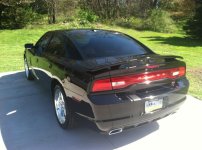
DARKEST tint for the rear window that isn't frustrating to see out of?

I believe they are 30%

I would buy that. Here's a picture of my Charger. Not a chance my factory 4Runner windows are only 2% lighter than this.
 

Attachments

  • e53b884f.jpg
    e53b884f.jpg
    106.8 KB · Views: 3,064
Legal limit for front sides here is 35%, I've always done the rear to match so it's easier to see out of at night, and the rear sides 20%.

Nothing worse than having to roll down windows to see where you're backing into, at least the rear window does roll down on these things, lol.
 
the rear of a 4runner will measure out about 25% FVLT (final visible light transmission). Most people that install a 20% tint (not 15% or 18%) get the best results with matching the front 2 windows to the rear factory tint. IF, the 4runner had all clear glass, IF it did, and you installed the same film all the way around , except the windshield, the front 2 windows would appear to look lighter. This is do to the windshield letting in light into the front part of the 4runner. I explain it to a customer this way, "The further you go back in a cave, the darker it becomes."

A 25%-30% film matches the rear really well. It is easier to tell a true match by looking from inside to the outside if the tint really matches. If you would like your windows darker, I might suggest a 18%-15% on the 2 fronts and adding a 45% ( give or take a little on the percentage) to the rear of the 4runner. It will match really well front to rear.

Good luck to all.
 
Original poster here. So i went with 20% all around, but my decision was easier in that the pro tint shop i used had 20% as the lowest tint for 3M Crystalline, which is what i went with. They had 4 "brands/levels" with Crystalline being the 2nd to the most expensive. I picked it for heat rejection, and even did the windshield with 70%, although learned immediately that heat rejection is a load of marketing crap. Might make a separate post on this entirely.

Anyway, 20% over factory is NOT too dark on the rears, I can see fine at night. I would have even gone darker, so 18% is indeed a sweet spot, and I can even see 10% doable! 20% in the FRONT is perfect, albeit illegal where i am. But tint decisions are not just willy nilly, there is a safety aspect....you don't want to be driving in your suburban neighborhood and not be able to see around you. I also took the guy's advice as he has been tinting for 30 years: if you go too dark in the back (limo) it feels you are driving around in a closet. All that said, I guess I can't complain.

Last point is it was definitely not cheap. I took it to the best reviewed Tint shop in Phoenix and indeed they were great but it came to $1050 (3M Crystalline) for those pricing out. (4/19) including front windshield.

please either post here or separately regarding the marketing crap of the heat rejection... im about to get my windows tinted and would love to hear your thoughts on the topic
 
please either post here or separately regarding the marketing crap of the heat rejection... im about to get my windows tinted and would love to hear your thoughts on the topic

Sure man.

Save your money. I am going to call this "The big Tint lie"

This has to do with science I am very curious about. I get it. I do. But here is the marketing: "Light tint rejects 60% of solar energy and up to 97% of heat-producing infrared rays for the ultimate in comfort." "Reject heat" cooler car, etc.

In the installer, they have an infrared light behind the various tints. You press the button and feel the heat (or lack of) behind the tint. 100% convincing. This is REAL - your hand does not lie.

But in function, and in the science behind how heat actually builds up in a vehicle, it is 100% BS.

After tint, my truck is seemingly not 1 degree cooler than prior to tint. I am not one to fall for placebo affect easily. So I did a search and found some guy ran an actual experiment which proved my suspicions in a Tesla.

Experiment: 3M Crystalline Tint Makes ZERO Difference in Cabin Temp | Tesla

So basically I just spent just over $1K to have darker windows which I could have done for $350. I was expecting a significant different in temperatures. THAT WAS THE WHOLE POINT of paying premium.

If anyone can find another real world dispute of this (or explain) I'd love to see it. And before you say TIME may be a factor, I am talking literally minutes here in Phoenix before its intolerable, same as before - and it was only 82-85 yesterday. AND keep in mind compared to many vehicles our windshield angle to the sun is much LESS horizontal than most.

I'd love to see the industry have real world measurements in addition to all current stats: A chart of Degrees raised over time (e.g. 30 minutes) on a standard industry platform. But that might mean we see this "alleged" BS, so don't expect that. But I am just 1 guy.
 
Last edited:
Sure man.

Save your money. I am going to call this "The big Tint lie"

This has to do with science I am very curious about. I get it. I do. But here is the marketing: "Light tint rejects 60% of solar energy and up to 97% of heat-producing infrared rays for the ultimate in comfort." "Reject heat" cooler car, etc.

In the installer, they have an infrared light behind the various tints. You press the button and feel the heat (or lack of) behind the tint. 100% convincing. This is REAL - your hand does not lie.

But in function, and in the science behind how heat actually builds up in a vehicle, it is 100% BS.

After tint, my truck is seemingly not 1 degree cooler than prior to tint. I am not one to fall for placebo affect easily. So I did a search and found some guy ran an actual experiment which proved my suspicions in a Tesla.

Experiment: 3M Crystalline Tint Makes ZERO Difference in Cabin Temp | Tesla

So basically I just spent just over $1K to have darker windows which I could have done for $350. I was expecting a significant different in temperatures. THAT WAS THE WHOLE POINT of paying premium.

If anyone can find another real world dispute of this (or explain) I'd love to see it. And before you say TIME may be a factor, I am talking literally minutes here in Phoenix before its intolerable, same as before - and it was only 82-85 yesterday. AND keep in mind compared to many vehicles our windshield angle to the sun is much LESS horizontal than most.

I'd love to see the industry have real world measurements in addition to all current stats: A chart of Degrees raised over time (e.g. 30 minutes) on a standard industry platform. But that might mean we see this "alleged" BS, so don't expect that. But I am just 1 guy.

Thanks for your input. I read the link you posted and while the initial experiment was decently thought out, there were a couple things missing.

One- the windshield was not tinted which as we all know, permits the most amount of light and heat into the car (depending on angle of the sun).

Two- the model 3 already has IR rejection built into their side windows so tinting those windows wouldn't really help too much with that specific car.

Three- there is a problem with the assumption of the experiment to begin with: that tinted car should be cooler after x # of time. While that assumption might be true for a short period of time, it isnt going to be true for an indefinite period of time. For example, you bring out both cars (tinted and untinted) and let them sit in the sun for 5 or 10 minutes. The tinted car should in fact be a bit cooler inside than the untinted one (assumed no IR rejection built in the glass already). However, if you let both cars sit in the sun all day, eventually both cars will be the same temperature inside. The takeaway is that perhaps the untinted car will take lets say an 60 minutes to get to maximum cabin temperature, the tinted car might take 75 minutes to get max temp.

so all in all, i don't think you actually wasted your money. what do you guys think?
 
I went to get my windows tinted for
My 5th gen 4Runner but the guy wasn’t able To do it, he said that the dealer tint had 2 layers wich made it impossible
To Do the ceramic tinting. He tried several time But it wouldn’t stay. Any suggestions .


Sent from my iPhone using Tapatalk
 
Thanks for your input. I read the link you posted and while the initial experiment was decently thought out, there were a couple things missing.

One- the windshield was not tinted which as we all know, permits the most amount of light and heat into the car (depending on angle of the sun).

Two- the model 3 already has IR rejection built into their side windows so tinting those windows wouldn't really help too much with that specific car.

Three- there is a problem with the assumption of the experiment to begin with: that tinted car should be cooler after x # of time. While that assumption might be true for a short period of time, it isnt going to be true for an indefinite period of time. For example, you bring out both cars (tinted and untinted) and let them sit in the sun for 5 or 10 minutes. The tinted car should in fact be a bit cooler inside than the untinted one (assumed no IR rejection built in the glass already). However, if you let both cars sit in the sun all day, eventually both cars will be the same temperature inside. The takeaway is that perhaps the untinted car will take lets say an 60 minutes to get to maximum cabin temperature, the tinted car might take 75 minutes to get max temp.

so all in all, i don't think you actually wasted your money. what do you guys think?


I too dont think its wasted money. I too have the 3m premium film and noticed an immediate difference. The only thing is I was not expecting the car to be cooler parked in the sun, rather the heat transmitted though the windows has been drastically reduced when in the car. Basically, I dont get as hot sitting in my car when its sunny. It was a big difference for me especially in the Summer. I dont have to crank the AC as hard to keep the car cool. So I think it was worth it. But seriously, Phoenix is like the surface of the sun hot so not much will help. My .02.

In Phoenix, well maybe one of these will help.

Lanmodo Portable Auto Car Umbrella (I'm not serious :wink2:)
 
Last edited:
I used 3M Crystalline 50 mainly for UV and heat rejection so my arms and face don’t get burned.

I absolutely love the 3M Crystalline stuff... I am getting the clear 90 put on the windshield. Cant even tell its on there.

Its amazing how well that stuff works from a UV and heat rejection standpoint.

Expensive, but its about best best stuff i've ever used.
 
A very high end film stops the heat from entering the car. NO if ands or buts. If you park your car in a Walmart parking lot in arizona in the middle of july its going to be hot when you get inside of it. The idea of a high end tint it to stop the heat from entering the car once the AC has been turned on and is cooling the car down. With the AC on recirculate and a high end IR film installed on the entire car, it will continue to get colder and colder inside the car.

plus there are the medical reasons to tint your car as well.

YouTube
 
Sure man.

Save your money. I am going to call this "The big Tint lie"

This has to do with science I am very curious about. I get it. I do. But here is the marketing: "Light tint rejects 60% of solar energy and up to 97% of heat-producing infrared rays for the ultimate in comfort." "Reject heat" cooler car, etc.

In the installer, they have an infrared light behind the various tints. You press the button and feel the heat (or lack of) behind the tint. 100% convincing. This is REAL - your hand does not lie.

But in function, and in the science behind how heat actually builds up in a vehicle, it is 100% BS.

After tint, my truck is seemingly not 1 degree cooler than prior to tint. I am not one to fall for placebo affect easily. So I did a search and found some guy ran an actual experiment which proved my suspicions in a Tesla.

Experiment: 3M Crystalline Tint Makes ZERO Difference in Cabin Temp | Tesla

So basically I just spent just over $1K to have darker windows which I could have done for $350. I was expecting a significant different in temperatures. THAT WAS THE WHOLE POINT of paying premium.

If anyone can find another real world dispute of this (or explain) I'd love to see it. And before you say TIME may be a factor, I am talking literally minutes here in Phoenix before its intolerable, same as before - and it was only 82-85 yesterday. AND keep in mind compared to many vehicles our windshield angle to the sun is much LESS horizontal than most.

I'd love to see the industry have real world measurements in addition to all current stats: A chart of Degrees raised over time (e.g. 30 minutes) on a standard industry platform. But that might mean we see this "alleged" BS, so don't expect that. But I am just 1 guy.

Well not trying to be a 3M advocate here, but referring only to the experiment you quoted, the guy says the windshield wasn't tinted in either tesla, and tesla's model 3 sunroof has an IR coating from factory, so by parking both of them on the sunlight, his measurements are not significant. The difference in IR protected areas between the two cars were were only the side and 'small' back window, and when you take into account the difference in body colors of the two cars, well, both cars interiors' will heat pretty evenly.

Now, you said that at the shop you can feel the difference between having the the tint between the IR or not having the tint in between, that would apply for example when you have the sun shining through your windshield and you move your hand from the center console(assume shaded) to the steering wheel, if you do not have the tint you will feel your hand warm up, and if you have the tint you should feel it warm up very little.

Lastly, even with IR or UV reflecting tints, if you leave your car in the sun for long periods of time it will get warm, how warm will depend on the specifics of the day, the tint may lengthen the time it gets the interior to get warm, but it will still get there, I think especially, on a vehicle like the one used for that test where most of the roof is glass.

Anyways, apologies for the long response!
 
I absolutely love the 3M Crystalline stuff... I am getting the clear 90 put on the windshield. Cant even tell its on there.

Its amazing how well that stuff works from a UV and heat rejection standpoint.

Expensive, but its about best best stuff i've ever used.

To be honest, if I had to do it over again on my T4R, I would go with the Llumar CTX ceramic instead of 3M Crystalline.

On paper the 3M Crystalline is better than the Llumar CTX.

In the real world, my Tacoma has Llumar CTX and I can't tell the difference between it and the 3M Crystalline on the T4R in terms of feeling the heat. And the Llumar was half the price of the 3M.
 
Last edited:
A vehicle does not only heat up through its windows. Your roof is receiving direct sunlight and there isnt much in the sense of insulation from the roof and the headliner. If you have a darker vehicle, itll be warmer than the same vehicle in white. Tint and window shades help with surface temperatures that can radiate heat making it seem hotter in the car. Ambient temps will rise no matter what. Its a sealed box.

I view tint as a privacy thing rather than a heat repellant. Thats why I only spent $175 on 20% fronts and 35% in the back windows. They'll probably fade in 5-10 years and turn purple, but strip and spend another $175 isnt that much a of a deal to me.
 
A vehicle does not only heat up through its windows. Your roof is receiving direct sunlight and there isnt much in the sense of insulation from the roof and the headliner. If you have a darker vehicle, itll be warmer than the same vehicle in white. Tint and window shades help with surface temperatures that can radiate heat making it seem hotter in the car. Ambient temps will rise no matter what. Its a sealed box.

I view tint as a privacy thing rather than a heat repellant. Thats why I only spent $175 on 20% fronts and 35% in the back windows. They'll probably fade in 5-10 years and turn purple, but strip and spend another $175 isnt that much a of a deal to me.

Inbound heat load is a given, that’s not why I would use things like Llumar CTX or 3M Crystalline on my off-road truck, it’s the rejection of infrared and UV. That said, it does help if you are cooling as a load is reduced.

I don’t like dark tint, don’t need the privacy, don’t like to compromise night time viewing… but I need to stop cooking myself sitting in the sun for 5-8 hours a day behind the wheel. I remember after a long trip, I needed up getting out with sunburnt lips.

On my street vehicles, I use regular tint, but you can also just get darker ceramic films. It think its just a better product.
 
To be honest, if I had to do it over again on my T4R, I would go with the Llumar CTX ceramic instead of 3M Crystalline.

On paper the 3M Crystalline is better than the Llumar CTX.

In the real world, my Tacoma has Llumar CTX and I can't tell the difference between it and the 3M Crystalline on the T4R in terms of feeling the heat. And the Llumar was half the price of the 3M.

That a good tip, perhaps ill look into that and save myself a few bucks.

I felt my tint shop who is 3M certified has pretty decent pricing on their film… about $200 for a windshield. Do you know how that might compare to what you are paying?
 
That a good tip, perhaps ill look into that and save myself a few bucks.

I felt my tint shop who is 3M certified has pretty decent pricing on their film… about $200 for a windshield. Do you know how that might compare to what you are paying?

I'm not sure because I didn't have my windshield tinted. Llumar makes an Air 80 or Air 90 for the windshield which should be a lot cheaper than 3M.

I only had my front windows tinted because my arms and face were burning from the afternoon sun on the way home from work every day.

For the both front windows:
1) Basic dyed tint using reputable tint like 3M Color Stable or Llumar ATC was $100.
2) Llumar CTX ceramic was $150.
3) 3M Crystalline was $300.
4) Some generic tint was like $50 which will probably peel and turn turn purple.

Llumar also makes a Stratos and Pinnacle which is premium and priced like 3M Crystalline. I think the key thing is to get a ceramic tint for the best heat and IR rejection. Llumar CTX seems to be the best for the money.

In terms of UV rejection, it seems like the dyed tints can do 99% like the ceramic. If you are just going for UV rejection, any reputable dyed tint would do.
 

Members online

Forum statistics

Threads
278,315
Messages
3,554,131
Members
248,016
Latest member
Advally Service

Trending content

Back
Top