Drilled/Slotted Brake Rotors

Coyotegray

New member
For my next brake service Im considering a kit that includes Drilled/Slotted Brake Rotors.

Has anyone seen any problems with this driving offroad in mud, etc..?
 
Register to hide this ad
I would never put them on a vehicle that sees off road duty. Do some searching and you will see mostly negative comments when you mix off road and drilled/slotted rotors.

If you want more stopping power, you need bigger brakes but the brakes on the 4Runner are pretty good in my opinion.
 
No real reason to bother. It's not a sports car. And yeah those plus off road aren't the best combo either.

Sent from my SM-S901U using Tapatalk
 
Even on sports cars the benefits are debatable and it introduces risks of cracking, breakage, etc. also think about the smaller pad surface contact patch you create. Imo I would stay away.


Sent from my iPhone using Tapatalk
 
some centric drilled/slotted brake rotors are on my mind when it comes time to replace my OEM rotors.

I had to panic stop on the freeway from 70 to 0 due to stop traffic coming off a blind offramp that went under a overpass. I blew threw the brakes and the brake petal sunk to the floor and had to swerve on to the shoulder to stop. This definitely got my attention.

Yeah, i drive on the road 90 percent of the time and probably if I"m lucky, i get to offroad 10 percent of the time, so slotted/drilled brake rotors make sense to me.
 
get the rotors turned and throw some akebono pads on. It's fantastic. I warped my rotors but i didnt get them turned when i swapped pads. and i'm also taking it alot easier on the brakes this time around when we're offroading.
 
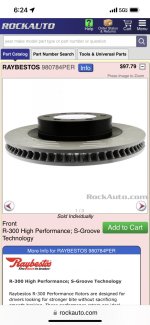
Raybestos or AC Delco High Performance Slotted rotors are all I use. Unlike the OEM, have not warped these yet and we have 330K miles on the truck and do plenty of off-roading.

2014 TOYOTA 4RUNNER 4.0L V6 Rotor | RockAuto
 

Attachments

  • IMG_3945.jpg
    IMG_3945.jpg
    137 KB · Views: 2,167
Love that those are working for you. That's what matters.

As far as slotting (or S-grooves :) ), the *theory* is that they help pad gasses dissipate faster. The reality is I've never seen a conclusive test. What they certainly *do* do is reduce the surface area the Pad gets to bite into and therefore increase the wear speed of the rotor because for the same stopping "friction" you are operating on a smaller rotor surface area. As far as warping, 99% of the time this is from uneven pad deposits on hot rotors and not physical rotor deformity. Again from a logic POV not sure how slotting is going to help here. If anything, removing Rotor material makes it less able to absorb heat so the rotor will heat up *more* than non-slotted for a given braking activity (say a 60mph to zero abs limited stop)

IMHO it's a gimmick folks use to charge more money for rotors. Yes, I've used a bunch of combinations. Slotted, drilled, etc. Back in my heavy Audi/VW/BMW tuning days.

Our 911 has drilled rotors from the factory. Even here I think it's mostly about looks though Porsche engineered the braking such that they accounted for the reduced surface area of the drilled rotor.

OK, I've nerded out more than I should have...
 
Well my unscientific testing has proven otherwise on several vehicle types: Suburban K2500, 4Runner, Honda Accord. In each case warping or brake pad deposits (cementite) has been eliminated and that includes a huge amount of mountain driving in CA with climbs/descents over 8,000’. The Honda OEM rear rotors cracked. No difference in brake pad life on any of the vehicles. The literature says this is possible on cheaper, poorly machined rotors as they can shave off brake pad material. I’m getting 80K to 90K on 4Runner pads in the front. All the literature and science says slotteds run cooler and if they run cooler there is less of a chance that you harden an area of the rotor which creates your “warp.”

One thing I will acknowledge, there is no discernable or observable difference in breaking distance.

P.S. Your so-called Porsche Macan runs a 2.0 liter Audi engine.
 
Last edited:
Well my unscientific testing has proven otherwise on several vehicle types: Suburban K2500, 4Runner, Honda Accord. In each case warping or brake pad deposits (cementite) has been eliminated and that includes a huge amount of mountain driving in CA with climbs/descents over 8,000’. The Honda OEM rear rotors cracked. No difference in brake pad life on any of the vehicles. The literature says this is possible on cheaper, poorly machined rotors as they can shave off brake pad material. I’m getting 80K to 90K on 4Runner pads in the front. All the literature and science says slotteds run cooler and if they run cooler there is less of a chance that you harden an area of the rotor which creates your “warp.”

One thing I will acknowledge, there is no discernable or observable difference in breaking distance.

P.S. Your so-called Porsche Macan runs a 2.0 liter Audi engine.

As I said above, super happy the slotted rotors are working for you. I'd love to see the literature and science you point to. Is the science related to slotted rotors or ventilated?

I'm just happy that rotors seem to warp less on the 5th gen 4R than they did on my old '07 GX470. I looked at it wrong and they warped.

Sick burn re: the Macan, but:
- I was talking about the 911 and
- Our Macan has the 3.0tt v6 from the Panamera, not the later ones which switched to Audi/VW sourced engines. Happy to go down the rabbit hole with you on this. BTW, yes, it's a glorified Audi Q5. Yes, it's way better to drive than the comparable Audi Sq5 (btdt). Oh, and is doesn't have drilled or slotted rotors. It's my wife's and she gets what she wants, And... I doubt you actually wanted to learn more about the Macan :)
 
In the spirit of learning: Drilled, Slotted & Vented Brake Rotors - What's Best? - YouTube

I am a big fan of this guy’s videos. Looks like I was a bit too hard on slotted.


Sent from my iPhone using Tapatalk

Looked at this video, he was critical of drilled. Not so much critical on slotted.

Looked at another video where the guy did tests on a non-abs car with OEM vented then slotted with peformance pads and the latter had superior stopping distance, especially after they were heated up.

All the literature says track racers use slotted as they are superior in dissipating heat. I went to slotted after my wife kept “warping” rotors. It was due to heat. Two scenarios: 1) heavy stops in SoCal traffic, followed by standing on the brakes while stopped at a light, thus creating a hardened spot of cementite; and 2) heavy braking coming down from a home we have on Big Bear Lake which has an altitude drop of 7,000’. Given those, I switched to the Raybestos or AC Delco (same manufacturer) slotted and no more issues. Could be due to the superior material and casting process. They do have the same rotors in plain vented.

We put tons of miles on our cars with a lot of moutain driving. I do all the work on our cars, so I’m going to use what works as I hate re-work because it cuts into my play time (fishing).

P.S. always wanted a 911 when growing up. Closet I got were VW Bugs. Wife had a SLK 280 w/ 6 speed manual. It was fun. I was German. It was impractical. All we want now are functional truck style (not crossover) SUVs. No fancy off-road suspensions, but very functional true 4WD SUVs.
 
Last edited:
Looked at this video, he was critical of drilled. Not so much critical on slotted.

Looked at another video where the guy did tests on a non-abs car with OEM vented then slotted with peformance pads and the latter had superior stopping distance, especially after they were heated up.

All the literature says track racers use slotted as they are superior in dissipating heat. I went to slotted after my wife kept “warping” rotors. It was due to heat. Two scenarios: 1) heavy stops in SoCal traffic, followed by standing on the brakes while stopped at a light, thus creating a hardened spot of cementite; and 2) heavy braking coming down from a home we have on Big Bear Lake which has an altitude drop of 7,000’. Given those, I switched to the Raybestos or AC Delco (same manufacturer) slotted and no more issues. Could be due to the superior material and casting process. They do have the same rotors in plain vented.

We put tons of miles on our cars with a lot of moutain driving. I do all the work on our cars, so I’m going to use what works as I hate re-work because it cuts into my play time (fishing).

Genuinely curious about 2 things, and thanks for sharing your experience:
1) Did you try the new pads with new non-slotted rotors? Or, did you change both?
2) I'd appreciate pointers to the literature you're referring to. I still don't understand how slotted rotors could be superior to standard at dissipating heat as they have slightly less mass.
3) I do buy that slotted might help reduce buildup for the reasons "engineering explained" noted regarding slots "scrubbing" the pads resulting in a) faster pad wear but perhaps b) the scrubbing helps with overheated pad-transfer to the rotor.

Regardless, truly appreciate your BTDT experience.
 
Genuinely curious about 2 things, and thanks for sharing your experience:
1) Did you try the new pads with new non-slotted rotors? Or, did you change both?
2) I'd appreciate pointers to the literature you're referring to. I still don't understand how slotted rotors could be superior to standard at dissipating heat as they have slightly less mass.
3) I do buy that slotted might help reduce buildup for the reasons "engineering explained" noted regarding slots "scrubbing" the pads resulting in a) faster pad wear but perhaps b) the scrubbing helps with overheated pad-transfer to the rotor.

Regardless, truly appreciate your BTDT experience.

You’ll get a mixed bag in the literature:

Brake Discs — Smooth vs Drilled vs Slotted – Newparts.com

“Slotted discs are also better at heat dissipation than plain or smooth ones, and are generally on par with drilled rotors.”

“The biggest advantage of slotted rotors over drilled rotors is the fact that the former are structurally more sound. This is also why slotted brake discs are used on professional race cars.”

Drilled vs Slotted Rotors, Which is Better for You? - PowerStop Brakes

“Slotted rotors do not improve any heat transfer. However, the slots can improve brake output by removing gas and dust that is trapped between the pad and rotor. This gas and dust reduces the friction force by preventing the pad from fully contacting the rotor.”

“Given the choice between drill holes and slots, the drill holes will give you better braking power over slots for normal city/highway driving. This is why high end BMW, Porsche, Corvette, and Mercedes rotors are drilled, not slotted. However, for track racing (high speed stops), slotted rotors are the better choice.”

Just a moment...

“Slotted rotor grooves offer two distinct benefits under heavy braking: brake fade, from high-temperature brake pad outgassing, can be significantly reduced, allowing gases to escape through the slots; and the grooves shave off thin layers of brake pad material, reducing glazing and improving braking consistency.”

 
You’ll get a mixed bag in the literature:

Brake Discs — Smooth vs Drilled vs Slotted – Newparts.com

“Slotted discs are also better at heat dissipation than plain or smooth ones, and are generally on par with drilled rotors.”

“The biggest advantage of slotted rotors over drilled rotors is the fact that the former are structurally more sound. This is also why slotted brake discs are used on professional race cars.”

Drilled vs Slotted Rotors, Which is Better for You? - PowerStop Brakes

“Slotted rotors do not improve any heat transfer. However, the slots can improve brake output by removing gas and dust that is trapped between the pad and rotor. This gas and dust reduces the friction force by preventing the pad from fully contacting the rotor.”

“Given the choice between drill holes and slots, the drill holes will give you better braking power over slots for normal city/highway driving. This is why high end BMW, Porsche, Corvette, and Mercedes rotors are drilled, not slotted. However, for track racing (high speed stops), slotted rotors are the better choice.”

Just a moment...

“Slotted rotor grooves offer two distinct benefits under heavy braking: brake fade, from high-temperature brake pad outgassing, can be significantly reduced, allowing gases to escape through the slots; and the grooves shave off thin layers of brake pad material, reducing glazing and improving braking consistency.”

Thank you!
 
Did OP ever state what problem they're trying to solve? If it's brake fade, upgrade the brake fluid. If it's stopping power, I'd try more aggressive pads (if they exist?). But like someone else pointed out the 4Runner seems to brake pretty well all things considered, but damn is the pedal mush. I have a Porsche as a fun/track car and the pedal is rock solid, always makes for a fun first mile or two when I swap from one car to the other.

IMHO both drilled and solid rotors would introduce the ability of foreign objects (sand, mud, tiny pieces of rock, etc) to get stuck in/on the rotor and chew the pads up. They're used in track/racing applications to help dissipate heat/dust, with slotted usually being preferred due to drilled introducing weak points where cracks can/will form between holes under repeated/hard use. The drilled rotors on my Porsche definitely look cool, but they'll be replaced with slotted for peace of mind. Never seen a 4Runner on a track but I guess there's a first time for everything!
 
Well my unscientific testing has proven otherwise on several vehicle types: Suburban K2500, 4Runner, Honda Accord. In each case warping or brake pad deposits (cementite) has been eliminated and that includes a huge amount of mountain driving in CA with climbs/descents over 8,000’. The Honda OEM rear rotors cracked. No difference in brake pad life on any of the vehicles. The literature says this is possible on cheaper, poorly machined rotors as they can shave off brake pad material. I’m getting 80K to 90K on 4Runner pads in the front. All the literature and science says slotteds run cooler and if they run cooler there is less of a chance that you harden an area of the rotor which creates your “warp.”

One thing I will acknowledge, there is no discernable or observable difference in breaking distance.

P.S. Your so-called Porsche Macan runs a 2.0 liter Audi engine.

IVe run drilled and also drilled and slotted. They are great for initial bite in the rain. Where they really shine is a point of performance the 4 runner will never hit so its somewhat moot point. You can get slightly shorter stop times but this is when the normal rotors overheat and the slotted-drilled ones allow abit more use prior to fade. They are also good at removing deposits that put the rotor out of balance or give it the shudder most people incorrectly call warp

But for some applications they are quite nice, maybe with some Hawk pads to. For drilled you want them chamfered to help minimize cracks.. ive cracked a few that werent.
 
Did OP ever state what problem they're trying to solve? If it's brake fade, upgrade the brake fluid. If it's stopping power, I'd try more aggressive pads (if they exist?). But like someone else pointed out the 4Runner seems to brake pretty well all things considered, but damn is the pedal mush. I have a Porsche as a fun/track car and the pedal is rock solid, always makes for a fun first mile or two when I swap from one car to the other.

IMHO both drilled and solid rotors would introduce the ability of foreign objects (sand, mud, tiny pieces of rock, etc) to get stuck in/on the rotor and chew the pads up. They're used in track/racing applications to help dissipate heat/dust, with slotted usually being preferred due to drilled introducing weak points where cracks can/will form between holes under repeated/hard use. The drilled rotors on my Porsche definitely look cool, but they'll be replaced with slotted for peace of mind. Never seen a 4Runner on a track but I guess there's a first time for everything!

331K miles of experience, 250K of that with slotted on the 4Runner, lot of off-road miles including sand and mud. Sand or mud chewing up pads has never been an issue. The ceramic pads are too hard to get chewed up.

Yeah the 4R will never see a track, which is why I always get a chuckle over guys here talking about their improved high speed cornering/handling with KDSS or XREAS.
 

Members online

Forum statistics

Threads
278,312
Messages
3,554,087
Members
248,016
Latest member
Advally Service

Trending content

Back
Top