Engine Oil - Conventional VS Synthetic

PWD4R

New member
https://youtu.be/tYkg0oDUXs8

I hope that video loads. Engineering Explained covers the differences on a technical aspect between the two kinds. I always have found his explanations to be pretty knowledgeable and unbiased so you may enjoy that video. If it doesn't work then search in YouTube "Is Synthetic Motor Oil Better For Your Car?"


Sent from my iPhone using Tapatalk
 
Register to hide this ad
Pour point depressantGTL

even between synthetics ...

https://www.youtube.com/watch?v=uQ_vxdO_9nc mobil1 seems like a winner to me

I expected M1 since they use a bit more PPD (pour point depressant. However this is just 1 attribute also need to understand resistance to oxidation, detergent & dispersant along with anti-wear. I used to be a field engineer for ExxonMobil so have good background of that product. It was 10 yrs ago most PAO with some esters for solubility but based on used oil analysis it's changed to probably less than 45% PAO with some Group III & ester. The reason is better margins.
I now work Shell & have seen better performance with thier GTL base stock the reason is its saturated Hydrocarbon started as methane then thru Fischer Thrope a synthetic oil, gas, diesel, jet fuel is made.
My point is M1 is good but has been surpassed in the non-ending game of innovation. As for the others there are only a few PAO base stock producers Mobil Chemical being a big player, the other Chevron-Phillips, Neste and 1or 2 small refiners in Europe.
For our personal use I'd recommend one of the 3-4 major brands, reason being they have $$$ for more R&D. However that said not all synthetics are equal. As I said earlier Mobil 1 uses partially PAO while Shell has GTL the others have since the 2000 San Francisco court challenge by Castrol of the definition of synthetics has allowed marketers to use group III base oil which is still highly refined crude oil bade stock.
 
LV2001BI - thanks for the information.

It would be my guess Mobil-1 is favored simply because it's widely available and often times put on sale at Costco/Walmart.
 
I just broke 200k on my 2005 tacoma and it has been mobile 1 the whole time. Switched to extended pro at 100k and couldn't be happier.
 
Interesting video, on which I have three comments and an opinion:

1) The dryboard segment was most useful. I think we all know synthetic is better than dino and now we know why.

2) At the end, the narrator states the video was sponsored by Pennzoil. Bothersome, but not overly so since the science appeared genuine and made sense.

3) My biggest issue was the viscosity demo. Whether or not it was the case, the use of unrealistic conditions (Arctic Circle-grade -35F temps) and oils of dissimilar viscosity screams "this is the only way we could gin up a visual that looks convincing."

In the end, the debate over oil quality and its effect on engine life probably should have ended many years ago. I have no proof, but strongly suspect that the evolution of oil and engines to today's quality standards means you can use any conventional or synthetic oil as long as 1) it's approved by your vehicle's manufacturer and 2) you follow the oil change intervals, and end up with no appreciable difference in engine wear over the life of an average vehicle.

Performance? Another animal, but any gains with synthetics are likely minimal.

Of course, with all that said, I use synthetics only in both our vehicles. :-D

I did put aside my anti-house brand bias to grab some 5-qt bottles of SuperTech full synthetic. Walmart has 'em rolled back to $12 at the moment. That's not a typo...$12 for a 5-qt jug.
 
Quite interesting actually especially since I am an Amsoil user for well over a decade. He never puts the thermometer in every quart for the camera so I will reserve my opinion as we cannot verify from the video that each was at the same temp.

What am I missing here? What is the significance of a test at -40 degrees in determining whether there's a significant difference in protection or performance at typical operating temperatures?

I'm not trolling here, just trying to be sure I'm not missing some piece of this puzzle.
 
What am I missing here? What is the significance of a test at -40 degrees in determining whether there's a significant difference in protection or performance at typical operating temperatures?

I'm not trolling here, just trying to be sure I'm not missing some piece of this puzzle.
The 4 oil samples were cooled to -35 F it shows the difference of pour point between mineral & synthetics and the difference between new & used. I wouldn't get all wound up about pour point because that is an ASTM test that determines the coldest temperature an oil can still pour so the lube may have the same consistency as 000 grease, it will pout but not flow easily the end effect is lube starvation. The better temperature value to measure is flow point that is the coldest temperature that oil will still flow. The rule of thumb used is typically back off pour point by 20 degree. as for the significant -40F it was just a low temp number. If have any other questions email me or you can go to STLE.org,(society of Tribologist and Lubricating Engineers) its an organization I belong to as a a CLS (certified lubrication specialist)
 
Last edited:
I don't get the purpose of his video, he really spent more time talking about the viscosity of the oil rather than the science behind conventional, synthetic-blends, and true synthetic oils. Viscosity is better controlled and manipulated in a synthetic blend or full synthetic oil yes, but it's only an aspect of the discussion.

I would have liked to have seen some more discussion about the base stocks, the difference between US and European definitions of "Full-Synthetic" oil and how a lot of synthetic blends get categorized as "Full Synthetic" because of that. Additionally the differences in the molecular structure of the oil and the better chain formation that a true Base 4 synthetic oil offers and the over all better controllable variables ones can achieve in true synthetic oils and how it benefits an engine.
 
The video had some value its a good basic info but if you want the definition of different base stocks for base oils:
Group I base stocks contain less than 90 percent saturates and/or greater than .03 percent sulfur and have viscosity index greater than or equal to 80 and less than 120.

Group II base stocks contain greater than or equal to 90 percent saturates and less than or equal to .03 percent sulfur and have viscosity index greater than or equal to 80 and less than 120.

Group III base stocks contain greater than or equal to 90 percent saturates and less than or equal to .03 percent sulfur and have viscosity index greater than or equal to 120.

Group IV base stocks are polyalphaolefins (PAO).

Group V base stocks include all other base stocks not included in Group I, II, III, IV

NOW TO THROW IN A MONKEY WRENCH: SHELL'S GTL (gas to liquids) according to some industry experts it falls between Grp III & V but here is the kicker GTL is made from methane gas and undergoes Fischer–Tropsch process which I believe the Germans invented during WWII to make synthetic fuel & lubricating oils. GTL is actually chemically more stable than PAO becuase its has fully saturated hydrocarbon chains.

As for how we in the US vs Europeans define or use the work synthetic there isnt really much difference since we use the same grouping structure. Now in the past the Germans had insisted that synthetic car engine oil (PCMO) passenger car motor oil had to be PAO (poly-alphaoliefin I believe even that has changed because Grp III is also considered synthetic. The precedence for this was the court challenge that Castrol leveraged against ExxonMobil (Mobil 1) in San Francisco Federal court in 2000.

Now to syn-blends I've been in the industry for 17 years and I still have to read an actual industry standard for syn-blend. Also understand some marketers tend to categorize thier lubricants as synthetics because they "use synthetic additives" which is misleading because almost all additives are synthesized.
In regards to motor oil which what the discussion is about the standard is mineral oil typically Grp II but by removing the impurities normally associated with crude oil you make the base oil much more oxidative stable, lower pour point, viscometeric characteristics,but it tends to have less solubility so then you add esters or other chemicals to increase solubility. Solubility is important for cleanliness.
All this info is just BLAH BLAH BLAH.... to most people which is why I follow regular ODI (oil drain intervals). When I worked for exxonmobil I used M1 in my cars it worked well protected my engines and kept in clean, but I took employment with Shell 9 yrs ago and slowly evaluated their PCMO products (Shell, Pennzoil & QS) all are excellent and I found provide equal or better performance. The claim Shell makes that their synthetic provides high level of cleanliness is true this week I had my 2006 Avalon timing chain cover re-sealed & replaced the valve cover gaskets the top deck was clean with no sludge or even varnish the inside of the timing chain cover was also clean w/o any deposits or varnish.
So the benefits of synthetic:
1:Increase drain intervals (caveat is use oil analysis before increasing ODI over 30%)
2:Possible increase in fuel economy but the best normally recorded with statistcally relevant data is at best 2-3%, any thing higher is questionable
3:Better cold and high temp performance
4: Better engine protection, but understand that when synthetic start to fail / go side ways its rapid as apposed of mineral oil (this based on using used oil analysis, becuase results tend to be better than mineral whereas mineral has a predictable curve of degradation)
So you may ask what do you use? I use Pennzoil Platinum Ultra 0w/20 in my 2015 RX 350, 0w/20 Pennzoil Platinum for my 2006 Avalon & Quaker State Ultimate Durability 5w/30 in my 2001 4 Runner because it $17/ 5 qt jug. I plan to switch my 2006 Avalon to 0/20 Quaker State Ultimate Durability on the next oil change because its only $17 for the 5qt jug.
 
Last edited:
There is a really nice video from this same guy about how to properly use your clutch. Which is very useful.
 
Fascinating stuff. Thanks.

Otoh, my girlfriend's 2006 4-cylinder Camry has 190,000 miles on it and it's still going strong. Not just putting-putting along either, but running strong. When she sold a 2003 4-cylinder Camry last year it had 220,000 miles on it and her son's in-laws have it up to 260,000 now. (Yeah, she drives a lot and tends to keep two cars.)

All on dino oil from costco or the local garage or whatever was on sale. She does use Toyota filters most of the time.

I suspect that starting with a high quality engine is as important as the brand of oil, assuming you change it regularly. We'll see how my new 4Runner and her new Avalon do on Toyota synthetic changed every 10k. They'll likely be fine, and the oil changes are free for 4 years.

John
 
...........So you may ask what do you use? I use Pennzoil Platinum Ultra 0w/20 in my 2015 RX 350, 0w/20 Pennzoil Platinum for my 2006 Avalon & Quaker State Ultimate Durability 5w/30 in my 2001 4 Runner because it $17/ 5 qt jug. I plan to switch my 2006 Avalon to 0/20 Quaker State Ultimate Durability on the next oil change because its only $17 for the 5qt jug.

Great info LV - one of the best thread reads, in layman terms (on the net)...very informative & understandable.

--------------------------------------------------------------------------------------------------------------------------------

For 25 years, all my vehicles have enjoyed Synthetic oil & the very best filter.
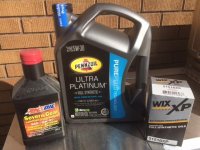
- but recently I went from Amsoil >> to Pennzoil Platinum >> to Pennzoil Platinum Ultra // just as good @ half the cost
- and my oil filters have evolved from Amsoil Syn >> to NAPA silver >> to NAPA gold >> to WIX Platinum XP (Syn. media & sourced by Amsoil)
See Post #14: http://www.toyota-4runner.org/3rd-gen-t4rs/215620-best-oil-high-mileage-engine.html

PS - I also us Amsoil Syn. Racing Grease plus my 12v batteries are AGM technology & Made in USA.
Interesting read - testing a consumer product, to the limit: canadian tire builds drivable ice truck

Years ago, I had a pan cake compressor to run an air nailer.
In the winder time, it would trip the 15amp fuse & failed to start.
- dumped the factory oil & replaced with Amsoil compressor oil
Now in the cold garage, compressor will start without fail.

Running Syn. Oil in colder Northern climates makes my vehicle engine spin faster on startup / while extending oil change frequency.
- I'm putting less stress on both the battery & starter
I'm sure excess heat can kills conventional oil quick enough - so the benefits of true synthetic products, is easily justified.
 

Attachments

  • PennUltraWIXxp.jpg
    PennUltraWIXxp.jpg
    42.7 KB · Views: 575
Last edited:
The 10,000 mile ODI is really an easy target to hit & surpass with synthetics the limiting factor is the filter. The 3.5L Toyota engine has a small filter so it has limited contaminate holding capacity. The other thing is the micron rating which the smallest size contaminate it will filter out. Then there is beta ratio which directly impacts the filter effiency. This is the reason over the road truck have 2-3 large oil filters or will large industrial engines 100L have 6 or more filters and require specific beta ratios.
My wife's RX350 has around 10000 miles the dealer offered a free oil change at 10k miles because that is the OEM scheduled ODI but at 5000 miles I dropped the filter & oil so any break-in metals are removed. Then at 9500 miles I dropped the oil & filter. I plan to change the filter every 5000 miles because again of the size limitation of the element. I use FRAM ULTRA SYNTHETIC filters it's $10 at wallymart
 
[MENTION=141772]LV2001BI[/MENTION]

I recall seeing some standards at some point years ago that showed that the US was a bit less strict on what they considered "Full-Synthetic" and some synthetic blend oils were being labeled as such. Where as Europe was more stringent on that, similar to how there's some differences in food labeling and standards.

Also doesn't base stock specify how much of the molecular structure must be "synthesized?" I've always seen Base two described as where most synthetic blends fall under, while Base three being a typically completely synthesized oil. Granted this was years ago, so I have no idea if this has changed at all. :)
 
Yes I think it was over 8 yrs ago that Germany specified that synthetics had to be PAO however believe that has changed they also consider group III to fall in the same category. Here is a German compound blender advertisement I found in the net notice how they claim "strict adherence to purity laws but then also accept Grp III.

BIZOL’s new and innovative motor oils meet and exceed the standards of the German automotive industry based on highest quality standards with 100% consumer transparency and protection.
Outside of Germany, partial Synthetic Motor Oils can be labelled as Fully Synthetic Motor Oils. This is not allowed in BIZOL because according to German Law we need to clearly label Fully Synthetic and Partial Synthetic motor oils. In essence, BIZOL’s Synthetic Motor Oils have the highest German quality standards with 100% consumer transparency and protection.
What is synthetic oil:
As the name implies, synthetic oil is made with products that are chemically manufactured. These products, primarily polyalphaolefins (PAO) and esters, possess many of the same qualities as crude oil but without its disadvantages. The chemical processes permit tight control of the molecular structure of PAOs and esters, ensuring the final oils have uniform and stable properties.

However, some synthetic oils are made from highly refined crude oil. A process known as severe hydrocracking breaks the long chain hydrocarbons into shorter, more uniform molecules and at the same time reduces the level of impurities in the oil. The oil produced, known as API Group III oil, has almost identical properties to synthetic PAO oil and in the U.S. is regarded as synthetic. In Germany, it is often referred to as HC synthesis oil.

Synthetic oil is an effective substitute for normal refined lubrication oil and has superior lubricating properties, is longer lasting, and is a better choice for modern engines.


Conventional lubrication oil is simply refined crude oil of a certain viscosity range that has been blended with an additive pack to meet the U.S. API specifications or, alternatively, the European ACEA specifications. Conventional oil contains a mixture of hydrocarbon compounds that all have different properties. These include paraffin chains and cycloparaffins that form the basis of the lubricating oil as well as volatile aromatics that are chemically reactive and form black sludge. Other impurities include waxes and a number of compounds containing nitrogen and sulfur. It is the presence of the aromatics, waxes, and other impurities that limit the service life of mineral oil and contribute toward engine wear.

Synthetic oils, whether manufactured synthetically or derived from highly refined API Group III base oils, contain a smaller variety of compounds with little variation in their properties. The level of impurities present in these oils is lower than that found in mineral oils.

Due to the negligible quantities of impurities, synthetic oils exhibit far more stable properties than mineral oils, and to a large extent, their service life is only limited by the life of the additive packs. Synthetic oil offers better engine protection than mineral oils in terms of heat, cold, wear, and sludge buildup.

They include the following statement "Synthetic oils, whether manufactured synthetically or derived from highly refined API Group III base oils,"

Here is a good article on this subject.
The Basics of Synthetic Oil Technology

The take away here is majority of modern engine oils that are API certified use at least GRP II now those Vis-grades that start at 0W that is more than likely API Gp III , PAO or a blend of both or even partial blend with group II base stock.

Like I said earlier Shell GTL is the monkey wrench because it's not made from crude or even severely hydrocracked / hydro-processed because it's made from methane gas so that is another synthetic but it doesn't fall under Base stock category IV or V. Why we'll these categories were standardized years prior.

 

Members online

Forum statistics

Threads
278,309
Messages
3,554,072
Members
248,016
Latest member
Advally Service

Trending content

Back
Top