Fixing your own flat tires

greasefingers

New member
When I get a flat tire, I have always plugged my own tires with the reamer & wick kit. These were probably designed to hold at 32psi plus a safety margin. Since the Dunlop’s that came with my rig are supposed to be 52psi; do you think these tire plugs that can be bought at auto stores, are safe at this pressure? I recently got a screw in my tire and brought it to STS because I figured their stuff (plug & adhesive) was better than a consumer could buy at a local parts store.
 
Register to hide this ad
Since the Dunlop’s that came with my rig are supposed to be 52psi
But do you actually run the tires at this pressure? I am guessing that these are LT rated tires and the 52 psi is the pressure required for a maximum load. With a passenger load, which is less than the maximum load, wouldn't you want to be running these tires at a lesser pressure - perhaps around 32 psi?
 
i prefer to have a tire shop do it and patch it from the inside of the tire. this way the tire pressure actually helps the patch stay on tighter instead of trying to blow it out like the plug. most do it for free if you bought the tires there or for a small fee if you didn't. i used to use the plugs on my '94 4runner and sometimes it'll still have a barely detectable slow leak. no matter what the tires are not as reliable as before being punctured but with patching from the inside it's a little more structurally sound than the plug method. it's the only way the tire shops approve of for liability reasons and that tells me a lot..
 
i prefer to have a tire shop do it and patch it from the inside of the tire.
Yeah, Safety Seal claims that their plugs make permanent repairs and I have a Safety Seal kit in case I need to use it offroad. Still, I would feel much better with a patch placed inside the tire, it doesn't cost that much to have it done. I wonder if a tire shop will apply an internal patch on top of a Safety Seal plug?
 
I spend a lot of time out in the middle of nowhere. I carry plugs and an air compressor to make fast work of punctures. The way I see it, use the best plug you can use to get back home. If you feel uncomfortable with the plug, then go get the tire repaired. There are few tire repair centers in the middle of the National Forest, and I have to be self-sufficient.

In the thousands of miles of backcountry driving, I have not had a flat that required repair. In the tens of thousands of miles of motorcycling off-road I have had a lot of flats. On my BMW GS, I have used a number of plugs for its tubeless tires. The Safety Seal plug has proved to indeed be a permanent repair. Other brands of plugs leaked and required further repair.

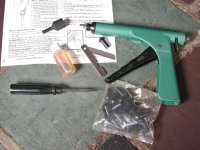
Here is another popular option:
http://www.stopngo.com/Contents/1075.htm

Or better description about its use:
<http://www.zenreich.com/ZenWeb/motorcycle/stopngo.htm>
 

Attachments

  • stopngo2.jpg
    stopngo2.jpg
    84.2 KB · Views: 530
I might add that the Safety Seal repair on my BMW has been subjected to higher speeds and more flex than a 4Runner tire will even see. Also, a motorcycle tire is a fraction the thickness of a truck or car tire. Pretty good proof that a plug can indeed seal effectively.
 
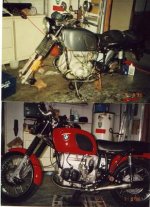
looks like a pretty good kit. hey Lemke, i ride a 1976 BMW R90/6, restored myself! here's a before and after pic:
 

Attachments

  • 1ca8.jpg
    1ca8.jpg
    28.6 KB · Views: 534
slowginjoe said:
You got it! In fact I advertise for Alice for free on the bike's plate frame. :D

Yes, this Texas boy gets around. I was suprised at how fast I could ride on Skyline without a ticket. It was a weekday though. San Francisco and Sacramento are two crowded cities I feel safe riding thru. Dallas is a war zone.
 
dcampen said:
But do you actually run the tires at this pressure? I am guessing that these are LT rated tires and the 52 psi is the pressure required for a maximum load. With a passenger load, which is less than the maximum load, wouldn't you want to be running these tires at a lesser pressure - perhaps around 32 psi?

I would not believe that running a tire that was designed for 52psi to be safe if it were lowered to 32. Your tires probably state 35psi max on them. So you are running them at 32psi like the rest of the world so a tire rated at 52psi should be run around 47 to 48 psi. If it was run at 32psi the sidewalls would surely wear out as well as the outer edges.
 
greasefingers said:
I would not believe that running a tire that was designed for 52psi to be safe if it were lowered to 32. Your tires probably state 35psi max on them. So you are running them at 32psi like the rest of the world so a tire rated at 52psi should be run around 47 to 48 psi. If it was run at 32psi the sidewalls would surely wear out as well as the outer edges.

is the 52 psi the 'max pressure'? my duelers has max pressure of 44 psi printed on the side wall but that doesn't mean they should be inflated anywhere near 40 psi. the max pressure means the absolute max that the pressure should be relative to the max load. the recommended pressure for my tires are 32 psi, like 90% of all car tires out there. 32 psi cold + ~5 psi after running on them for a bit + passenger and equipment load is about right for this tire. if you are pumping it up to 48 psi cold and unloaded and it's rated at 52 psi max you may be way over the max. pressure.
 
I would not believe that running a tire that was designed for 52psi to be safe if it were lowered to 32.
I think that is not correct and that it may be perfectly safe to run a tire with a 52 psi max pressure at 32 psi _if_ the load on the tire is significantly less than the max load that corresponds with the 52 psi max pressure.

For example, if the tire specified a max load of 2000 lb at a max pressure of 60 psi then the tire could be safely run at 30 psi if the load on the tire was only 1000 lb.
 
I think standard tire plugs will work fine on these tires...

I also carry a small electric air compressor (It fits in the storage bin in the cargo area) and a plug kit to fix my own small punctures.

I know a lot of people like to bash plugging a tire, but think about this-- You can have a nail in your tire for months and never lose any air pressure.... so a properly installed tire plug should make a 1000 times better seal and permanently fix any small puncture.
 
Does anyone know whether a tire shop can OR SHOULD replace the valve stems without unmounting the tires from the wheels? Wouldn't the tire beads get unseated off of the rim if air pressure is lost? I recently had a valve stem on my other car go bad and Costco replaced all 4 valve stems without unmounting the tires because the lead balance weights weren't touched at all. I'm concerned because the pressure dropped below 25psi (about 2/3 of the normal sidewall height) and I drove about 15 miles on the tire at low speed from work to home (I know, I know, you're probably thinking why the hell didn't I notice a change in the ride, but coincidentally I rotated the tires at home the night before and I thought that maybe I didn't mount a tire correctly since the car was pulling to the right and kept on driving home). That's the 3rd bad valve stem in a 3 year period & all my tires were from Costco. They gave me some BS about moisture getting pumped into the tire causes the valve stems to go bad, but I have a 15gal air compressor at home and I thoroughly fill & bleed the tank prior to pumping any air into my tires. Thx n adv!
 
You have to break the bead on a tire to put a new valve stem in a wheel.

Valve stems are installed by feeding them through the hole in the wheel from the inside, then they use a special tool that threads onto the valve stem to continue pulling it through until it seats.

What they do is mark the wheel and tire, so they can be put back in the same position. Then they don't have to bother with re-balancing.
 
Last edited:
greasefingers said:
Since the Dunlop’s that came with my rig are supposed to be 52psi;

For normal driving conditions and no extra loads, you should be running the air pressure recommended by the sticker inside the drivers side door jam, not what it says on the tire. Also, see your owner's manual for recommended tire pressure. This is usually around 32 to 35 psi for stock size tires.
If you are running higher pressure than needed, you will wear your tires unevenly (the center will wear out).
Do the chalk test to see where your tires touch the road; this will help you determine proper psi.
 
I've used plugs for years without any problems/leaks. If you're not comfortable with the standard (R+S) type plug, There is a plug that is attached to a patch that can be install from the inside that is really good, most tire repair shops will have them.

Koz
 

Members online

Forum statistics

Threads
278,310
Messages
3,554,079
Members
248,016
Latest member
Advally Service

Trending content

Back
Top