

paddlenbike
Member
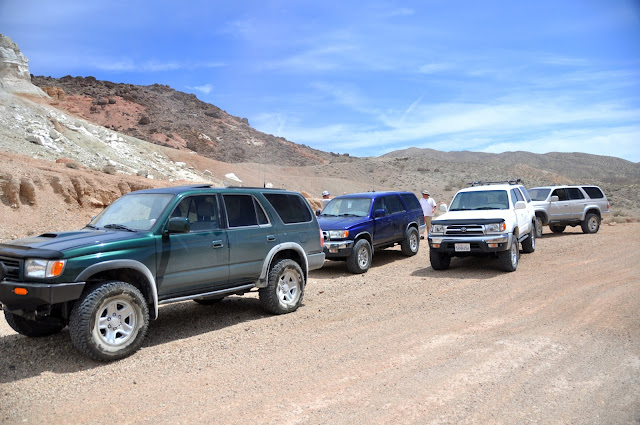
Four of us with 3rd gens headed south from Northern California down to the Mojave Desert for a weekend of wheeling. We all caravanned together, on the same roads at the same speed and did nothing to try and eek-out mileage (no drafting, etc.) The results were not what I expected.
Highway driving--(1) is heading south, (2) is mileage heading north to home
1999 4R - 0.0" lift, auto/V6, 265/75R16 ATs - (1) 24.2 mpg, (2) 22 mpg
1997 4R - 2.5" lift, auto/V6, 265/70R16 ATs - (1) 22 mpg, (2) 20.0 mpg
1999 4R - 1.0" lift, 5sp/V6, 265/75R16 ATs, aftmkt frt bumper - (1) 20.8 mpg, (2) 18.6 mpg
2000 4R - 2.5" lift, 5sp/SC V6, 265/75R16 ATs, Yakima rack - (1) 20.7 mpg, (2) 18.6 mpg
Our first surprise was that the automatics returned better highway mileage. I think it's mostly due to cruising RPMs. We were driving around around 72 MPH on the first leg of our trip and the 2 5-speed 4Runners were turning around 2700 RPMs while the auto 4Runners were at ~2200 RPMs with 265/75R16s and a little over 2300 RPMs with 265/70R16s. On the return trip we had a strong headwind for much of the way home and our average speed was higher at between 75 and 80 MPH, thus why the reduced economy. Our tankfull of offroad driving produced nearly identical mileage numbers.
This was not a huge surprise but the lifted and supercharged 4Runner got exactly the same mileage as the lesser lifted naturally-aspirated truck (both were 5speeds) with the exact same size and brand of tires (BFG ATs).
I think the flat highway driving put the automatic 4Runners in their sweetspot--cruising with the torque converter locked up and at an optimal RPM for mileage. The autos must be returning better mileage solely due to the reduction in cruising RPMs (2300 RPMs vs my 2700 RPMs), which makes me wonder if the step up to a 285/75R16 all terrain tire would affect my highway mileage as much as the auto guys claim. Regardless, I thought the mileage results were interesting.
Highway driving--(1) is heading south, (2) is mileage heading north to home
1999 4R - 0.0" lift, auto/V6, 265/75R16 ATs - (1) 24.2 mpg, (2) 22 mpg
1997 4R - 2.5" lift, auto/V6, 265/70R16 ATs - (1) 22 mpg, (2) 20.0 mpg
1999 4R - 1.0" lift, 5sp/V6, 265/75R16 ATs, aftmkt frt bumper - (1) 20.8 mpg, (2) 18.6 mpg
2000 4R - 2.5" lift, 5sp/SC V6, 265/75R16 ATs, Yakima rack - (1) 20.7 mpg, (2) 18.6 mpg
Our first surprise was that the automatics returned better highway mileage. I think it's mostly due to cruising RPMs. We were driving around around 72 MPH on the first leg of our trip and the 2 5-speed 4Runners were turning around 2700 RPMs while the auto 4Runners were at ~2200 RPMs with 265/75R16s and a little over 2300 RPMs with 265/70R16s. On the return trip we had a strong headwind for much of the way home and our average speed was higher at between 75 and 80 MPH, thus why the reduced economy. Our tankfull of offroad driving produced nearly identical mileage numbers.
This was not a huge surprise but the lifted and supercharged 4Runner got exactly the same mileage as the lesser lifted naturally-aspirated truck (both were 5speeds) with the exact same size and brand of tires (BFG ATs).
I think the flat highway driving put the automatic 4Runners in their sweetspot--cruising with the torque converter locked up and at an optimal RPM for mileage. The autos must be returning better mileage solely due to the reduction in cruising RPMs (2300 RPMs vs my 2700 RPMs), which makes me wonder if the step up to a 285/75R16 all terrain tire would affect my highway mileage as much as the auto guys claim. Regardless, I thought the mileage results were interesting.
Last edited:

 Since adding mine, my mileage is the same, except when I do a lot of high elevation or mountain driving I actually get better mileage with the SC than I did without it.


