High Transmission Temps After Drain & Fill

m0ist

New member
Sup ya'll.

A couple of days ago I did a drain and fill on my 2000 auto transmission and am having some higher than normal operating temperatures. I have around 210k and am not sure the last time it was changed. I'm running an external heat exchanger with the radiator bypassed. Before the drain and fill, I typically saw 165deg F highway driving and the most I ever saw was 200 on a hot day going up a long hill.

The dealer didn't have any ATF so I picked up the valvoline maxlife ATF from parts store.

Fluid that I took out wasn't bad looking at all. I must have added a little too much back into the trans, and I was seeing 220 at highway speeds. Long story short I took about a quarter of a quart out, and am now seeing 185 crusing on the highway. At lower speeds though, temperatures quickly rise up to the 200-205 mark.

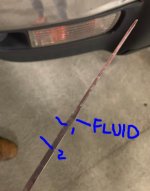
After checking levels per the book (P-L-P while idling at temperature) my dipstick only indicates i'm only around 3/4 the way to the first hot mark on the stick.

Should I add more fluid or leave it alone? 185 isn't offensive to me, but seeing 200 is a little scary. Never saw temperatures this high before.

I apologize if this is a dumb question. This is my first automatic car and first time servicing an auto trans.
 
Register to hide this ad
Why did you think you were overfilled? It sounds like you are underfilled.

If you're at operating temp between 158-176, your dipstick level should be within the hot range on the dipstick. Here's what I suggest you do. On level ground, have the parking brake on and the transmission in Drive. Put your left foot firmly on the service brake and use your right foot on the accelerator pedal and bring the rpms up to around 1,000. Doing this will increase your trans temp without having to drive it. When you reach 180 degrees, put the trans in park and immediately check your fluid level. If it's not to the top mark on the dipstick, add some. The trans will start to cool pretty quickly, so after you add some, do the same procedure again to bring it back up to 180 degrees. Repeat this process until you have the level to the top hot mark.
 
Last edited:
If you're at operating temp between 158-176, your dipstick level should be within the hot range on the dipstick. Here's what I suggest you do. On level ground, have the parking brake on and the transmission in Drive. Put your left foot firmly on the service brake and use your right foot on the accelerator pedal and bring the rpms up to around 1,000. Doing this will increase your trans temp without having to drive it. When you reach 180 degrees, put the trans in park and immediately check your fluid level. If it's not to the top mark on the dipstick, add some. The trans will start to cool pretty quickly, so after you add some, do the same procedure again to bring it back up to 180 degrees. Repeat this process until you have the level to the top hot mark.

So, just to be clear, it's supposed to be at the top most hot mark?

Can you advise approximately how much fluid it takes to bring level from bottom hot notch to the top?
 
So, just to be clear, it's supposed to be at the top most hot mark?

Can you advise approximately how much fluid it takes to bring level from bottom hot notch to the top?

At 180 degrees, I would expect to see it at the top hot mark. I don't know how much it takes to get it from the bottom to the top hot mark. Start with adding 1/4 quart and repeat the process 1/4 quart at a time until you get it to the top mark. With these transmissions, it's ok to be a little under-filled and a little overfilled. You just don't want to be way under or overfilled.

I don't know if this is going to fix your issue or not but it's not going to hurt to have your trans properly filled with fluid. The fact that your trans was fine before the service leads me to believe you under-filled it.
 
So, just to be clear, it's supposed to be at the top most hot mark?

Can you advise approximately how much fluid it takes to bring level from bottom hot notch to the top?
Typically it's about a half quart. You also might want to take into consideration that you mixed synthetic fluid with what was most likely non synthetic Dexron III. Not a huge problem, they are compatible, but mixing them might affect transmission operation or temps.
 
Typically it's about a half quart. You also might want to take into consideration that you mixed synthetic fluid with what was most likely non synthetic Dexron III. Not a huge problem, they are compatible, but mixing them might affect transmission operation or temps.

Fair point, but as a data point I recently swapped 6 qts of tired Toyota fluid with 6 qts of Valvoline Maxlife myself via drain/fill method and aren't seeing temp issues. My guess is the OP is dealing with some other issue...either underfilled or something else.
 
Fair point, but as a data point I recently swapped 6 qts of tired Toyota fluid with 6 qts of Valvoline Maxlife myself via drain/fill method and aren't seeing temp issues. My guess is the OP is dealing with some other issue...either underfilled or something else.

Wow, I only drained out a little less than 4 quarts. My dipstick never read in the "hot" range before this. I added back in a full 4 quarts thinking I was originally underfilled; my dipstick was within the hot range but I was seeing stupid hot temperatures on the highway.

I'm going to add a little more before my drive home from work and see what that does. I've already pretty much added back what I took out lol
 
Wow, I only drained out a little less than 4 quarts. My dipstick never read in the "hot" range before this. I added back in a full 4 quarts thinking I was originally underfilled; my dipstick was within the hot range but I was seeing stupid hot temperatures on the highway.

I'm going to add a little more before my drive home from work and see what that does. I've already pretty much added back what I took out lol

Definitely take dipstick readings before adding more. I'm not sure why I got 6qts out, but having the front wheels raised on ramps (was replacing the radiator and stuff at the time) might have contributed. I added back in fresh fluid what I'd removed, and got a hot reading at the top of the hot range on the dipstick.
 
Fair point, but as a data point I recently swapped 6 qts of tired Toyota fluid with 6 qts of Valvoline Maxlife myself via drain/fill method and aren't seeing temp issues. My guess is the OP is dealing with some other issue...either underfilled or something else.


You got 6qts out when you drained yours? I only get a gallon.


Sent from my iPhone using Tapatalk
 
Check the fluid level.

HINT:
- Drive the vehicle so that the engine and transmission are at normal operating temperature.

Fluid temp: 70 - 80°C (158 - 176°F)

- Only use the COOL range on the dipstick as a rough reference when the fluid is replaced or the engine does not run.


ty004runn_rm1di-318_svg


1. Park the vehicle on a level surface and set the parking brake.
2. With the engine idling and the brake pedal depressed, shift the shift lever into all positions from P to L position and return to P position.
3. Pull out the dipstick and wipe it clean.
4. Push it back fully into the pipe.
5. Pull it out and check that the fluid level is in the HOT range.
If the level is not within the HOT range, add new fluid.

You want the fluid at the lower HOT mark, gotta have room for expansion at
higher temps.
 
I’m so confused on atf temps. I’ve heard uphill 260 is not healthy, but not tranny ruining. Don’t mean to hijack the thread but if I have my family of 3 in my auto 00’ fully loaded and I’m seeing 230’ temps uphill is that bad?


Sent from my iPhone using Tapatalk
 
I’m so confused on atf temps. I’ve heard uphill 260 is not healthy, but not tranny ruining. Don’t mean to hijack the thread but if I have my family of 3 in my auto 00’ fully loaded and I’m seeing 230’ temps uphill is that bad?


Sent from my iPhone using Tapatalk

230 degrees is pretty normal when climbing sustained grades. If you haven't added an external cooler yet, I recommend it. It will drop your temps by around 20 degrees. Some people choose to bypass the cooler in the radiator from fear of a cooler failure (the dreaded pink milkshake. I chose to run my external cooler in-series with the stock cooler in the radiator.

The good thing is you're monitoring your trans temp which is smart. I start to worry when my temp gets above 230. I think the highest I've seen is 240 degrees on a relentless very steep grade in the Santa Cruz mountains. It must have been at least a 15-20% grade for a couple miles with no reliefs. On a recent trip to Death Valley, there was a gnarly sustained grade we were climbing and my trans temp was getting to around 230 with no end in site to the grade. The ambient temp outside was around 100 degrees that day. I chose to pull over and let my trans cool down before continuing. This is one of the reasons why we monitor our trans temps to let us know when it's time to stop and give our rig a rest. When it comes to engine coolant temps and trans temps, ignorance isn't bliss, it's dangerous. The analog coolant temp gauge is pretty worthless. By the time you see the needle rising, your coolant temps are already really high. By being able to see a real time digital readout of your coolant and trans temps, you can spot a problem before it becomes an even bigger problem.

In case you're interested in installing an external trans cooler, here's a video I made of installing one on my 2000 3rd Gen:

<iframe width="560" height="315" src="https://www.youtube.com/embed/2nVbwe2t2T8" frameborder="0" allow="accelerometer; autoplay; encrypted-media; gyroscope; picture-in-picture" allowfullscreen></iframe>

Also, knowing when to turn overdrive can lower your temps as well:

<iframe width="560" height="315" src="https://www.youtube.com/embed/BEZfDOkGVno" frameborder="0" allow="accelerometer; autoplay; encrypted-media; gyroscope; picture-in-picture" allowfullscreen></iframe>

Finally, knowing when to use 4lo can save your trans as well:


<iframe width="560" height="315" src="https://www.youtube.com/embed/wqxeZvljYGc" frameborder="0" allow="accelerometer; autoplay; encrypted-media; gyroscope; picture-in-picture" allowfullscreen></iframe>
 
You may want to consider disconnecting the cooler lines and with some light air pressure blow out the cooler lines to makes sure they are not clogged.
:frusty:
 
So, I went on a 90 mile drive last night. I did not see temperatures about 170. Ambient temperatures were much cooler... ~75degF

When I parked, my temperatures were only at 160. Here is where the dipstick is (at 160). Should I leave this alone, or still add?
 

Attachments

  • Capture.jpg
    Capture.jpg
    28.3 KB · Views: 799
Add just a little more to bring it to the lower hatch mark of the HOT mark on the dipstick.

Any other quirks with the tranny?
 
Nope, shifts smooth no slipping and temperatures are nice. When it was in the full range it was getting hot.

Seems there are a lot of transmission posts on here all of the sudden lol
 
So, I went on a 90 mile drive last night. I did not see temperatures about 170. Ambient temperatures were much cooler... ~75degF

When I parked, my temperatures were only at 160. Here is where the dipstick is (at 160). Should I leave this alone, or still add?

Dude, if you do what I said in one of my earlier posts you can bring your trans temp up higher without driving it and then check to see where your dipstick level is at. I'm guessing you still need to add.

My reasoning for bringing the dipstick level to the top hot mark at 180 degrees is because that's the upper end of the operating range the FSM specifies. It just makes sense. Somebody mentioned you want to be at the lower hot mark when you're within the range specified by the FSM to allow for expansion. Well, maybe at the lower hot mark at 158 but what about at 176? I've been filling my auto trans vehicles like this for 30 years. If I've been grossly overfilling my transmissions all these years, the breather on the top of my trans would have puked out fluid and that's never happened. Just because your level is at the top hot mark doesn't mean your trans is filled to the brim. Take your rig up a sustained grade bringing the temp to 200+ and then check the level. Your dipstick reading will be way over the top hot mark because the fluid continues to expand as it gets hotter.

At the very least add fluid until you're at the bottom hot mark at 169 degrees. But, after doing that, I think you should bring it up to 180 and see if you're now at the top hot mark. My two and a half cents.
 
Dude, if you do what I said in one of my earlier posts you can bring your trans temp up higher without driving it and then check to see where your dipstick level is at. I'm guessing you still need to add.

My reasoning for bringing the dipstick level to the top hot mark at 180 degrees is because that's the upper end of the operating range the FSM specifies. It just makes sense. Somebody mentioned you want to be at the lower hot mark when you're within the range specified by the FSM to allow for expansion. Well, maybe at the lower hot mark at 158 but what about at 176? I've been filling my auto trans vehicles like this for 30 years. If I've been grossly overfilling my transmissions all these years, the breather on the top of my trans would have puked out fluid and that's never happened. Just because your level is at the top hot mark doesn't mean your trans is filled to the brim. Take your rig up a sustained grade bringing the temp to 200+ and then check the level. Your dipstick reading will be way over the top hot mark because the fluid continues to expand as it gets hotter.

At the very least add fluid until you're at the bottom hot mark at 169 degrees. But, after doing that, I think you should bring it up to 180 and see if you're now at the top hot mark. My two and a half cents.

I understand what you're saying and it makes complete sense, which is why i'm confused in the first place...

I've now added slightly less than what I originally had put in. This is because i was overheating at that initial fill level. The dipstick level at 200+ was grossly over the top most notch (like you said it would be), I took some out because I assumed I overfilled. Now, with ~1/4 quart removed from that initial fill, my temperatures are fine.

I'm scared if I add in that ~1/4 quart left that I took out, I'll start overheating again....
 
Last edited:
I understand what you're saying and it makes complete sense, which is why i'm confused in the first place...

I've now added slightly less than what I originally had put in. This is because i was overheating at that initial fill level. The dipstick level at 200+ was grossly over the top most notch (like you said it would be), I took some out because I assumed I overfilled. Now, with ~1/4 quart removed from that initial fill, my temperatures are fine.

I'm scared if I add in that ~1/4 quart left that I took out, I'll start overheating again....

I sort of doubt a 1/4 quart of fluid low or high would make any difference whatsoever with your temps. It's confusing why you were overheating, but if everything is working well, I guess just leave it as is.
 

Members online

Forum statistics

Threads
278,309
Messages
3,554,071
Members
248,016
Latest member
Advally Service

Trending content

Back
Top