How to tell radiator age?

Brique

New member
Ok, so I got my 4Runner a few weeks ago and since it's at 180k miles, I've got a radiator replace/external trans cooler install on my priority list.

Last night I was poking around through my truck's maintenance records on toyota.com/owners and discovered that 1 year and 5k miles ago a transmission fluid flush was done at the dealership (PO was nice enough to dealer maintain for me). There's no mention in the records of a new radiator, but the one in the truck right now seems fairly newish judging from the condition of the plastic on it. Just wondering if anyone knew a way to get a ballpark idea of how old the radiator is from some clue on the radiator itself. Maybe a year buried in the serial number or something.

Any thoughts?
 
Register to hide this ad
If everything looks good and fluids look fresh I wouldn't worry about it especially since you're considering an external trans cooler... That also extends the life of a radiator
 
I'm resurrecting this thread because I'm also in a similar boat. I've owned my 97 for about 5 years now, and the previous owner had really great maintenance records, but I couldn't tell if the rad has actually been replaced or not because of difficult to read handwriting (which I'm not faulting him for because he had limited mobility as it was).

Like the OP, my radiator looks newer than most other OEM equipment in the engine bay, so I'm thinking it was replaced at some point. I just wanted to see if there was a way to actually get a date off of it.

Also, considering I've put 60k miles on it, maybe I should just replace it soon anyway? I wheel very infrequently, and I don't tow, but I definitely drive a lot in the mountains, and Denver can get pretty friggin' hot, so I'm right on that 50/50 need of a tranny cooler.
 
Does the radiator have an "ND" in white font somewhere on the top? If so, it's more than likely original.
 
A Trans Cooler is such an inexpensive and easy to do mod that if its in question, just buy an external cooler if all fluids look good.
 
I'm resurrecting this thread because I'm also in a similar boat. I've owned my 97 for about 5 years now, and the previous owner had really great maintenance records, but I couldn't tell if the rad has actually been replaced or not because of difficult to read handwriting (which I'm not faulting him for because he had limited mobility as it was).

Like the OP, my radiator looks newer than most other OEM equipment in the engine bay, so I'm thinking it was replaced at some point. I just wanted to see if there was a way to actually get a date off of it.

Also, considering I've put 60k miles on it, maybe I should just replace it soon anyway? I wheel very infrequently, and I don't tow, but I definitely drive a lot in the mountains, and Denver can get pretty friggin' hot, so I'm right on that 50/50 need of a tranny cooler.

Radiator replacment is really not on the TO DO list for maintenance at dealerships. Most likely original. If it was me I would replace it. Cheap, piece of mind. Or do the cooler. Either way do something.
 
You might find a date stamp on it, but you'd likely have to take it out to do so. AND there's no guarantee it didn't sit in a warehouse for 5 years before it was installed...
 
I'm parts of the "if it aint broke" crowd.

I've been flushing the rad every 3 years since new on my '98 Ltd and at 514,000 km (319,000 miles), it's still fine with no signs of impending failure.
 
One thing I look at for age is the condition of the fins. Those will get more and more messed up with age.

Or you could remove a dead bee from the fins, take it to the lab and have it carbon-14 dated for an exact time that bee died and piece together the date of the radiator. Watch out though, might come back as your radiator is dated from 3 billion years B.C.
 
No surefire way to know. Observe the temperature when it's warmed up. If it's staying cool, you're good to go. You can also pop the cap off and check the condition of the coolant. If it has anything floating in it, that's bad. Shine a light in there and look at the cores. Do they have buildup on them? If it smells rancid it's very old and at that point suspect. Other than that, you shouldn't be concerned.
 
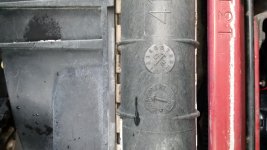
If it's a factory Toyota radiator, it will have a date code stamp right on top of it.
Open the hood check the top plastic tank, usually close to the fill neck.
Two round circles. One with months and the other the years.
An arrow pointing to the month and year that it was built.
For all the ones I've seen, its usually been built very close to the production date of the truck.

IE: sticker on door for production date says 8/99. The radiator date code would be 6 or 7/99..

Unless its been changed with a newer factory Toyota one then the code will be newer then the truck.
On an after-market one I'm not sure if they date them. But most likely they do. Just not sure where.

If it wasn't pouring outside here i'd go take a picture of mine. When I get home from work I'll try to snap one and post it.

This is the date stamp on my 02 Tacoma. The Taco was built 8 of 2002. So it looks like the radiator was built on the 17 day in 7 of 2002
 

Attachments

  • IMG_20150910_165028.jpg
    IMG_20150910_165028.jpg
    133.8 KB · Views: 2,562
Last edited:
I have a 1998 limited, 127,000 miles with no record of the radiator being changed. The markings from Toyota do not look like the previous post
5bb05380be3eaa1d2dad77222c55a39f.jpg
 
Whoops! I only got one reply notification to this thread from the first reply and I didn't realize it was going still!

Anyway, I also have the white lettering similar to rtarv, but I'll look closer for the arrow circle stamps. I do have some dirt and crud in the coolant fill tank, and the fins are getting pretty beaten up now. The dirt and crud could be from a water crossing I did a few years ago that was a bit deeper than I thought.

I'll probably just replace it because I'm fully aware that the "If it ain't broke fix it" mentality can backfire when your transmission gets milkshaked (milkshook?!). From what I hear, if I replace it, then likely no need for an external tranny cooler unless I'm towing or hard wheeling in a hot climate (which I'm not). Correct? Anyone have a good link for a good OEM replacement (followed by a good link on how to replace the radiator?)?

Thanks!
 
I replaced mine at 215K with an OE Denso radiator off of Amazon for $100 and change. I've read on here that the Denso radiator is not exactly the same radiator as the original Toyota radiator- which doesn't imply it's bad or anything like that. The original Toyota rad cost around $220, more than I was willing to spend, so I opted for the Denso. I did a side by side comparison of the original and Denso, and the Denso looked as good as the original in its build quality. No issues to report with it, so far, after 6K miles! I'd recommend buying one.


Some threads worth reading:

http://www.toyota-4runner.org/3rd-gen-t4rs/114586-radiators-koyo-vs-rest.html
http://www.toyota-4runner.org/3rd-gen-t4rs/115475-how-radiator-replacement.html
 
Last edited:
Just checking in to see if anyone else can confirm that the original radiator will have a date stamp on it somewhere near the top. I have a new to me 2000 SR5 and was just putting together a trans cooler order, but I noticed that the radiator looks a lot newer than, well, most of the things in the engine bay. I have basically nothing in the way of maintenance records (140k), so I'm thinking I'll probably do the cooler anyway, but the potential of having a pretty darn new radiator in there gives me pause.
 
$200 and you've got a new radiator and trans cooler and peace of mind. Not really worth thinking to much about it.


I share this view and just did it myself. If you bother with a trans cooler just put a new rad in too. They are on sale right now. I also advocate running tranny through new rad and cooler myself but there are different camps on that.


Sent from my iPhone using Tapatalk
 
failure points

I would do an inspection of weak/failure points including the cap....I've seen many stock/aftermarket radiators start to weep where the plastic ends meet the metal fins....also for some reason the last set of Camrys I've worked on the said plastic ends started to crack around the hose connections...
 

Members online

No members online now.

Forum statistics

Threads
278,315
Messages
3,554,104
Members
248,016
Latest member
Advally Service

Trending content

Back
Top