
I can't understand pre-load spacers

m@x

New member
Hello everyone.
I am doing some research in how the spacers work, their types, advantages and disadvantages.

The top-mounted spacers were easy to understand - you drop the strut assembly down, the strut and coil continue to operate in their factory range, but another suspension component can be damaged if the strut assembly is extended to the max.

What I can't understand is the pre-load spacers and I need your help to explain me their effect.

The spacer is mounted inside the strut assembly, between the coil and the upper mounting plate. OK.

What I don't understand is:

- The spacer creates a pre-load and therefore affects the quality of the ride that is stiffer (unlike top-mounted)

What kind of pre-load are we talking about? How a spacer between a car and a spring can affect the spring rate? Let's assume we have a 100kg box sitting on a spring and the spring compresses by 2" under this weight. If I add a spacer between that box and the spring, how can it preload the spring more? The spring will be compressed by the same 2". The distance will increase - yes. This is why the strut is extended by the thickness of the spacer and the lift is achieved.
IMHO the ride could be affected by the extended strut, because the extended strut would provide less resistance to the coil as well as shock absorption...

- The preload spacer limits coil spring compression (unlike top-mounted)


How can the compression be limited when the spring has more room to compress? Since the strut is slightly extended, it has more distance to travel until it hits the bump stop, and therefore the spring can compress more. Isn't this right?

I am confused. Please help me understand.
Maybe I will understand things better if I know what part reaches first its maximum (spring or strut) when the assembly is fully extended, and what part reaches first its minimum (strut or spring) when the assembly is fully compressed in t4r?

Also,
Daystar is not using preload spacers in their 2.5/1.5 kit anymore
- Since the top-mounted spacers don't extend the strut, any thickness would be safe for X-REAS, right?
- Can the 2.5/1.5 kit potentially cause damage when the struts are fully extended?
- Should I buy a front differential drop kit with a 2.5/1.5 lift?

Thank you!
Max
 
Register to hide this ad
It's just basic geometry. A spacer INSIDE the coil perches effectively takes up some of the space for the spring to compress with a non-compressable material. If you put the spacer OUTSIDE the space the spring operates in, then the spring's movement is not affected. But if you put the spacer inside that "box" that the spring operates in, now you've taken up some of it's space with a material that can't compress. So it "pre-loads" the spring and alters the ride quality.
 
It's just basic geometry. A spacer INSIDE the coil perches effectively takes up some of the space for the spring to compress with a non-compressable material. If you put the spacer OUTSIDE the space the spring operates in, then the spring's movement is not affected. But if you put the spacer inside that "box" that the spring operates in, now you've taken up some of it's space with a material that can't compress. So it "pre-loads" the spring and alters the ride quality.

This is pretty accurate.

To use your analogy though, a 100kg box compresses a spring 2". With the preload spacer, the spring is already compressed 1" but the overall length hasn't changed. Since we know that 2" of compression is required to absorb 100kg of load, the spring only compresses 1" now. So before when you loaded the spring it moved 2", now it only moves 1" because 1" of the previous travel is already built in without affecting overall travel length. And, while overall length is not affected, the spring can't physically compress all the way to the bottom of shock travel because now some of that space is taken up with a spacer. This is also not really a problem because the bump stops on the frame typically intervene before this happens.

Also, Daystar does still make this type of kit, its a bit harder to install because it requires a spring compressor but the soft 4runner springs can definitely benefit from some stiffening up; Ive had compliments on my ride quality from several people so the stiffer ride is an improvement similar to swapping in FJ springs. Check out wheelersoffroad.com if you are interested in this kit. You do not need a diff drop with this kit, stock CV angles are slightly angled up and this size of this kit just inverses that slight angle down.
 
Last edited:
It's just basic geometry. A spacer INSIDE the coil perches effectively takes up some of the space for the spring to compress with a non-compressable material. If you put the spacer OUTSIDE the space the spring operates in, then the spring's movement is not affected. But if you put the spacer inside that "box" that the spring operates in, now you've taken up some of it's space with a material that can't compress. So it "pre-loads" the spring and alters the ride quality.

This is pretty accurate.

To use your analogy though, a 100kg box compresses a spring 2". With the preload spacer, the spring is already compressed 1" but the overall length hasn't changed. Since we know that 2" of compression is required to absorb 100kg of load, the spring only compresses 1" now. So before when you loaded the spring it moved 2", now it only moves 1" because 1" of the previous travel is already built in without affecting overall travel length. And, while overall length is not affected, the spring can't physically compress all the way to the bottom of shock travel because now some of that space is taken up with a spacer. This is also not really a problem because the bump stops on the frame typically intervene before this happens.

Also, Daystar does still make this type of kit, its a bit harder to install because it requires a spring compressor but the soft 4runner springs can definitely benefit from some stiffening up; Ive had compliments on my ride quality from several people so the stiffer ride is an improvement similar to swapping in FJ springs. Check out wheelersoffroad.com if you are interested in this kit. You do not need a diff drop with this kit, stock CV angles are slightly angled up and this size of this kit just inverses that slight angle down.

Thanks guys for your replies! I apologize I didn't reply earlier - I just came from a business trip and I didn't have a chance to write from there.

Both of you refer to the spring compression that occurs because another object takes some of the space, therefore preloading the spring.
But isn't the space between the lower spring seat and the upper seat spring constantly changing when the strut assembly is working? The way I see it, when you insert a spacer between the spring and the upper spring seat, the spring doesn't compress because is pushes down the lower spring seat and so the strut extends, and therefore the lift is achieved.

The compression of the spring can occur only if it sits in the "box" that doesn't change in size, and then you add a spacer in the box.

I will post some pictures I made later in the day.

Thanks again guys!
 
the lower spring seat should not be moving.

What I mean is the movement of the lower seat in relation to the upper spring seat or car frame, but not in relation to the ground.

I may be missing something but AFAIK, when the car goes through the bumps, it is the portion in between the spring seats (upper and lower) that "flexes". So if you place a pre-load spacer under the upper seat, you'll end up with the same load, same spring compression but the upper seat will just raise up therefore lifting the car. So what pre-load are we talking about then?

A spring will compress further only if:
1) You put more weight onto it
2) The upper seat and lower seat are not moving in relation to each other. The distance is constant. And then you add a spacer.

Thx,
Max
 
the spring seats in a certain pocket, with a pre load spacer the spring is compressed in its original location to make room for the spacer. Which changes the pre-load and the original spring rate which causes it to be stiff.
 
So I am a more visual person and all this theory-craftin' mumbo jumbo is making my head hurt more than it already does in this heat... :flame:

I found this interesting thread on TacomaWorld WITH PICTURES! That explains various spacer lifts.

some thoughts on suspension lifts. - Tacoma World Forums

But I enjoy theory-crafting... so here's my text wall! :tongue1:

So first lets go over the basic ideas of suspension. The main purpose of springs is to support the weight of the vehicle, while the shock absorbers; by way of spring's ability to support weight and compress/expand control/dampen the up and down movement of the suspension. Springs are rated in a few ways, commonly by lbs. per inch (not accounting for variable rate springs which I don't believe are used on the 120 Platform;) for example, my Eibach 700lbs that come with my OLW 2.5" Lift kit takes 700lbs to compress the spring 1" from its "unloaded" height.

A preload spacer being put within the spring/shock assembly increases the ride height by stiffening the springs and limiting compression. The idea is that if it takes 700lbs to compress the springs, then adding a spacer that is calculated to simulate lets say 1400lbs of "preload" on the spring effectively removes 2" of spring travel. The spring/shock assembly is still the same over all length (the effective height of the spring/shock assembly is partially determined by the shock piston/ram/shaft length and the suspension travel when installed,) but it will compress 2" less and thus will result in less over all spring travel. This results in a stiffer ride because shocks are designed to work over distance traveled; i.e. the stock shock absorber perhaps dampens best when allowed to travel roughly 4", but due to the preload spacer, it now only works within a travel of 2" one average and will not have enough distance to properly counteract the spring's expansion/compression cycles.

Any of that make sense?
 
the spring seats in a certain pocket, with a pre load spacer the spring is compressed in its original location to make room for the spacer. Which changes the pre-load and the original spring rate which causes it to be stiff.

So I am a more visual person and all this theory-craftin' mumbo jumbo is making my head hurt more than it already does in this heat... :flame:

I found this interesting thread on TacomaWorld WITH PICTURES! That explains various spacer lifts.

some thoughts on suspension lifts. - Tacoma World Forums

But I enjoy theory-crafting... so here's my text wall! :tongue1:

So first lets go over the basic ideas of suspension. The main purpose of springs is to support the weight of the vehicle, while the shock absorbers; by way of spring's ability to support weight and compress/expand control/dampen the up and down movement of the suspension. Springs are rated in a few ways, commonly by lbs. per inch (not accounting for variable rate springs which I don't believe are used on the 120 Platform;) for example, my Eibach 700lbs that come with my OLW 2.5" Lift kit takes 700lbs to compress the spring 1" from its "unloaded" height.

A preload spacer being put within the spring/shock assembly increases the ride height by stiffening the springs and limiting compression. The idea is that if it takes 700lbs to compress the springs, then adding a spacer that is calculated to simulate lets say 1400lbs of "preload" on the spring effectively removes 2" of spring travel. The spring/shock assembly is still the same over all length (the effective height of the spring/shock assembly is partially determined by the shock piston/ram/shaft length and the suspension travel when installed,) but it will compress 2" less and thus will result in less over all spring travel. This results in a stiffer ride because shocks are designed to work over distance traveled; i.e. the stock shock absorber perhaps dampens best when allowed to travel roughly 4", but due to the preload spacer, it now only works within a travel of 2" one average and will not have enough distance to properly counteract the spring's expansion/compression cycles.

Any of that make sense?

Thanks for your replies! I am still struggling to understand the physics behind this. Just wanted to mention again that I am not contradicting your explanations, I really try hard to understand it. Maybe my not-very-deep knowledge about suspensions makes things even harder.

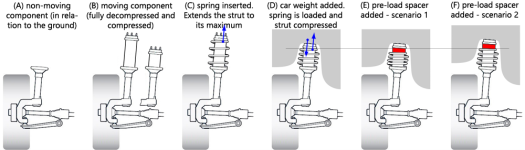
Finally I finished the picture of "how I imagine it". I just finished it and posting it as promised. I am glad that BlackWorksInc has also mentioned about the visual side of things. Hopefully this will help me understand the spacers' effects better.

susp.png

I will describe the steps A through F.
(A) This is the component that I imagine as not to be moving. LTDSC is right - the lower spring seat is not moving in relation to the ground.
(B) We have the upper part added (in mind) - this part moves up and down. I put the pictures with maximum extension and maximum compression
(C) Now we add the spring over the strut. The spring becomes a bit preloaded, just because the room between the spring seats is not enough for the spring to fully expand (even if the strut is fully extended). The spring is pushing the strut mount upwards.
(D) We add the weight of the car and the spring is compressed. Now there is a load.
(E) and (F) - the scenarios with the spacer added.

Just imagine in (D) that you squeeze the spring down to make some room between the spring and the upper spring seat, then add the spacer in there and release the spring. What will happen?

Will the spring stay compressed down (as in E) or will it revert to its initial compression (as in F) pushing up the spacer -> the upper spring seat -> the strut mount -> the car?

There is a horizontal line showing the upper baseline of the spring. The spring will go below the line if we add more weight to the car. And the spring will go above the line if we remove weight. If we add a spacer, the spring shouldn't compress more. The spring will push the whole car up (F). The only way the spring will become compressed (E) is if we make sure that in (D) the strut can not extend anymore. When the spacer is added the spring cant push it anywhere and becomes compressed.

It's like if you were standing on the spring barefoot and then in shoes. Will you go up or will your shoes compress the spring more?
It would compress only if your head was stuck in a ceiling that couldn't move up. Then the spacer shoes would compress the spring.

I don't know, I just can't find another explanation to myself why the spacer preloads the spring when the spring can easily push the spacer upward. ..

Unless I am missing something. :frusty::frusty::frusty:
 

Attachments

  • susp.png
    susp.png
    133.3 KB · Views: 9,542
Last edited:
My understanding is its a little of E and a little of F. Because E won't really lift the vehicle any, just stiffen the spring.

The spacer being inserted will preload the spring (compressing it) and add a distance that can't be changed (the height of the spacer) and the combination of the two will create roughly a heigh similar to Picture C because it will counteract the static weight of the vehicle somewhat more than D because of preload on the spring.

That make sense?
 
Last edited:
My understanding is its a little of E and a little of F. Because E won't really lift the vehicle any, just stiffen the spring.

The spacer being inserted will preload the spring (compressing it) and add a distance that can't be changed (the height of the spacer) and the combination of the two will create roughly a heigh similar to Picture C because it will counteract the static weight of the vehicle somewhat more than D because of preload on the spring.

That make sense?

Thanks BlackWorksInc for the reply. I appreciate it. Your answer lead me to look further in the mechanics of the spring and this is what I have found:

Spring rate - is the weight that is required to compress the spring by 1 inch or cm. There are only 3 factors that affect this value:
1) diameter of the spring wire
2) diameter of the spring itself
3) the number of coils in the spring.

The pre-load does not affect the spring rate at all. More than that, if the spring that has a spring rate of 100kg per 1 cm is initially compressed (preloaded) by 1 cm, it takes additional 100kg of "pre" weight before the spring moves down at all.

Let's take an example - two similar springs.
Spring A = 4" total, rate: 100lb per 1"
Spring B = 4" total, rate: 100lb per 1"

So it takes 100lb to deflect both springs from 4" to 3".

Now we preload the spring A by 1":
Spring A = 3" preloaded
Spring B = 4"

If we want to compress both springs down to 2", we will need 200lb of pressure for both springs. Even if the spring A is pre-loaded, the final spring load and length will be identical for both springs.
If we want to compress both springs down to 1", we will need 300lb of pressure for both springs. And again, both springs will be loaded equally and will have same length.
And if we apply only 100lb of pressure, the spring A won't move since it was preloaded by 1" but spring B will move by 1". And both springs will be loaded equally and have equal length.
But if we load both springs with 50 lb, then spring A will ignore that since it's not enough weight to compress it further. And spring B will move down by 0.5"
Now the springs will not be loaded equally and will have different length.

What I am trying to say with this example is that on a car, the 3 ton of load on springs is more than enough weight to overweight and cancel out the initial 1" spacer pre-load because the spring will be much further compressed. With or without the preload, the springs will be of equal length in the end.
So the question is why would they pre-load the spring? And if the spring is of the same height (car weight hasn't changed) how do we get the lift?

My assumption is that the spacer is not pre-loading the spring. It simply moves the car up. I think of it as a thicker upper spring seat. The spring doesn't care if the upper seat was thickened downwards or upwards. If upwards - it's like the top mount spacer. If downwards - the strut rod will have to come out by that 1" and that's it.

Sorry if I am being stubborn. It's just that the more I read about mechanics, the more proof I see that the spring has no initial load.

max
 
Last edited:
I got it!

Pre-loading = refers to compression of the spring before there is any weight pushing from the top.
Zero pre-load = you have the strut assembly in your hands and the distance between the lower and upper spring seats is just enough so that the spring rests unloaded and has no rebound tension.

If the car is preloaded with a spacer imitating 200lbs of weight, and then a weight of 500lbs is applied from the top, then this pre-loaded spring will have absolutely the same length and stiffness and other properties as a zero pre-loaded spring had, with 500lbs sitting on the top.

Why then pre-load? Because of the 1" spacer, the piston inside the shock will come out by 1" which will give more suspension travel and therefore a lift (that would be fig. (D) vs (F) in my pic from above).

I think that the main reason why people notice ride quality change is because the strut doesn't operate in its normal range anymore. The spacer makes it to extend a bit.

A very good explanation here:
Could someone explain spring preload (coilovers) - Zilvia.net Forums | Nissan 240SX (Silvia) and Z (Fairlady) Car Forum

by sykikchimp @ zilvia.net

I guess now I know exactly how it works. Thank you guys for your help and your time! Much appreciated!
 
Last edited:
I am confused about the difference between a strut spacer and top plate spacer and came upon this thread. I came to the same exact conclusion as the OP: pre-load only refers to an unloaded strut assembly when distance from top to bottom spring perches is restricted by the shock shaft length. However, once you load the strut with vehicle weight, the spring load with and without the spacer (thus, the length of the spring) is exactly the same.

Picture this: Two struts side-by-side on a table. Same springs. Strut A has a spacer, strut B doesn't. Both are the same length. Strut lengths are the same because perch distance is limited by shock travel. A is pre-loaded, say, with the equivalent of 200 lbs with that spacer. Because spring and spacer must "live" in the same limited space, spring A is shorter (pre-loaded) by the exactly the spacer length. Now what happens when you install them on each side of a truck and slowly lower both sides? B will compress first until 200 lbs has loaded onto it. A is pre-loaded to 200 lbs so won't compress yet. At 200 lbs, both springs are the same length, but strut B is shorter by exactly the length of that spacer. From there on, both struts will compress until spring loading equals vehicle load. Again, final spring lengths are the same, A is longer by the length of the spacer.

So all the spacer does is lift the vehicle, but offers no change in effective spring rate, only where in the shock travel the compression takes place. So how does a strut spacer really differ with a top plate spacer? I don't see a difference. Can someone point out what I'm missing?
 
Last edited:
I am confused about the difference between a strut spacer and top plate spacer and came upon this thread. I came to the same exact conclusion as the OP: pre-load only refers to an unloaded strut assembly when distance from top to bottom spring perches is restricted by the shock shaft length. However, once you load the strut with vehicle weight, the spring load with and without the spacer (thus, the length of the spring) is exactly the same.

Picture this: Two struts side-by-side on a table. Same springs. Strut A has a spacer, strut B doesn't. Both are the same length. Strut lengths are the same because perch distance is limited by shock travel. A is pre-loaded, say, with the equivalent of 200 lbs with that spacer. Because spring and spacer must "live" in the same limited space, spring A is shorter (pre-loaded) by the exactly the spacer length. Now what happens when you install them on each side of a truck and slowly lower both sides? B will compress first until 200 lbs has loaded onto it. A is pre-loaded to 200 lbs so won't compress yet. At 200 lbs, both springs are the same length, but strut B is shorter by exactly the length of that spacer. From there on, both struts will compress until spring loading equals vehicle load. Again, final spring lengths are the same, A is longer by the length of the spacer.

So all the spacer does is lift the vehicle, but offers no change in effective spring rate, only where in the shock travel the compression takes place. So how does a strut spacer really differ with a top plate spacer? I don't see a difference. Can someone point out what I'm missing?

I do not know any of the engineering facts but I do know that when I put in my Daystar lift with the preload spacers it rode the same as it did stock. Other than setting higher you would never know the lift was installed.
 
Yeah, that makes sense to me.
I found a really good article addressing this:
Slee - An overview of Toyota IFS Suspenison LiftsSlee - An overview of Toyota IFS Suspenison Lifts
Basically, a strut spacer does not change the max strut length and therefore, will have the same droop. However, it can cause coil bind (adjacent wraps touching). A top plate spacer doesn't contribute to coil binding, but extends droop which changes max angles for all the joints.
Both will lift, different poisons I suppose if either are excessive.
 

Members online

No members online now.

Forum statistics

Threads
278,309
Messages
3,554,071
Members
248,016
Latest member
Advally Service

Trending content

Back
Top