iPhone 5 Info Thread

Thai

Elite Member
This is mainly for iPhone owners or would-be buyers. If you're an Android user and hates iPhone, then just move on. This is for MY information. If you find this thread useful, then great. If you don't, then just move on. No need for attention-seeking posts here. This thread is NOT about Apple vs. Android, unless otherwise compared via articles linked.

And this is the mother of all iPhone 5 reviews: AnandTech - The iPhone 5 Review

A very thorough and exhaustive review!
 
Last edited:
Register to hide this ad
Why Apple initially chose 30-pin dock connector: The Future Of Apple’s Dock Connector [Feature] | Cult of Mac

"The problem with USB, though, is that it was designed as a protocol to standardize PC peripherals: keyboards, mice, digital cameras, printers, disk drives, that sort of thing. In other words, USB expects that you’ll be using a traditional desktop computer to load drivers to access an accessory.

The problem with USB is that it expects you’ll be using a traditional desktop computer at one end.

And that’s the problem. Your iPhone, your iPad, your iPod… sure, these are all computers, but they don’t load drivers. In conventional desktop computing terms, these are still accessories. So how do you get one accessory to talk to another accessory without drivers?

That’s where Apple’s 30-Pin Dock Connector comes in. It allows an iPhone, an iPad or an iPod to talk directly to compatible accessories, no drivers required. It’s the soul of Apple’s billion-dollar iPod, iPhone and iPad accessory empire.

The 30-Pin Dock Connector is what allowed Apple to turn the iPod, then the iPhone and iPad, into the hub of so many people’s digital lives. Thanks to the Apple Dock Connector, we have cars that can speak with our iPhones or iPads, televisions that can suck movies from our iPods and display them 50-inches high, and an endless and affordable array of iPod-compatible toys, peripherals, accessories and speaker docks. It’s telling that the one iDevice that doesn’t ship with a 30 Pin Dock Connector — the iPod shuffle — is the one that has a negligible number of third-party accessories made for it: the iPod shuffle is the only iPod that uses straight USB instead of 30 pins.

We’ve already seen that a USB connector only has four pins: two for data, one for power and one for ground. It’s up to a connected computer to be able to load drivers to be smart and powerful enough to translate the data coming from a USB device into a format it can actually work with.

The 30-Pin Apple Dock Connector works quite differently, though. Each pin has a specific function, and all a compatible accessory needs to do is watch what data is coming through the specific pins it needs to provide that device’s functionality.

Think of the Apple Dock Connector like a lock, and a compatible accessory like a key. In any lock, there are a number of tumblers; for a key to open that lock, it needs to be precisely cut so that its ridges trip those tumblers and then unlock, say, a door or a box.

That’s how the 30-Pin Apple Dock Connector works. While two of those thirty pins do provide USB data-in and data-out for the purposes of syncing, the rest have very specific functions. The result is that if you plug your iPhone into, say, a speaker dock, the speaker dock’s connector is configured so that it only trips the pins it needs: in this case, audio out and power in. An accessory made to display video from your iPod classic on your TV, on the other hand, will be configured to only watch the video out and audio out pins. And so on.

The original 30-Pin Dock Connector was a remarkably future-proof design, and Apple has added functionality to many of the blank pins over time; until now, there’s a pin for nearly every function an accessory could possibly want to provide. The benefits for accessory makers are huge, because they don’t have to make devices with power-hungry CPUs to try to figure out and translate all of the data coming in and out of an iDevice into a format it can actually use.

But there’s a catch. While the Apple Dock Connector has lasted almost a decade without a significant design change, it’s one of the bulkiest components of an iPhone or iPad. That makes the Dock Connector a big bottleneck when it comes to slimming down future iPhones and iPads and giving them better battery life. After nine years, it’s in Apple’s vested interest to make a smaller, better Dock Connector.

In 2012, many of the pins on the 30-Pin Apple Dock Connector are reserved for obsolete technology.

A full eight pins on the 30 Pin Dock Connector are dedicated to maintaining Firewire compatibility. The only problem is that Apple has abandoned Firewire in favor of USB 2, Thunderbolt and now USB 3. It’s pretty much a dead technology. All of those pins can be reclaimed without impacting consumers or accessory makers (except in extremely marginal cases).

That’s not all. We’ve also highlighted pins 8, 9 and 10, which seem to exist only to provide pretty marginal video-out functionality to a handful of iPods. Between both the Firewire pins and the legacy video-out pins, we can easily shave 11 pins off of a 30-Pin Apple Dock Connector, leaving just 19 pins total.

That’s why the best option available to Apple is to just drop the pins accessory makers aren’t using from the existing Apple Dock Connector. Doing so will allow Apple to make the connector at least 37% smaller while still maintaining backwards compatibility by selling a 30-Pin-to-19-Pin adapter, which, of course, will also make Apple a tidy profit. All the while keeping relationships intact with both accessory partners and customers who might otherwise have seen thousands of dollars worth of their “Made for iPod”, “Made for iPad” or “Made for iPhone” accessories become obsolete overnight."

 
Last edited:
Link: AnandTech - iPhone 5 Memory Size and Speed Revealed: 1GB LPDDR2-1066

"The E7E7 gives us the density of each of the two DRAM die (512MB per die, 1GB total). The final two characters in the part number give us the cycle time/data rate, which in this case is 1066MHz."

Link: Apple using custom ARM core for A6 to balance performance/watt | Ars Technica

Link: iPhone 5 review -- Engadget

"Two times faster? Twice the graphics performance? Better battery life? Actually, yes. The iPhone 5 over-delivers on all those promises. Running the Geekbench test suite on the iPhone 4S gave us an average score of 634. The iPhone 5 netted an average of 1,628. That's more than twice as fast and, while you won't necessarily see such huge increases in day-to-day usage, apps do load noticeably quicker, HDR images are processed in half the time and tasks like video rendering in iMovie are equally expedient.

SunSpider scores average at 924ms, which is more than twice as fast as the 2,200ms the iPhone 4S manages and still quite a bit quicker than the 1,400ms scored by the Galaxy S III and the 1,700ms managed by the HTC One X."

"Power is nothing without longevity and, shockingly, the iPhone 5 copes amazingly well. In a day of heavy usage with LTE, GPS and WiFi all enabled, we managed 14 hours and 18 minutes before the phone succumbed to the elements.

On our standard battery rundown test, in which we loop a video with LTE and WiFi enabled and social accounts pinging at regular intervals, the iPhone 5 managed a hugely impressive 11 hours and 15 minutes. That's just 10 minutes shy of the Motorola Droid RAZR Maxx."

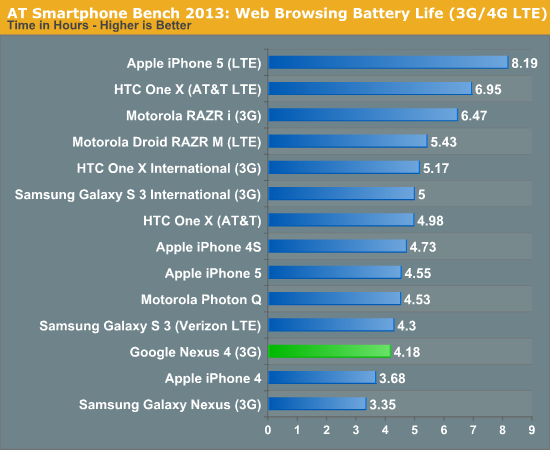
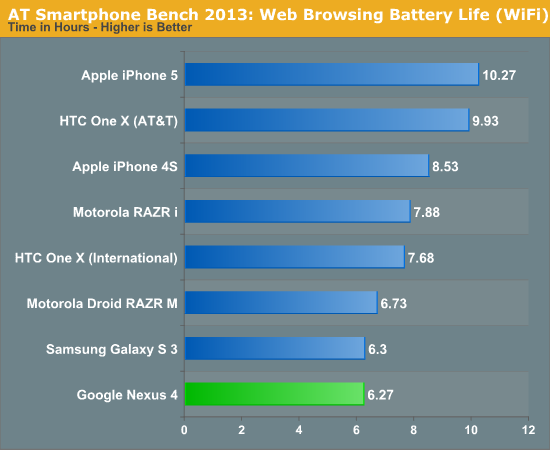
Per AnandTech:
BATTERY LIFE:
51300.png

51301.png


Latest battery life test:
HTC-Droid-DNA-battery-life-tested-heres-how-the-smartphone-beast-scored---GSMArena-Blog-133538-png.jpg
 
Last edited:
Link: iPhone 5 Benchmarked: The Fastest Smartphone in the Land | News & Opinion | PCMag.com

A few quotes:

"The iPhone 5 looks to be the fastest smartphone we've ever tested at PCMag.com.

(Since you're wondering about Chrome, which is an optional download on Android phones, it gives similar Browsermark results to the default browser on the Samsung Galaxy S III.)

The iPhone 4S running the Safari browser in iOS 6.0 on a dual-core 800MHz A5 processor is about on par with leading Android 4.0 phones like the Samsung Galaxy S III and the Motorola Droid RAZR M, both of which are using 1.5GHz Qualcomm Snapdragon S4 processors. Obviously, the difference is that Safari is a faster browser than the Android browser.

...the "memory" and "stream" scores, both of which test loading data in and out of RAM, come out much better on the Apple device.

Mix together the two sets and you see how much of a difference the Safari browser makes, but also that the iPhone 5 still wins with the browser taken out of the picture.

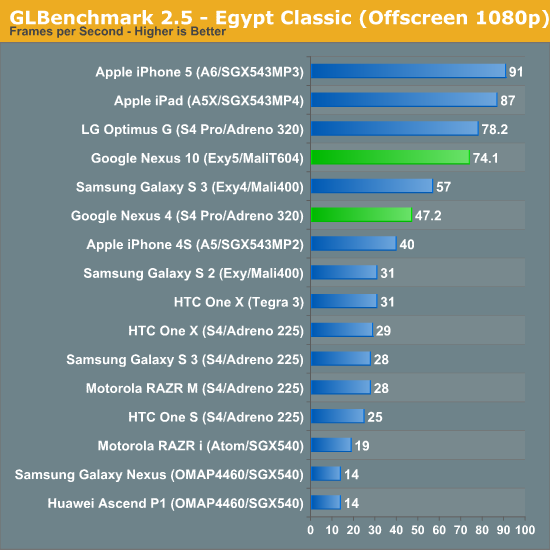
The Galaxy S III has 26 percent more pixels than the iPhone 5 (921,600 to the iPhone's 727,400) but as you can see, in the "offscreen" measure of raw graphics performance, the iPhone 5 doubles the Galaxy S III's result. It's simply a more powerful phone.

Based on these benchmarks, the iPhone 5 lives up to the promise of being twice as fast as the iPhone 4S. It's also, for now, the fastest handheld computer sold in the US."

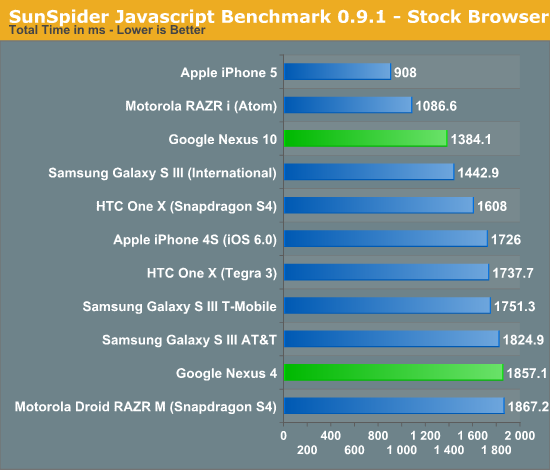
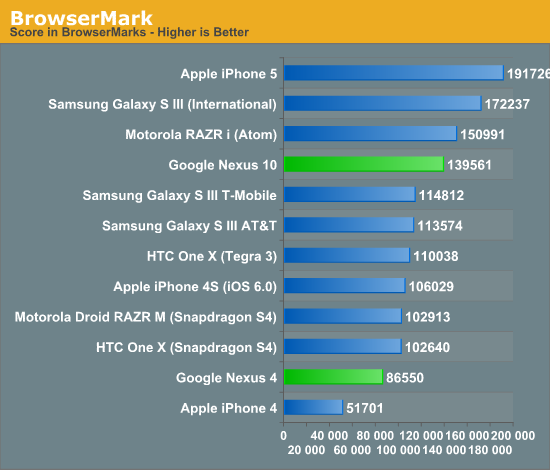
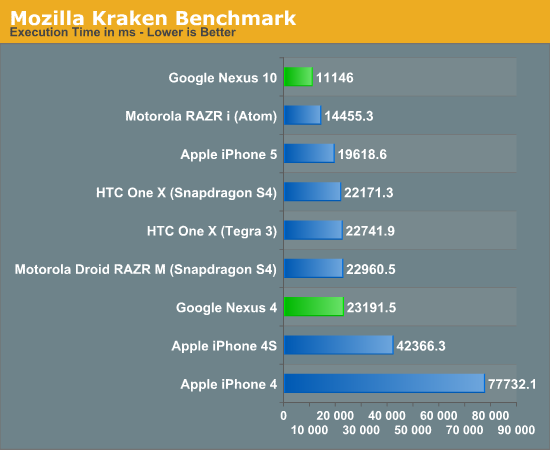
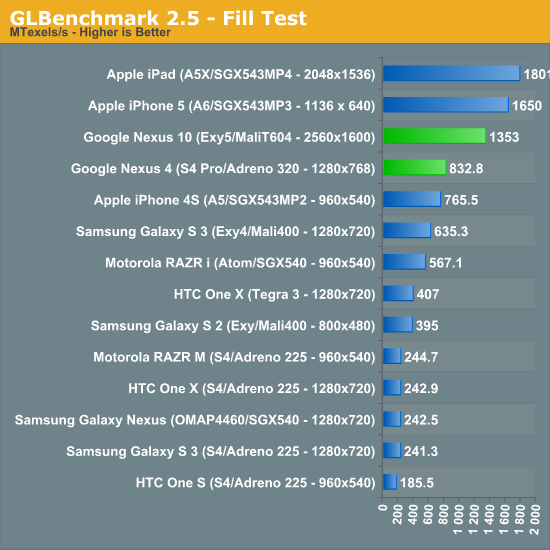
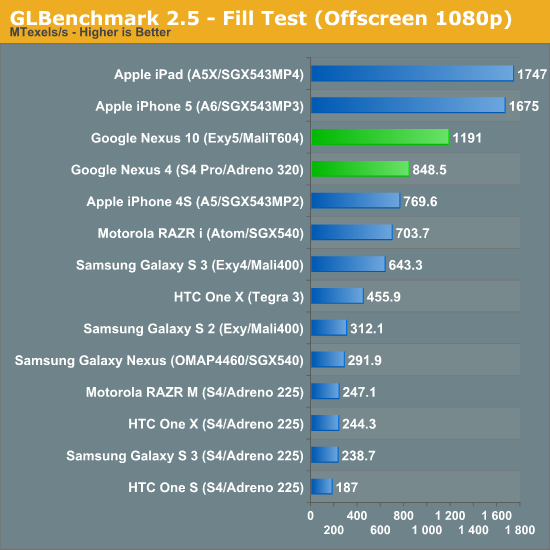
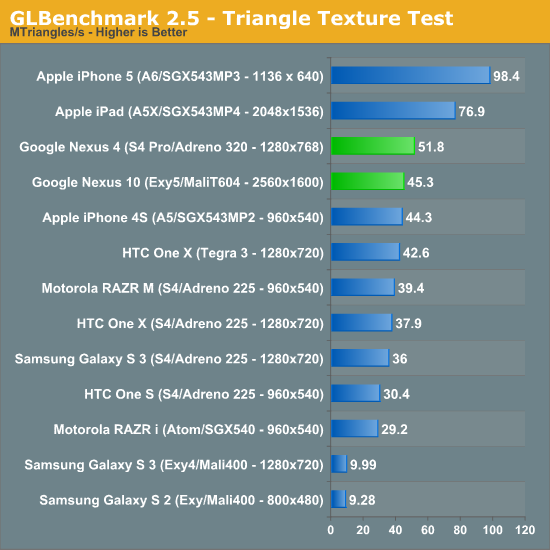
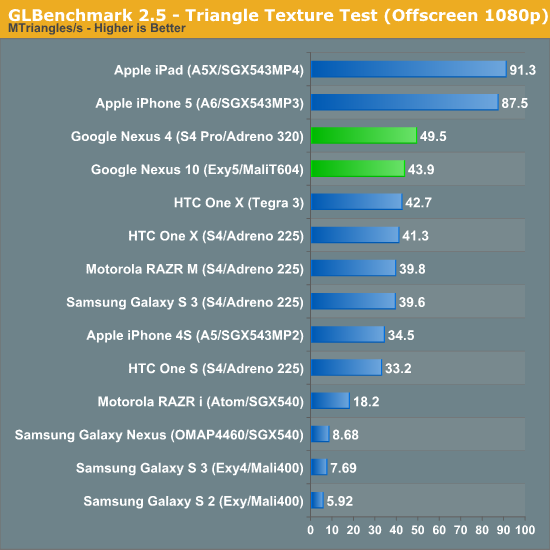
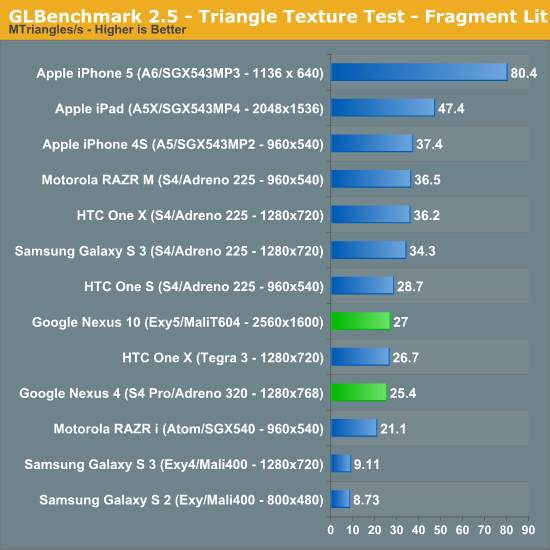
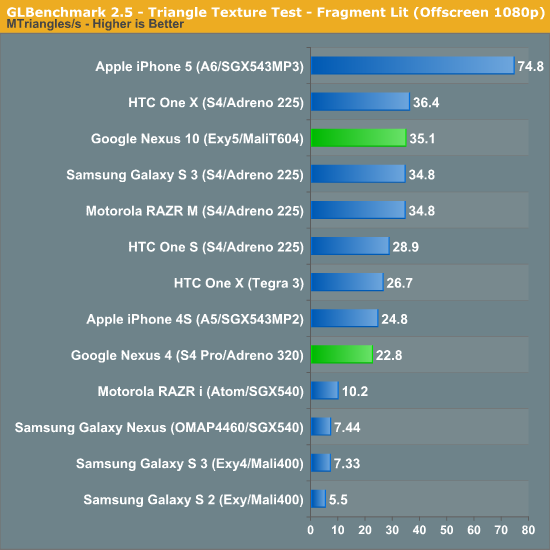
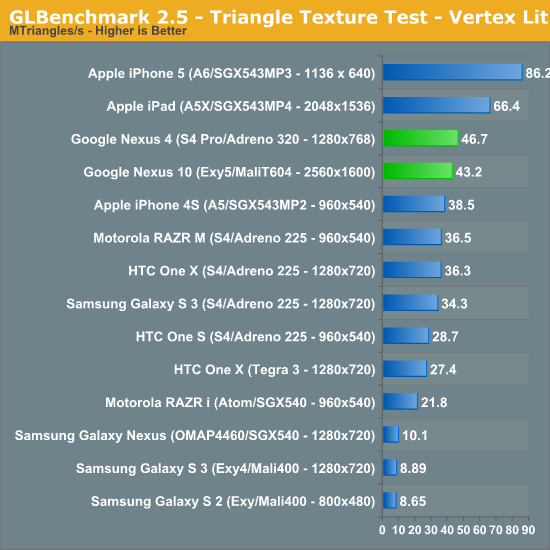
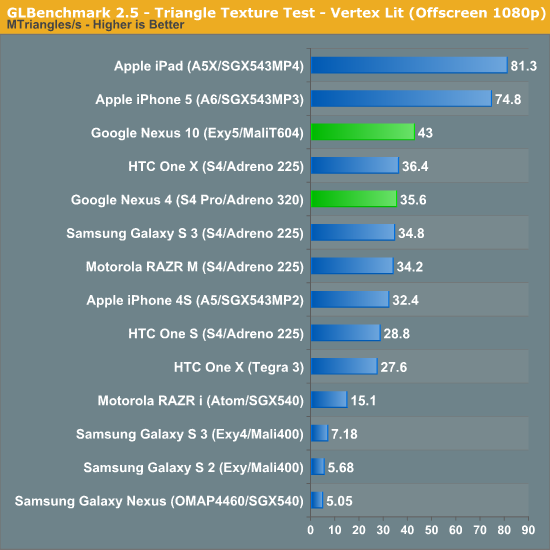
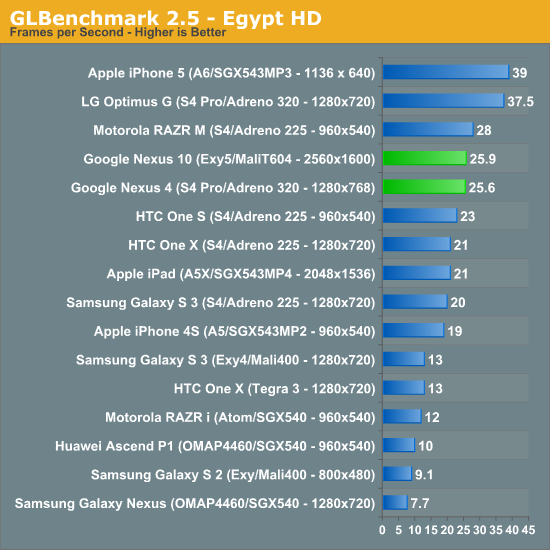
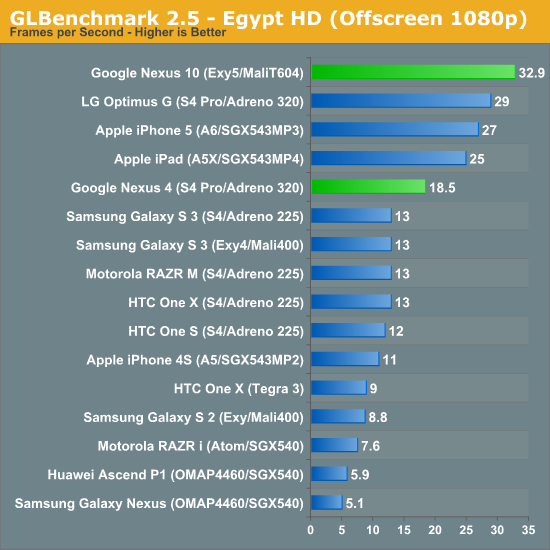
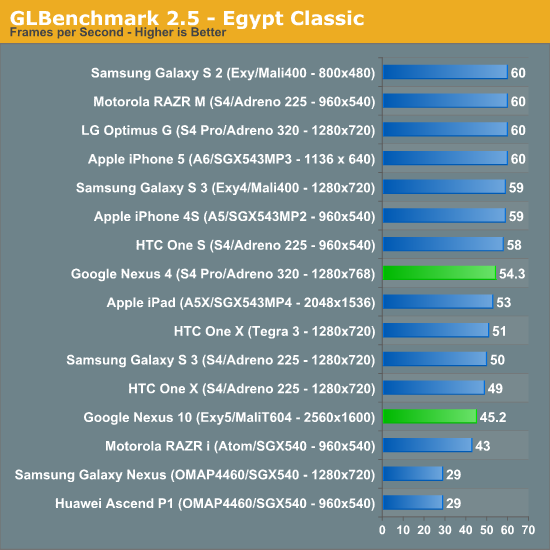
Latest benchmarks from AnandTech: http://www.anandtech.com/show/6425/google-nexus-4-and-nexus-10-review
51291.png

51292.png

51294.png

51299.png

51278.png

51279.png

51280.png

51281.png

51283.png

51284.png

51285.png

51286.png

51287.png

51288.png

51289.png

51290.png
 
Last edited:
In the near future, you will have two major quad-core processors (Exynos from Samsung and Snapdragon S4 PRO from Qualcomm). Samsung will use Exynos, while HTC (and others) will use Snapdragon PRO.

This is preliminary benchmarks for S4 PRO from LG phone (not released yet):
49958.png

49956.png


For iPhone 5, the BrowserMark score was 191726 (higher is better). For Sunspider, iPhone 5 got 908 (lower is better).

It seems that, as of now and near future, the A6 will be top dog, regardless of core numbers.
 
Link: Sharp, others steal iPhone 5 display biz from Samsung

DisplayMate: iPhone 5 Galaxy S III Display Technology Shoot-Out

From the article:

"DisplayMate found that the Galaxy S III display had a brightness that was “about half of the iPhone 5 due to power limits from the lower power efficiency of OLEDs” and a color gamut that “leads to distorted and exaggerated colors… which adds a Green color caste to many images.”

DisplayMate’s advice to Samsung is to keep refining OLED technology and to consider using a smaller display in the future to avoid power consumption issues that have hurt display quality in the Galaxy S III.

“It [iPhone 5] is the best smartphone display we have seen to date,” Dr. Raymond Soneira, DisplayMate’s president, said in the report.

“The display on the iPhone 5 is a significant improvement over the display on the iPhone 4,” said Soneira in the report. “Apple has uncharacteristically understated how much better the display is on the iPhone 5."

...[regarding GSIII] concerns regarding premature OLED aging"

Another article summarized nicely: compared with the screen on Samsung’s Galaxy S III, the iPhone 5′s display is much more accurate at displaying color; is much brighter; reflects less ambient light, making it easier to read outside; and consumes significantly less power, according to the report. It also comes out of the box needing almost no calibration to display images and colors accurately.

More Display testing: http://www.anandtech.com/show/6334/iphone-5-screen-performance

Color Gamut: http://www.displaymate.com/Gamut_9.html

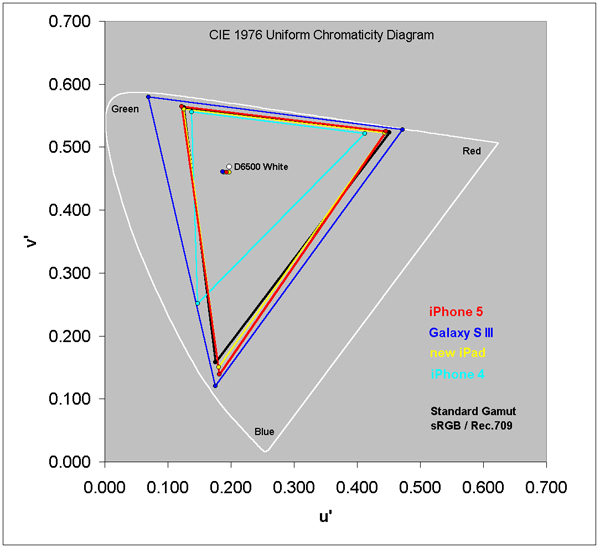
Color Gamut: The Color Gamut is the range of colors that a display can produce. A widely held and exploited misconception is that the bigger the Color Gamut the better - but it isn't... If you want to see accurate colors in photos, videos, and all standard consumer content the display needs to match the Standard Color Gamut that was used to produce the content, which is called sRGB / Rec.709. A display with a larger Color Gamut cannot show colors that are not in the original content - it just exaggerates and distorts the colors. A smaller Color Gamut produces subdued colors, and too large a Color Gamut produces over saturated and even Gaudy colors. That's why a smaller Color Gamut is visually better than too large a Color Gamut. Most LCDs have a Color Gamut smaller than the Standard and most OLEDs have a Color Gamut larger than the Standard.

"The iPhone 5 and new iPad have a much larger (vs. iPhone 4) and accurate Color Gamut that is an excellent match to the sRGB / Rec.709 Standard so they will produce accurate colors as long as there is also an accurate Standard White Point and Standard Intensity Scale.

The Galaxy S III has a Color Gamut that is not only much larger than the Standard Color Gamut, which leads to distorted and exaggerated colors, but its Color Gamut is quite lopsided, with Green being a lot more saturated than Red or Blue, which adds a Green color caste to many images."
Gamut_9.jpg
 
Last edited:
Link: Apple Lightning cable inspection finds an extra-smart connector, won't make for cheap substitutes -- Engadget

Link: Apple iPhone 5

"The layout for this CPU appears to have been done by hand. However, on this A6 chip, the ARM core appears to have been laid out by hand. This does lend credence to the current thinking that this is a custom ARM core specifically designed for the A6. This is a more expensive and time-consuming method of layout. However it usually results in a faster maximum clock rate, and sometimes results in higher density."

Earpods teardown: Apple EarPods Teardown - iFixit
 
Last edited:
Experts discussing iOS vs. Android: Experts Talk iOS vs. Android, NFC at Security Summit | News & Opinion | PCMag.com

"Dan Guido, CEO of Trail of Bits, pointed to unpatched devices and Google's laissez faire attitude toward app inclusion in Google Play as two major reasons why Android devices are more often targeted by hackers than iOS gadgets.

You might expect these exploits to be ultra-sophisticated, but Guido and his fellow panelists suggested that Android exploits are "remarkably unsophisticated." And since they're often app-based, it's probably your fault. So stop downloading those sketchy apps!"

As for NFC:

"When talk turned to NFC, Gordon said Bank of America wasn't really a fan. "The proximity is good for security but it makes the process no easier than swiping a credit card," ExtremeTech noted. Verizon's Delatorre had similar sentiments.

Guido, however, was surprisingly supportive. Since NFC requires a user to be very close to its target, there's a low risk of theft. Meanwhile, NFC readers are pretty pricey and at times complex, so it doesn't make financial sense for hackers to dabble in NFC just yet."


The comment about NFC readers being pricey and complex is interesting. Until both of these issues are resolved, i doubt that you will see NFC being widespread for daily use at your local market, restaurant, etc.. BUT, if it does become cheap and simplified, then will it result in increase theft?????? Note, this may be the reason why Verizon refuses to install Google Wallet on its Android devices. Apparently, Verizon (and ATT & TMo) are working on a more integrated secure digital payment method.

NFC still 3-5 years out: http://www.pcmag.com/article2/0,2817,2411219,00.asp
 
Last edited:
Interesting article on the A6: Custom CPU core design in iPhone 5 marks an Apple first - Macworld Australia

Quote:

“Mobile processors have been using Cortex-A9 [core designs] for the past two-plus years,” Linley says in an email. “Cortex-A15 is the next step in ARM’s roadmap, and the first Cortex-A15 should appear in phones around the end of this year. It offers a large increase in performance, although at some cost to battery life.”

But it’s also designed to meet requirements for a very wide range of end products, from smartphones to big servers. Apple will forgo ARM’s A15 designs but create an A15-class CPU of its own specifically for mobile devices. “Having control of the CPU allows Apple to optimize the design to meet its own needs,” Linley says. “Apple is willing to spend a little more money – on a more expensive CPU — if it makes the end product, such as an iPhone, noticeably better.”

Part of the gain is realised by moving to a smaller die process for the chip, to 32 nanometers from 45 nm. But by itself that’s not enough, according to Lal Shimpi.

“The result is compute performance that’s similar to the A5X in Apple’s 3rd generation iPad, but with a smaller overall die area.”

Why not just run the Cortex-A9 cores found in the earlier Apple A5 SoC at a higher frequency?

To push frequency you have to push voltage, which has an exponential impact on power consumption,” according to another post by Lal Shimpi. “Running your cores as close as possible to their minimum voltage is ideal for battery life. The right approach to scaling CPU performance is a combination of increasing architectural efficiency ([the number of] instructions executed per clock goes up), multithreading and conservative frequency scaling.”

Here is a nice timeline of A6 design and production: Apple's A6 chip development detailed | Apple - CNET News
 
Last edited:
Here is a tidbit about MP and basic camera stuff worth reading: http://www.cnet.com/8301-17918_1-57...more-isnt-always-better-smartphones-unlocked/


dpreview just finished a review of the iPhone 5 camera. As many camera enthusiasts know, dpreview (and cameralabs) is top-notch and very authoritative when it comes to camera reviews.

Here is the review: Quick Review: Apple iPhone 5 Camera: Digital Photography Review

Advice for the purple flare:

"All lenses are succeptable to lens flare to some degree, and as you can see from the images at the top of this page, the iPhone 4S isn't immune either (ditto the iPhone 4 and competitive smartphones from other manufacturers).

Really, our advice is not to worry. Just do what you should do anyway, and avoid putting bright lights near the edge of the frame when shooting."

Consumer Reports: http://appleinsider.com/articles/12...d-to-iphone-5-android-cameras-also-have-flare

"Their results found that the iPhone 5 did display a "haze" when photos were taken in bright light, but the issue was no more pronounced with Apple's latest handset than with other devices.

Comparable issues with smartphone cameras were found with the iPhone 4S, the Samsung Galaxy S III, and the Motorola Droid Razr Maxx. All of the devices were tested under the same conditions in Consumer Reports' labs.

While the organization acknowledged the problem "can be annoying," they also said it's not likely to be something that will affect most photos. Users are also advised to minimize its presence by using their hand to shield their phone's camera lens from sunlight.

While some speculated it could be related to a defect with the phone, further investigation revealed the problem is common with many modern digital cameras, especially miniaturized devices."
 
Last edited:
Here is the full benchmarks to backup what i wrote (and demonstrated) b/w iPhone 5 and Galaxy Note 2: Benchmarks: Samsung Galaxy Note II vs Apple iPhone 5 | Hardware.Info United Kingdom

Galaxy Note II
It has a 1.6GHz Exynos 4412 quad-core processor, 5.5-inch HD Super AMOLED display with resolution of 1280 x 720 and 267ppi, 2GB of RAM, 16/32 or 64GB of internal memory (expandable with microSD), whopping 3100mAh battery (swappable) and the latest Android operating system 4.1 Jelly Bean with Samsung’s TouchWiz UI. Like Galaxy S3, GN2 shares quad-core Mali-400 graphics processing unit.
 
Last edited:
Interesting article: Mapping a Path Out of Steve Jobs's Shadow - Businessweek

"Much about the company’s direction and even its products still reflects Jobs’s decisions and design preferences—the iPhone 5 was the last model to receive detailed input from Jobs, say two people familiar with its development. The company has yet to release any product Jobs didn’t personally bless."
 
Last edited:

Members online

No members online now.

Forum statistics

Threads
278,306
Messages
3,554,045
Members
248,016
Latest member
Advally Service

Trending content

Back
Top