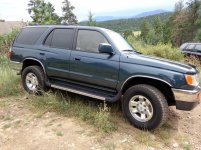
Is buying a 3rd gen 4Runner with over 150K miles a bad idea?

I said by the book, not what real owner do. I dont follow the book, but i also do roadside repairs and am prepared to deal with broken parts, i don't expect the vast majority of drivers do this.

And those wear and tear items probably should have been replaced by 150k miles, but i guess most people push them off.

Edit, Who doesnt change their rotors when they do brakes? I do them everytime or every other time, thought this was a pretty common practice.
 
I think you should at least hold out for one that has good maintenance records. Or at the very least a responsible owner that can tell you what has been done and what hasn't.

Just because its a 4runner wont guarantee it will be trouble free. radiator, shocks, etc...)

Cosign. They are excellent trucks, just get one with maintenance records so you know what has been done, and what will need to be done. Mine has 185k and ran like new before the injector over the second cylinder went out.

Get a FSM and tools if you decide to purchase a 4runner so that you can maintain it well yourself without getting raped by the local stealership.

Most maintenance things can be done by anyone with a fair amount of mechanical ability. I'd pull the trigger if the runner has a maintenance record and has under 200k miles for around $4000.
 
BrianSD_42, You are sometimes a little hard on our 4Runners (and yours) but I see what you are trying to get across. Save money for a rainy day with any older higher mileage car/truck. I'm just thinking numbers here but a chance of a drastic maintenance issue (blown heads) is about ~10% after 200K. I would say that chance is 50% on a ford explorer for instance. My numbers might be a little off but basically saying even though these are very reliable rigs compared to other makes be ready for a anything. I'm ready now but I have been able to save up as my 4Runner has been reliable over the last two years/ 20K miles costing me little money (well not so much mod wise).

OP, I bought my 4Runner at 168K and it now has 190K. It has been a great truck between those miles. It has taken us on three harder off-road trips and couple of road trips including a 3500 mile trip w/ a 12 and 16 driving days. On top of all that it is our daily driver that gets 19-22 mpg and is still going strong.

Mason
 
Last edited:
Yeah guys I know it sounds like I'm hard on our 4Runners (which I do love) but I'm trying to balance against the "they run forever" mentality. It's cool to think that if you have lots of cash but many new and potential members don't have thousands for maintenance. With proper expectations potential buyers will be better off.

Most of the guys who do their own wrenching and have a 2nd car have no worries because they know they can fix it and the 4Runner is a great truck. I'm trying to look out for the guy with a family who is told by seller that the truck will run 300k no problem.
 
3rd gen advise

I'm at 275k with my 99' sr5 v6 manual.

I just had the injectors done on the drivers side, cost $1350. to diagnose and fix.
Earlier this summer I had to re-do the clutch and replace the bell housing for $1400.
Was without my primary vehicle for 4 weeks this summer on top of the $$.

I'm just looking around to try and get a feeling for what I can expect.

It's a one family car with all maintenance records, runs solid.

Should I sell it right away or drive it another year?

I cant imagine what could go wrong but then again I never expected the injector to go.
 
I'm at 275k with my 99' sr5 v6 manual.

I just had the injectors done on the drivers side, cost $1350. to diagnose and fix.
Earlier this summer I had to re-do the clutch and replace the bell housing for $1400.
Was without my primary vehicle for 4 weeks this summer on top of the $$.

I'm just looking around to try and get a feeling for what I can expect.

It's a one family car with all maintenance records, runs solid.

Should I sell it right away or drive it another year?

I cant imagine what could go wrong but then again I never expected the injector to go.

An injector is like $50, WTF. Where did you go so I never have anyone bring there car to that shop!!!!

My buddys shop charges flat rate of $450 to pull trans and swap clutch.
 
An injector is like $50, WTF. Where did you go so I never have anyone bring there car to that shop!!!!

My buddys shop charges flat rate of $450 to pull trans and swap clutch.

Mechanic A. changed plugs and coil connectors @$100./hr air filter etc. cost $310.
Mechanic B. 3 drivers side injectors $175 each. @90./hr + intake gasket cost $1109.
so $1420. all together.

Don't bring your car to a mechanic in Boston :(

I was thinking it was the injector the whole time because I had a tune up 12k miles ago
 
Mechanic A. changed plugs and coil connectors @$100./hr air filter etc. cost $310.
Mechanic B. 3 drivers side injectors $175 each. @90./hr + intake gasket cost $1109.
so $1420. all together.

Don't bring your car to a mechanic in Boston :(

I was thinking it was the injector the whole time because I had a tune up 12k miles ago

No your fine this does happen and why it pays to do your own work.

IMO your truck should last you for a good amount more time. You may want to research the lower ball joint failure. If ball joints are original than I would replace them with OEM and that thing should last you another 100k if you drive that clutch right. I bought mine with 180k and have driven her too 260k. I did have to do all the normal maintenance you need on a high mileage vehicle. Just no way around that, all parts wear out.
 
I save lives and get paid less than a mechanic! The world is awesome. That's why I try to fix the things I can fix myself.
 
Mine has 253k miles and I supercharged it at 250k. The engine and trans are all original, never replaced nor rebuilt. So you can probably guess what I think.
 
////////////////////////////////////// LONG /////////////////////////////////////


YES, some are preventative and some are wear-n-tear BUT it does not matter because pretty much all of those items will need replacing by 200k-225k miles unless you are ok with the "drive it till it dies" style of vehicle ownership.

ALSO, I believe that a lot of the vehicles on the used market have not had those items completed. What often happens is 1+ major items goes bad at 120-150k miles costing the owner at least $500 or $750 to fix and they decide to sell. Sometimes he/she will do the right thing and have a good mechanic do the job using OEM parts but MORE OFTEN they go cheap with cheapo parts and then sell it. Hence my statement that vehicles for sale @ 150k mile mark (around there) rarely have had those items replaced. Especially since most of the failures will occur post 150k miles and not before. This is especially true of trade-in vehicles where the dealer/reseller fixes as little as possible for as cheap as possible and then sells it.

I am just warning the OP that the while Buyers Guide is a good guide of what to look out for when buying a truck, it is old and just because the seals ($800-$1200) haven't gone bad at 140k miles or 155k miles it isn't a sign that you are good. TRUST ME they will go bad by 200k miles. Just because the LBJs ($450-$600) haven't gone bad at 150k miles TRUST ME you will want to replace them before 200k miles for safety sake. The same can be said about the brakes ($600-$800) and the waterpump ($500) and the suspension ($1000+) and the steering rack ($600-$700) and radiator ($500) PLUS much more.
The items listed in this paragraph based on my estimate will total to about $4500-$5000 to have repaired by a proper Toyota shop, possibly more if you go to a dealer. This work would probably occur over 5 years so say $1000 per year in maintenance ... not that bad but I want you-all to be aware. Those numbers also don't account for a trans or head gasket failure, both of which are valid risks around the 200k mile mark.​


I am not jaded but I am a realist who has owned his 4Runner 2002. In 11 years of ownership I have seen a lot. I love my truck but people need to be realistic. 200k miles is a great lifespan for all parts on a truck. It is perfectly reasonable for your HEADS to crack ($1200+ per side) or gaskets ($600-$800 per side) to break or LBJs to fail or a trans to fail or a RAD to fail ect at 200k miles. You have to be realistic.

Think of the buyers guide as a guide to what will probably fail by 200 or 225k miles... Back when it was written more of the trucks on T4R had around 100k miles and those warnings applied well. But now that so many are at 150k + miles it is more of a "likely to fail guide" than a "buyers guide". We also now see far more daily "my truck's XXX is broke please help" threads on T4R than 2-4 years ago.

NOW if you can do the work yourself then you will have much lower costs.. If you have the tools and patience then all the information you need can be found on this website (or similar). You could order the OEM parts from a online dealership like Camelbak Toyota for ~ 25% less than normal dealer prices. Then these costs go down dramatically. It just depends on what type of owner you will be.​


The 4Runner is a great vehicle but some parts will just need to be replaced. I am still amazed by how little (and it was a lot of $$) I have actually replaced, how much still works 100% at 217k miles. Pretty much everything on the truck works 100% except what I mentioned above, most of which IS in the buyers guide.

===> Try to find one with as low miles as possible, plan for (via a savings account) several $$$ repairs to be needed before you hit 200k miles mark and enjoy the great truck that you have. At least with a 4Runner it will make it to 200k which is a lot more than can be said about other SUVs on the road today. With proper maintenace and repairs you can go beyond the 200k mark, well into 300+ and beyond.​


Just my 2-cents based on 11 years ownership.


////////////////////////////////////// END RANT /////////////////////////////////////

Totally agree!

What sucks for me as an original owner is that I was so used to this truck being new & reliable that I didn't do any wrenching for the first 10 years of ownership & never carried any tools with me. All I did was drop it off at my mechanic to have the scheduled maintenance done. The only things I had replaced in the first 10 years was a battery, tires, catalytic converter, muffler & a tail light bulb. LOL OK, a few wiper blades! Not even brake pads, because it's a stick my OEM pads lasted 140,000 miles!

Now over the last few years I've dumped thousands into this thing (& thats not including mods) getting it back up to snuff. Now it's in tip top shape & I'd drive it across country tomorrow. I'm at the point where I'm replacing parts that still look good but will fail eventually like LBJ's & I carry 50lbs of tools in the back.
 
////////////////////////////////////// LONG /////////////////////////////////////


ALSO, I believe that a lot of the vehicles on the used market have not had those items completed. What often happens is 1+ major items goes bad at 120-150k miles costing the owner at least $500 or $750 to fix and they decide to sell. Sometimes he/she will do the right thing and have a good mechanic do the job using OEM parts but MORE OFTEN they go cheap with cheapo parts and then sell it. Hence my statement that vehicles for sale @ 150k mile mark (around there) rarely have had those items replaced. Especially since most of the failures will occur post 150k miles and not before. This is especially true of trade-in vehicles where the dealer/reseller fixes as little as possible for as cheap as possible and then sells it.

/////////////////////////////////////

Agree again.

I had a 01 Accord Coupe as a DD & it was a great car. But as a DD to get to work I need it to be reliable. Obviously I didn't love it like the T4R so when it started to get up there in age & miles & too many things started to go wrong I decided to sell it. I wasn't going to sell it "as is" for a small amount of money. I fixed everything with NAPA auto parts & got a good dollar for it. Investing $600 got me an extra $1500 on the sale. The average person likes the long list of new parts & probably thinks that Moog is just as good as OEM just a lot cheaper.
 
It'll click over 300,000 miles before September is over. Now it's lifted and has 285s on it.

I did have to have new bearings installed in the rear end as it made a tremendous amount of noise but at the price I bought it for I couldn't complain one bit. The ring and pinion etc. and the locker actuator and associated parts were just fine. USUALLY ime the rear end only gets that way because people don't think about the diff fluids until it's too damn late. They do break down over time. I think if the PO had the fluids changed out with quality fluids at the suggested times it would have been fine.

That said, look for service records if you can get them out of the PO. I bought mine from my mechanic and good friend, and he was very honest about it's issue with the rear end. A random seller may not be the same. As always take it to a good mechanic for a look over. Loosing a hundred bucks for an inspection is a lot better than paying 7k for a pos that is about to die.
 

Attachments

  • DSC01931.jpg
    DSC01931.jpg
    138.6 KB · Views: 949
I think in the 250k range is when a few things start needing to be replaced, but those things will last at least another 250k if done right.
 
Think of the buyers guide as a guide to what will probably fail by 200 or 225k miles... Back when it was written more of the trucks on T4R had around 100k miles and those warnings applied well. But now that so many are at 150k + miles it is more of a "likely to fail guide" than a "buyers guide". We also now see far more daily "my truck's XXX is broke please help" threads on T4R than 2-4 years ago.

I think we need to tone down the drama just a bit here. Saying that all this stuff will "probably fail" by 200k mile is a bit strong. There's a difference between "failing" and "needing to be replaced out of caution".

I'm sitting with 210k miles on mine, and NOTHING has failed. Absolutely nothing. I had a bad rear O2 sensor when I bought it but that was more an annoyance than anything. I changed the timing belt at 200k and as far as I could tell it hadn't been replaced since the 80k mile mark. LBJs were fine. Brake rotors were fine. I replaced the shocks and struts and was disappointed at how little it changed the ride.

Does a 4Runner with upwards of 150k mile benefit from a significant mechanical refresh? Absolutely.

Will it leave you on the side of the road if it doesn't get one? Not likely.
 
I've looked at some buying guides here on the forums, and have a better understanding of what to look for, but would appreciate some advice from the forum pros here :)

Not a pro here. Not at all. But I just bought a truck like the one you are thinking about and I made a poor choice, as it turns out.

I've owned several Toyotas and like others here have found them well-built and have put hundreds of thousands of miles on them without a lot of hassle, so when I bought mine (2000 4 cyl 2WD 189K miles, $3.9K) I went more for appearance than I worried about the mechanicals. Power was low on the test drive, the steering wandered and there was a booming sound in the cab at about 60 MPH but I attributed all of that to the worn out oversized tires and concentrated on the excellent paint and interior. I figured the dealer I bought it from would have to smog it and that would take care of any engine issues.

I've had great luck with used Toyotas in the past but not this time. Turns out that someone did a valve job on it at some point and screwed it up. It took two mechanics, lots of replaced parts and about $1200 to figure out the cam timing was off and it still throws a CEL (300,302) every so often. Power is mostly OK now but erratic (varies day by day) and I foresee more $ in the future.

The booming turned out to be an out of balance driveshaft - $170 - but the suspension/steering problems remain. It still wanders after replacing a bunch of bushings, new tires and an alignment $1K) Shakes at 70 like a dog passing peach pits. Bad new tires? Bad alignment? More parts? Dunno, and I am going to have to find a new front end shop to check the other guy's work because he swears there is nothing wrong with it.

My advice would be to buy the truck that drives exactly the way you want it to drive on the day you buy it, and if that costs you a few $ more it's a bargain. Service record are all fine but if the truck has issues you may play hell trying to sort them out. A little at a time isn't so bad.

I'm still happy with my purchase though - the cost of repairs is a nowhere the payments I'd be making on a new one, it still looks good and I like driving it.

And I have a new hobby.
 

Members online

Forum statistics

Threads
278,317
Messages
3,554,125
Members
248,016
Latest member
Advally Service

Trending content

Back
Top