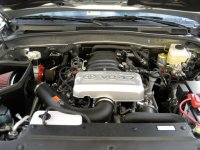
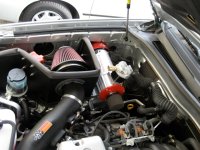
IMO, whether it is the powder coated tube or plastic, they're both going to perform about the same. The R-factor of the powder coated aluminum vs. the thinner plastic tube are going to be about equal since any warm air can heat up the plastic faster since it is less dense and has less mass. Takes longer to heat up the metal one since its density and mass are higher (given a linear/constant rate of absorption over linear time at any specific given temparture). Given enough time at equal under-hood tempartures, they will function relatively equally. The plastic tube with get warmer quicker, but they should both end up at around the same temp if you are on a longer run. (Technically, everything under the hood, short of the radiator and exhuast manifolds, should all end up at or about the same temp if the engine is run for long enough time.
If plastic had a superior F-factor compared to metal, we'd have plastic house doors - when most exterior doors today are indeed metal (sandwiched around polystyrene/styrofoam).
The ideal solution would be to get the metal tube, ceramic coat it (ala JetHot or similar) inside and out, and run it to the cooler air source, which I guess is the stock air box. Ceramic coating would keep the intake charge at the ambient since it takes hundreds if not a thousand degrees to transfer enough heat through the walls to affect the air flowing through it. I ceramic coat the exhaust headers on my race car - and it works so well on those that you can nearly lay a bare hand on them within 5 minutes of a run. The differences in the EGT readings when we pull it on the dyno are very noticeable between ceramicoated vs non-coated.