KDSS Balancing - Correcting lean after lift

There is a procedure documented in the 5th gen repair manual for this...

It's similar. It will resolve the lean (temporarily from my experience).

Warning if you do it... The instructions are very misleading. They say something about not backing out the bolts more than 10-12mm, But they mean measuring from the case surface to the outer edge of the bolt, not what any logical human would interpret the statement to back out 10-12mm to mean. So most people who read the procedure and don't get a warning from somone else....end up backing it out too far and get air in the system...ask me how I know this LOL. Really poorly written instructions and diagram, but very simple procedure once you know that catch and read the instructions very carefully.. which is to really only back out ~5mm (can't remember how thick the nut is...)

Attached is the diagram...

Is it possible for someone to post photos of this from their 5th gen or from having done this?

I have a lean to the driver side (with KDSS), it's pretty bad at ~1.5".... I installed some spacers on the rear spring, driver side, but I'm still ~0.75.

I tried the this KDSS fix and it didn't seem to work but I wasn't on a fully level surface (Front to back).... going to try again but I'm not 100% sure I'm loosening the right screws.
 
So I went an ordered a trim packer for the passenger side since I have one on the driver expecting the KDSS lean, installed it.. and it leveled it out. While I was working on it.. i also added OME rear trim packers too.. lol
 
KDSS lean and sway bar configuration

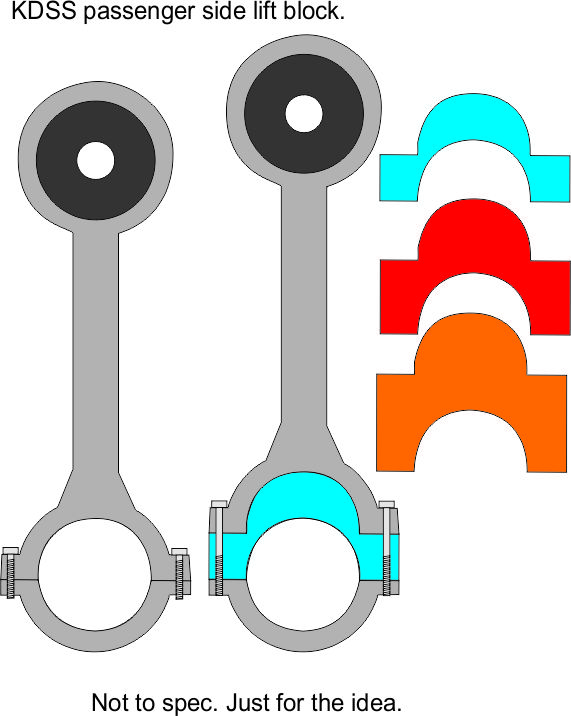
The only way to really balance it would for someone to manufacture extended passenger side links for the front and rear or make lift blocks for them. Lower the pivot point. The trouble is there are many different lifts and each vehicle seems to behave differently even with the same lift.

kddslift1.jpg

I posted this in another thread earlier today. I think it explains in words what TK-422 is illustrating.

I have the dreaded (KDSS?) lean after an ICON stage 7 lift install. Both before and after the lift. The passenger side was higher by 1/2" both front and back before the lift. Now after the lift it's 1/2 inch higher in the front right and 1" higher in the back right side. The overall lift is about 3" at all four wheels.

wfo9 showed me the KDSS balancing procedure which led me to this thread?

Here is how I see the configuration of the KDSS system:

The KDSS system has a piston on one side, the driver's side front and back, and a fixed strut on the other side, the passenger side. How can we lift the vehicle 2" to 3" and not change the strut length? This alone must throw off the KDSS system. This is just a question.

The front sway bar is fixed at three points. Two points are on the left and right LCA, with bushings for flexure and rotation. The third point is a fixed length strut to the frame on the passenger side. The KDSS piston is a moving point, responding to changes in length or pressure between the sway bar and the frame.

The back sway bar is a U-shaped bar that rotates on bushings at the two axle mounts. It sits somewhat level behind the axle at rest, anchored to the axle at the front ends of the bar and the KDSS points at the back, at about third points of the U-shape. The sway bar is free to rotate as the back axle moves up and down. It's attached by a fixed length rod on the passenger side. The piston is attached to the left side. Both the rod and the piston are free to rotate around the sway bar as the forward ends move up and down with the axle. As the axle moves it moves the sway bar ends forward or backwards. And of course, the axle does not remain level or move equally up and down on the two sides, but varies with the terrain and sway as the vehicle turns.

The sway bar must move with the axle as it rises or falls on either side. The fixed rod remains the same length below the frame but can rotate and swing backwards as the sway bar rises and falls, and necessarily must move forward and backwards as the axle moves. The KDSS piston can move backwards as the sway bar rises and can also change length.

Understanding the geometry helps to understand what can change as the axle moves. What does the KDSS piston do in response to flexure of the sway bar about these three points?

I'm not supposing to know how KDSS works or if this is part of the problem. It's just food for thought.

 
I posted this in another thread earlier today. I think it explains in words what TK-422 is illustrating.

I have the dreaded (KDSS?) lean after an ICON stage 7 lift install. Both before and after the lift. The passenger side was higher by 1/2" both front and back before the lift. Now after the lift it's 1/2 inch higher in the front right and 1" higher in the back right side. The overall lift is about 3" at all four wheels.

wfo9 showed me the KDSS balancing procedure which led me to this thread?

Here is how I see the configuration of the KDSS system:

The KDSS system has a piston on one side, the driver's side front and back, and a fixed strut on the other side, the passenger side. How can we lift the vehicle 2" to 3" and not change the strut length? This alone must throw off the KDSS system. This is just a question.

The front sway bar is fixed at three points. Two points are on the left and right LCA, with bushings for flexure and rotation. The third point is a fixed length strut to the frame on the passenger side. The KDSS piston is a moving point, responding to changes in length or pressure between the sway bar and the frame.

The back sway bar is a U-shaped bar that rotates on bushings at the two axle mounts. It sits somewhat level behind the axle at rest, anchored to the axle at the front ends of the bar and the KDSS points at the back, at about third points of the U-shape. The sway bar is free to rotate as the back axle moves up and down. It's attached by a fixed length rod on the passenger side. The piston is attached to the left side. Both the rod and the piston are free to rotate around the sway bar as the forward ends move up and down with the axle. As the axle moves it moves the sway bar ends forward or backwards. And of course, the axle does not remain level or move equally up and down on the two sides, but varies with the terrain and sway as the vehicle turns.

The sway bar must move with the axle as it rises or falls on either side. The fixed rod remains the same length below the frame but can rotate and swing backwards as the sway bar rises and falls, and necessarily must move forward and backwards as the axle moves. The KDSS piston can move backwards as the sway bar rises and can also change length.

Understanding the geometry helps to understand what can change as the axle moves. What does the KDSS piston do in response to flexure of the sway bar about these three points?

I'm not supposing to know how KDSS works or if this is part of the problem. It's just food for thought.

FWIW, my solution was a 10mm OME trim packer on top of my passenger side rear lift coil.
 
Right rear was low by almost 1”. Front was easily leveled due to adjustable coilovers.

Have had this same issue for about just over a year now. Seemed like my rear driver side was the highest for both front and back on both sides and the lowest point was diagonally across at the front passenger side. Really weird. I put an yellow plastic OME trim packer on the rear passenger side to help the lean in the back and now debating to either a) raise my passenger side 5100 shock perch up one notch or b) install the OME front metal spacer in the shock, not sure which route to go. Or should I just go get front coilovers for the adjustability factor like [MENTION=54404]jbstrd[/MENTION] said he did?
 
The problem is the fulcrum that is created by having a fixed link on the passenger side. It is the same for the front and back of the KDDS swaybar.

kddslift2.jpg


It creates more resistance on the right side when a lift is installed. This makes the drivers side sit higher. Using spacers or adjusting the coils will level it out but it leaves a higher preload on that side of the vehicle.

If you catch air on a jump you can bend those links. :frusty:

bent_rear_swaybar_mount.jpg
 
Set the front at the same height and you won’t have a lean. If you have to do any adjustments with the valves you are setting yourself up for failure. It’s not heavily documented or maybe everyone that lifts with KDSS has been led to believe a lean is an acceptable outcome. Those of us that have set them at the same height are dead set even.
 
Set the front at the same height and you won’t have a lean. If you have to do any adjustments with the valves you are setting yourself up for failure. It’s not heavily documented or maybe everyone that lifts with KDSS has been led to believe a lean is an acceptable outcome. Those of us that have set them at the same height are dead set even.

Although (in this case) it's an anecdotal sample of two, I would honestly agree with this, in general. Many problems arise in KDSS vehicles when people try to manually 'level' it when lifting, assuming there is a lean they need to accommodate. In many cases there is no lean, and the 'black box, shadows and mirrors' nature of the KDSS system can produce odd results and be ultimately confounding.

Consider the fact that stock KDSS vehicles come with the front shocks set evenly from the factory (and for the most part KDSS trucks are reasonably level on the lot), that would suggest to me that starting 'even' is the best first step to a KDSS lift. Also, knowing that a change to the front can and will affect the leveling of the rear, helps. Only some trial-and-error demonstrated this to me, and no one at Toyota had any clue. Even RSG swung and missed on the first round, despite me suggesting they do the initial install with the front set evenly (i.e. note I did not say 'leveled').
.
.
.
 
Last edited:
I have a 2021 with 12,000 miles on it. Ironman 4x4 Foam Cell Stage 1 Suspension. KDSS lean started around 9,000 miles (I think) It progressively got worse. At one point this caused major tire rubbing in turns. Something I had not experienced in the past. I have done the reset per the manual but cannot get it better than the 7/8th" acceptable difference.

After some driving, it will then return to a greater than 7/8th" lean. I am just trying to find out if anyone has found a successful long-term fix. Especially if anyone has the same Stage 1 Ironman Foam Cell setup like I have.

Thanks!
 
I have a 2021 with 12,000 miles on it. Ironman 4x4 Foam Cell Stage 1 Suspension. KDSS lean started around 9,000 miles (I think) It progressively got worse. At one point this caused major tire rubbing in turns. Something I had not experienced in the past. I have done the reset per the manual but cannot get it better than the 7/8th" acceptable difference.

After some driving, it will then return to a greater than 7/8th" lean. I am just trying to find out if anyone has found a successful long-term fix. Especially if anyone has the same Stage 1 Ironman Foam Cell setup like I have.

Thanks!

Get some Treaty Oak KDSS spacers for both the front and rear. I had no KDSS lean at nearly +4" front lift and +3" rear lift, just after lift install. Still no lean after all the coils settled after 3 months (+3.5" front, +2.7" rear). The spacers will return the sway bars back to (or close enough to) their original unlifted geometry.

Did you get an alignment after your lift was installed?

FYI if you order the spacers through Mike at Exit Offroad, you can save on sales tax.
 
Last edited:

Members online

No members online now.

Forum statistics

Threads
278,310
Messages
3,554,080
Members
248,016
Latest member
Advally Service

Trending content

Back
Top