KDSS Long term reliability?

Thanks for taking the time to summarize. I'm very happy with "among the most basic" (less to fail).

Followup question: if the system is "softer" under 12mph, what does this mean for wheel articulation and passenger ride? More, or less, swaying and jarring at low speeds?

To summarize again.. Below 12mph the swaybars are somewhat disconnected from the frame. So wheels can move independent without the sway bar transferring energy to the opposing wheel on the same axle line (it's not really a single axle in the front)

Above 12mph the accumulator valve is closed, so the swaybar to frame mount becomes more or less fixed and begins transferring energy across the axle making impacts to one wheel effect the other. This basically stiffens the ride dramatically on uneven (across the axle) terrain.

There is a bit more to it and some energy is still transferred and there is some other unknown geometry aspects, but the simplified view is simply locked vs unlocked.

From the factory. KDSS does a great job of balancing road manners with slow speed offroad capability. It does however stop performing well offroad over 12mph. For whatever reason.. trying to understand this clear pro/con balance has been difficult for many. If you have driven them all in multiple conditions.. it's very easy to feel as it pretty much slaps you in the face at times.

The recent discussion here is about overriding the behavior to allow it to loosen up over 12mph and if that would have reliability concerns and at what point (if ever) do the accumulators, pistons, seals.... begin to fail.
 
Last edited:
Is there a reason 12 MPH is the magic number? I run lots of fire roads at typically higher speed (until the road tells me to slow down). Would a softer sway bar be a bigger advantage to my driving comfort over say, lowering the tire pressure?
 
wfo9

You just saved folks from having to wade through 19 pages of discussion! Now I know why my ride seemed rough on our pot-holed alley. I’ll try it again more slowly...
 
Same action open or closed where the load is uniform on one side. If the valves were open at high speed, the cornering would be the same. The LC200 for example is always active. I don't know why they close the valves on the 4Runner other than to reduce wear somewhat or they think the system will overheat from fluid flow in the moguls at too much speed. There may be some additional effect in terms of removing the air springs from the system by closing the valves.

I need to see the inside valving in the accumulator assembly to really know. It may actually be possible that the only thing that's happening when closed is to eliminate the accumulator air spring effect and firm up the action, but not actually close flow between the cylinders. After learning more about how the LX570 system works that's what it does. It selectively eliminates various air chambers to adjust spring rates.

I have no idea how to actually test this other than video moguls at variable speeds.

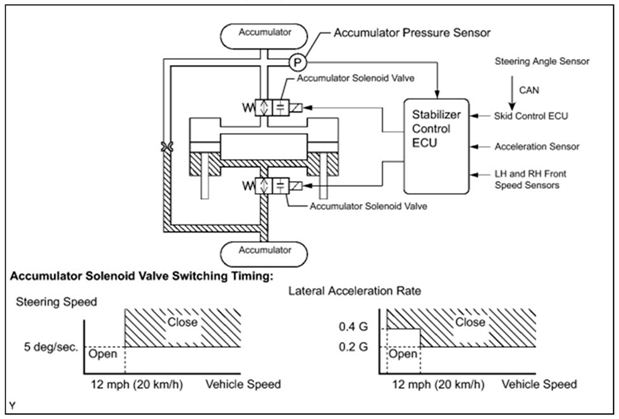
Edit: I'm stupid. I didn't realize it until I looked at this diagram just now after learning more about the LX570. I don't think KDSS ever becomes inactive. It just firms up the motion by removing the air springs provided by the accumulators. I think visually looking at the outside of the valve manifold that the function of closing is to block the accumulator only. Not to stop fluid between the upper or lower chambers of the two pistons. Not sure why I had never recognized this, but it does not lock out the cylinders above 12mph. Not at all. It simply makes them a very firm direct hydraulic relationship rather than a softer one that adds some dampening by using accumulators. I'm embarrassed about how badly I missed something obvious.
167132d1268351767-does-the-gx-tilt-kdss3.jpg

Judging by the "accumulator valve switching" diagrams (is that from the LX570?), it would appear that it is not as simple as 'above 12 mph' the system firms up. Either the steering wheel must also be turned (5 deg/sec, which is not 'fast'), or .2G+ lateral acceleration. Looking through the 2010 RTM for the 4Runner KDSS, the 'Stabilizer Control ECU' does take steering wheel and yaw sensor inputs. This implies that if a KDSS equipped 4Runner is traveling straight on a washboard road at over 12 mph (no steering input, and no lateral G's), then KDSS automatically is in the 'soft' mode.
 
This implies that if a KDSS equipped 4Runner is traveling straight on a washboard road at over 12 mph (no steering input, and no lateral G's), then KDSS automatically is in the 'soft' mode.

I've wondered about the chart since first coming across it and may end up adding an indicator led to get an accurate read on the system. I want some data.
 
Judging by the "accumulator valve switching" diagrams (is that from the LX570?), it would appear that it is not as simple as 'above 12 mph' the system firms up. Either the steering wheel must also be turned (5 deg/sec, which is not 'fast'), or .2G+ lateral acceleration. Looking through the 2010 RTM for the 4Runner KDSS, the 'Stabilizer Control ECU' does take steering wheel and yaw sensor inputs. This implies that if a KDSS equipped 4Runner is traveling straight on a washboard road at over 12 mph (no steering input, and no lateral G's), then KDSS automatically is in the 'soft' mode.

So what you are saying is that if you never turn you never have problems... Until you meet the tree at the bend in the road :jk:
 
Looks like I'm joining the testers. As of this afternoon I've disconnected the module on the driver's side of the frame, taped it up thoroughly and took it for a test drive.

First thing I noticed was the heavier steering feel. Others noticed something similar in the thread below. There is a noticeable, but quite minor increase in slight bounciness in the vehicle while driving at medium (30-50 mph) speeds. Basically a dip in the road has a minor bounce before it settles back in, where as with KDSS there would be none. My biggest complaint with KDSS is the harshness over sudden dips such as potholes, manhole covers, etc. Disconnecting the module definitely reduces the severity of the impact, while you can definitely still feel it, it just takes the edge off. I was actually expecting a more significant change, but maybe its a good thing as it is more than safe feeling still at speeds up to 50 mph. I have yet to go on the interstate here which has speed limits ranging from 75-85 MPH, but will be doing so in the next week.

http://www.toyota-4runner.org/5th-gen-t4rs/258740-steering-feel-slop-changes-every-drive.html
 
Update to my previous post. With the KDSS module disconnected I took the 4R on a mild trail with a few moderate washouts. This is where I've seen by far the largest improvement in ride quality. I was actually amazed how much smoother the ride was over a hard packed surface with quite large rocks all over the place. For the first time ever on this trail, it was a smooth ride, and that was with E rated KO2s at 36 psi (not aired down).

I was worried about highway safety as most considering this route probably are. I took the on-ramp at a slightly reduced speed than I normally would, and while there was a very, very minor increase in body roll, it did not remotely feel any more dangerous than any other car I've driven. While traveling at speed (70-80 mph) the ride is slightly smoother than with KDSS functioning normally. On a section with concrete slabs that were not remotely level, I could definitely feel a bouncier/springier ride, where normally this would be a quite unpleasant section, aside from the repetitive aspect of it, wasn't bad.

On the way home, it really hit me how much more I enjoyed the ride. It is not as noticeable as I expected, but I am quite pleased with the change. It just feels right.

I will be leaving the module disconnected going forward, and will (try) to update at somewhat regular intervals going forward as to any change in behavior, or sudden issues with the KDSS system.
 
Interesting. I sort of want to try this on the way home from work tonight. There are a number of roads that are being re-done so this past couple weeks have been bumpy. The freeway I take has a few spots over underpasses that are raised and when running over them it feels bouncy under compression.
 
Update to my previous post. With the KDSS module disconnected I took the 4R on a mild trail with a few moderate washouts. This is where I've seen by far the largest improvement in ride quality. I was actually amazed how much smoother the ride was over a hard packed surface with quite large rocks all over the place. For the first time ever on this trail, it was a smooth ride, and that was with E rated KO2s at 36 psi (not aired down).

I was worried about highway safety as most considering this route probably are. I took the on-ramp at a slightly reduced speed than I normally would, and while there was a very, very minor increase in body roll, it did not remotely feel any more dangerous than any other car I've driven. While traveling at speed (70-80 mph) the ride is slightly smoother than with KDSS functioning normally. On a section with concrete slabs that were not remotely level, I could definitely feel a bouncier/springier ride, where normally this would be a quite unpleasant section, aside from the repetitive aspect of it, wasn't bad.

On the way home, it really hit me how much more I enjoyed the ride. It is not as noticeable as I expected, but I am quite pleased with the change. It just feels right.

I will be leaving the module disconnected going forward, and will (try) to update at somewhat regular intervals going forward as to any change in behavior, or sudden issues with the KDSS system.

So all you did was simply unplug the connector to the KDSS control unit? I’m assuming you have warning lights illuminated on your dash correct?
 
Doesnt kdss have it’s own fuse? Couldn’t you just add a switch inline with the fuse and disconnect/reconnect on the fly.
 
Doesnt kdss have it’s own fuse? Couldn’t you just add a switch inline with the fuse and disconnect/reconnect on the fly.

As discovered in another thread, a switch or even disconnecting the fuse seems to lock KDSS into the high speed setting. A switch wired in to the module on the frame would potentially work, but I honestly don't know if I see a reason to. I don't plan on reconnecting it any time in the future (other than bringing it in to the dealer for other reasons, and avoiding the 20 questions) and even then, will immediately disconnect it again.
 
Update to my previous post. With the KDSS module disconnected I took the 4R on a mild trail with a few moderate washouts. This is where I've seen by far the largest improvement in ride quality. I was actually amazed how much smoother the ride was over a hard packed surface with quite large rocks all over the place. For the first time ever on this trail, it was a smooth ride, and that was with E rated KO2s at 36 psi (not aired down).

I was worried about highway safety as most considering this route probably are. I took the on-ramp at a slightly reduced speed than I normally would, and while there was a very, very minor increase in body roll, it did not remotely feel any more dangerous than any other car I've driven. While traveling at speed (70-80 mph) the ride is slightly smoother than with KDSS functioning normally. On a section with concrete slabs that were not remotely level, I could definitely feel a bouncier/springier ride, where normally this would be a quite unpleasant section, aside from the repetitive aspect of it, wasn't bad.

On the way home, it really hit me how much more I enjoyed the ride. It is not as noticeable as I expected, but I am quite pleased with the change. It just feels right.

I will be leaving the module disconnected going forward, and will (try) to update at somewhat regular intervals going forward as to any change in behavior, or sudden issues with the KDSS system.

I can't say this with much confidence, but I don't think it's really safe to do this. Just because it was comfortable for one type of road condition doesn't mean it's going to be safe. It would seem to me that the sway bar is effectively disconnected, right? My concern isn't so much that the sway bar is less or not-effective, but that the suspension was designed as a system, and you've effectively removed a large part of that. Personally, I would just remove KDSS all together and move to a smaller swaybar.
 
Yeah, those Toyota engineers don't know WTF they're doing. Never mind KDSS, the whole "suspension" thing is just a hyped-up marketing gimmick. I tore out all those springs and shocks and things and just welded everything up solid. Now the cornering is amazing! Like it's on rails. The ride was a little harsh at first but I aired down from 36 to 35 PSI and now it rides like a Cadillac*.


*
Cadillac_Special_Delivery_19040220.jpg
 
I can't say this with much confidence, but I don't think it's really safe to do this. Just because it was comfortable for one type of road condition doesn't mean it's going to be safe. It would seem to me that the sway bar is effectively disconnected, right? My concern isn't so much that the sway bar is less or not-effective, but that the suspension was designed as a system, and you've effectively removed a large part of that. Personally, I would just remove KDSS all together and move to a smaller swaybar.

I'm not guaranteeing there will be no issues down the road, that is why I claimed to be a tester. The suspension system isn't a single part. KDSS is a glorified sway bar system, it doesn't affect the shocks, or the springs, and the springs and the shocks are the same in a KDSS equipped as well as an non-KDSS equipped Trail. At worst it could be as equivalent as completely removing the sway bar, which others have done, and lived to tell the tale. While there is definitely some debate, and we can do that to the end of time about the theoretical reduced life of the actuators within the KDSS system if left permanently in an open position, the only real way to know for sure is to test it.
 
My first 2014 was with KDSS. I hated it so I just took the loss to trade into a non-KDSS TE 2014.

I agree with those here who say KDSS rides harsh and pretty much sucks for everything over 12mph (and the "within spec" 3/4" lean....).

Maybe if I was driving a leased KDSS truck I'd do the disconnect thing, but no way for a long term vehicle. There's just too many unknowns about how the suspension will act over time with potentially changing the load bearing parts and wear pieces.

Not to mention the whole emergency maneuvering at highway speed thing.

But yeah, KDSS sucks.
 
is it to keep your truck totally level so that you can run around with a measuring tape all day long and reach satisfaction?
 
I'm not guaranteeing there will be no issues down the road, that is why I claimed to be a tester. The suspension system isn't a single part. KDSS is a glorified sway bar system, it doesn't affect the shocks, or the springs, and the springs and the shocks are the same in a KDSS equipped as well as an non-KDSS equipped Trail. At worst it could be as equivalent as completely removing the sway bar, which others have done, and lived to tell the tale. While there is definitely some debate, and we can do that to the end of time about the theoretical reduced life of the actuators within the KDSS system if left permanently in an open position, the only real way to know for sure is to test it.

Sorry, I didn't intend for it to come across as criticism. It's just worth mentioning, because someone out who is used to how modern vehicles handle might decide to try this to make the ride slightly more comfortable, but get themselves into trouble because the threshold where the vehicle could roll will be lower without a sway bar. My concern with the suspension "as a system" is that spring rates were likely chosen with respect to having that sway bar, KDSS or not.

Just another observation, but I've noticed that the people who tolerate the harsher ride with KDSS have lived with certain types of cars. For me, that's the M3 which I once daily drove on PA roads with coilovers. I probably have enough nerve damage from that, I don't even notice harshness anymore :redface:
 

Members online

Forum statistics

Threads
278,307
Messages
3,554,048
Members
248,016
Latest member
Advally Service

Trending content

Back
Top