Low Compression in one cylinder

YFZsandrider

New member
I sold my '98 a few months ago and a couple weeks ago picked up a 2000 Limited with diff locker. It has 185k on it, and the previous owner took exceptional care of it.

So when going through and doing a full tune up, I changed plugs and wires, and put a compression tester on each cylinder while I had the plugs out. All cylinders read between 185 and 205, except for the middle cylinder on the drivers side... it was at 110!:shrug:

Ive driven it about 1200 miles and in that time, it doesn't use any oil or lose any coolant. Seems to have great power and runs real smooth. Also, the spark plug from that cylinder didn't look anything different from the rest.

I'm guessing I might have a valve that is too tight and stays partially opened? Is there anything else I can test to pin point it?
 
Last edited:
Register to hide this ad
Piston rings can seize up. With that many miles it's not odd. Did you hold the throttle fully open when checking compression? it could be a bent or burnt valve. Perform a wet compression test and see if the pressure rises.
 
Piston rings can seize up. With that many miles it's not odd. Did you hold the throttle fully open when checking compression? it could be a bent or burnt valve. Perform a wet compression test and see if the pressure rises.

No, I didn't hold the throttle open. I can see the reason behind that, but why would that affect this one cylinder and not the others?
 
Piston rings can seize up. With that many miles it's not odd. Did you hold the throttle fully open when checking compression? it could be a bent or burnt valve. Perform a wet compression test and see if the pressure rises.

What do you mean by a wet compression test?

Dealing with a similar issue and A friend of mine told me to put a little bit of oil down into the cylinder prior to compressing it. He didnt explain why. Is this what your referring to?
 
What do you mean by a wet compression test?

Dealing with a similar issue and A friend of mine told me to put a little bit of oil down into the cylinder prior to compressing it. He didnt explain why. Is this what your referring to?

"wet" means using oil,
dry is just doing a regular compression test, you should always hold the throttle wide open.

If you find one or a few cyl low there are a few problems that might cause that cyl with low psi. 1. Valves bent or open. 2. piston rings worn.

so by adding a table spoon or so of oil helps seal the gaps in between the rings for a few min. so if you compression returns by adding oil you know you have worn rings. if the psi is still the same with oil added a valve is messed up.

so in conclusion by adding oil or "doing a wet cyl test" you can eliminate one or the other to help find the real problem.
 
"wet" means using oil,
dry is just doing a regular compression test, you should always hold the throttle wide open.

If you find one or a few cyl low there are a few problems that might cause that cyl with low psi. 1. Valves bent or open. 2. piston rings worn.

so by adding a table spoon or so of oil helps seal the gaps in between the rings for a few min. so if you compression returns by adding oil you know you have worn rings. if the psi is still the same with oil added a valve is messed up.

so in conclusion by adding oil or "doing a wet cyl test" you can eliminate one or the other to help find the real problem.

Awesome thanks for the clarification shoot. Can the valves be corrected without pulling the heads?
 
Well... if I do a compression test after wetting the top of the rings with oil, and the compression doesn't improve, couldn't I just put compressed air to the affected cylinder and check to see where its escaping?

If its from a damaged or partially unseated intake valve, I'll hear it escaping through the intake, similarly through the exhaust if its an exhaust valve... right?

And if its a head gasket issue, I'll either hear the compression escaping into a neighboring cylinder, or see it bubbling into the radiator?
 
you can do that. its a leak down test. you'll lose some air, and that is normal. If you use a leak down tester it has a gauge so you can measure how fast the air is leaking.
 
"wet" means using oil,
dry is just doing a regular compression test, you should always hold the throttle wide open.

If you find one or a few cyl low there are a few problems that might cause that cyl with low psi. 1. Valves bent or open. 2. piston rings worn.

so by adding a table spoon or so of oil helps seal the gaps in between the rings for a few min. so if you compression returns by adding oil you know you have worn rings. if the psi is still the same with oil added a valve is messed up.

so in conclusion by adding oil or "doing a wet cyl test" you can eliminate one or the other to help find the real problem.

shoot, quick question here.

so if your piston ring(s) are worn and can't retain oil that is being pushed to them from the oil pump, does that lost oil get incorporated with the compression stroke and combusted with the air/fuel mixture?
 
shoot, quick question here.

so if your piston ring(s) are worn and can't retain oil that is being pushed to them from the oil pump, does that lost oil get incorporated with the compression stroke and combustion with the air/fuel mixture?

i dont think you quite understand how piston rings work. they are mainly gaskets to prevent any "blow by" or air escape as the piston moves up and down. on the bottom end oil lubricates the crank shaft and barrings along with other components. top side of the piston air and fuel are mixed and ignited then dispelled out, this needs suction , compression and pressure to cycle the air and fuel, and this is done by the up and down of the piston.

The piston rings help create a tighter seal between the piston and the cylinder wall. if your piston rings are worn they are letting more blow by (air pass by them when the piston moves up and down) and oil can slip from the bottom to the top and get burned. thats one way people burn oil, also why blue smoke is seen coming out of the exhaust pipes.
 
i dont think you quite understand how piston rings work. they are mainly gaskets to prevent any "blow by" or air escape as the piston moves up and down. on the bottom end oil lubricates the crank shaft and barrings along with other components. top side of the piston air and fuel are mixed and ignited then dispelled out, this needs suction , compression and pressure to cycle the air and fuel, and this is done by the up and down of the piston.

The piston rings help create a tighter seal between the piston and the cylinder wall. if your piston rings are worn they are letting more blow by (air pass by them when the piston moves up and down) and oil can slip from the bottom to the top and get burned. thats one way people burn oil, also why blue smoke is seen coming out of the exhaust pipes.

thanks for the explanation shoot!

how is the piston ring itself lubricated then? I thought it is straight up metal? Against the cylinder wall would be metal on metal...?
 
thanks for the explanation shoot!

how is the piston ring itself lubricated then? I thought it is straight up metal? Against the cylinder wall would be metal on metal...?

a little bit by oil as for the lower rings that come in contact with the oil in th bottom end, but yes you are right, metal on metal. but they are designed to be like that.
 
I also have low compression on one cylinder and am hoping someone can help me out. My compression results were
Cyl 1: 195. Cyl 2: 175
Cyl 3: 195 Cyl 4: 190
Cyl 5: 200 Cyl 6: 145

Cylinder 6 went up to about 185 when I put some oil in there

From what I have read this probably means I have a worn piston ring in #6 - but is this the only explanation? I have read that there is a possibility that the ring could be gunked up and stuck, resulting in a bad seal. Has anyone had any luck improving compression with a sea foam treatment through the pcv hose?
 
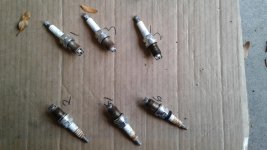
Also - I noticed that all of the lower compression is on one side. Further, all of my plugs on that side has brown coloring on the white parts...is that burnt oil?

20171001_171028.jpg

I thought it was interesting that only the plugs on that side looked like that, and that the lower compression readings were only on that same side. Does this meaning anything to anyone or am I way off here?
 

Attachments

  • 20171001_171028.jpg
    20171001_171028.jpg
    135.7 KB · Views: 880
I also have low compression on one cylinder and am hoping someone can help me out. My compression results were
Cyl 1: 195. Cyl 2: 175
Cyl 3: 195 Cyl 4: 190
Cyl 5: 200 Cyl 6: 145

Cylinder 6 went up to about 185 when I put some oil in there

From what I have read this probably means I have a worn piston ring in #6 - but is this the only explanation? I have read that there is a possibility that the ring could be gunked up and stuck, resulting in a bad seal. Has anyone had any luck improving compression with a sea foam treatment through the pcv hose?

You need to perform a leak down test on cylinder 6 and figure out where the pressure is going. If it's getting past the rings, you will hear air escaping out the oil filler on the top of the valve cover. If it's an exhaust valve, you can hear it at the tail pipe. If it's an intake valve, you will hear it at the throttle body. If it's the head gasket, you can take off the radiator cap and you'll see bubbles coming up.

You'll need to get a leak down tester and you'll need an air compressor. If don't own these, maybe a shop would charge nominal fee to just check that one cylinder for you.
 
You need to perform a leak down test on cylinder 6 and figure out where the pressure is going. If it's getting past the rings, you will hear air escaping out the oil filler on the top of the valve cover. If it's an exhaust valve, you can hear it at the tail pipe. If it's an intake valve, you will hear it at the throttle body. If it's the head gasket, you can take off the radiator cap and you'll see bubbles coming up.

You'll need to get a leak down tester and you'll need an air compressor. If don't own these, maybe a shop would charge nominal fee to just check that one cylinder for you.

Thanks for the tips! I will see if I can rent/borrow those tools.

Does the coloration of the spark plugs mean anything to you?
 
Thanks for the tips! I will see if I can rent/borrow those tools.

Does the coloration of the spark plugs mean anything to you?

I'm not an expert at reading spark plugs. If i saw one that was black from burned oil on it, I'd assume oil was getting past the rings. There's nothing alarming from the look of your spark plugs to me.

I did a quick Google search and found this article:
Reading 101: How to Read Your Spark Plugs - OnAllCylinders
 

Members online

Forum statistics

Threads
278,309
Messages
3,554,071
Members
248,016
Latest member
Advally Service

Trending content

Back
Top