LT Tire Pressure

Alright, hopefully this will help as there has been an awful amount of debate on this topic. I found this document that references maths much higher than I can compute, but seems to be on par with what "most" people define as their sweet spot. The basic equation is this: .

So in my case I run P265/70/R17 Duratracs with a max pressure of 51; max load of 2454 (2697 - 9% for SUV); load of 1753 (rear load on placard of 4Runner).
This equates to: (51 * 1753) / 2454 = 36.

In the case of the same size but E rated Duratrac (with the same 9% for SUV already taken into account): (80 * 1753) / 2907 = 48.

Again, hopefully this provides a simpler method of trying to figure out what pressure you should run and is universal among P, Euro Metric, and LT metric.
 
Alright, hopefully this will help as there has been an awful amount of debate on this topic. I found this document that references maths much higher than I can compute, but seems to be on par with what "most" people define as their sweet spot. The basic equation is this: .

So in my case I run P265/70/R17 Duratracs with a max pressure of 51; max load of 2454 (2697 - 9% for SUV); load of 1753 (rear load on placard of 4Runner).
This equates to: (51 * 1753) / 2454 = 36.

In the case of the same size but E rated Duratrac (with the same 9% for SUV already taken into account): (80 * 1753) / 2907 = 48.

Again, hopefully this provides a simpler method of trying to figure out what pressure you should run and is universal among P, Euro Metric, and LT metric.

I would think that the "Chalk Method" and using common sense (i.e. if you're tire needs to be deflated below 36psi and is ballooning pretty badly, don't ruin the sidewalls by running a lower street pressure...) are probably the easiest way to determine your personal street tire pressure. But you know that nerd [MENTION=66316]1engineer[/MENTION] likes his math. :heh: Thank you for the interesting read though!
 
I would think that the "Chalk Method" and using common sense (i.e. if you're tire needs to be deflated below 36psi and is ballooning pretty badly, don't ruin the sidewalls by running a lower street pressure...) are probably the easiest way to determine your personal street tire pressure. But you know that nerd [MENTION=66316]1engineer[/MENTION] likes his math. :heh: Thank you for the interesting read though!

I did the chalk test when I put my 275/70/17 KO2 tires on stock SR5 wheels and I could not get full contact on the edges even at 32 psi. At 40 psi only the center had good contact. The chalk test has to be done when the tires are new. If you wait till the center is worn down then you will get full contact but it will not be accurate. As I stated in the past anyone who can stand running an E tire at 45 psi or more better hope all the road are smooth that they drive on.
 
I did the chalk test when I put my 275/70/17 KO2 tires on stock SR5 wheels and I could not get full contact on the edges even at 32 psi. At 40 psi only the center had good contact. The chalk test has to be done when the tires are new. If you wait till the center is worn down then you will get full contact but it will not be accurate. As I stated in the past anyone who can stand running an E tire at 45 psi or more better hope all the road are smooth that they drive on.

That's true, if the tire or alignment is off too much or the vehicle is not on level ground it will not be as accurate.

If you're chalk test looks like this:
IMG_5754.jpg~original


I wouldn't be too concerned (not my picture, it's from an FJ Forum; but those are the same Nittos I run ironically) as the very edges will never rub off completely, the tire will always be a bit round at the edges because of how it sits and rolls. The above picture is a fairly good chalk test result, imo when you consider the fact that most of us are putting a 33" tire (typically 285mm wide or around 11.25" wide) on rather narrow rims in the 7~8" range (my Nittos actually came with a sticker that said not to install on anything smaller than 7.5" wide wheels, which is exactly the width of my factory sport edition wheels) and as a result they will want to "pull up" a the edges a bit.

Also I run my 10ply E-Load LT285/70R17 Terra Grapplers at 46psi for street pressure. The truck actually rides very nice over most road going terrain, if you've ever been in the Bay Area you'll know that having an SUV vs. a low slung toy car is a much better idea. Way too many potholes, crappy road, and garbage asphalt for such a "booming" area. :rolleyes:
 
I've been running the KO2 275's for the past 4k miles. Initially 40psi is what I had in them, as calculated by both me and the computer at the store. I had a balancing problem to contend with but the road I regularly drive to work is horrible and I felt every bump and imperfection. The past 1k miles I've dropped the pressure to 37psi (picking the middle point of the 36 & 38 psi other users reported good results with in the KO2 thread). The ride has greatly improved as it isn't as stiff or rough.
I'm pretty sure the calculated 40psi is fine if the vehicle is operated at max GVWR all the time. Most of the time I'm driving to work I'm the only one in the vehicle, I'm not towing anything, and have 1/2 a tank or less of fuel with only my recovery kit in the back to add any weight (~60lbs).

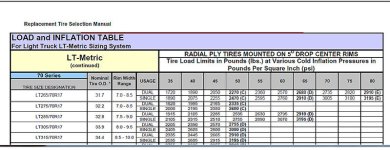
Now I had a few minutes this morning and found an LT load/inflation chart from Bridgestone (see end of page B24) and found that even the small difference between 265 and 275 both 70R17 give different load ratings at the same inflation, so what the computer may spit out for a 265 wouldn't be accurate for the 275 size. This also could have been part of my problem. Now apparently Bridgestone doesn't make 275/70R17's in anything greater than C load rating, but even that is more than enough for our trucks.

For simplicity's sake I moved the 265/70R17 line from the bottom of B24 to the top of B25 to make this easier to follow.
LT tire inflation.jpg
 

Attachments

  • LT tire inflation.jpg
    LT tire inflation.jpg
    68 KB · Views: 15,772
That's true, if the tire or alignment is off too much or the vehicle is not on level ground it will not be as accurate.

If you're chalk test looks like this:
IMG_5754.jpg~original


I wouldn't be too concerned (not my picture, it's from an FJ Forum; but those are the same Nittos I run ironically) as the very edges will never rub off completely, the tire will always be a bit round at the edges because of how it sits and rolls. The above picture is a fairly good chalk test result, imo when you consider the fact that most of us are putting a 33" tire (typically 285mm wide or around 11.25" wide) on rather narrow rims in the 7~8" range (my Nittos actually came with a sticker that said not to install on anything smaller than 7.5" wide wheels, which is exactly the width of my factory sport edition wheels) and as a result they will want to "pull up" a the edges a bit.

Also I run my 10ply E-Load LT285/70R17 Terra Grapplers at 46psi for street pressure. The truck actually rides very nice over most road going terrain, if you've ever been in the Bay Area you'll know that having an SUV vs. a low slung toy car is a much better idea. Way too many potholes, crappy road, and garbage asphalt for such a "booming" area. :rolleyes:

Alignment was not a factor because the rear tires were the worst and it was done on a level painted garage floor. The outside edges of the chalk on the floor never got touched. I drove several thousand of miles and the little nubs or whatever you call them on the tread never wore off on the tire edges even at 34 psi.
 
I decided to email Cooper just to see what answer I'd get. I'm running 255/80-17. Here's the response:

From: Consumer Quality Systems <[email protected]>
Date: November 13, 2015 at 11:58:52 AM PST
To: "[email protected]" <[email protected]>
Subject: RE: Correct tire pressure
Dear xxxxxxx:

Thank you for your email and recent tire purchase, we appreciate your business. Always follow the air pressure recommendation of the vehicle manufacturer (as listed on the placard on the door of your vehicle). Proper air pressure is based on the weight of your vehicle and not the brand or type of tire you have. Even if you've changed tire sizes or rim diameters you would still utilize the door placard recommended pressure settings. Also, never exceed the max air pressure as listed on the sidewall of the tire.

If you have questions regarding this or need more information please contact your vehicle manufacturer. There are several sites you can refer to as well regarding tire pressure safety.

RMA: Rubber Manufacturers Association ? The national trade association for tire manufacturers that make tires in the U.S.
Home | Safercar -- National Highway Traffic Safety Administration (NHTSA)

Sincerely,
Julie
Consumer Relations
 
Sounds to me as if Julie hasn't actually looked at the labeling on the B-pillars of vehicles. The sticker specifically says the size of the tire, the GAWR and GVWR, and PSI for those specs . Deviating from those specs would most certainly warrant deviating from the suggested PSI.
4292418643d705260c63cd53561b81f8.jpg
 
Last edited:
My take on this whole post is just run whatever psi you are comfortable with. I ran my E tires at 32 for quite a while even in 115 degree temps and I am still alive. I tried them a 40 and they were to harsh for me. I generally run around 36 now. I could not tell a difference in handling or much else at any of these pressures.
 
Toyota has a TSB for their LT equipped Tundras and FJs to replace the placard on the door with a new one stating 46psi for the tires.

I fill all my customer's LT tires to 46psi unless they specify a specific pressure when having their service done and simply quote Toyota's LT tire spec.

All that being said, I run 46psi in my Nitto Terra Grappler LT285/70R17's and have good results on my 4th gen.

Nitto Terra Graplers limit Max pressure specified on sidewall at 35 PSI. Isn't it risky to inflate 11 PSI above that Max?
 
No, it isn't. Many of you are missing the fundamental difference between P rated tires and LT rated tires.
For Nitto Terra Grapplers, sizes D & E, the max PSI is 65 & 80 respectively.
 
Nitto Terra Graplers limit Max pressure specified on sidewall at 35 PSI. Isn't it risky to inflate 11 PSI above that Max?

44psi is for P (Passenger) rated tires (are you sure you're sidewall says 35psi MAX? That seems very weird to me, usually most P-rated tires go to about 40~44psi max). I am running an E-Load LT (Light Truck) Variant of the Nitto Terragrapplers, the max pressure for the E-Loads is 80psi.
 
Modern radial tires will have a very even contact patch side to side until getting into extreme ranges of under or over inflation. The contact patch gets longer with lower pressure, not wider like bias ply tires.

The recommended inflation pressure has a decent margin of error built into it, so you probably won't experience any failures at 36psi on an LT, with close to stock weight, just decreased tread life. At max GVWR, on a hot day, at high speed, you might.

You should try checking your tire temperatures with an IR thermometer after running on the highway at 36psi versus 42psi.

5.png

Sorry, I know this an old post, this makes sense but I've just never read it before. This would seem to reduce the merit of the "chalk test" as you should get a similar chalk test result at a wide range of pressures. That would also explain why so many people report even treadwear at many different pressures.

So this would make me think we have some flexibility when choosing normal street pressure for LT tires. Seems like the guidelines would be 35 psi minimum since LT's are not rated below 35 psi and JB's test shows deflection and sidewall flex starting to rise significantly below 35 psi. Always ensuring load rating exceeds 1/2 your max GAWR or whatever other load requirement you may have, of which 35 psi should for most all 5th gen users. And then beyond that, you could raise pressure to improve mileage, lower temperatures, etc., just knowing that you are trading off handling/grip and ride quality at higher pressures.

Is this right? or am I missing something? So taking a low end of 35 psi, at what high pressure would you expect to see ballooning and uneven tread wear in the center?
 

Members online

Forum statistics

Threads
278,309
Messages
3,554,071
Members
248,016
Latest member
Advally Service

Trending content

Back
Top