Metaltech's Ironman 4x4 KDSS Lift Instructions

assassin

New member
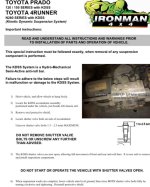
Hello all I'm finishing up my studying of lifting a 4runner and metaltech just posted on their website on how to disable the KDSS on our 4runners so that we can install our parts.
KDSS%20Instructions%20Prado_4Runner.pdf


My question is how many of you disabled your KDSS by opening the valves when you installed your lifts? I have access to a vehicle lift when I install so opening the valves might be easier than trying to hold everything in place. I've read of people using ratchet straps or a jackstand to keep kdss components from moving during install but how many of you have disabled the kdss by opening the valves?

On the land cruiser forums this seems to be the common method to lift a kdss equiped vehicle.

My biggest concern is screwing up the KDSS system by over loosening those screws.

Seems like opening the KDSS valves and shaking the vehicle back and forth allowing the kdss to reset then tightening the valves
or following this guys method:
https://www.youtube.com/watch?v=xtURdW66WM4
Might be the correct most of the lean before adding spacers.
 

Attachments

  • Screen Shot 2018-09-10 at 9.28.54 PM.jpg
    Screen Shot 2018-09-10 at 9.28.54 PM.jpg
    72.1 KB · Views: 2,042
Register to hide this ad
Yea I've taken my kings out a few times and never released the KDSS. You can leave the sway bar attached too. Just disconnect your outer tie rods to allow you to get the coilover in. Use a jack to push up on the KDSS piston on the opposite side you are working on. That will force the sway bar down on the side you are working on, and push the LCA further downward. Its actually pretty easy on the ground with stands and a floor jack.

The rear will definitely be easier on your lift...depending on how tall your new rear coils are.
 
I've obviously seen many people use the floor jack / stands method with what seems to be success, but there's something intuitively correct about releasing pressure on a hydraulic system before working on components connected to it.

I wonder if any toyota mechanics / dealership types here can confirm or deny what the OEM company line is?
 
I've obviously seen many people use the floor jack / stands method with what seems to be success, but there's something intuitively correct about releasing pressure on a hydraulic system before working on components connected to it.

I wonder if any toyota mechanics / dealership types here can confirm or deny what the OEM company line is?

That is my exact thought process...
 
Yea I've taken my kings out a few times and never released the KDSS. You can leave the sway bar attached too. Just disconnect your outer tie rods to allow you to get the coilover in. Use a jack to push up on the KDSS piston on the opposite side you are working on. That will force the sway bar down on the side you are working on, and push the LCA further downward. Its actually pretty easy on the ground with stands and a floor jack.

The rear will definitely be easier on your lift...depending on how tall your new rear coils are.

This, no need to disconnect or open any part of the kdss system.
 
Using a jack or ratchet to hold the piston / bar in place seems like it'd be simulating the weight (pressure) of the suspension with tires on the ground. I know [MENTION=118321]Jetboy[/MENTION] has experience, how do you work on yours? Max [MENTION=129593]MTN4RNR[/MENTION] were you there to see Califab do your King system?

Having said all of that, would OME / ARB make a trim packer if it wasn't necessary? Was the trim packer intended for KDSS leveling in the first place or just off center loads causing a lean?
 
Using a jack or ratchet to hold the piston / bar in place seems like it'd be simulating the weight (pressure) of the suspension with tires on the ground. I know [MENTION=118321]Jetboy[/MENTION] has experience, how do you work on yours? Max [MENTION=129593]MTN4RNR[/MENTION] were you there to see Califab do your King system?

Having said all of that, would OME / ARB make a trim packer if it wasn't necessary? Was the trim packer intended for KDSS leveling in the first place or just off center loads causing a lean?

The pistons are always pressurized and push down. The reason is that they use accumulators - which is a fancy term for pressurized overflow reservoirs - very similar to how a remote reservoir on a shock works. When the piston compresses the shaft of the piston takes up some of the volume inside the cylinder. The oil volume has to go somewhere. Where it goes is into a reservoir called an accumulator. The accumulator has a bladder inside that separates compressed air from the oil. This is the same function that the floating piston does in a shock - if you ever see the term IFP.

The result of this system is that the KDSS cylinders are always under pressure from that gas charge in the accumulator. IIRC the charge is about 500psi. I think the calculation results in something like 300lb of force down on the bottom of the piston. Exactly like a pressurized shock. The primary difference here is that the piston diameter on the KDSS cylinder is a lot larger. The cross sectional area of the piston shaft multiplied by the oil pressure gives you the force. Since the KDSS cylinder is under more pressure (shocks are typically 2-300psi) and has a larger piston, the force is higher. But in concept it's exactly the same thing.

It should not be bled for almost any reason or have the pressure relieved. Just like you would not remove the pressure from your shocks for work other than opening it up to work on the insides, you should not need to do anything with KDSS system for work other than internal work on the pressurized system. It's completely fine to let them extend to the max point and bottom out while you're doing other stuff. Then compress back to get your sway bar attached. It's no different from what you do when you install a rear shock. Just more force.

Hope that helps.

Also FWIW you could relieve the pressure - but it'll be a big PITA to get it back. Where shocks use a reservoir with an external schrader valve for pressurizing with nitrogen, the KDSS accumulators have no such external gas pressurization option. They have an air chamber that is fixed in volume and the oil is pressurized into the system. Most of us don't have a high pressure oil pump.
 
Using a jack or ratchet to hold the piston / bar in place seems like it'd be simulating the weight (pressure) of the suspension with tires on the ground. I know [MENTION=118321]Jetboy[/MENTION] has experience, how do you work on yours? Max [MENTION=129593]MTN4RNR[/MENTION] were you there to see Califab do your King system?

Having said all of that, would OME / ARB make a trim packer if it wasn't necessary? Was the trim packer intended for KDSS leveling in the first place or just off center loads causing a lean?

Califabrication used a ratchet strap to hold the piston in place. They did the front first, then the rear. Seemed to work just fine!
 
...
It should not be bled for almost any reason or have the pressure relieved. Just like you would not remove the pressure from your shocks for work other than opening it up to work on the insides, you should not need to do anything with KDSS system for work other than internal work on the pressurized system. It's completely fine to let them extend to the max point and bottom out while you're doing other stuff. Then compress back to get your sway bar attached. It's no different from what you do when you install a rear shock. Just more force.

Hope that helps.

Also FWIW you could relieve the pressure - but it'll be a big PITA to get it back. Where shocks use a reservoir with an external schrader valve for pressurizing with nitrogen, the KDSS accumulators have no such external gas pressurization option. They have an air chamber that is fixed in volume and the oil is pressurized into the system. Most of us don't have a high pressure oil pump.

So don't mess with the KDSS valves is your recommendation
 
So don't mess with the KDSS valves is your recommendation

Yep. That's the short answer. And you don't have to hold the piston compressed. You can just push it back when you're done. Or you can use a strap to keep it compressed. Either way works just fine.

Also - calibrating by system can help, but won't fix the lean.

Finally - if you want to hurt your head - try to figure out the functionality of the LX570's system...

ahc1-jpg.1558504
 
Last edited:
Yep. That's the short answer. And you don't have to hold the piston compressed. You can just push it back when you're done. Or you can use a strap to keep it compressed. Either way works just fine.

Also - calibrating by system can help, but won't fix the lean.

Finally - if you want to hurt your head - try to figure out the functionality of the LX570's system...

ahc1-jpg.1558504

Not bad actually I graduated in Chemical Engineering lol, diagram helps alot is there one for the 4Runner KDSS system probably not much different.
 
Not bad actually I graduated in Chemical Engineering lol, diagram helps alot is there one for the 4Runner KDSS system probably not much different.

KDSS is much simpler. Only two cylinders. 4 valves (2 electric, 2 manual) and two accumulators. And only takes info from speed, steering angle, yaw/accelerometer sensor and VSC.

The LX has a lot going on internally. The gas chambers are both accumulators in part and air springs. By using the valves in sequential orders it can choose what air springs to remove or add to the system and adjust spring rates. But it also transfers the rates throughout the system as well and includes coil springs that are hard to see in the picture that act internally in the center control sub-assembly. So there's constantly changing spring rates at each corner and dampening rates, plus adjustment in roll stiffness both left/right and front/rear at the same time. So when you have more load in the rear it not only self levels, but also adds rear spring rate dynamically in cornering to compensate. It also does a forced articulation function, has nonlinear dampening control with variable dampening along with the variable spring rate adjustments. It's not magic, but it has a lot of moving parts and takes in put from a bunch of sensors to determine pitch, yaw, etc, - even uses "thump" sensors to minimize road noise. I'm not sure its something I'd want though. But it does make KDSS seem a lot more basic in function.
 

Members online

Forum statistics

Threads
278,316
Messages
3,554,120
Members
248,016
Latest member
Advally Service

Trending content

Back
Top