
MPG is going to kill me

gizmopt2002

New member
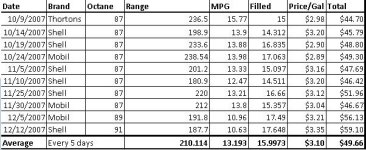
When I bought the '95 4Runner I knew the 3.0 sucked gas, but not this bad. I used to get about 15, now I get 10. Check out my spread sheet.

What do you guys think? Any inexpensive way to improve it? Sea foam, PVC Valve, fuel filter? lol I have those in the back of my truck.

I go the same route everyday, same speed never go above 2.65k RPM while accelerating. Can't spend ALOT of money, I'm in HS, so choices are limited. I'm thinking Seafoam the crap outta it, new sparks, wires, oil, fuel filter. Tires are most defiantly out of the question, no way can I afford that right now, and I don't need them, there are 4 new Goodyear Wrangler RT/S LT/C range, and one B range? I thought that was really odd, I wanna wither switch out that one or the others. Granted I could save MPG's and a crappy ride if I change them, I was planning on either Firestone Destination AT or General Grabber ATII.

New air filter already, no manual hubs, only ADD, and my pass side CV axle is shot, but I have a new one sitting in my garage waiting to be installed.
 

Attachments
  • mpg.jpg
    mpg.jpg
    52.4 KB · Views: 1,358
Last edited:
Register to hide this ad
Correct me if i am wrong, but i think that during the winter months, the gas companies put in a special formulation into their gasoline. This helps the northerners for some reason (i forgot), but the special formulation decreasese fuel economy. I have always noticed this during the winter months...all my cars are less fuel efficient.
 
Found it: (from chevron website)

"Oxygenated gasoline is a mixture of conventional gasoline and one or more combustible liquids which contain oxygen. At present, ethanol is the most common oxygenate in the United States. The government requires gasoline to be oxygenated during the winter in areas that have a carbon monoxide pollution problem (cold weather and atmospheric inversions worsen carbon monoxide pollution). Oxygenated gasoline helps engines run leaner, which helps some engines
 
I've seen postings that say cleaning the mass air flow (MAF) sensor is supposed to help fuel economy a little bit.

A search should turn up instructions on how to do it. It's the sensor in the air intake, right behind the air filter box, so access to it is a snap. The process involves cleaning it very carefully with electrical contact cleaner, as the business part of the sensor is essentially two tiny bare wires.

I've also heard of people proactively changing the oxygen sensors even if the CEL isn't on in order to improve MPG. Both the MAF and the O2 sensors control the air/fuel mix, so if they're feeding the computer bad data, it could be burning more fuel than necessary.
 
Last edited:
For me its what Thai says. I ALWAYS have noticed crappy fuel economy in all the cars I've owned during the brutal winters up here. I've never put Seafoam into anything fuel injected before, I guess I'm yella. If anyone does, please tell us about it.
 
TheBlueWave said:
I've never put Seafoam into anything fuel injected before, I guess I'm yella. If anyone does, please tell us about it.

I do put in Chevron Fuel System cleaner...but that is usually after oil changes (every 5K miles). Not sure if it helps, but i hope that it does something! :D My local Chevron gas station sells them cheap for some reason ($4 for a bottle to clean 12 gallons)...so, it's not burning a big hole in my wallet.
 
Check your tire pressures....a 10degree difference in ambient temps from when you filled them last can have a 1-2psi change.

Also, tires loose pressure at the rate of about of 1psi/month

A loss of about 6psi can increase fuel consumption upto about 5%

Alignment is another area where energy can be lost

Swapping out the diff and transfer case with new and higher performance fluid can also net you a 1-2mpg increase. I swapped over to Royal Purple and saw an increase.

Check your fuel filter and spark plug gaps...


As previously mentioned

1. MAF cleaner (about $3.50 at a autoparts store) as that can net you a good increase if its dirty as well.

2. O2 sensor might be bad.

Thai also has it correct, oxygenated fuels are used in the winter which help reduce emisions but also reduce economy. In addition, the higher density (colder air) of the winter months also means that you're vehicle must increase fuel flow to meet the proper A/F ratio.


I use seafoam in the 4runner every 15K miles. Probably not required but since i dont use premium grade fuels (but i do use Chevron and Shell fuels), its a cheap and easy way to at least "feel" like im doing something. I also use it in my Gf's VW Golf whos mileage went up about 2mpg after the first treatment that i used on her car. She is quickly approaching another interval.
 
Last edited:
I noticed that your mileage decreased when you used higher octane gas. You'll never improve your mileage enough with higher octane gas to justify the extra cost anyway. I get about 10% less per gallon when I use 10% ethanol gas. Hope I helped.
 
Fix your CV shaft, it causing more drag on your drivetrain. which reduces your MPG

Get Manual hubs... the "locked hubs" have your front driveshaft spinning when your in 2wd. more drag, reduced more mpg.

switch to synthetic fluids... they claim better protection and less friction. I can agree on the less friction.


In my old 94 4runner with 3.0 and 5 sp; 4:10 gears, 3" lift, 33x10.5.
I switched to manual hubs, I gained 2-3 mpg.
I switch to redline gear oil and I gained 2-3mpg.
After that I was getting 16-19 mpg on the highway doing 65-75 mph.
 
Thanks for the response guys. I've know about winter fuel mixes and their decrease in MPG (from T4R.org coincidentally), but I just haven't seem a big impact like this before. There is no MAF on the 3.0 unfortunately, it is a MAFV, a mass air flow valve, nothing to clean there. I'm probably gonna seafoam the hell out of it, change the oil & filter, change the fuel filter (came with the car), and the PVC valve (also came with the car), and if I still see no results, I'll dish out the dinero for the O2 sensor. I'll check the PSI again, just to be sure, quick question though, if the max PSI in my LT tires is 45, what should it be at?

wvuviv30 said:
Fix your CV shaft, it causing more drag on your drivetrain. which reduces your MPG

Get Manual hubs... the "locked hubs" have your front driveshaft spinning when your in 2wd. more drag, reduced more mpg.

switch to synthetic fluids... they claim better protection and less friction. I can agree on the less friction.


In my old 94 4runner with 3.0 and 5 sp; 4:10 gears, 3" lift, 33x10.5.
I switched to manual hubs, I gained 2-3 mpg.
I switch to redline gear oil and I gained 2-3mpg.
After that I was getting 16-19 mpg on the highway doing 65-75 mph.

Man, I wish I had the 5 spd, the Auto on these this Toyota, although bulletproof, sucks up gas.

See, I have 4.88 gears riding on 31x10.50 . Once I save a little money, I plan on switching to manual hubs and adding a lift. Synthetic is on it's way, as it is already over 3,500k from the previous owners oil change, I love Amsoil, but can't afford it so I use Mobil1.

Thai said:
Here is a good article about other causes of drop in fuel economy during the winter months: http://alternativefuels.about.com/od/environmentalimpact/a/winterfuelecon.htm

Another good article: http://www.helium.com/tm/241291/there-factors-cause-achieve

Basically, you have to live with it for now...and RE-CHECK YOUR TIRE PRESSURE!!

Since this is a cool topic to discuss, i am moving it to General Section.

Thai, you're like the Wiki of T4R.org. (which is a good thing) Your input is always from reputable articles, plus your own knowledge. Muchas gracias!

(edited for post whoring)

Okay, just went and checked the tires. 3@ 34 PSI with a max of 50 bumped to 40, and one @ 29 with a max (cold) of 35, bumped to 35.
 
Last edited:
Interesting spec form edmunds.com,
Fuel
Fuel Tank Capacity: 17.2 gal.
EPA Mileage Estimates: (City/Highway)
Manual: 14 mpg / 14 mpg Automatic: : 18 mpg / 16 mpg
Range in Miles: (City/Highway)
Automatic: 309.6 mi. / 275.2 mi. Manual: 240.8 mi. / 240.8 mi.

Based on V6 in 4WD.

If I ever get to 300 miles a tank I'll gladly streak across my town. (thank god O'Hare is bigger than my town)
 
gizmopt2002 said:
I'll check the PSI again, just to be sure, quick question though, if the max PSI in my LT tires is 45, what should it be at?

Okay, just went and checked the tires. 3@ 34 PSI with a max of 50 bumped to 40, and one @ 29 with a max (cold) of 35, bumped to 35.

Is your tire bigger than stock?? If so, is it a lot bigger?? IMHO, if your tires are same (or +1 in size...ex: 31 --> 32") as stock, then i would keep it at factory's recommended pressure(s). If you're bigger than normal by more than +1, then i would run at least 35 psi.

Or if you want something more technical or elegant, then you can try this:

"You find your correct tire pressure for non stock size tires by running a chalk line across the tread, drive 20 meters, check the line, if line is only erased in the center deflate and drive in steps until entire line to the edges is gone. Due to the weight difference you have to do that front and rear. The pressure you arrive at, should be your normal operating pressure. For extended freeway trips increase psi by 10."

"Do the chalk line test for proper normal tire pressure once your vehicle is loaded up.
Then use 100% of that on pavement (add 30% for sustained fast speed while traveling to the loacation).
70% of normal on gravel roads if speed stays at an average of 30 mph (short sections can be driven at up to 60 mph - no longer than 20-30 minutes).
40% of normal in really soft sand (avoid sharp turns - be aware of your bulging sidewalls).

So, if 32 psi is your normal pressure:
41 psi on the freeway
22 psi on gravel roads
13 psi for soft sand"

The above quote is from a true off-road expert (not a wannabe like me)...he is an off-road instructor (http://www.4x4abc.com/). I am not sold on the "10 psi +" for highway driving, but i guess that it makes sense. For my G and 32" M/T, I use factory psi on highway and 18 psi off-road (anywhere off pavement).

Hope this helps.
 
Pincushion said:
I noticed that your mileage decreased when you used higher octane gas. You'll never improve your mileage enough with higher octane gas to justify the extra cost anyway. I get about 10% less per gallon when I use 10% ethanol gas. Hope I helped.

How can you not use 10% ethanol gasoline? I believe it is mandated in every state now by federal regulations.
 
JungleJim said:
How can you not use 10% ethanol gasoline? I believe it is mandated in every state now by federal regulations.

Nope, not every state. On our way to New Mexico I saw numerous gas stations offering regular unleaded w/o ethanol, which was a little more expensive than their premium with ethanol.
 
Ethanol blends are only in the most congested counties in Texas. I live just outside of Dallas county. I make a point to gas up at home as much as possible. That ethanol can't be good on your engine, especially if it's not made for ethanol usage.

Regular unleaded in my county is the same price as ethanol unleaded in Dallas county.
 
gizmopt2002 said:
Quick update. MPG still sucks with new CV.

Has the Valve Clearance been confirmed to be correct? At 90k it's probably time to check it. Just 'cause it's quiet doesn't mean it's ok. Too little valve clearance will hold a valve open slightly reducing power/economy and ultimately it'll cause valve damage.

O2 sensors get old. That would be my next guess. Good luck! :cheers:
 

Members online

Forum statistics

Threads
278,309
Messages
3,554,074
Members
248,016
Latest member
Advally Service

Trending content

Back
Top