
Need advice! Coolant boiling in high altitude

Runs with Dougs

New member
Having some issues with my 99 4Runner LTD v6. She has a little over 260,000 under her belt.
I live at high altitude, around 8500 ft, and have been having radiator issues after turning the car off after the drive up. The drive up gains about 3000 ft over 8 miles and is rough on the car. I don't notice any signs of overheating on the way up. Temp gauge stays the same, no smoking, no changes in RPMs or performance.. it makes it up fine. When I turn the car off I can definitely notice the coolant boiling in the reservoir and the radiator, and a few times if the coolant level was high enough it has boiled over out of the reservoir. This drive is the only time I have this issue. Too bad it is my drive home! Does this have to do with the rapid increase in altitude? Maybe a lower boiling temp at higher altitude? Could my thermostat be stuck?

Local shop has quoted $250 for p&L to replace thermostat, thermostat gasket, and coolant temp sensor- not guaranteeing it to fix problem. I never had this issue before with my previous radiator, which cracked and was replaced by same shop.

Newbie looking for help. Thanks in advance!
 
Register to hide this ad
Have you change the coolant every 2 years or 20000 miles?

I did a radiator flush and got new coolant before I drove from TX to UT. This past winter my radiator cracked, so my current radiator is brand new- not much mileage on it. It hadn't been 2 years or 2000 miles between the flush and getting a new radiator and coolant.
 
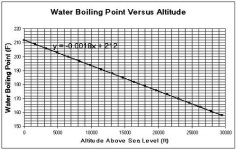
The boiling point increases with the altitude. For example water boils at 100 Celsius (212 F) at the sea level and at 97 Celsius (206.6 F) at about 5000 feet.
Since you are at 8500 feet I am sure the boiling point is about 90 Celsius. Thermostat opens at 82 Celsius. So once the coolant flows into the reservoir tank and since it is not pressured with a radiator cap, I am sure it will boil.

To increase the boiling point of coolant, use a higher fraction of anti-freeze. Don't use 50:50.

I am positive your cooling system is OK, just get a higher fraction of antifreeze.

According to the graph y = 212+ (-0.0018 X feet): At your altitude (8500 ft) the boiling point is 91.5 Celsius (196.7 F)
 

Attachments

  • 654543.JPG
    654543.JPG
    59.5 KB · Views: 7,433
Last edited:
I'm not an expert on the subject, but it would seem to me that altitude would have zero effect on coolant within the pressurized cooling system, only on the hot coolant passed into the reservoir due to expansion. It might boil briefly as it adjusts to the drop in pressure when it hits the reservoir, which it might not do at sea level, but it really is nothing to worry about. It's just letting off steam, literally. The phase change from minor boiling will cool it below the boiling point vary quickly.

In any case, I'd invest in a new cap--which does determine the system pressure, before I invested in a new thermostat, which doesn't. You might try the cap for the later '01+ 3G 4Runners which is 1.1 bar, as opposed to our '99's, which run a 0,9 bar cap.
 
Last edited:
I am actually having this same problem right now. Bought my 99 last October, had no problem with this. Back in June, I flushed and refilled my coolant with the Toyota OEM coolant, and last week, I've been noticing that the coolant is boiling out of the radiator and into the reservoir tank after I am done driving. I live up in attitude too, but my drives don't include massive elevation changes. I mixed the coolant to about 50:50. Maybe I should go a bit more concentrated on the coolant side?

I was also told that my fan clutch is shot, causing the boiling over, which kinda makes sense, but not really.
 
I am actually having this same problem right now. Bought my 99 last October, had no problem with this. Back in June, I flushed and refilled my coolant with the Toyota OEM coolant, and last week, I've been noticing that the coolant is boiling out of the radiator and into the reservoir tank after I am done driving. I live up in attitude too, but my drives don't include massive elevation changes. I mixed the coolant to about 50:50. Maybe I should go a bit more concentrated on the coolant side?

I was also told that my fan clutch is shot, causing the boiling over, which kinda makes sense, but not really.

You're supposed to mix it 66% coolant 33% water but again that shouldnt matter that much
 
In any case, I'd invest in a new cap--which does determine the system pressure, before I invested in a new thermostat, which doesn't. You might try the cap for the later '01+ 3G 4Runners which is 1.1 bar, as opposed to our '99's, which run a 0,9 bar cap.

I'm guessing (well, a somewhat informed guess) that it might be something as simple as a bad radiator cap. That's the cheapest and easiest thing to replace so I'd start there (and if it doesn't fix it, you probably need a new one anyway).
 
The boiling point increases with the altitude. For example water boils at 100 Celsius (212 F) at the sea level and at 97 Celsius (206.6 F) at about 5000 feet.
Since you are at 8500 feet I am sure the boiling point is about 90 Celsius. Thermostat opens at 82 Celsius. So once the coolant flows into the reservoir tank and since it is not pressured with a radiator cap, I am sure it will boil.

To increase the boiling point of coolant, use a higher fraction of anti-freeze. Don't use 50:50.

I am positive your cooling system is OK, just get a higher fraction of antifreeze.

According to the graph y = 212+ (-0.0018 X feet): At your altitude (8500 ft) the boiling point is 91.5 Celsius (196.7 F)

I had talked about this with a buddy of mine, and wanted to try using a higher ratio of coolant to water. So, based on that info the drive up the canyon, a gain of about 3000 ft, could lower the boiling point by about 5.5 degrees F.
 
I'm guessing (well, a somewhat informed guess) that it might be something as simple as a bad radiator cap. That's the cheapest and easiest thing to replace so I'd start there (and if it doesn't fix it, you probably need a new one anyway).

Definitely a good idea. I had replaced my radiator cap recently, but on my previous radiator, when it was no longer holding pressure. If the shop put that same cap onto the new radiator I would think it should still be fine. I asked the shop if it could be a bad cap and according to them it was testing fine. I am leaning towards not getting the job done through them, and try to play around with a few things first, like using more coolant than water. In that case, I might just get a new radiator cap to be safe since they are so cheap.
 
I'm not an expert on the subject, but it would seem to me that altitude would have zero effect on coolant within the pressurized cooling system, only on the hot coolant passed into the reservoir due to expansion. It might boil briefly as it adjusts to the drop in pressure when it hits the reservoir, which it might not do at sea level, but it really is nothing to worry about. It's just letting off steam, literally. The phase change from minor boiling will cool it below the boiling point vary quickly.

In any case, I'd invest in a new cap--which does determine the system pressure, before I invested in a new thermostat, which doesn't. You might try the cap for the later '01+ 3G 4Runners which is 1.1 bar, as opposed to our '99's, which run a 0,9 bar cap.

What I was going to say. A properly pressured coolant system won't boil over at any altitude you can drive to in the US.

OP, this has nothing to do with your thermostat or when you changed your coolant last. It's probably the radiator cap, if not it's something more serious. There's definitely something wrong though, because I run 50/50 all over Utah, frequently above 8000 feet, and I don't have the problem you're describing.
 
Definitely a good idea. I had replaced my radiator cap recently, but on my previous radiator, when it was no longer holding pressure. If the shop put that same cap onto the new radiator I would think it should still be fine. I asked the shop if it could be a bad cap and according to them it was testing fine. I am leaning towards not getting the job done through them, and try to play around with a few things first, like using more coolant than water. In that case, I might just get a new radiator cap to be safe since they are so cheap.
I think more coolant in the radiator is for colder climates. Try the cap and go from there.
 
Correction: The boiling point DECREASES with the altitude.

The coolant inside the reservoir can boil as it is exposed to 1 atmospheric pressure which is close to 1 bar.
If it is boiling inside the radiator, then it got to be the radiator cap or your car is over heating.
 
Last edited:
What I was going to say. A properly pressured coolant system won't boil over at any altitude you can drive to in the US.

OP, this has nothing to do with your thermostat or when you changed your coolant last. It's probably the radiator cap, if not it's something more serious. There's definitely something wrong though, because I run 50/50 all over Utah, frequently above 8000 feet, and I don't have the problem you're describing.

That would be great if it was just the radiator cap! How can you rule out the thermostat? And if it's something more serious any thoughts on what that could be? Thanks for the advice bud!
 
I'm ruling out the thermostat because you say you're not overheating :). If the thermostat was failing to open your temp gauge would spike immediately.

Boiling point of a liquid depends on lots of things, but one of those things is pressure. More pressure = higher boiling point. Your coolant system pressurizes itself as it heats up, and that pressure lets the coolant get to higher temps without boiling. I think you're boiling because you don't have enough pressure. That's normally a bad radiator cap, if it's not, it could be a bad hose, it could be a blown head gasket. Normally I'd ask if the truck was burning coolant, but if you're losing coolant out the overflow bottle on a regular basis then you wouldn't be able to tell anyway. You could still inspect your coolant hoses to see if there's any crusty pink or light green residue, that's a sure sign of a leaking hose and that would cause your loss of pressure. But I think it's a radiator cap because by your description, the truck doesn't do the boiling at lower altitude, only when you get home where the air pressure is less. Possibly just enough less to make the radiator cap misbehave.

Rad cap is cheap. If you replace the cap and it still does it, get a block test from NAPA or wherever and test your coolant for exhaust particles. If the block test is negative and the cap is good have a rad shop do a full system pressure check to find where it's losing pressure at (I don't know how far away you are but I like JMAC on State Street in SLC for radiator stuff).

If it's not a pressure issue at all then it's over my head, but that's my bet.
 
The boiling point increases with the altitude. For example water boils at 100 Celsius (212 F) at the sea level and at 97 Celsius (206.6 F) at about 5000 feet.
Since you are at 8500 feet I am sure the boiling point is about 90 Celsius. Thermostat opens at 82 Celsius. So once the coolant flows into the reservoir tank and since it is not pressured with a radiator cap, I am sure it will boil.

To increase the boiling point of coolant, use a higher fraction of anti-freeze. Don't use 50:50.

I am positive your cooling system is OK, just get a higher fraction of antifreeze.

According to the graph y = 212+ (-0.0018 X feet): At your altitude (8500 ft) the boiling point is 91.5 Celsius (196.7 F)

Good info, but applicable only to an unpressurized cooling system. With a cooling system that's only a few psi above atmospheric pressure the boiling point of straight water at 8000 ft. will be well above the normal operating temperature of a T4R. With a normal system that's pressurized to about 15 psi above atmospheric pressure, the boiling point of straight water will drop from about 250F at sea level to about 240F at 8,000 ft.
 
Good info, but applicable only to an unpressurized cooling system. With a cooling system that's only a few psi above atmospheric pressure the boiling point of straight water at 8000 ft. will be well above the normal operating temperature of a T4R. With a normal system that's pressurized to about 15 psi above atmospheric pressure, the boiling point of straight water will drop from about 250F at sea level to about 240F at 8,000 ft.

Read the post again. He was talking about the boiling occurring in the unpressurized overflow reserve.
 
I'm ruling out the thermostat because you say you're not overheating :). If the thermostat was failing to open your temp gauge would spike immediately.

.

I think you mean failing closed.

I'm with you on the radiator cap. That would be the first thing I'd change too.

OP, do you have a OBDII reader you can plug in and see what your actual coolant temps are? That would be helpful info. It's possible the truck is running a little hotter than it should (possibly due to thermostat or other minor cooling system issue) and when the water leaves the pressurized coolant loop it's above its boiling point at your altitude.
 

Members online

Forum statistics

Threads
278,312
Messages
3,554,089
Members
248,016
Latest member
Advally Service

Trending content

Back
Top