Need Help - Household Electrical Wiring

Bluesky 07

Senior Member
I'm pretty sure I know how to wire this but wanted to ask how you who have some experience and expertise would do it. Researched it online and it's crazy how much conflicting info there is.

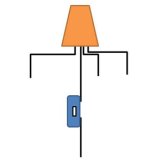
The fixtures are mounted on rafters in an unfinished basement. This part of the basement will not be finished in the future. I tried to explain everything else in the illustration but lmk if you need any questions answered. Would really appreciate some feedback on how you would handle this.

udMQC7Hl.png
 
Register to hide this ad
Pretty easy. Just be careful working with high voltage electrical wiring and make sure you don't need a permit, etc. You could easily have googled what you're looking for... Single pole switch to Lights

I would like to recommend the following two books that I have in my collection:

  • Stanley Complete Wiring
  • Black and Decker The Complete Guide to Home Wiring

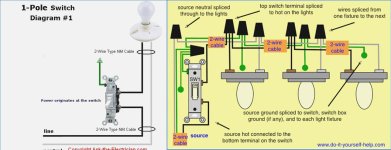
Anyway just to get the pictures I googled it for you. Enjoy the pic! Switch to lights in series.

Black (pwr) goes through the switch. White (neutral) by-passes switch to the lights. Grounds are obvious.
 

Attachments

  • Wiring Diagram_3.jpg
    Wiring Diagram_3.jpg
    93.9 KB · Views: 298
Pretty easy. Just be careful working with high voltage electrical wiring and make sure you don't need a permit, etc. You could easily have googled what you're looking for... Single pole switch to Lights

I would like to recommend the following two books that I have in my collection:

  • Stanley Complete Wiring
  • Black and Decker The Complete Guide to Home Wiring

Anyway just to get the pictures I googled it for you. Enjoy the pic! Switch to lights in series.

Black (pwr) goes through the switch. White (neutral) by-passes switch to the lights. Grounds are obvious.

Not so much to we who are not as familiar as others. :confused:

Did the web search and you're right, there are many diagrams and articles. I couldn't find a definitive answer about the grounds. These are plastic boxes and the supply ground in the existing fixture isn't connected to anything, it's just balled up and shoved in the box. Sounds like that one should be connected to the ground screw of the fixture and the same with the other two I'm adding. Is that right?

Also, the existing fixture is in the middle, not on one end. Does that matter?

Thanks for taking the time to respond. I appreciate the book recommendations and will look at both.
 
Last edited:
Not so much to we who are not as familiar as others. :confused:

Did the web search and you're right, there are many diagrams and articles. I couldn't find a definitive answer about the grounds. These are plastic boxes and the supply ground in the existing fixture isn't connected to anything, it's just balled up and shoved in the box. Sounds like that one should be connected to the ground screw of the fixture and the same with the other two I'm adding. Is that right?

Also, the existing fixture is in the middle, not on one end. Does that matter?

Thanks for taking the time to respond. I appreciate the book recommendations and will look at both.

Yes, there should be a ground on your switch (Only three terminals on a single pole switch) and the ground should have been on your fixture as well.

It doesn't matter where your lights are. They're still wired in series with 14/2. In the illustration with the three lights your additional fixtures will look like the light on the end. Your wires will terminate at the two additional light fixtures. Make sense? Pwr/neutral/grd goes to your main light and branches off to your two additional fixtures.
 
Yes, there should be a ground on your switch (Only three terminals on a single pole switch) and the ground should have been on your fixture as well.

It doesn't matter where your lights are. They're still wired in series with 14/2. In the illustration with the three lights your additional fixtures will look like the light on the end. Your wires will terminate at the two additional light fixtures. Make sense? Pwr/neutral/grd goes to your main light and branches off to your two additional fixtures.

Thanks, I really appreciate it. So at the middle fixture, it'll be black to black, white to white, and ground to ground with the wires going to the additional outlets and pigtails out to go to the screws on that fixture, is that right?
 
Thanks, I really appreciate it. So at the middle fixture, it'll be black to black, white to white, and ground to ground with the wires going to the additional outlets and pigtails out to go to the screws on that fixture, is that right?
This is correct.

You should have four wires in your wire nut for each wire (Black, White, and Ground) as such...

Quick little drawing for you.
 

Attachments

  • Wiring Diagram_4.jpg
    Wiring Diagram_4.jpg
    36.3 KB · Views: 231
If you are using more wires you will also need a larger wire nut. Likely red if you are using 4 wires.

attachment.php
 
Thanks, everyone. I really appreciate your time in answering my questions.

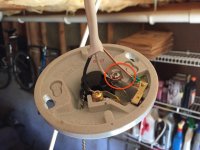
I took this pic of the current fixture just to show why the ground thing had me puzzled. I'm not shocked (no pun intended) as I've seen plenty of online advice saying no ground is necessary in plastic boxes and I assume it had to meet code, right? House was built in 2008 and everything works correctly. (Knocking on wood.) Should I check the switch to be sure the ground is connected there? It has to be, right?

3Gqv6Lpl.jpg
 
Run ground to junction box, NOT connect to plastic

Like Rock Rat says and drew ^^^

...no ground is necessary in plastic boxes and I assume it had to meet code, right?
3Gqv6Lpl.jpg
That is correct; One cannot ground plastic, an insulator.
If that were a metal junction box, yes, the ground wire should be connected to it.
However, it makeS sense that the ground wire always be ran to the junction box because:
1) You are most likely using a wire with 3 conductors already, AND
2) Later you may decide to install a fixture with metal housing.

I WOULD still insulate and tie-off the hanging ground wire to make sure it does not move and short against the hot terminals.

EXAMPLE...
ArlAt5h4nnt8JUhqw81SuIHMEN1lmcAVzdl1uYXciP7pGZmA6ophHg8rbYcPB36n1YAucTh92UtaQJbRGJ-nQ6W-W25naP9CPUW4VXlecaMkDkMrT8x8c9rGDZ23Cxo-LBUfQwk1RHkRANkIGKSo0G4ALSAB420E3re9avt5SuxyvkZx5wrEwrIqv7BSnhjxyBunqAmxIGsR8Sdmkx03aYmm_Tx3eZuNyiXEqonPftrHPs1v5GuKF42PAs1bQl7PDR5r8Ra1GVutTKSDu59aG5D-LZtuH2O3AGrWocn4WmQnQqmRs7K8nPmTWpQNVRiPSY-DoKeSON--EYkG1umJebR_muCuXM861bq97VPkRa_gsAKc3Tuu11cDJN7O1pdFFpHWWZWRL4YaSMlYHNOgNIXKaj4XWxHRSmhxhbF4LIWRdZ11TgWOnpSvAqnoIp4tyc4Ogq5sZZ-WEQznCg2-4x3wZMmSCngNbnslUfJqZuy8Lpq23bLTpSn2R6yMynbRdWOEx162XBypkERXCA4ZEPNZ4hjR3cBdzAo-euMiCnW_KHNvkwZtsBYhd0N4KQb7NsQVN-L78zkOUVBwc8S1J0y9wSfOn1qUpOFCzwL9=w710-h639-no


However... lights are wired in parallel.
... They're still wired in series with 14/2...

By "series", perhaps you meant "Daisy-chained"?
 
Last edited:
Thanks, everyone. I really appreciate your time in answering my questions.

I took this pic of the current fixture just to show why the ground thing had me puzzled. I'm not shocked (no pun intended) as I've seen plenty of online advice saying no ground is necessary in plastic boxes and I assume it had to meet code, right? House was built in 2008 and everything works correctly. (Knocking on wood.) Should I check the switch to be sure the ground is connected there? It has to be, right?

Just make sure the ground going to the switch is connected and you'll be ok. Wait until you start running three wire where you have two switches controlling your lights. I have 11 cans in my bonus room, flood lights, ambient lighting, a switch for my movie screen, one for the projector, one for the gas fireplace, outlets for the wine fridge, microwave, popcorn maker etc. Now that WAS FUN to wire!!

EDIT: Exactly what RAD4Runner said. Keep the ground in tact, you may need it later if you ever run different light fixtures.
 
Last edited:
Like Rock Rat says and drew ^^^


That is correct; One cannot ground plastic, an insulator.
If that were a metal junction box, yes, the ground wire should be connected to it.
However, it makeS sense that the ground wire always be ran to the junction box because:
1) You are most likely using a wire with 3 conductors already, AND
2) Later you may decide to install a fixture with metal housing.

I WOULD still insulate and tie-off the hanging ground wire to make sure it does not move and short against the hot terminals.

EXAMPLE...

However... lights are wired in parallel.


By "series", perhaps you meant "Daisy-chained"?
Yes!! haha
 
[MENTION=116467]Rock_Rat[/MENTION], [MENTION=80771]RAD4Runner[/MENTION], [MENTION=128995]TK-422[/MENTION], thanks again for the advice. Here are the results.

This is how I did the fixtures at each end.
cBwAnlOl.jpg


When I looked more closely at the original fixture, it was straight plastic and didn't have a ground screw at all. I replaced it with the same porcelain (that's what it looks like at least) model as were installed on each end. Here's the wiring. I found the push-in connectors to be far easier given the 4 wires in each connection.
pWDGkawl.jpg


And then there was light!
IfG75uQl.jpg
 
...This is how I did the fixtures at each end.
...And then there was light!

Cool! But isn't that bare ground wire too close to neutral? You made sure it did not bend too close to neutral when you pushed it up into the junction box?
 

Attachments

  • BlueSky.jpg
    BlueSky.jpg
    45.7 KB · Views: 190
[MENTION=114846]Bluesky 07[/MENTION] Yes I agree with [MENTION=80771]RAD4Runner[/MENTION] ^^^^^ Too close for comfort. Also, be sure to wrap your wire clockwise as shown in the attached. Your neutral wire should be fixed. Other than that good job. Forgive my rudimentary drawings. HaHa
 

Attachments

  • screw.jpg
    screw.jpg
    61.1 KB · Views: 99
Thanks, I'll check them all to be sure.

Wouldn't it trip the breaker if they touched?

Yes it should but it's still going to spark. Let's put it this way, if you were a licensed electrician, this wouldn't pass code. Anything I do, I ensure it's done to code.

Quick EDIT: Your neutral wire won't spark. However, if it contacts the ground it could potentially bring current back to your main panel.
 
Last edited:
Yes it should but it's still going to spark. Let's put it this way, if you were a licensed electrician, this wouldn't pass code. Anything I do, I ensure it's done to code.

Quick EDIT: Your neutral wire won't spark. However, if it contacts the ground it could potentially bring current back to your main panel.

Thanks. I'll check it.
 
Checked all three new fixtures and none of the wires has less than an inch of clearance from the other wires in the box. Thanks for the heads up on that. I'd always rather be on the safe side.
 

Members online

No members online now.

Forum statistics

Threads
278,309
Messages
3,554,071
Members
248,016
Latest member
Advally Service

Trending content

Back
Top