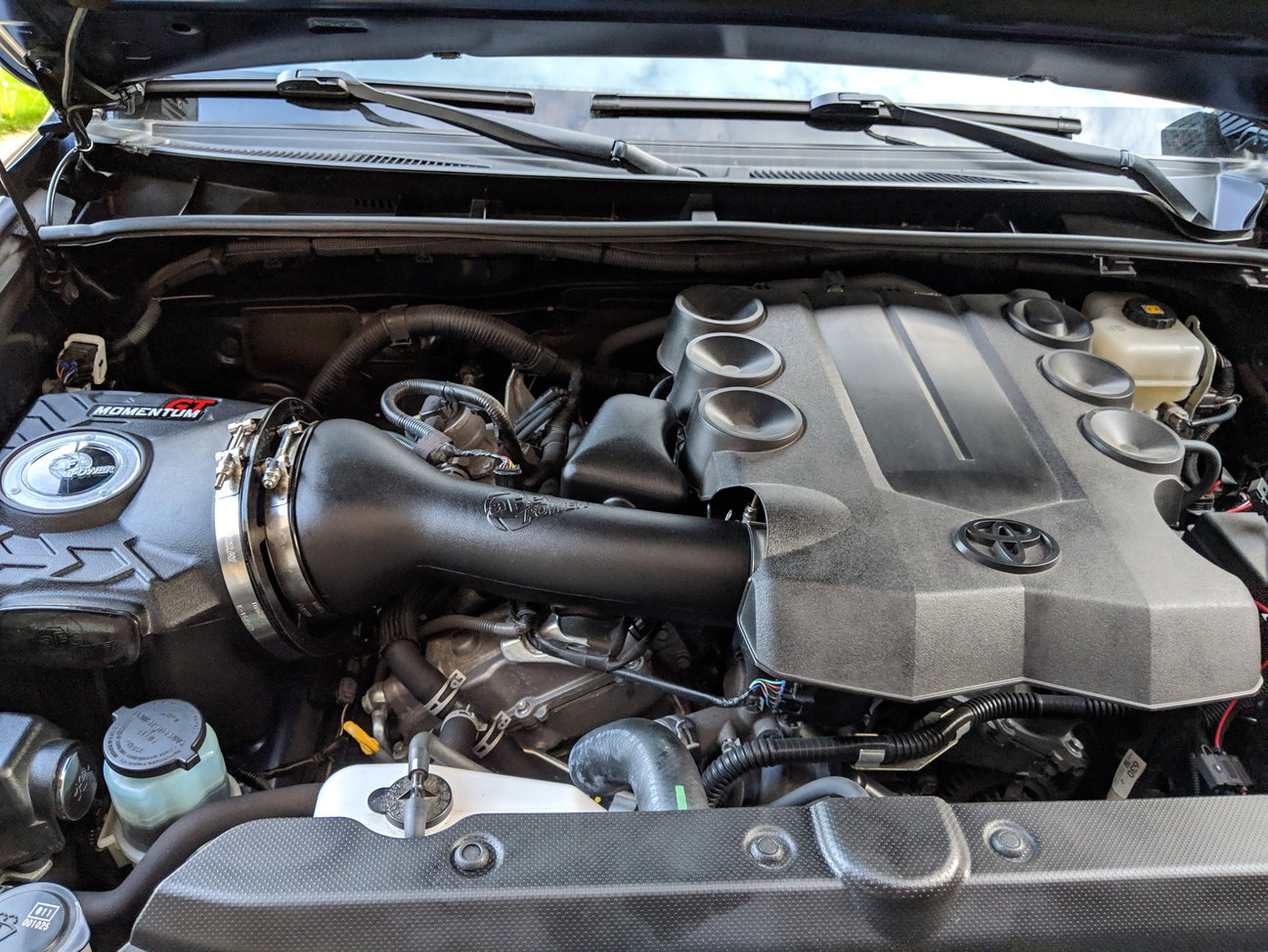
New aFe Momentum GT Intake

love the CAI, I installed mine a few weeks ago and appreciate the added throttle feel, engine noise and added torque.
 
Been looking at these intakes for a while, it's been about 6 months just curious to hear how you guys are liking these still.
 
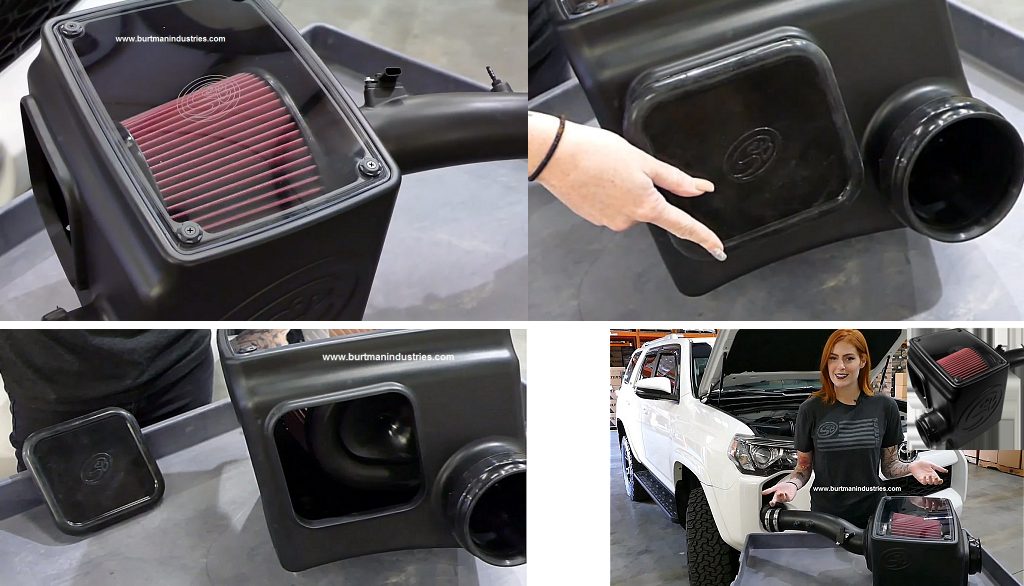
I have a brand new intake by S&B that's awesome. Fits all 5th gens:

pdp_75-5115_1_960x960.png


New S&B intake at Burtman Industries, order link, etc - install video shown here as well.

sb_4runner_5th_gen.jpg


I will also do a lower price for the first few that call their orders in. 717-319-2100

Also, see here for the airflow results that are very detailed:

https://drive.google.com/file/d/1sgG_5sXfLeCbbLiVr2btplviX4Uj_Eqm/view?usp=sharing
 
Been looking at these intakes for a while, it's been about 6 months just curious to hear how you guys are liking these still.

Still doing great.

Was driving coworkers back from lunch last week. Had to stomp on the gas. This makes the intake get real loud. Everyone was like "what was that?!" and "That does not sound like we are going to soccer practice."

So 2 things:
1) My coworkers are *******s
2) Turns our the 4Runner can sound real angry when it needs to.
 
Still doing great.

Was driving coworkers back from lunch last week. Had to stomp on the gas. This makes the intake get real loud. Everyone was like "what was that?!" and "That does not sound like we are going to soccer practice."

So 2 things:
1) My coworkers are *******s
2) Turns our the 4Runner can sound real angry when it needs to.

Thanks for the response, I watched your install video this morning. Loved the before and after comparisons.
 
Got mine installed this past weekend, I paired mine with the AFE Throttle Body Spacer and TRD Air Accelerator in the fender to resolve the finger wide gap that others have complained about.

img_20190502_174754_b1d343235a85ef9f82842612e684ded20e039e68.jpg


img_20190502_175442_d112b85142527b0739f4e3ec0c5752a9beb5bdee.jpg


img_20190502_181431_0c09ae2415704f70c6bdd456d2717afd12cc75ad.jpg


Having already had the TRD Air Accelerator from the TRD CAI, I had always wondered if it would fit in accordance with the AFE, after a quick test fit I was convinced that I could use it.

img_20190502_183712_98445cf1f34745414f8836773a3032b539f528ca.jpg


So I reinstalled it in the fender

img_20190502_183746_c22e52ee6c7fc9ad0e6edbaa1a240ccdecd9367d.jpg


Here you can see it inside the AFE gasket

img_20190502_183613_81d8a4a992cfdaf4c807134d72ef9de3d0587bf0.jpg


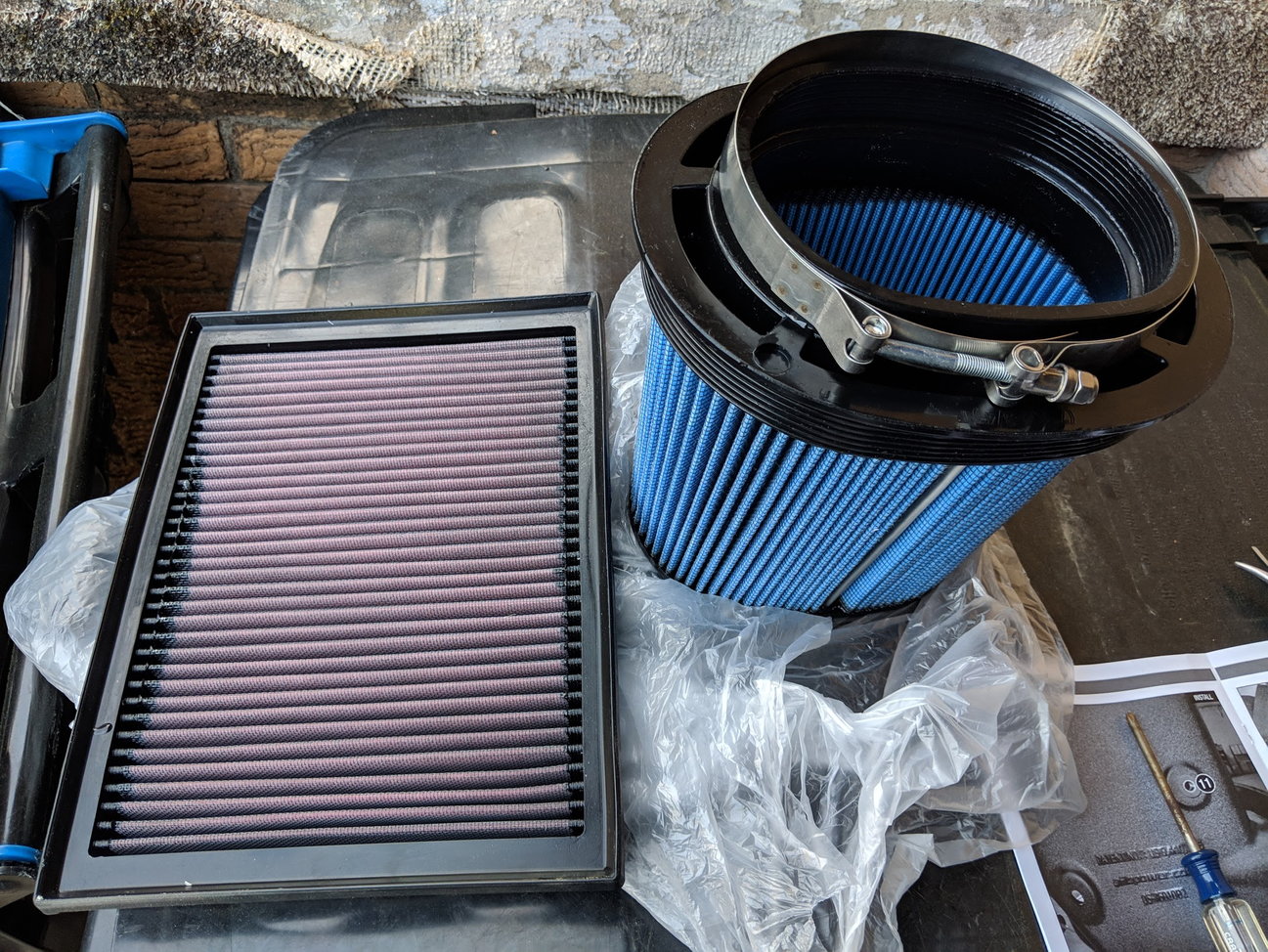
Here's a side by side of my drop in K&N filter next to the AFE Pro Oiled filter

img_20190502_190227_2eec4202e2d80dba83a1493a70068cfcf0606d15.jpg


Install was super easy

img_20190502_193151_0d4cf96701e5f279c0390b6ecc3410c14ee653bf.jpg


img_20190502_193609_71ee93f54f5f82eee318c6c84a5b9dbcd76b3ab7.jpg


Overall I'm very happy with the intake, I'm glad that I was able to modify it with the TRD piece to pull air more directly from the fenderwell instead of the engine bay. Very happy with the increased throttle response and get up and go that the truck has, not to mention the nice growl when I step on it :biggrin1:
 
Blackstone proves it!

Also worth mentioning these higher flow intakes often don't block as much dirt/silica from reaching the insides of the engines.

Just an FYI...

Recently got back oil analysis results from my latest oil change on my Ford diesel that I sent to Blackstone. With a K&N oiled filter/charger it showed a definite increase in silica. I also have a Tundra that I use a dry AFE filter and no such increase was shown when I got those results back.

I won't be using an oiled filter on my new T4R.
 
Just an FYI...

Recently got back oil analysis results from my latest oil change on my Ford diesel that I sent to Blackstone. With a K&N oiled filter/charger it showed a definite increase in silica. I also have a Tundra that I use a dry AFE filter and no such increase was shown when I got those results back.

I won't be using an oiled filter on my new T4R.

I think it's been pretty well settled by lab tests that oiled air filters suck at filtering air. And they only handle about half as much dust before losing air flow as compared to typical pleated paper filters. People still buy them. Placebo effect is strong. What's really funny to me is the testing showing huge air flow gains at 600cfm. That's over 10,000 rpms in a 4 liter engine. If you can figure out how to get a 1GR to spin past 10,000 rpms - I'm really curious about it!
 
Last edited:
See these cool test results on the S&B intake I sell. I think this is pretty neat. Some more pics here: S&B intake at Burtman Industries, order link, etc - install video shown here as well.

75-5115 Test Results.pdf - Google Drive

The summary doesn't match the test data.

The test efficiency sheet for the OEM filter says efficiency is 99.94%. Your summary page 2 charge says 99.40%. 99.94 =/= 99.40. The filtering efficiency rate for an OEM paper filter at 99.94% is a LOT better than either the oil based or aftermarket paper filters. They're not really even close. 12 times as much dust passes the oil filter and 5 times as much dust passes through the aftermarket paper filter.

You should correct the summary to match the test data. It's misleading.
 
Last edited:
See these cool test results on the S&B intake I sell. 75-5115 Test Results.pdf - Google Drive

A Lesson on CAI
Science and Math Warning!

4.0L engine, displacement measured bore x stroke x cylinders
So to get the total displacement the engine must complete a combustion cycle for each cylinder, that's 2 full rotations of the crank on a 4 cycle engine.
Say you're an aggressive driver and occasionally your truck actually sees the redline, 6000rpm, but most of the time you're only get to about 3000rpm during acceleration.
4.0 L = 0.141259 CuFt / 2 crank rotations = 0.0706295 CuFt/rpm x 6000 rev = 423.777 CFM
At redline your engine can only consume 423.777 CFM under ideal conditions, 1/2 that at normal cruise (211.8885 CFM). Anything above the redline value on the charts is irrelevant as your engine can't pull more CFM unless you've added forced induction (supercharger or turbo).

The charts show that to get this CFM the engine has to pull a ~15" H2O vacuum on the stock intake at redline. Looking at the S&B intake chart, to pull the same CFM only requires about half of that. So theoretically the engine has to work only half as hard to draw the air required to run at redline with this intake at redline. Drop it down to normal acceleration and cruise, <3000rpm, and the difference is much less significant.

If we look only where the required vacuum starts to separate between the stock intake and the S&B:
(est) 150 CFM / .0706295 cuft/rpm = 2123 rpm. So with this intake you really don't see any performance improvement until you're above 2100 rpm. Most of us will drive our trucks above that rpm, how much time we spend above that is highly dependent upon driver.

What you will realistically see after installing this intake, above 2100rpm the engine will accelerate and increase rpm more quickly than with the stock intake. Keep in mind this is all assumed ideal conditions, no loss for dirty filters, high humidity, high altitude, or any other number of factors which affect air density and fluid dynamics. Does this mean you shouldn't get a CAI, that's still up to you.

Realistically the full potential of an intake cannot be realized unless the computer which controls timing and air/fuel ratio is aware of the additional intake. That means either getting a tune or black box to adjust the input from the MAF sensor. URD's MAF Calibrator does exactly that, which means the computer knows it is getting more air, adjusts the fuel mixture for it, and you can realize the full potential of the performance increase available with changing your intake. Without a tune or black box, your engine will eventually adjust the fuel/air ratio, however, this will take time, and it will not be as efficient as a tune or black box.
 
Last edited:
The summary doesn't match the test data.

The test efficiency sheet for the OEM filter says efficiency is 99.94%. Your summary page 2 charge says 99.40%. 99.94 =/= 99.40. The filtering efficiency rate for an OEM paper filter at 99.94% is a LOT better than either the oil based or aftermarket paper filters. They're not really even close. 12 times as much dust passes the oil filter and 5 times as much dust passes through the aftermarket paper filter.

You should correct the summary to match the test data. It's misleading.

It's wasn't me that did the testing :)

You are correct, there was a transposed number on the summary portion of the test results but the numbers displayed on the website are accurate.

Sometimes the stock filter is a bit more efficient than S&B's cotton filter; however, an efficiency rate of 99.26% using ISO Coarse Dust is still a very good efficiency number especially given that S&B's intake improves the airflow over stock by 43.47%. That is a huge number. S&B makes filters for GM Parts and Service and their efficiency requirements are actually much lower than 99.26% for some vehicle applications. Yes, the stock filter has a very high efficiency rate, but at the expense of airflow. If you want a higher efficiency number for your truck, then just buy S&B's intake with a dry filter. This filter offers a 99.69% efficiency rate and still provides a 42.99% improvement in airflow
 
It's wasn't me that did the testing :)

You are correct, there was a transposed number on the summary portion of the test results but the numbers displayed on the website are accurate.

Sometimes the stock filter is a bit more efficient than S&B's cotton filter; however, an efficiency rate of 99.26% using ISO Coarse Dust is still a very good efficiency number especially given that S&B's intake improves the airflow over stock by 43.47%. That is a huge number. S&B makes filters for GM Parts and Service and their efficiency requirements are actually much lower than 99.26% for some vehicle applications. Yes, the stock filter has a very high efficiency rate, but at the expense of airflow. If you want a higher efficiency number for your truck, then just buy S&B's intake with a dry filter. This filter offers a 99.69% efficiency rate and still provides a 42.99% improvement in airflow

The testing was probably fine. The summary of the testing is not accurate. S&B should fix it. 99.69% is still not very good. More than 5 times as much dust passes than the OEM filter. Meaning the engine will pass through more dust in 50k miles with the S&B paper filter than the OEM filter over 250k miles. To me - that's not a very good result.

Also - the charts show more data points than the tables accompanying them. The OEM paper filter performs significantly better (more air flow and better filtration) as the dust level increases. That's obvious in the chart, but kinda hard to compare given that the values used to create the chart are not all included in the tables. I think the data pretty directly shows that if you're going to play in the dirt - OEM is better all around. If you're looking for quarter mile times - the S&B is probably marginally better.
 
Actually an efficiency rate 99.69% is very good. It is only .25% less efficient than the stock filter while providing 42.99% improvement in airflow. The majority of S&B's competitors don't even have the equipment necessary to provide this type of test results. That being said, if you don't care about airflow, then stock will also do a good job of protecting your engine. You sound like a knowledgeable person. I just wanted to let you know that not all cotton or filters for that matter are created equally. S&B has a great reputation for providing great airflow vs stock while still protecting your engine. Let me know if you have any other questions.

I sell the Afe too and have sold pretty much all brand intakes over the years. I just really like the S&B as it's all made in house in the usa and I also think it's gives the most for the price compared to the other options out there.
 
Actually an efficiency rate 99.69% is very good. It is only .25% less efficient than the stock filter while providing 42.99% improvement in airflow. The majority of S&B's competitors don't even have the equipment necessary to provide this type of test results. That being said, if you don't care about airflow, then stock will also do a good job of protecting your engine. You sound like a knowledgeable person. I just wanted to let you know that not all cotton or filters for that matter are created equally. S&B has a great reputation for providing great airflow vs stock while still protecting your engine. Let me know if you have any other questions.

I sell the Afe too and have sold pretty much all brand intakes over the years. I just really like the S&B as it's all made in house in the usa and I also think it's gives the most for the price compared to the other options out there.

It's semantics, but 0.25% less efficient when comparing to nearly 100% efficiency of most OEM filters is not really descriptive of the difference. The relative efficiencies should be compared to the goal of 100% - meaning; the S&B allows 500% more dust to pass. If the goal were 50% efficiency, calling it a 0.25% difference would be a fair representation. In this case - it's not.

Claiming that the two are similar in protection is not accurate or a fair representation of the data.
 

Members online

Forum statistics

Threads
278,316
Messages
3,554,107
Members
248,016
Latest member
Advally Service

Trending content

Back
Top