Normal Fuel trim readings?

jross20

New member
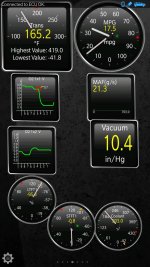
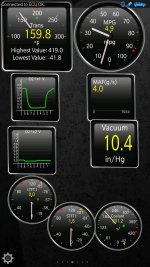
So, my short term fuel trim always pegs at +80-90% during normal acceleration. This seems absurdly high to me, but I came from a 2011 Tacoma v6, so maybe what I think is normal isn't normal for the 5vz? (The taco never went above +/-2%)

What do you guys see typically? Also note, no codes other than nonsense ones that mean nothing.

Acceleration is sometimes sluggish, and other times it's absurdly awesome (like, super fast). This is with the same about of throttle (roughly). I thought it was the rear brakes, but that's fixed now and the fast/slow acceleration is still here. I'm trying to solve the acceleration issue which is why I'm looking at fuel trims.

If this trim is out of line, what do I need to do to fix it?

Vehicle:
2000 4Runner SR5 4x4, v6, auto.
 
Register to hide this ad
What I read somewhere was that ideally the combination of long term trim and short term trim should be under 20, ideally as low as possible.

Up until recently (when it appears my OBD reader pooped the sheets) I would monitor both all the time, using Torque on my Android HU. Typically my LT was between ~0 & +3, with the ST ranging up to +6 and down to -6. That's for day to day driving, traffic, etc. Didn't pay attention to any WOT readings. I also have a MAF gauge up and watch it to see that it is generally in the right place.

Double check (and clean) your MAF, that has a lot to do with where it thinks the trim should be. Vacuum leaks will also throw it off a lot (more air getting in than it's thinking so it over adjusts the fuel trims to compensate.
 
Last edited:
Regularly more than about 5% on any of the fuel trims would start to be cause for concern on a stock motor. The 20% max number is just that - the max that can be applied to long term fuel trim.

-Charlie
 
Service manual says +-0 to +-20% is within spec. And IIRC it's +- 35 when you add them together together and shouldn't trigger a light.

You should be throwing a code at that point. Not entirely sure how you can say it's non sense. Lol maybe those codes are actually important.

No maintenance history and is it Cali spec or federal spec? Can't really help you find the issue other than Righfully telling you, yes you have a problem with your engine and a good cause for concern
 
Last edited:
The STFT is the decimal point of the fuel trims. The LTFT is the whole number.

LTFT.STFT

Every time the STFT maxes out either positive or negative. It subtracts or adds 1 to the LTFT.

Watching your air fuel ratio when it has sluggish acceleration would be better. The LTFT might change. However, the only time the fuel trims change is because of the change in the actual Air Fuel ratio compared to the desired Air Fuel ratio and pcm is adjusting the fuel trims to get the AF back where it belongs.

Since you are being directed to clean your MAF sensor. Also Make sure your TPS is good.

How old is your pre-cat O2 sensor? It’s worth changing it first if it’s old, has more than 100k miles on it, or it’s not a Denso or NTK sensor.


Sent from my iPhone using Tapatalk
 
Thanks for the replies guys. I will try to get some graph readings on the drive home tonight.

The MAF was cleaned, but maybe I should replace it? 19 years old I presume. As for the 02 sensors (pre/post), they are factory as far as I am aware. So also 19 years old, I was thinking about swapping them since they aren't that much. She has 126k miles now.

As far as the nonsense codes, I'll need to pull them again as I don't remember them. But I think one was like ROR. No check engine lights, etc.
 
Thanks for the replies guys. I will try to get some graph readings on the drive home tonight.


The MAF was cleaned, but maybe I should replace it? 19 years old I presume. As for the 02 sensors (pre/post), they are factory as far as I am aware. So also 19 years old, I was thinking about swapping them since they aren't that much. She has 126k miles now.


As far as the nonsense codes, I'll need to pull them again as I don't remember them. But I think one was like ROR. No check engine lights, etc.


First thing I would do is change the pre-cat O2 sensor. It may be a bugger depending on location and rust.


Sent from my iPhone using Tapatalk
 
First thing I would do is change the pre-cat O2 sensor. It may be a bugger depending on location and rust.


Sent from my iPhone using Tapatalk

Okay sounds good. Is there a different part number for the front and rear? Pre/post cat.

Also, I did a mega short test when I went to lunch. I'm a dumb dumb, the long term trim is jumping to +/- 80-90%, not the short. The short term still jumps around but not as bad.

Is this still a cause of concern? I would really like to get the power back haha
 
Okay sounds good. Is there a different part number for the front and rear? Pre/post cat.

Vehicle dependent, and I don't mean 4runner vs avalon vs hummer. I mean there are about 8 different variations of the 3rd gen 4runner.

YouTube

Watch the video, read the notes, make 100% certain about the CA vs Fed emissions (it's a sticker on the hood), buy the part(s) your specific vehicle needs.

For MY 1999, Fed emissions, 5vzfe auto 4runner, it was the same part number front and rear.
 
Okay sounds good. Is there a different part number for the front and rear? Pre/post cat.

Also, I did a mega short test when I went to lunch. I'm a dumb dumb, the long term trim is jumping to +/- 80-90%, not the short. The short term still jumps around but not as bad.

Is this still a cause of concern? I would really like to get the power back haha

Are you sure that's not 8-9%? The ECU doesn't have the capacity to increase fuel trims 80%. It maxes out way before then. I think your code reader or whatever is being used isn't reading the data right.
 
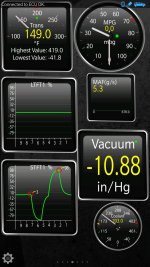
Capturing some more shots when I can safely, and now here is one at idle with the engine warmed up.
 

Attachments

  • Screenshot_20190917-191912.jpg
    Screenshot_20190917-191912.jpg
    135.3 KB · Views: 7,390
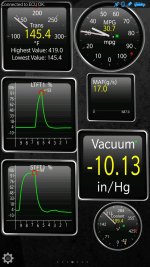
Okay both do hit what seem like wild numbers.
 

Attachments

  • Screenshot_20190917-192500.jpg
    Screenshot_20190917-192500.jpg
    134.6 KB · Views: 7,409
Can you just use the gauge instead of the graph? If so does it act the same?

What are the lower numbers? It that a 10 second graph?

Can you put TPS in there? And B1S1 O2 sensor voltage.

Anything above around 15% or below -15% should code for too rich or too lean.


Sent from my iPhone using Tapatalk
 
Yeah, if you could change it to a gauge. Maybe the graph is showing a percentage of max, not the actual reading. Your cruising fuel trims look normal at 45 MPH.

Your engine runs a bit hot, but maybe that's just a fluke thing or was during stop and go driving?
 
Can you just use the gauge instead of the graph? If so does it act the same?

What are the lower numbers? It that a 10 second graph?

Can you put TPS in there? And B1S1 O2 sensor voltage.

Anything above around 15% or below -15% should code for too rich or too lean.


Sent from my iPhone using Tapatalk

I'm not sure, it was the default. I'll change them to gauges and test tomorrow. Sorry I've never monitored fuel trim before, haha.

Yeah, if you could change it to a gauge. Maybe the graph is showing a percentage of max, not the actual reading. Your cruising fuel trims look normal at 45 MPH.

Your engine runs a bit hot, but maybe that's just a fluke thing or was during stop and go driving?

Yeah someone had mentioned that, the heat. She usually will top out around 203-205 on non-stop drives. Never seen her go over that even in traffic. I guess I need to get a new thermostat.

I'll swap to gauges in the morning and post some tests!
 
Last edited:
Yeah someone had mentioned that, the heat. She usually will top out around 203-205 on non-stop drives. Never seen her go over that even in traffic. I guess I need to get a new thermostat.
The same thermostat installed correctly (jiggle valve down) will probably get the temps rock solid at 190*F +/- about 3*F. If you do replace it, get an OEM thermostat, they are MUCH more reliable.

Based on those screenshots, I almost think your OBD reader is just getting bunk data points. The trims, when not spiking, are perfectly fine.

-Charlie
 
The same thermostat installed correctly (jiggle valve down) will probably get the temps rock solid at 190*F +/- about 3*F. If you do replace it, get an OEM thermostat, they are MUCH more reliable.

Based on those screenshots, I almost think your OBD reader is just getting bunk data points. The trims, when not spiking, are perfectly fine.

-Charlie

Oh I only get Japanese parts for my Japanese girl, (except for aftermarket suspension stuff).

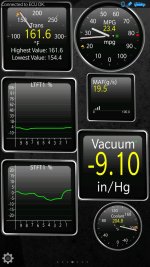
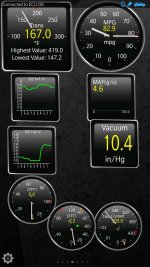
Here are some new screen shots. If the trim is fine... Do we have any other ideas about the random loss of power?
 

Attachments

  • Screenshot_20190918-094439.jpg
    Screenshot_20190918-094439.jpg
    134.3 KB · Views: 879
  • Screenshot_20190918-094502.jpg
    Screenshot_20190918-094502.jpg
    134.8 KB · Views: 867
Other than Torque or your reader is giving you bogus values (engine temp of ~430 degrees?!?) nothing is out of the ordinary there. It's probably a sensor that's gone bad. If you can get a hold of the factory service manual that floats around here in digital form there are test procedures for each major sensor that controls fuel or timing such as the MAF, O2 sensors, and TPS. That's where I would start.
 

Members online

Forum statistics

Threads
278,309
Messages
3,554,070
Members
248,016
Latest member
Advally Service

Trending content

Back
Top