OILs: comparing synthetic vs conventional

Register to hide this ad
Wow. So the biggest thing I got from this video is apparently you're supposed to change your synthetic at the same interval as you would your conventional. I would tend to disagree with this, but I'm not the scientist. Not to mention if you're putting that type of money into your oil changes, you must be the type of person that plans on keeping your vehicle forever.

Personally I've used both types of oils in my past vehicles, and I always used 3k for my conventional changes, and 5-7k for my synthetic changes.
 
Wow. So the biggest thing I got from this video is apparently you're supposed to change your synthetic at the same interval as you would your conventional.

Run the same change interval when switching over to a synthetic unless you take an oil sample to prove the oil can go longer. Otherwise you are just guessing. Every engine wears out oil differently which is why it's hard to give a blanket statement on how much longer a synthetic can be extended by. Another thing to keep in mind is just because the oil can handle an extended interval, it doesn't necessarily mean the filter can too.
 
Run the same change interval when switching over to a synthetic unless you take an oil sample to prove the oil can go longer. Otherwise you are just guessing. Every engine wears out oil differently which is why it's hard to give a blanket statement on how much longer a synthetic can be extended by. Another thing to keep in mind is just because the oil can handle an extended interval, it doesn't necessarily mean the filter can too.

I agree about the filter. I think a lot of people overlook or just dismiss the filter. I have noticed that my oil will stay clean looking right up to about 5—7,000 miles and then it turns dark. It's not a gradual darkening of the oil like one might assume as the oil used more — it's almost like a switch is flipped and the oil turns.

My only thoughts on why this is is that it's the oil filter reaching its capacity to filter effectively and all the crap starts to bypass the filter and murk up the oil. Now I avoid this and change the oil/filter before it turns.

I have made the switch to Quaker State Ultimate Durability full synthetic 5w20 with a D3 filter every 5,000 miles now. I have no plans to extend the OCI either.

My father in-law bought a late 90s Dodge Dakota pickup not long ago. I pulled the dipstick on it and the oil looked like black gelatinous ink.

Not surprisingly, the engine died the same day he bought it and it has been in the shop ever since. I don't know what he was thinking buying a truck that had oil that looked as if it had gone 25,000 miles.

I'm a firm believer these days of changing oil on time and using the best oil & filter you can afford.

And for those who are afraid of full synthetic oil in a high mileage engine, I have over 400k on my engine — and my truck loves full synthetic.

 
Last edited:
Run the same change interval when switching over to a synthetic unless you take an oil sample to prove the oil can go longer. Otherwise you are just guessing. Every engine wears out oil differently which is why it's hard to give a blanket statement on how much longer a synthetic can be extended by. Another thing to keep in mind is just because the oil can handle an extended interval, it doesn't necessarily mean the filter can too.
I used Amsoil on my past truck, and used an Amsoil filter too. I've also tried Mobil 1 but liked Amsoil better. It would go 7k or more before turning color, whereas conventional darkens up much quicker.

Honestly I can't justify using synthetic at the same intervals as conventional, although once my free Toyota maintenance runs out, I may switch to synthetic and test a sample.

Then again, oil longevity also depends on how you use your vehicle.
 
Last edited:
I once bought a 91 Toyota 4WD truck that had oil that could have been used as black paint.
Changed it immediately, and the new oil immediately turned into black paint.
Changed it again in about 500 miles, and the new oil immediately darkened.
Engine ran fine until it developed piston slap about 20K miles later.
I got my 97 4Runner with 120K miles on it, and it appeared to be reasonably well taken care of.
Ran Group 3 ("fake") synthetic (Valvoline Synpower, I think) for exactly 3K miles, and took a sample, and sent it for UOA. Results: the oil was, for all practical purposes, as good as new. None of the measurements showed any significant decline from new oil.
Therefore, I settled on 5K oil/filter change interval, which probably still allows me a couple thousand miles slop factor in case work gets busy and I can't make the 5K interval.
Oh, and at 5K miles the oil is dark, but you can still see light through it when it drains.
 
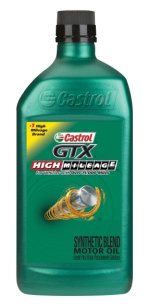
I've been using Castrol GTX High Mileage Partial Synthetic Motor Oil for years.
GTX High Mileage Part Synthetic Engine Oil | Semi Synthetic Oil, Semi Synthetic Motor Oil | Motor Oil, Engine Oil | Castrol - Motor Oil, Engine Oils, Full Synthetic Oil, Transmission Fluid and Lubricants

Castrol.jpg

Seems to be a good motor oil but I have no way to know if it's any better than anything else. It looked like a good choice for what was available at the local auto parts store and I've stuck with it since my Subaru is still going strong at 324,000 miles and I started using the Castrol GTX at around 100,000 miles.

I know the old school suggested oil and filter change frequency of every 3000 miles is considered overkill, but I still change it every 3000 miles. We're not talking a huge amount of money to do it this frequently and it's my belief the single best thing you can do to extend the life of your vehicle is regular fluid changes.

Oh, and I stick with the OEM filters from Toyota. A mechanic friend of mine told me around 35 years ago to always buy the OEM filters from the dealer and I've followed that advice for the vehicles I've owned over the years.
 

Attachments

  • Castrol.jpg
    Castrol.jpg
    92.6 KB · Views: 1,463
Last edited:
Over the past few years i have put up to 70k miles on a vehicle in a single year. Whether it was a subaru, mazda turbo, camry, odyssey, or my 4runner i always make the switch to synthetic. And change anywhere from 4-6k sometimes i go longer when out of town but always a new filter if going over 6k.

To everyone who buy their synthetic oil: i have found mobile 1 cheapest at walmart. I will never put a fram filter in a vehicle i touch or work on, but any quality filter will do.
 
the more expensive fram filters are built better with a steel core and end caps, but the base filter is crap with cardboard ends and collapsing filters.

personally, I like the Purolator filters. even the classic filter is built well and cleans better than most. used to be able to buy them at wally world for $3 but they just stopped carrying them. now they cost me $4.50 at advance auto parts.
 
I agree about the filter. I think a lot of people overlook or just dismiss the filter. I have noticed that my oil will stay clean looking right up to about 5—7,000 miles and then it turns dark. It's not a gradual darkening of the oil like one might assume as the oil used more — it's almost like a switch is flipped and the oil turns.

My only thoughts on why this is is that it's the oil filter reaching its capacity to filter effectively and all the crap starts to bypass the filter and murk up the oil. Now I avoid this and change the oil/filter before it turns.

I have made the switch to Quaker State Ultimate Durability full synthetic 5w20 with a D3 filter every 5,000 miles now. I have no plans to extend the OCI either.

My father in-law bought a late 90s Dodge Dakota pickup not long ago. I pulled the dipstick on it and the oil looked like black gelatinous ink.

Not surprisingly, the engine died the same day he bought it and it has been in the shop ever since. I don't know what he was thinking buying a truck that had oil that looked as if it had gone 25,000 miles.

I'm a firm believer these days of changing oil on time and using the best oil & filter you can afford.

And for those who are afraid of full synthetic oil in a high mileage engine, I have over 400k on my engine — and my truck loves full synthetic.

I know that any synthetic v conventional thread can easily get out of hand, so I'm asking this purely for curiosity's sake; did you switch it to synthetic when you bought your rig (around 380k, right?) or was it synthetic the entire time (to your knowledge)?
If I'm not mistaken, I think that the concern is not synthetic itself, but switching at a higher mileage and revealing pre-existing leaks that the dino oil was 'sealing'.
 
I would rather top off my oil now and then than to push dead oil through the internals. The gaskets are cheap, the engine is expensive. My IS300 leaks from the cam seals with 180,000 miles on them. I just place some cardboard under the engine in the garage to catch the drips.
 
I know that any synthetic v conventional thread can easily get out of hand, so I'm asking this purely for curiosity's sake; did you switch it to synthetic when you bought your rig (around 380k, right?) or was it synthetic the entire time (to your knowledge)?
If I'm not mistaken, I think that the concern is not synthetic itself, but switching at a higher mileage and revealing pre-existing leaks that the dino oil was 'sealing'.

I got my truck around 350,000 miles. Oil changes were were infrequent at best and always done at whatever cheap place they could find. I was the first to introduce synthetic to it.

At first I figured conventional got it this far so why change? I also worried about switching over to synthetic because people talk about that being a problem. But I finally realized that synthetic was just way better oil and worth trying.

I started with Valvoline Maxlife synthetic blend and the truck liked it just fine. I eventually switched over to full synthetic and have no issues.

Perhaps the switch was made easier by first using the Maxlife synthetic blend which is claimed to have a lot of seal conditioner in it.

My truck uses about a 1/4 of a quart during its 5k oil change interval; most if not nearly all of which is from the leaky valve covers and rear seal. I'm too lazy and cheap to fix that stuff right now. The oil loss is no different than when I ran conventional oil either.

I will say however that with the Valvoline Maxlife synthetic blend, I really didn't lose any oil at all. Must've been all that seal conditioner doing its thing I guess.
 
I agree that people only think about the life of the oil & not the filter.
That's why I stayed with dino oil & Wix filters & change every 3000.
 
Why 5W-20? A bit light don't you think?
Especially for CA?

I agree about the filter. I think a lot of people overlook or just dismiss the filter. I have noticed that my oil will stay clean looking right up to about 5—7,000 miles and then it turns dark. It's not a gradual darkening of the oil like one might assume as the oil used more — it's almost like a switch is flipped and the oil turns.

My only thoughts on why this is is that it's the oil filter reaching its capacity to filter effectively and all the crap starts to bypass the filter and murk up the oil. Now I avoid this and change the oil/filter before it turns.

I have made the switch to Quaker State Ultimate Durability full synthetic 5w20 with a D3 filter every 5,000 miles now. I have no plans to extend the OCI either.

My father in-law bought a late 90s Dodge Dakota pickup not long ago. I pulled the dipstick on it and the oil looked like black gelatinous ink.

Not surprisingly, the engine died the same day he bought it and it has been in the shop ever since. I don't know what he was thinking buying a truck that had oil that looked as if it had gone 25,000 miles.

I'm a firm believer these days of changing oil on time and using the best oil & filter you can afford.

And for those who are afraid of full synthetic oil in a high mileage engine, I have over 400k on my engine — and my truck loves full synthetic.
 
I would rather top off my oil now and then than to push dead oil through the internals. The gaskets are cheap, the engine is expensive. My IS300 leaks from the cam seals with 180,000 miles on them. I just place some cardboard under the engine in the garage to catch the drips.

I completely agree. Priorities, right?

I got my truck around 350,000 miles. Oil changes were were infrequent at best and always done at whatever cheap place they could find. I was the first to introduce synthetic to it.

At first I figured conventional got it this far so why change? I also worried about switching over to synthetic because people talk about that being a problem. But I finally realized that synthetic was just way better oil and worth trying.

I started with Valvoline Maxlife synthetic blend and the truck liked it just fine. I eventually switched over to full synthetic and have no issues.

Perhaps the switch was made easier by first using the Maxlife synthetic blend which is claimed to have a lot of seal conditioner in it.

My truck uses about a 1/4 of a quart during its 5k oil change interval; most if not nearly all of which is from the leaky valve covers and rear seal. I'm too lazy and cheap to fix that stuff right now. The oil loss is no different than when I ran conventional oil either.

I will say however that with the Valvoline Maxlife synthetic blend, I really didn't lose any oil at all. Must've been all that seal conditioner doing its thing I guess.

Ah that makes sense. And OK so you've had 50k+ with no issues so far. That's good to know. I use MaxLife too since I bought mine 19k ago with no problems yet so that's good. I would assume that if dino oil was 'sealing' leaks, the negative affects would start to show themselves in other areas with age. Better to find out and fix than remain in the dark and potentially shorten the life of your engine.
 
I got my truck around 350,000 miles. Oil changes were were infrequent at best and always done at whatever cheap place they could find. I was the first to introduce synthetic to it.

At first I figured conventional got it this far so why change? I also worried about switching over to synthetic because people talk about that being a problem. But I finally realized that synthetic was just way better oil and worth trying.

I started with Valvoline Maxlife synthetic blend and the truck liked it just fine. I eventually switched over to full synthetic and have no issues.

Perhaps the switch was made easier by first using the Maxlife synthetic blend which is claimed to have a lot of seal conditioner in it.

My truck uses about a 1/4 of a quart during its 5k oil change interval; most if not nearly all of which is from the leaky valve covers and rear seal. I'm too lazy and cheap to fix that stuff right now. The oil loss is no different than when I ran conventional oil either.

I will say however that with the Valvoline Maxlife synthetic blend, I really didn't lose any oil at all. Must've been all that seal conditioner doing its thing I guess.

Just tighten the valve cover bolts a half a turn & they should stop leaking. The torque specs are so low on those I bet they vibrate loose. It worked for me.
 
Last edited:
Just tighten the valve cover bolts a half a turn & they should stop leaking. The torque specs are so low on those I bet they vibrate loose. It worked for me.

I was noticing a pretty substantial leak on mine, and having read this on here I put a socket on them just to see, and sure enough they were just barely finger tight. I'll give a few weeks and see if it dries up, and if not I guess I'll start planning to do them.
 
I was noticing a pretty substantial leak on mine, and having read this on here I put a socket on them just to see, and sure enough they were just barely finger tight. I'll give a few weeks and see if it dries up, and if not I guess I'll start planning to do them.

I planned on doing the gasket too if it didn't work. Then I was like what the hell might as well get the valve cover powder coated too! I saved a lot of money & time just by turning a socket. Clean the area with some degreaser & see if it gets wet again.
 
Back in 2000 I bought a '95 celica GT 5speed with 34,000 on the odo and proceeded to give it Pennzoil 10w30 and cheapo from filters (didn't know better) every 3000 miles. Sold it last fall with 186,000 and it still ran great. It never burned or leaked oil except from the valve covers. It was the 5sfe 4 cylinder. My guess is it's most important to have regular changes than what type of oil or filter going in.
 
Just tighten the valve cover bolts a half a turn & they should stop leaking. The torque specs are so low on those I bet they vibrate loose. It worked for me.

I do see a flaw with this method because you can't get to all the bolts easily. On the driver side, the plenums are in the way for the bolts on the upper part of the valve cover. On the passenger side, the throttle body get's in the way of removing the wiring loom which blocks the upper bolts on that side. So, at the very least, the plenums and throttle body have to come off.

In order to tighten the bolts evenly, which you really should be trying to do, you still have to remove parts off the engine. So, why not just keep going and remove the valve covers and get the leak stopped the first time around. There's a very good chance part or all of the leaking could be coming from the half moons or cam plugs and tightening the bolts isn't going to do anything for a leak coming from those areas.

Timmy the Toolman's two cents.
 
Last edited:

Members online

Forum statistics

Threads
278,309
Messages
3,554,071
Members
248,016
Latest member
Advally Service

Trending content

Back
Top