Onboard air removable wiring setup?

Racehoss

New member
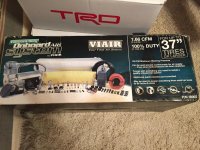
I have one of these Viair onboard air systems. I don't want to permanently mount it because I switch from vehicle to my wife's rig. I need help figuring out how to make it a plug in system to the 12v plug in the back of our 5th gens. I was going to mount the whole system on a plastic cutting board so I can just switch it between vehicles. I Live in Austin Texas and I'm clueless when it comes to electrical. Are those 12v cigarette plugs powerful enough to run this? It powers my arb fridge just fine image.jpg
 

Attachments

  • image.jpg
    image.jpg
    139.7 KB · Views: 1,514
Last edited:
Register to hide this ad
just entered into a chat regarding this .....

Chat transcript


Nick Decasas Tue, 06/28/16 04:52:29 pm America/Chicago
Hello, how can we assist you today?

Client 04:52:29 pm
Can a VIAIR 10007 system be plugged into a 400 max watt 12V outlet?

Nick Decasas 04:53:56 pm
I don't think it would work, you would need a constance charge of 13.8V

Client 04:54:28 pm
I understand the vehicle would have to be running.

Nick Decasas 04:54:34 pm
Correct

Client 04:54:56 pm
Do you recommend running the power strait to the battery?

Nick Decasas 04:55:10 pm
Yes, definitely

Client 04:57:02 pm
ok, someone on the forum was asking ...he wanted to make it a portable unit so he could transfer to another vehicle when needed. He would need to run a dedicated circuit within specs to supply enough power to the VIAIR 10007, correct???
Toyota4runner.org forums...

Nick Decasas 04:57:46 pm
In that case, why won't he go with one of our portable units such as the 450P? We don't suggest using our C models as a portable option

Client 04:58:40 pm
ok, he already has one, so that's why he is asking.... he has the wrong item for his desired application, correct?

Nick Decasas 04:59:13 pm
Yes, he does

Client 05:00:02 pm
thanks!

Nick Decasas 05:00:12 pm
You're welcome!


Duration: 8m 28s
Chat started on: VIAIR Corporation - Constant Duty Onboard Air System (P/N 10007)

 
I developed a setup for my ARB dual compressor to do just what you're pursuing for the VIAIR.

I recommend installing a quick disconnect of some sort directly to the battery using the appropriate size wire. I used #8 AWG heavy duty welding cable with the type of connectors they use on fork lift chargers. I then put the male plug on the harness for the compressor and welded up a cage with rubber feet for the compressor to ride around in.

20150314_115301-e1467152462767.jpg


20150328_165527-e1467152472455.jpg


20150328_165616-e1467152485513.jpg


20150328_165657-e1467152523445.jpg


You'll need a good wire crimper and some heat shrink to do the job properly. Along with a couple battery lugs large enough for your terminal connection and a quick connect rated for your amperage. If the harness doesn't have any in-line protection, you'll need to add a fuse as well.

What amperage does the the unit draw under full load?

 
Viair makes a kit specifically for this application.

however if you don't want to exchange it, wire it as per the included instructions, then get two of these from your local parts store:
02700343_00.jpeg

connect them as per colour to the compressor wiring, and you should be golden.
I believe this compressor wants a 30A fuse or something ridiculous, so I wouldn't plug it in to the cigarette lighter
 
That was nice of you Saker to go the extra step to answer the OP's question.

I am surprised to see that the cigarette outlet is rated at 400W. Isn't that >30A for a 12V circuit? Also isn't the fuse for that outlet only 15A. Whatever the answer, I would be very cautious about running any high amp device from that outlet. I have seen the wires and they look like 18 gauge to me.

*** EDIT. NM, I see OP and Saker were talking about the AC plug not the cigarette plug. My bad!
 
Last edited:
That was nice of you Saker to go the extra step to answer the OP's question.

I am surprised to see that the cigarette outlet is rated at 400W. Isn't that >30A for a 12V circuit? Also isn't the fuse for that outlet only 15A. Whatever the answer, I would be very cautious about running any high amp device from that outlet. I have seen the wires and they look like 18 gauge to me.

P=V*I*pf
400W=12*I*1 (assuming a resistive device)
I=33.3A


*edit* viair claims a max draw of 23A, but I'd still be wary of plugging into the 12v outlet
 
Last edited:
P=V*I*pf
400W=12*I*1 (assuming a resistive device)
I=33.3A

Yes exactly. Yet they use such a thin gauge wire and only use a 15a fuse, hence my surprise. With a 15A fuse, one would think it should only be rated at 180W.

*** EDIT. NM, I see OP and Saker were talking about the AC plug not the cigarette plug. My bad!
 
Last edited:
the 12 volt outlet (socket)in the back of my t4r is only 120 watts and the 120 volt outlet is 400watts... not nearly enough for my 300P Viair portable compressor.
I was looking at a plug to use the trailer plug. There is suppose to be a power line in that plug with a 40 amp fuse. Any thoughts from the electrical folks?
 
Last edited:
Ok guys, my mistake.
I was thinking of the 120V max wattage when speaking to the rep, not the 12V outlet wattage capability.

The answer is still the same. OP cannot run his VIAIR 10007 by plugging it in the 12V outlet.

He could run heavy wire to the rear to achieve that, or just make it portable and connect to the battery, but I didn't think that was what he was trying to achieve.
 
I like the quick connect idea from the battery. Do I still need the relay in the mix? Again I don't understand this type of electrical. I figure if I supply the compressor with power and put a switch in between I'd be good. Like my house wiring. But sounds like in automotive it needs a relay??? Sorry folks
 
Yes you absolutely need the relay. The little push button switch is not rated to handle the line current of the compressor
 
You have two choice.

1. Sell/return it and get a proper high flow portable. There are several good ones already made to do exactly what you want to do. They will hook up directly to the battery with cables and clamps and will be much more compact. The cig lighter is never going to be enough for something like this. You need good high amp power right off the battery or a distribution block..

2. Educate yourself on DC electrical and build some type of portable mount and hook-up for what you have.

Honestly, option 2 won't be that great unless you make it semi portable and somehow mount it in each vehicle. Otherwise it is just going to be a big awkward contraption to lug around.

I have a Smittybilt 2781 flows 5.6 cfm and fits in a very small bag. $150.. done. I also have an onboard air system in my 5th gen, but the portable is super handy.

As far as a relay goes...
A relay is just a remote controlled switch. As long as your switch and wiring can support the amp draw of the device... there is no need for a relay. The reason most things need a a relay is that the switch in the cab is usually just for control and cannot support high current/amps of the actual device. If the switch is right at the device, there is typically no need for a relay as long as the switch is rated for the amp draw.
 
Last edited:
[MENTION=136669]Racehoss[/MENTION] I read through the online manual and found some diagrams for your unit. It already comes with a relay/pressure switch unit, inline fuse, and a remote gauge and switch panel for your dash.

Untitled-1.png


Untitled1.png


If you decide to build a portable skid for this compressor I would mount the compressor, air tank, inline fuse, and dash switch/gauge all on the same assembly. Simply wire it up as the instructions detail and use either the alligator clips or the quick connect method for your final attachment to the battery. You should have everything you need in the kit for a safe installation (minus the quick connects). Just make sure you mount the inline fuse as close to your connection method as possible, keeping the overall length of the power cord as short as possible.

The trailer plug idea sounds pretty cool but the manual states: "- If it is necessary to mount the air compressor further from the battery, such as inside your vehicle or in the bed of your pickup, use a minimum 8 AWG positive lead wire for remote installation." So I would err towards the safe side and not put your factory harness at risk since it's probably either a 12 or 10 gauge wire. Honestly, you probably wouldn't damage anything since the wires can handle far more than the "rated" ampacity assigned by the NFPA, but you will most certainly get some voltage drop which will hurt performance.

Good luck with your install!

 
Last edited:

Members online

No members online now.

Forum statistics

Threads
278,309
Messages
3,554,071
Members
248,016
Latest member
Advally Service

Trending content

Back
Top