One Hundred Twenty-Five Bucks

Status
Not open for further replies.
Look, Toyota denied the problem existed and refused to do anything about it until a bunch of people sued them and our government jumped in to hold them accountable. And there were actual incidences involving sudden acceleration.

Somebody was greedy. So what. Toyota lied to us, didn't want to do anything about it, tried to cover it up, and now they have to pay for their f-up.
So, how did the prosecution and their expert witnesses, with full access to source code, do at proving anything?

"our government" had just become the largest shareholder in 2/3rds of the domestic auto manufacturers, and saw an easy smear campaign against their largest rival. Good old, Chicago politics at their best.
 
Last edited:
I say no harm, no foul if you keep the money local - head on over to Crave in C. Rock and blow it all on absurd burgers and adult milkshakes.

Young family, another baby on the way - I can't act like I'm not gonna cash the shit outa that check when it comes.

I agree that the lawsuit was bullshit. I don't remember filling anything out as I don't agree with it. Still got my check in the mail. I cashed it because I figure that any funds left over would go to the lawyers.
Whatever you gotta tell yourself.
 
Same here.

Regardless, when you agree to accept payment from a class action settlement, you are also agreeing to have no future claim against the sued entity for the same issue. So, if you accept the $125.00 you have no further recourse against Toyota should you happen to experience the sudden acceleration phenomenon yourself, and/or if you or your loved ones get injured or killed due to a result of such experience. But if you don't accept the money, you can sue Toyota again. For the same thing.

That's not correct.

First, The only way for someone not to be bound by this class action is if they specifically opted out (which is not the same as doing nothing) and the deadline to opt out passed many months ago. Unless you opted out then you are bound by this suit. Accepting the check makes absolutely no difference.

Second, this suit was not about injuries or damage resulting from unintended acceleration. This suit was only about economic losses (i.e., resale value is lower because declining public opinion of Toyota safety). Any claims about actually experiencing unintended acceleration are specifically and explicitly excluded from this action. If anyone does or did experience unintended acceleration, this class action will have absolutely no effect on their ability to bring a claim for that.
 
Settlement notices were mailed to more than 22.6 million potential class members, Steve Berman, co-lead attorney for the plaintiffs, said in an e-mail June 12.

"We have received only 76 objections on behalf of 90 individual objectors," he said. By June 7, the administrator for the settlement had received requests from 1,949 plaintiffs to opt out of the agreement, Berman said.

The proposed settlement includes $200 million in attorneys' fees and $27 million in expenses, according to court papers.

Gee. I wonder why these lawsuits happen. I'm sure it's to protect the public, and not because a bunch of ambulance chasers want to cash in.
 
Yup, this and this. "Oh look, here's a free $125 just for filling out a form".

I got it too. I wasn't harmed in any way so I threw it out. Just don't understand a mindset like OP's.

Me too. Did not think it fair to make Toyota pay me for a problem I don't have.
 
Last edited:
I have a question: What about the responsibility of the drivers? Maybe you guys don't remember driving POS vehicles back in the day but I sure do. I bought a lightly used 1976 Chevy Pickup. A few days after I got it the throttle stuck wide open. I was in traffic but had enough brains to shift it into neutral and turn the key back a click. Yeah the brakes became manual and had to stomp on those but big deal. I never even thought about suing Chevy. In many cases crap like that happened. Was it the manufacturer's fault? Was it the mechanic's fault? Really I didn't give a hoot because I take responsibility for keeping me and my passengers alive if something happens.

Yes, there could be instances where a manufacturing defect could cause me or anyone to crash. The driver's side front airbag going off while driving 70 mph around a curve could do it I suppose. A rod coming through the block and piercing my eye could do it as well. The brakes failing while the steering wheel locked and the accelerator sticking and the doors automatically locking all at the same time could do it too. But unintended acceleration? Holy hell, put it in neutral and hit the brakes. $1.2B for that? We live in entitlement times guys. [MENTION=84557]Eagle[/MENTION] you should be proud of your colleagues lol.

The $125? I could care less if you guys spend it or tear it up. It's not important.

A few links showing how drivers that had even half a brain could not kill themselves in these situations:

How To Deal With Unintended Acceleration - Tech Dept. - Car and Driver
Toyota Recall: Scandal, Media Circus, and Stupid Drivers - Editorial - Car and Driver
It's All Your Fault: The DOT Renders Its Verdict on Toyota's Unintended-Acceleration Scare ? Feature ? Car and Driver

Where's the frigging personal responsibility guys? Jeez. Dumbasses.
 
Last edited:
Whatever you gotta tell yourself.

Originally I was just making a bad joke, but if you want to have this debate, I am more than happy to do so.

Like at least one other commenter noted, $125 is actually a really cheap way for Toyota to stave off potential liability from individuals who might otherwise seek far more costly redress at another point. Those on here who are complaining that these settlements will make Toyota somehow "cheap out" in the future should realize that settlements like this are specifically designed to save the company money when they've admitted fault.

Second, specifically addressing those who say that they "wouldn't take money for a problem you didn't have" - you DID have a problem, regardless of whether you actually experienced UA. Like it or not, the UA fiasco damaged the reputation of Toyota as a company who builds safe, reliable cars and that reputation is part of what makes up the resale value of our rides. $125 is a REALLY conservative estimate of the hit taken to all of those cars resale values. That's actual, tangible damages- loss of value directly attributable to mistakes Toyota made. The way to look at his check, under this theory, is as Toyotas effort to compensate him for that loss of value.

So yes, I stand by my point about blowing the money on burgers and milkshakes with booze in them, or mods for his truck, or toward his kids' college fund, or whatever else makes him happy. You can't draw the circle only big enough to consider impact on one person at a time - that's both inefficient for the company and unfair to others who have, in very real ways, been affected by mistakes made.
 
I have a question: What about the responsibility of the drivers? Maybe you guys don't remember driving POS vehicles back in the day but I sure do. I bought a lightly used 1976 Chevy Pickup. A few days after I got it the throttle stuck wide open. I was in traffic but had enough brains to shift it into neutral and turn the key back a click. Yeah the brakes became manual and had to stomp on those but big deal. I never even thought about suing Chevy. In many cases crap like that happened. Was it the manufacturer's fault? Was it the mechanic's fault? Really I didn't give a hoot because I take responsibility for keeping me and my passengers alive if something happens.

The simple and most logical answer to this is, it's much easier to blame a set of convoluted computer instructions and convince people there's something wrong vs. a sliding steel cable with two ends and a stationary outer sheath.

It's pretty hard to talk circles about a piece of cable and make the case sound convincing--there's only so many parts and factors to blame and pretty much anyone older than the age of 10 would completely understand how it functions.

On the other hand, when it comes to source code, I'm pretty sure not even the programmers know why each and every line of code is in the set; and it's easy to fast talk and gloss over certain things to make other certain things sound more dramatic than it really is. Besides, most lay people would not understand all the syntax and would pretty much just believe the "expert's" opinion.

The real question is, if someone is truly convinced that the manufacturer is at fault, would they really want to take responsibility? ie. if you knew that that throttle cable was built shoddy with an improper outer sheath that causes binding under certain conditions, wouldn't you want to sue them, regardless?

Funny thing is, when there was nothing to blame back in the old days, there did not seem to be a mass hysteria of unintentional acceleration claims. You can draw your own conclusion as to why that is, lol.
 
"We have received only 76 objections on behalf of 90 individual objectors," he said. By June 7, the administrator for the settlement had received requests from 1,949 plaintiffs to opt out of the agreement, Berman said.

From the sounds of this thread most of the people who opted out must be members here :rolleyes:
 
The simple and most logical answer to this is, it's much easier to blame a set of convoluted computer instructions and convince people there's something wrong vs. a sliding steel cable with two ends and a stationary outer sheath.

It's pretty hard to talk circles about a piece of cable and make the case sound convincing--there's only so many parts and factors to blame and pretty much anyone older than the age of 10 would completely understand how it functions.

On the other hand, when it comes to source code, I'm pretty sure not even the programmers know why each and every line of code is in the set; and it's easy to fast talk and gloss over certain things to make other certain things sound more dramatic than it really is. Besides, most lay people would not understand all the syntax and would pretty much just believe the "expert's" opinion.

The real question is, if someone is truly convinced that the manufacturer is at fault, would they really want to take responsibility? ie. if you knew that that throttle cable was built shoddy with an improper outer sheath that causes binding under certain conditions, wouldn't you want to sue them, regardless?

Funny thing is, when there was nothing to blame back in the old days, there did not seem to be a mass hysteria of unintentional acceleration claims. You can draw your own conclusion as to why that is, lol.

I would only sue if I had absolutely, positively no other recourse and I knew with 100% certainty that I was right. Hell, I might not even then because I despise lawyers so much. Not them personally just their ethics and morals or lack thereof. In your weak sauce example above there are many things you can do before suing like selling it or fixing it.
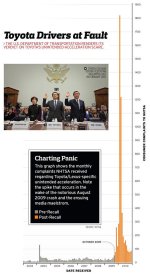
Here. This sums the mentality of most people right here:
 

Attachments

  • its-all-your-fault-toyota-dot-unintended-acceleration-graph-alternate-photo-404624-s-original-ph.jpg
    its-all-your-fault-toyota-dot-unintended-acceleration-graph-alternate-photo-404624-s-original-ph.jpg
    121.2 KB · Views: 206
Last edited:
I would only sue if I had absolutely, positively no other recourse and I knew with 100% certainty that I was right. Hell, I might not even then because I despise lawyers so much. Not them personally just their ethics and morals or lack thereof. In your weak sauce example above there are many things you can do before suing like selling it or fixing it.
Here. This sums the mentality of most people right here:

Nooo...I think you misunderstood me, my point was it's easy to convince people on non-tangible things they don't really understand and can't fully grasp vs trying to convince people about tangible things they can touch and feel and understand the inner workings. If someone is truly convinced that they have been wronged, they'd be much more likely to sue and stick it to the man. That's my point about why there were not many (or maybe none at all??) class action lawsuits of this nature before drive-by-wire throttles became mainstream. There's only so many ways a lawyer can twist and turn the explanation of how a throttle cable functions, lol.

I didn't follow this whole ordeal because I, like you, can't stand that today you can pretty much sue at the drop of a hat; but I think I recall one of the "issues" of Toyota's ECU programming being that there was no built-in override where if you press the brake pedal it cancels the gas pedal input and closes the throttle body. Now, what on earth did we do back in the day when that kind of override was physically not possible due to the mechanical linkages? Somehow we still survived and managed to deal with it :noidea:
 
Last edited:
"our government" had just become the largest shareholder in 2/3rds of the domestic auto manufacturers, and saw an easy smear campaign against their largest rival. Good old, Chicago politics at their best.

Oh Boy....more "it's Obama's fault" fantasy. What's next...the lawyers met in the Oval Office to write their lawsuit? People are using settlement money to pay for Obama Care?

Next up black helicopters drop Seal Team Six into Toyota showrooms to jerry-rig accelerators!

:painkiller::painkiller:
 
Trial lawyers get rich. Manufacturer saves face because class action suits mean you pay out a fraction of what you'd do if people took suits individually.

The law firm doesn't get the right to put my name on a suit so they can give me a fraction of what they're raking in to shake down a big business KNOWING they will settle instead of going to court.

It's what's wrong with this country.

Anyone who has been on the receiving end of one of these shakedown artists, had to sit in for a videotape subpoena, and deal with them across a conference table won't sell out for a few bucks.
 
Last edited:
... and deal with them across a conference table won't sell out for a few bucks.

This reminds me of an episode of Frontline I just watched, "Generation Like" Where they spoke to the 12-24 year old demographic, at the end of the show they brought up "selling out", 98% of the "kids" less than 18 years old, they spoke too had no clear concept of what selling out actually meant, pretty interesting also pretty sad.
 
Last edited:
This reminds me of an episode of Frontline I just watched, "Generation Like" Where they spoke to the 16-24 year old demographic, at the end of the show they brought up "selling out", 98% of the "kids" they spoke to had no clear concept of what selling out actually meant, pretty interesting also pretty sad.

I have a sense of justice.

Even if it means nothing, I don't feel like encouraging bad behavior.

I figure my name is worth more than 125 bucks.
 
Status
Not open for further replies.

Members online

Forum statistics

Threads
278,312
Messages
3,554,089
Members
248,016
Latest member
Advally Service

Trending content

Back
Top