Payload weight for 30k mile expedition

aawolf

New member
My wife and I will be traveling 25-35k in our 4Runner on an expedition through the U.S. and South America, leaving this July.

With the addition of a aftermarket swing-arm + dual jerry can rear bumper I'm beginning to worry a bit about weight.

I've worked out an inventory list with fairly accurate weight estimates.

Here's what I'm looking at:

  • Stock payload capacity for my model (2000 4WD 4-Speed 3.7L): 1365 lbs
  • Estimated maximum payload: 1437.63 lbs

So, we will likely be over by around 100lbs. Now, if we were just making a couple trips through town with this weight I wouldn't be worried at all. But this is 30K miles through countries with road qualities that will often be a lot worse than anywhere in the US, not to mention occasional off-road excursions.

What we do have going for us is upgraded springs: OME 890/906. I've also replaced the LBJs with stock fairly recently.

So, I wanted to get the opinion of those more experienced than me:

How concerned should I be about the weight we'll be carrying on such an abusive adventure?

What other suspension components should I consider replacing ahead of leaving?

What is my is my most likely point of failure?
 
Register to hide this ad
Tires, most likely. What are you running? What is the weight rating?

Ah, great point. I'm running BFG All Terrain T/A KO, LT265/75R16 LRE RWL, MSPN 20679.

We will buy a brand new set of 5 before departing this summer.

It looks like these bad boys have a load index of 123 which equates to 3417lb per tire.

3417lb x 4 = 13,668lbs... more than twice the estimated vehicle weight. So no problems there, I think?
 
I really would not worry about tires really. Even el cheapo wallmart tires can hold way more than what you could hold in your vehicle.

You seem to have over-estimated a few things, like the table and chairs. You are within the safe tolerance of the vehicle.

I would not worry about things breaking...

What is the most important is to distribute the weight correctly, because at those payload, with everything in the back, you could get some really badly placed center of gravity which could result in loss of control, or really annoying behaviour of the vehicle. Since the rear seats are removed, you could store the battery, emergency gasoline and water, emergency tools in the resulting opening beside the front seats. That would even-out the center of gravity of the vehicle.

This trip is a very nice plan of yours by the way, I hope you will update us in here.
 
You seem to have over-estimated a few things, like the table and chairs.

Those are precise weights from the manufacturer, actually. Mostly the only weights I'm un-sure on are the ones marked estimate.

What is the most important is to distribute the weight correctly, because at those payload, with everything in the back, you could get some really badly placed center of gravity which could result in loss of control, or really annoying behaviour of the vehicle. Since the rear seats are removed, you could store the battery, emergency gasoline and water, emergency tools in the resulting opening beside the front seats. That would even-out the center of gravity of the vehicle.

Ah interesting point. Indeed much of my weight will be tacked onto the absolute rear of the vehicle due to the rear bumper.

Alas, many of your suggestions aren't going to be possible: the entire purpose of the rear tire carrier is to be able to carry the 10 gallons of extra fuel outside of the vehicle. The extra battery is permanently wired up front though, so that's a win. The refrigerator is permanently mounted in place of one of the seats. We still have the other rear seat. I'll definitely keep in mind that the un-used rear seat will be the best place for the heaviest of all the other items, though.

This trip is a very nice plan of yours by the way, I hope you will update us in here.

Thank you, will do :)
 
Those OME 890 springs are going to get absolutely WRECKED with all of that weight.

I'll exaggerate and say I doubt they'd make it to Mexico before you started riding on the bump stops.

I recommend you buy some bags of tube sand and place them in the back about where you think the weight will be and go for a drive. Those springs are going to hate their lives.

You may want to consider the 891 (I don't even know if these would be enough... Perhaps [MENTION=60147]the great him[/MENTION] can comment) or even the 861, though that will lift your back end wayyyy up.

891s and airbags maybe?

*edit* after reading your signature I think you may have the wrong springs listed...? Which are you running front and rear?
 
Last edited:
890's will not hold. 891's are a poor bet. Like above, I'd look into 861's and Toyota LC shocks. There are write ups on how to get the shocks to fit, but I run those and with a large storage system and swing out and the ride height is right where it should.

I had to ditch my 891's due to not being able to carry daily weight, once I added my overland gear it was riding lower than stock.
 
Those OME 890 springs are going to get absolutely WRECKED with all of that weight.

890's will not hold.

Seems like there's a bit of confusion. [Edit: oops, the confusion was entirely my fault I meant 880/906.]

OME [EDIT removed: 890] 880/906 as in 880's in front and 906's in the rear.


It sounds like some of your concerns might still apply though? I've indeed been on a test run for a couple of weeks down to Baja, carrying probably around 1000lbs. Not quite up to the 1400lb. Everything help up well aside from an anti-rattle clip on on driver side front brake.
 
Last edited:
Hmmm...75lbs for a stove and propane?

MSR hiking stoves are much lighter and naphtha fuel (aka white gas) is much more available than propane in remote parts of the world. Another bonus is a Coleman lantern makes for a super bright and portable (not tied to a 10lb tank) light with no battery worries.

Plus, in the event of an accident, I'd rather have a couple gallon cans of liquid fuel 5' from me than a compressed gas propane bomb.
 
Last edited:
...airbags maybe?

I think that air bags may help.

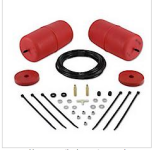
Like some
photo1.png

air lift rear spring air bags

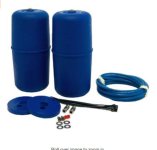
Or Firestone's version

photo2.jpg

called CRide Rite
coil rite.

You can get either brand for about $100 at amazon and other places.

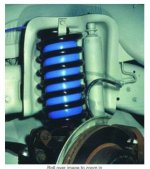
The fit inside your rear coil springs

photo3.jpg

and they have a hose where you can manually inflate or deflate each bag using a Schrader valve.

If you get the Firestone version, pay attention to when they say to cut the hose using a "sawing" motion. I used a sharp knife, and I also used wire cutters, and the hoses leaked right where they attached to the bags. I recut them,
and then I added a fair amount of nylog to both the connection point at the air bag and the hose itself, before I connected the two.

Also, be careful. These airbags don't hold much air, so it's easy to over-inflate them. I recommend a low-pressure air gauge so that you can get good readings. I've also considered buying a small, portable bicycle pump to use to inflate my air bags. My air compressor puts out some much air so quickly that it's hard to control it.

The air bags will provide extra support to your rear springs to keep them from sagging. Of course, for 30K miles, if you can get rear springs with out air bags that will handle the extra weight, you might find that you get a better ride. I think that the air bags can make the ride a bit harsh, although they will boost the rear height back to where it should be.
 

Attachments

  • photo1.png
    photo1.png
    69 KB · Views: 540
  • photo2.jpg
    photo2.jpg
    21.2 KB · Views: 549
  • photo3.jpg
    photo3.jpg
    33.9 KB · Views: 565
Hmmm...75lbs for a stove and propane?

MSR hiking stoves are much lighter and naphtha fuel (aka white gas) is much more available than propane in remote parts of the world. Another bonus is a Coleman lantern makes for a super bright and portable (not tied to a 10lb tank) light with no battery worries.

Thanks for the input. I've put a lot of thought, research, and energy into choosing our equipment. We're going to be cooking full meals 2x a day, day-in, day-out. As a backpacker myself, I'm familiar with hiking stoves. They absolutely won't cut it.

I've also spent an inordinate amount of time researching propane availability throughout South America. It's a challenge, mainly from an adapter point of view, but solvable. Fortunately we will only need to fill up 2-3 times throughout the trip.
 
The air bags will provide extra support to your rear springs to keep them from sagging. Of course, for 30K miles, if you can get rear springs with out air bags that will handle the extra weight, you might find that you get a better ride. I think that the air bags can make the ride a bit harsh, although they will boost the rear height back to where it should be.

Great info, thank you. I get the feeling that the airbags are a bit of a band-aid. Or perhaps more of a "finishing touch" kind of thing. I may very well end up installing them, but I agree with your sentiment that if I can find the right springs for the job instead, I might be better off going that route.

I honestly didn't think the OME 906's in the rear would have such a hard time. At 1000 lbs they have seemed great with no sagging. At 1400, is it really a matter of 400lbs making that much more of a difference?
 
Seems like there's a bit of confusion.

OME 890/906 as in 890's in front and 906's in the rear.

It sounds like some of your concerns might still apply though? I've indeed been on a test run for a couple of weeks down to Baja, carrying probably around 1000lbs. Not quite up to the 1400lb. Everything help up well aside from an anti-rattle clip on on driver side front brake.

The 906 is a stout spring, but the 890 is a rear spring... Can you check the part numbers? I'd be interested to know what you're matching to the 906.
 
The 906 is a stout spring, but the 890 is a rear spring... Can you check the part numbers? I'd be interested to know what you're matching to the 906.

Ah, crap you're right. I wrote the wrong spring number down in my Service Log, and copied the error into this post.

OME 880
OME 906 Struts
Shocks, Bilstein 4600

Confusion == 100% my fault.
 
We're going to be cooking full meals 2x a day, day-in, day-out. As a backpacker myself, I'm familiar with hiking stoves. They absolutely won't cut it.

Yep, hiking stoves certainly aren't light and forget...there's always pumping!
Sounds like you've put a lot of thought into your trip.

Adventure awaits!
 
Ah, crap you're right. I wrote the wrong spring number down in my Service Log, and copied the error into this post.

OME 880
OME 906 Struts
Shocks, Bilstein 4600

Confusion == 100% my fault.

Hm... I'm not sure how I feel about that set of springs hauling all that weight. That's a lotttt of mileage on springs that are advertised as "stock weight" springs.

I thought the 906 were a "heavy" srping.
 
Hm... I'm not sure how I feel about that set of springs hauling all that weight. That's a lotttt of mileage on springs that are advertised as "stock weight" springs.

I thought the 906 were a "heavy" srping.

He is still pretty much within manufacturer's limitations toward weight.

I really don't see a reason to panic, as long as the weight is correctly distributed. Also, springs are not affected as much by ''mileage'' as many would think.

I would work toward load distribution more than having the stiffest set of springs in the world.
 
He is still pretty much within manufacturer's limitations toward weight.

I really don't see a reason to panic, as long as the weight is correctly distributed. Also, springs are not affected as much by ''mileage'' as many would think.

I would work toward load distribution more than having the stiffest set of springs in the world.

Unfortunately load distribution isn't much of an option for him. His tent, fuel, fridge, rear bumper, etc are all where they have to go.

My experience riding in a 4Runner that was just a bittt lighter than mine (didn't have cargo drawers) and softer springs (LC 8 wraps vs OME 861's) is that it rode and handled like garbage compared to mine.

I don't know, maybe [MENTION=57546]4-Ripcord[/MENTION] could bring his overly educated self into the discussion.
 
Great info, thank you. I get the feeling that the airbags are a bit of a band-aid. Or perhaps more of a "finishing touch" kind of thing. I may very well end up installing them, but I agree with your sentiment that if I can find the right springs for the job instead, I might be better off going that route.


I honestly didn't think the OME 906's in the rear would have such a hard time. At 1000 lbs they have seemed great with no sagging. At 1400, is it really a matter of 400lbs making that much more of a difference?


I view the airbags more as adding adjustability for times when you have a heavy load... but your need is to accommodate a fairly static but heavy load.

As for finding out about the load, i think you should do a trial. Load up the truck with 1400 lbs and drive it for a week or so. That will give you the feel for how it will ride or handle.

As for air bags, they may be good to fine tune the back, but they won't be a replacement for having springs tuned to a full load. Remember, when adding heavier bumpers and a winch up front (for example) heavier springs are recommended to offset the weight.

And regarding the weight being within (or actually just over) the spec, although the truck can handle the weight, it doesn't mean that the factory setup is optimized for that weight. Usually, our trucks aren't fully loaded, so I suspect that the stock suspension is optimized for less than a full load.

I know you've upgraded your springs, it's just a question of should you with stiffer rear springs for your trip, and my vote would be yes.
 
Last edited:

Members online

No members online now.

Forum statistics

Threads
278,316
Messages
3,554,112
Members
248,016
Latest member
Advally Service

Trending content

Back
Top